正在加载视频...

视频加载失败

Mind = BLOWN 🤯 Grok 3 just launched with reasoning abilities that put other AIs to shame. Just spent hours testing it vs ChatGPT. My honest breakdown: • Reasoning mode destroys basic Grok for complex tasks • Image generation is SIGNIFICANTLY better than ChatGPT • Coding still needs work...

11,517 次观看 • 1 年前 •via X (Twitter)

0 条评论

暂无评论

原始帖子的评论将显示在这里

相关视频

Anne-Laure Le Cunff (Anne-Laure Le Cunff) might be the most productive person I’ve ever met. She’s simultaneously running a successful business, writing a book being published by a major publisher, and getting a PhD in neuroscience. She says it’s only possible because of ChatGPT. It saves her time on the administrative tasks required to run her business. It helps her create better outlines so that she can write pieces more efficiently. It even breaks down complex research papers so that she can incorporate them into her PhD work. We spent an hour and a half exploring in-detail every part of her ChatGPT workflow—and we even used it live to help her fine-tune her meditation practice. We get into: - How ChatGPT saves her time running her business - Tips to break down research papers into digestible insights - How she leverages ChatGPT to revamp her YouTube thumbnails - Using ChatGPT to write original articles - Doing deep online research using ChatGPT - How to use ChatGPT to generate advice tailored for your needs - How to surface useful insights from your journal using ChatGPT This is a must-watch for curious, creative people who want to get more done. Watch below! ---- Timestamps: Introduction 01:10 How to use ChatGPT to save time running a business 02:11 Tips to breakdown research papers with ChatGPT 05:17 How to use ChatGPT to generate explanations tailored for you 09:38 Leveraging ChatGPT to find hidden gems on the internet (like recipes for obscure cheese) 19:51 How to create awesome YouTube thumbnails with ChatGPT 33:47 Incorporating ChatGPT into your writing process 51:13 Rapid fire questions from X 56:52 Surfacing useful insights from Anne-Laure’s meditation journal 1:13:01 The case for journaling in the age of AI 1:29:04

Dan Shipper 📧

72,623 次观看 • 2 年前

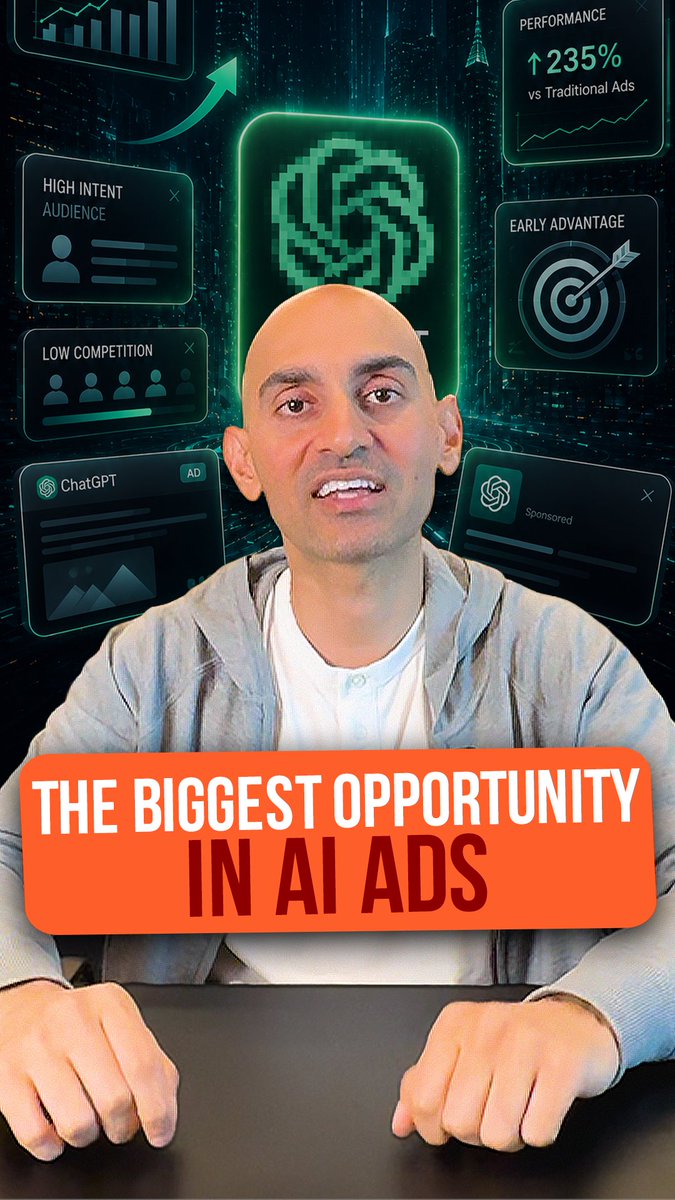
For the first time ever, you can buy ads inside ChatGPT. And because the platform is still new, almost nobody has figured out how to use it properly yet. That means the opportunity is wide open. Here’s what changed. OpenAI launched a self-serve Ads Manager, making ChatGPT ads accessible to businesses that previously would not have been able to participate. You no longer need to be a massive brand with an enormous advertising budget. But these ads work differently from Google. Google usually matches an ad to the words someone searches. ChatGPT looks at the larger context of the conversation and what that person is trying to accomplish. That creates a new challenge: how do you know which conversations your business should appear in? You start with real demand. What are people already searching for in your industry? What questions are they asking? What problems are they trying to solve? And what language do they use to describe those problems? That’s where Ubersuggest comes in. Use it to find the topics people search for most, see how competitive they are and identify where your competitors are already getting attention. Then turn those insights into the conversation themes, ad angles and landing pages you use for your ChatGPT campaigns. The technology is new, but the principle is not: Understand what people want, learn how they talk about it and show up when they are ready to make a decision. The companies that learn this early will have an advantage while everyone else is still trying to understand how it works.

Neil Patel

12,249 次观看 • 23 天前

🚨PERPLEXITY JUST LAUNCHED SOMETHING THAT MAKES EVERY OTHER AI PRODUCT LOOK LIKE A TOY.. AND NOBODY IS TALKING ABOUT IT.. They built a Personal Computer.. Not an app.. Not a chatbot.. A full digital worker that runs 24/7 on a Mac mini even while you sleep.. You press both command keys.. And it wakes up.. Ready to work.. But here's where it gets insane.. This thing doesn't run on one AI model.. It runs on 19 of them.. At the same time.. It uses Claude Opus for complex reasoning.. Gemini 3.1 Pro for deep research with a 2 million token context window.. Nano Banana Pro for 4K images.. Grok for fast tasks.. It doesn't just pick one model and hope for the best.. It reads your task.. Breaks it into subtasks.. And routes each one to whichever model is best at that specific thing.. All running in parallel.. While ChatGPT is still thinking about your first question.. Perplexity has already split your project into 6 pieces and assigned each one to a different AI.. And here's the part that should worry OpenAI.. Perplexity hallucinates at 3.3%.. ChatGPT hallucinates at 12%.. Claude at 15%.. It's not even close.. Because Perplexity is built differently.. Every other AI tries to remember facts.. Perplexity searches for them first.. It's structurally forced to cite live sources before it's even allowed to generate a response.. OpenAI Operator launched with a 32.6% success rate on computer-use tasks.. People called it "the world's most anxious intern" because it pauses every 5 seconds to ask if it's doing the right thing.. Perplexity runs multi-hour and multi-day workflows independently.. Only interrupts you when it hits a decision that actually matters.. You can start a task from your iPhone on the train.. And it executes on your Mac mini at home.. The economics are wild too.. Internal studies show it saved teams an average of $1.6 million in labor costs.. Performing 3.25 years of work in four weeks.. And unlike every other AI company.. Perplexity dropped ads entirely.. They charge $200 a month because they said they're in the "accuracy business".. Not the advertising business.. They even launched a $42.5 million publisher program to pay media partners when their content gets cited.. While OpenAI is getting sued by every newspaper on earth.. Google and OpenAI want you locked into their ecosystem.. If a better model comes out tomorrow you're stuck.. Perplexity just updates its routing matrix.. You get the best model on earth automatically.. No switching.. No migrations.. No friction.. This isn't an AI assistant anymore.. This is the first real AI employee.. And it costs $200 a month.

Evan Luthra

1,097,697 次观看 • 4 个月前

Cerebras inference is very fast. So fast that it changes how we think about configuring our LLMs for voice agent use cases. Kimi K2.6 is a 1T parameter reasoning model that Cerebras serves at 650 - 1,000 tokens per second (end-to-end throughput), with time to first token metrics as low as 150ms (latency). These numbers are two to three times faster than other similarly capable models. The biggest lever we get from this kind of speed is that we can use the model in reasoning mode, and still have excellent "time to first non-thinking token." This solves a big pain point we have in 2026 for voice agent use cases. Almost all recent innovation in post-training has focused on making models good at reasoning ("test time compute"). This is great, but it makes the user-facing model latency much, much slower. Which is a problem for conversational voice agents. We can run Kimi K2.6 with reasoning turned on, and get responses faster than other models produce with reasoning disabled. On my 30-turn voice agent benchmark, Kimi K2.6 with reasoning enabled ties GPT 5.1 and Haiku 4.5 with reasoning disabled, and is still about 200ms seconds faster! On my primary task agent benchmark, Kimi K2.6 is now the #2 model. It ranks just behind Gemini 3.5 Flash in "high" reasoning mode, and tied with GLM 5, Sonnet 4.6, and GPT 5.4 with reasoning set to "low." But Kimi K2.6 completes each turn in the agent loop in under 500ms. The other four models are all at least 3x slower. (Models only qualify for this benchmark if they can complete task turns at a P50 <4s.) A couple of other things that this speed buys us, for production voice agents: - Tool calls happen fast enough that we don't have to work around tool call latency in our pipeline design. - We can prompt the model to output structured data at the beginning of a response, followed by plain text for voice generation. This opens up possibilities like asking the model to do complex classification/generation tasks that influence the rest of the pipeline. For example, the model could create a detailed style prompt for a steerable TTS model, for each individual conversation turn. And, of course, you can use Kimi K2.6 with reasoning turned off. Cerebras calls this "instant" mode. Here's a video of a Cerebras Kimi K2.6 voice agent with voice-to-voice response time, measured at the client, under 500ms. This is the true response latency as perceived by the user, including all network and audio codec overhead, transcription and turn detection, Kimi K2.6 token generation, and voice generation. 500ms is, effectively, instant. So the Cerebras naming for this mode is a propos. :-)

kwindla

40,593 次观看 • 3 个月前

JUST IN: Perplexity launched "Perplexity Computer" — and it might be the most complete AI agent system available right now. Not a chatbot upgrade. Not a research tool with a new name. A system that plans entire projects, delegates to specialist AI models, and runs autonomously for hours, days, or months (their words). Here's what makes the architecture genuinely different: → Opus 4.6 handles core reasoning and orchestration → Gemini handles deep research (spawning its own sub-agents) → Grok handles lightweight speed tasks → Veo 3.1 handles video generation → Nano Banana handles image creation → ChatGPT 5.2 handles long-context recall and wide search → You can override model choices per subtask 19 models total. Each task runs in an isolated environment with a real filesystem, real browser, and real tool integrations. You describe an outcome. It breaks it into tasks and subtasks, creates sub-agents for each, and coordinates them automatically. When a sub-agent hits a problem, it spawns more sub-agents to solve it. And it connects to your existing stack — GitHub, Google Drive, Gmail, Slack, Jira, Linear, Notion, Confluence, Ahrefs, Airtable, and more. Critically, it doesn't just run once. It can run on a schedule. Reading your docs, checking your project boards, pulling from your CRM, and acting on what it finds. Market monitoring. Competitor tracking. Weekly reports with charts. Content pipelines. CRON jobs that actually execute. Not "AI that helps you once." AI that runs in the background for days or months. Think of it as managed OpenClaw — similar autonomous capability (scheduled tasks, multi-step workflows, tool integrations) but fully managed. No Mac Mini. No security config. No infrastructure to maintain. I tested it with a complex prompt — a full stock trading simulator with what-if scenarios, correlation heatmaps, sentiment analysis, and a Bloomberg Terminal aesthetic. Two prompts later: deployed to Netlify via GitHub, with working CRON jobs updating live data. I've started using it to analyze my portfolio. But coding is just one lane. This thing researches, writes reports, generates datasets, creates videos, processes documents, and connects to your existing tools — all in one coordinated workflow. The real shift: you don't choose a model anymore. You describe what you need. The system routes each piece of work to whichever model does it best — and spawns new agents when it hits a wall. 19 models, dynamic sub-agents, scheduled tasks, and your entire tool stack connected. Thoughts?

Paweł Huryn

219,822 次观看 • 6 个月前

OpenAI just announced API access to o1 (advanced reasoning model) yesterday. I'm delighted to announce today a new short course, Reasoning with o1, built with OpenAI, and taught by Colin Jarvis, Head of AI Solutions at OpenAI, to show you how to use this effectively! Unlike previous language models which generate output directly, o1 “thinks before it responds,” and generates many reasoning tokens before returning a more thoughtful and accurate response. It is great at complex reasoning -- including planning for agentic workflows, coding, and domain-specific reasoning in STEM fields like law. But how you should use it is quite different from other LLMs. I think o1 will be a game changer for many AI applications; and in this course, you'll learn how to use it effectively. In detail, you’ll: - Learn to recognize what tasks o1 is suited for, and when to use a smaller model, or combine o1 with a smaller model - Understand the new principles of prompting reasoning models: Be simple and direct; no explicit chain-of-thought required; use structure; show rather than tell - Implement multi-step orchestration in which o1 plans, and hands tasks over to gpt-4o-mini to execute specific steps; this illustrates a design pattern to optimize intelligence (accuracy) and cost - Use o1 for a coding task to build a new application, edit existing code, and test performance by running a coding competition between o1-mini and GPT 4o - Use o1 for image understanding and learn how it performs better with a "hierarchy of reasoning," in which it incurs the latency and cost upfront, preprocessing the image and indexing it with rich details so it can be used for Q&A later - Learn a technique called meta-prompting, in which you use o1 to improve your prompts. Using a customer support evaluation set, you'll iteratively use o1 to modify a prompt to improve performance You'll also learn about how OpenAI used reinforcement learning to produce a model that uses "test-time compute" to improve performance. I think you'll find this course enjoyable and valuable. Please sign up for it here:

Andrew Ng

357,661 次观看 • 1 年前

ChatGPT o1 is the most "intelligent" AI model and it's not even close! Full o1 generates thinking steps ~50 faster than preview. It's more accurate, reliable, and got better on harder tasks that require advanced reasoning and knowledge. I ran a few tests on it already. Here are my observations: Full video with examples & explanations: Strengths - impressive at math, code, and knowledge-intensive tasks. Weakness - it only failed on a cross-word puzzle but I think it might be solvable when a web search becomes available. In the end, while very efficient with complex knowledge use, it's still constrained by data it's trained on. Speed - the thinking steps are generated a lot faster! Not a fair comparison with the open alternatives but I think this improves the overall user experience. "Knowledgeable and highly intelligent" - as mentioned in the demo by OpenAI researchers, o1 is great at dealing with ambiguity and filling in knowledge gaps. I was impressed by how it implemented an agentic solution (with lots of details) from a basic diagram of architecture (with minimal details). Check out the sample video. Better Task Coverage - Due to the speed and the ability to make sense of instructions and intent (i.e., know when to response fast and when to "think" deeply) much better, it feels like it might be more useful for a broader range of tasks. Image understanding - the image understanding capability is mysterious (often leads to faster responses but no thinking) but impressive. More experiments and notes soon. Stay tuned!

elvis

102,643 次观看 • 1 年前

The new Google Search is rolling out and there seems to be confusion on what it will look like. Google literally told us. Let me clarify for anyone who is still unsure of what is rolling out this week. Last month Google responded to everyone saying Search is dead. Here is what they said: "You will absolutely continue to see blue web links in search results. AI Mode is not the default experience in Search. You will continue to get a range of results on Search." [Want to know where your site stands across Google AI, ChatGPT, Claude, Grok, etc? Check here (it's free): Google has explicitly laid out what Search will look like from this point going forward. The new Search box accepts text, images, files, videos, and open Chrome tabs. It anticipates your intent before you finish asking. It is powered by the most advanced Gemini model Google has ever put into Search, and layered on top of that, information agents will now be able to run 24/7 in the background on behalf of your buyer. Think of it in 5 steps: Step 1: The buyer describes their problem, their category, their needs in full. Step 2: The agent breaks that down into sub-topics and maps out a plan. Step 3: It determines what intel is needed right now versus later. Step 4: It monitors blogs, news sites, and social posts continuously for relevant changes. Step 5: It sends the buyer a synthesized update with links and the ability to take action. Blue links are not going away in the short-term, but the brands getting recommended by information agents 24 hours a day while also ranking in traditional results are going to pull so far ahead of the ones doing only one or the other that it will not be a fair fight. This is exactly what SEO Stuff ( has been building for every customer. Optimized content depth that covers every sub-question a buyer in your category asks, so the agent finds you at every step of its plan. Editorial authority from trusted websites that signals credibility to every retrieval system Google has ever built, across both traditional rankings and AI citations simultaneously. One investment. Blue links and AI citations. Around the clock. SEO Stuff's Complete Done-For-You Plan: SEO Stuff's "Optimized Content" Plan: There is a reason more than 80 percent of SEO Stuff customers reorder. The results continue long after the work is done. Google Search is changing. AI Search is here. Your websites need to prepare accordingly. Want to know where your site stands across Google AI, ChatGPT, Claude, Grok, etc? Check here (it's free):

Alex Groberman

44,078 次观看 • 2 个月前

The new Google Search is rolling out and there seems to be confusion on what it will look like. Google literally showed us. Let me clarify for anyone who is still unsure of what is rolling out right now. Last month Google responded to everyone saying Search is dead. Here is what they said: "You will absolutely continue to see blue web links in search results. AI Mode is not the default experience in Search. You will continue to get a range of results on Search." [Want to know where your site stands across Google AI, ChatGPT, Claude, Grok, etc? Check here (it's free): Google has explicitly laid out what Search will look like from this point going forward. The new Search box accepts text, images, files, videos, and open Chrome tabs. It anticipates your intent before you finish asking. It is powered by the most advanced Gemini model Google has ever put into Search, and layered on top of that, information agents will now be able to run 24/7 in the background on behalf of your buyer. Think of it in 5 steps: Step 1: The buyer describes their problem, their category, their needs in full. Step 2: The agent breaks that down into sub-topics and maps out a plan. Step 3: It determines what intel is needed right now versus later. Step 4: It monitors blogs, news sites, and social posts continuously for relevant changes. Step 5: It sends the buyer a synthesized update with links and the ability to take action. Blue links are not going away in the short-term, but the brands getting recommended by information agents 24 hours a day while also ranking in traditional results are going to pull so far ahead of the ones doing only one or the other that it will not be a fair fight. This is exactly what SEO Stuff ( has been building for every customer. Optimized content depth that covers every sub-question a buyer in your category asks, so the agent finds you at every step of its plan. Editorial authority from trusted websites that signals credibility to every retrieval system Google has ever built, across both traditional rankings and AI citations simultaneously. One investment. Blue links and AI citations. Around the clock. SEO Stuff's Complete Done-For-You Plan: SEO Stuff's "Optimized Content" Plan: There is a reason more than 80 percent of SEO Stuff customers reorder. The results continue long after the work is done. Google Search is changing. AI Search is here. Your websites need to prepare accordingly. Want to know where your site stands across Google AI, ChatGPT, Claude, Grok, etc? Check here (it's free):

Alex Groberman

23,380 次观看 • 1 个月前