Video yükleniyor...

Video Yüklenemedi

Ana Sayfaya Dön

🔖 Open-source L2 ADAS for automotive OEMs 🛣️ Vision Pilot 1.2 release is now live 🚖 3D world understanding for real-time ADAS on edge devices using a single front-facing camera without requiring LIDAR, RADAR, or dense depth maps. 👇️Github repo:

29,453 görüntüleme • 1 ay önce •via X (Twitter)

1 Yorum

alvaro lordelo profil fotoğrafı
alvaro lordelo1 ay önce

How about the back cameras to check surroundings?

Benzer Videolar

🚨 BREAKING: Big news in the computer vision world! 🎥 Luxonis | Robotic Vision just dropped its new OAK 4 line, and it’s a big upgrade for edge computer vision. Instead of being “just a stereo camera,” OAK 4 is a fully standalone vision computer with 52 TOPS of on-device AI. Models run locally, depth is computed locally, and no external PC or cloud pipeline is required. This is why robotics teams love it: lower latency, lower cost, fewer failure points in the field. The hardware is built for the real-world. IP67, shock-resistant, wide-FOV RGB + stereo pair, IR projection, IMU, audio, and a patent-pending calibration system that keeps depth accurate even when conditions change. But the real move is the platform. With Luxonis Hub, you can deploy models, grab telemetry, push OTA updates, or collect data when performance drifts, all from a unified interface. It turns a single device into an end-to-end edge CV system. Most customers today in robotics are groups who just want something that works: AMRs, bin-picking systems, trailer-loading robots, and ag-tech. 🤖 And they all say the same thing, the appeal isn’t raw TOPS, it’s the all-in-one simplicity that lets them scale without building custom infrastructure. Feels like the direction edge vision has been waiting for: rugged hardware + high-throughput on-device compute + a real management layer. A next step toward “plug-and-deploy” perception for robots. 🔗 Find out more here: ~~ ♻️ Join the weekly robotics newsletter, and never miss any news →

Lukas Ziegler

41,955 görüntüleme • 9 ay önce

Wow. Recreating the Shawshank Redemption prison in 3D from a single video, in real time (!) Just read the MASt3R-SLAM paper and it's pretty neat. These folks basically built a real-time dense SLAM system on top of MASt3R, which is a transformer-based neural network that can do 3d reconstruction and localization from uncalibrated image pairs. The cool part is they don't need a fixed camera model -- it just works with arbitrary cameras -- think different focal lengths, sensor sizes, even handling zooming in video (FMV drone video anyone?!). If you've done photogrammetry or played with NeRFs you know that is a HUGE deal. They've solved some tricky problems like efficient point matching and tracking, plus they've figured out how to fuse point clouds and handle loop closures in real-time. Their system runs at about 15 FPS on a 4090 and produces both camera poses and dense geometry. When they know the camera calibration, they get SOTA results across several benchmarks, but even without calibration, they still perform well. What's interesting is the approach -- most recent SLAM work has built on DROID-SLAM's architecture, but these folks went a different direction by leveraging a strong 3D reconstruction prior. Seems to give them more coherent geometry, which makes sense since that's what MASt3R was designed for. For anyone who cares about monocular SLAM and 3D reconstruction, this feels like a significant step toward plug-and-play dense SLAM without calibration headaches -- perfect for drones, robots, AR/VR -- the works!

Bilawal Sidhu

704,381 görüntüleme • 1 yıl önce

🚀 Announcing Echo — our new frontier model for 3D world generation. Echo turns a simple text prompt or image into a fully explorable, 3D-consistent world. Instead of disconnected views, the result is a single, coherent spatial representation you can move through freely. This is part of a bigger shift in AI: from generating pixels and tokens to generating spaces. Echo predicts a geometry-grounded 3D scene at metric scale, meaning every novel view, depth map, and interaction comes from the same underlying world — not independent hallucinations. Once generated, the world is interactive in real time. You control the camera, explore from any angle, and render instantly — even on low-end hardware, directly in the browser. High-quality 3D world exploration is no longer gated by expensive equipment. Under the hood, Echo infers a physically grounded 3D representation and converts it into a renderable format. For our web demo, we use 3D Gaussian Splatting (3DGS) for fast, GPU-friendly rendering — but the representation itself is flexible and can be easily adapted. Why this matters: consistent 3D worlds unlock real workflows — digital twins, 3D design, game environments, robotics simulation, and more. From a single photo or a line of text, Echo builds worlds that are reliable, editable, and spatially faithful. Echo also enables scene editing and restyling. Change materials, remove or add objects, explore design variations — all while preserving global 3D consistency. Editing no longer breaks the world. This is only the beginning. Echo is the foundation for future world models with dynamics, physical reasoning, and richer interaction — environments that don’t just look right, but behave right. Explore the generated worlds on our website and sign up for the closed beta. The era of spatial intelligence starts here. 🌍 #Echo #WorldModels #SpatialAI #3DFoundationModels Check it out:

SpAItial AI

177,073 görüntüleme • 9 ay önce

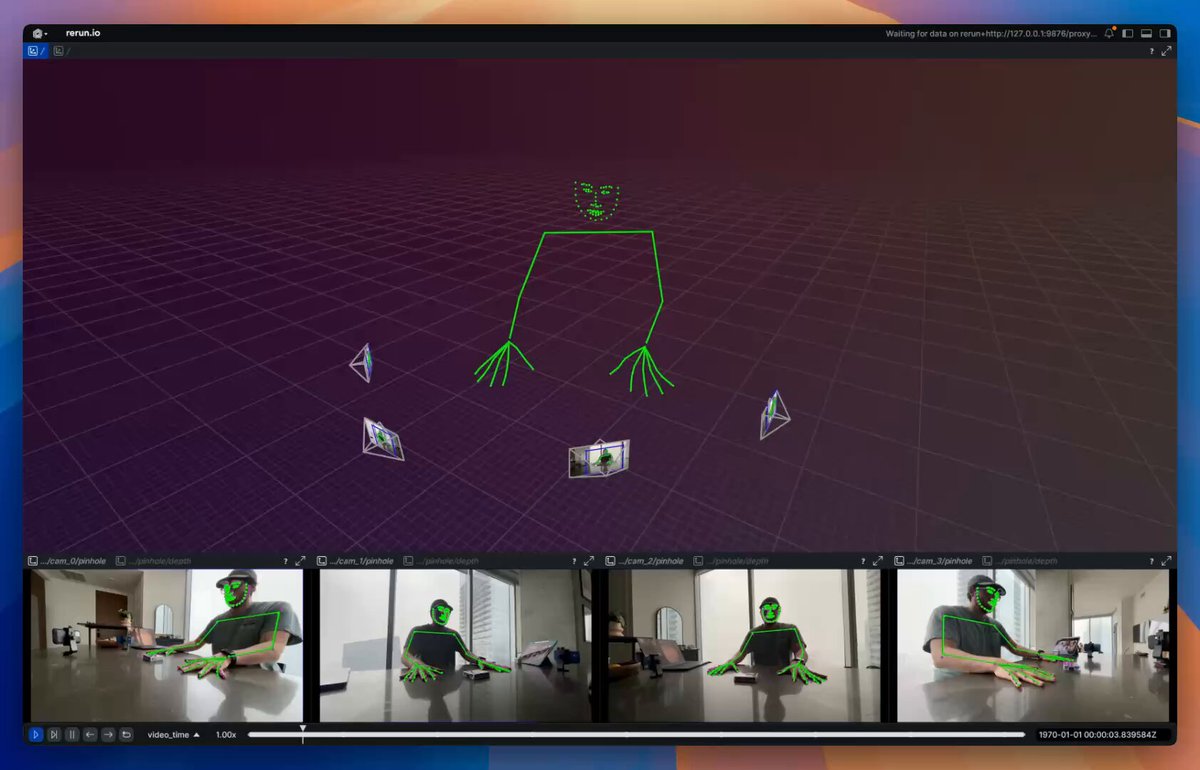
MVP of Multiview Video → Camera parameters + 3D keypoints. Visualized with Rerun The basic pipeline as of right now looks like this: 1. Capture 🔴 – Using 4 iPhones and an Insta360 Go. iPhone videos are captured via Final Cut Pro Multicam for easy sync and the exocentric view; the Insta360 Go is used for the egocentric view. 2. Sync 🕒 – Custom Gradio app using two Rerun viewers and callbacks for easily aligning frame timestamps so the ego and exo views are aligned. 3. Calibrate 🎯 – Use VGGT from Jianyuan and AI at Meta to get intrinsics/extrinsics for sparse cameras. 4. Estimate 3D 🕺 – Use RTMLib whole‑body keypoint estimator on each frame, then triangulate in 3D. What's missing? 1. No temporal coherence: I’m estimating keypoints one frame at a time and one camera at a time. This leads to a lot of jittering. For now, I plan on adding a One Euro Filter to help with jittering. Long term, I'd want to train a multiview keypoint estimator 2. Kinematic fitting is still missing; this is my next goal. The output will be joint angles, as explored in my previous posts. 3. Missing dense point cloud: VGGT seems to fail for me here. I’m looking to explore using MP‑SFM as a method for generating dense multiview depth maps + normals (plus it has a friendlier license compared to VGGT). 4. Eventually, creation of 4D Gaussian splatting using something akin to DN‑splatter—my long‑term goal is a data engine that provides poses/depths/splats/keypoints/etc.

Pablo Vela

42,785 görüntüleme • 1 yıl önce