Sensitive content

This media may contain sensitive content.

Video yükleniyor...

Video Yüklenemedi

Ana Sayfaya Dön

🔞Ordinary day in school. Maybe. First big animation Alice model by @ XBJRTMSTUDX (gimme yo fen model bro....) 2 video with and without background music Enjoy yall (if there anyone 3d nsfw animators, how yall adding impact physics) #porno #3d #fpe #animation #video #nsfw #blender

35,654 görüntüleme • 1 ay önce •via X (Twitter)

0 Yorum

Yorum bulunmuyor

Orijinal gönderinin yorumları burada görünecek

Benzer Videolar

Want to create an avatar from a single image? FlexAvatar is a transformer model that creates full 360°, high-quality, and expressive 3D head avatar from just a single portrait image in minutes. Real-time Demo: FlexAvatar's lightweight architecture allows both animation and rendering in real-time, enabling interactive user experiences. To create a new 3D head avatar, only one image is required, e.g., from a webcam. The final avatar is ready after 2 minutes. Architecture: Under the hood, FlexAvatar adopts a transformer-based encoder-decoder design. The encoder maps the input image onto a latent avatar space, while the decoder produces 3D Gaussian attribute maps by incorporating the animation signal via cross-attention. The model learns all facial animations directly from the data without relying on pre-built 3D face models. This equips the avatars with realistic facial expressions. The internal avatar latent space can be conveniently used to integrate additional observations of a person via fitting. This enables use-cases where more than one image of a person is available, e.g., from a phone scan of the person. We train jointly on 2D monocular videos and multi-view data. However, in monocular videos, the animation signal leaks the target viewpoint, causing the model to produce incomplete 3D heads. We call this phenomenon entanglement of driving signal and target viewpoint. To prevent entanglement, we introduce bias sinks. These are learnable tokens that indicate whether a training sample stems from a monocular or a multi-view dataset. During training, the model learns to produce incomplete 3D heads only when the monocular token is present. During inference, FlexAvatar then always uses the multi-view token for which the model has learned to produce complete 3D heads. This simple design allows to combine the generalizability from monocular data with the quality of multi-view data. FlexAvatar summary: - Input: Single-image, phone scan, or monocular video - Output: Full 360° head avatar - Expressive animations - Real-time rendering and animation - Generalization to any portrait - Create a new avatar in 2 minutes - Use bias sinks to combine 2D and 3D data 🏠 🌍 🎥 Great work by Tobias Kirschstein and Simon Giebenhain!

Matthias Niessner

96,371 görüntüleme • 9 ay önce

World Model is trending— let's revisit our HunyuanWorld journey. We’ve been pioneering open-source 3D world generation in the past two months, and this ride’s only getting started. 🌍 📅 July: HunyuanWorld 1.0 📌 First open-source 3D world model compatible with CG pipelines (Unity/Unreal/Blender) 📌 Hit 2K+ GitHub stars in just two months ⭐—thank you for the love! 📅 August: 1.0-Lite 📌Same top-tier quality, running on consumer GPUs! 📅 September: 1.0-Voyager 📌 Direct 3D output + world memory—taking exploration further! Seamlessly integrated into CG pipelines with layered 3D modeling (assets, terrain, skybox) and fully open-sourced.. we’re fully committed to building open-source spatial intelligence for all! 🚀 💡 Why it matters? ✅ Seamless CG Pipeline Integration: Export generated 3D scenes as standard mesh formats, effortlessly integrating into industry-standard tools like Blender, Unity, and Unreal Engine for direct editing, animation, and physical simulation. ✅ Hierarchical Scene Editing: Deconstruct scenes into semantic layers (sky, background, foreground objects) via instance recognition and layer decomposition, allowing for atomic-level control—independently modify, relocate, or replace objects without rebuilding the entire world. Project page: Github: Amazing creations by Stijn Spanhove camenduru GENEL | AIを用いた動画制作 apolinario 🌐 とりにく Directive Creator 🪥 👇 #AI #3DGeneration #OpenSource #WorldModels #Hunyuan3D #HunyuanWorld

Tencent HY

20,178 görüntüleme • 1 yıl önce

Here are 10 AI video editor GitHub repos worth bookmarking: 1. Shotcut Most actively maintained open source video editor in 2026. 14K stars. Cross-platform with AI-assisted features. Just shipped a new release April 30, 2026. 2. Kdenlive The closest open source alternative to Adobe Premiere Pro. Multi-track editing, proxy editing, VST audio, and customizable workspace. Best for professional workflows. 3. OpenShot The easiest entry point for beginners. Drag and drop, 400+ transitions, 3D titles, and AI-assisted trimming. 5,700 stars. 4. Blender Not just 3D. Blender's video sequence editor and compositing pipeline is used in professional film production. 18,300 stars. Unmatched for VFX. 5. Recordly Screen recorder with auto-zoom, cursor polish, webcam overlays, and styled frames built in. Built for demo videos and walkthroughs. 6. Wan2.1 Alibaba's open source text-to-video model. Cinema-grade 1080p generation. Apache 2.0. The gold standard for open source video generation in 2026. 7. HunyuanVideo Tencent's 13B parameter open source video model. 11.9K stars. Handles 720p and 1080p with high temporal coherence. 8. CogVideoX Apache 2.0 licensed. Loads natively via Hugging Face Diffusers. Strong prompt following and smooth frame transitions. Needs 16GB VRAM minimum. 12.5K stars. 9. Open-Sora Most starred open source video generation project at 24K stars. Full training pipeline for $200K. Production-level output quality. 10. Mochi 1 Focused entirely on motion quality. The most natural-looking physics of any open source video model. Water, fabric, and human gestures without AI jitter. Apache 2.0.

Kanika

17,726 görüntüleme • 3 ay önce

I got this custom scorpion rigged, animated and running in my game in one full day with AI. GPT-6 built the entire rig. My part was preparing the model and motion references, then giving feedback. After trying a few approaches, I found a workflow that worked: 1. Give it a model that makes sense. I generated the model with Tripo P2.0, then cleaned it up myself. Low-poly, optimized, split into logical parts. I think that preparation mattered a lot. GPT-6 works on the mesh through code. A manageable vertex count and sensible parts give it a clearer starting point for bone placement and skinning. 2. Show it the movement you want. I took a reference image of the character and used Seedance to generate side-view animation videos. I decided which animations the game needed and selected the takes with the movements I liked. Then I gave GPT-6 the model, the videos and that animation list. There was no existing rig to start from. 3. Compare the animation frame by frame. This was the idea I wanted to test: ask GPT-6 to compare its Blender animation against the reference video frame by frame, from the same view. That gave it concrete poses and timing to work toward. I could point to where the feet should be planted or when the tail should strike. 4. Expect to give feedback. A generated run can look like hopping. An attack can start with a jump you never wanted. Choosing the references matters, and a side view still leaves depth and hidden legs to figure out. It took several iterations. I explained what looked wrong and how I wanted it to move, and GPT-6 kept refining the animation. Once the walk worked, I also had it create left and right strafe animations procedurally from that walk. Those didn't need their own reference videos. By the end of the day, the creature was in Unity. I've recorded the full workflow, including the Blender setup and feedback process:

Stefan 3D AI

12,563 görüntüleme • 8 gün önce

A 20 YEAR OLD IS MAKING $20,000 A MONTH WITH THE LAZIEST BUSINESS MODEL ON THE INTERNET. SHE WORKS TWENTY MINUTES A DAY FROM HER CAR. SHE HAS NEVER PRODUCED AN ORIGINAL IDEA. Children's YouTube is a goldmine. Channels with simple songs and bright colors pull hundreds of millions of views. Traditional studios spend a fortune to animate them. She spends zero dollars and does it from the driver's seat. She opens YouTube on her phone. She finds a viral baby video with millions of views. She copies the link. She uses a free tool to rip the entire transcript of the video. She takes that transcript and pastes it into an AI platform called Swagga. She types one sentence: "Make me a prompt for a similar video using this as inspiration." The AI acts as her creative director. It analyzes the viral song and spits out a highly detailed master prompt for a new, original 3D animation. She copies the prompt. She switches to the video generator tab. She selects Sora 2 and hits generate. Three minutes later, the AI outputs a fully rendered, broadcast-ready 3D animation. A brightly colored, musical video designed specifically to capture the attention of a toddler. She downloads it. She posts it. She puts her car in drive. The entire process takes twenty minutes. Her channel pulls in thousands of dollars a week in AdSense. She is running a complete children's television network without an office, without animators, and without original ideas. The traditional creator economy is obsessed with authenticity and hard work. The ghost economy is obsessed with leverage. Most people will watch her video and call it lazy. A few will open a new tab.

ZER

126,725 görüntüleme • 2 ay önce

Wow. Recreating the Shawshank Redemption prison in 3D from a single video, in real time (!) Just read the MASt3R-SLAM paper and it's pretty neat. These folks basically built a real-time dense SLAM system on top of MASt3R, which is a transformer-based neural network that can do 3d reconstruction and localization from uncalibrated image pairs. The cool part is they don't need a fixed camera model -- it just works with arbitrary cameras -- think different focal lengths, sensor sizes, even handling zooming in video (FMV drone video anyone?!). If you've done photogrammetry or played with NeRFs you know that is a HUGE deal. They've solved some tricky problems like efficient point matching and tracking, plus they've figured out how to fuse point clouds and handle loop closures in real-time. Their system runs at about 15 FPS on a 4090 and produces both camera poses and dense geometry. When they know the camera calibration, they get SOTA results across several benchmarks, but even without calibration, they still perform well. What's interesting is the approach -- most recent SLAM work has built on DROID-SLAM's architecture, but these folks went a different direction by leveraging a strong 3D reconstruction prior. Seems to give them more coherent geometry, which makes sense since that's what MASt3R was designed for. For anyone who cares about monocular SLAM and 3D reconstruction, this feels like a significant step toward plug-and-play dense SLAM without calibration headaches -- perfect for drones, robots, AR/VR -- the works!

Bilawal Sidhu

704,241 görüntüleme • 1 yıl önce

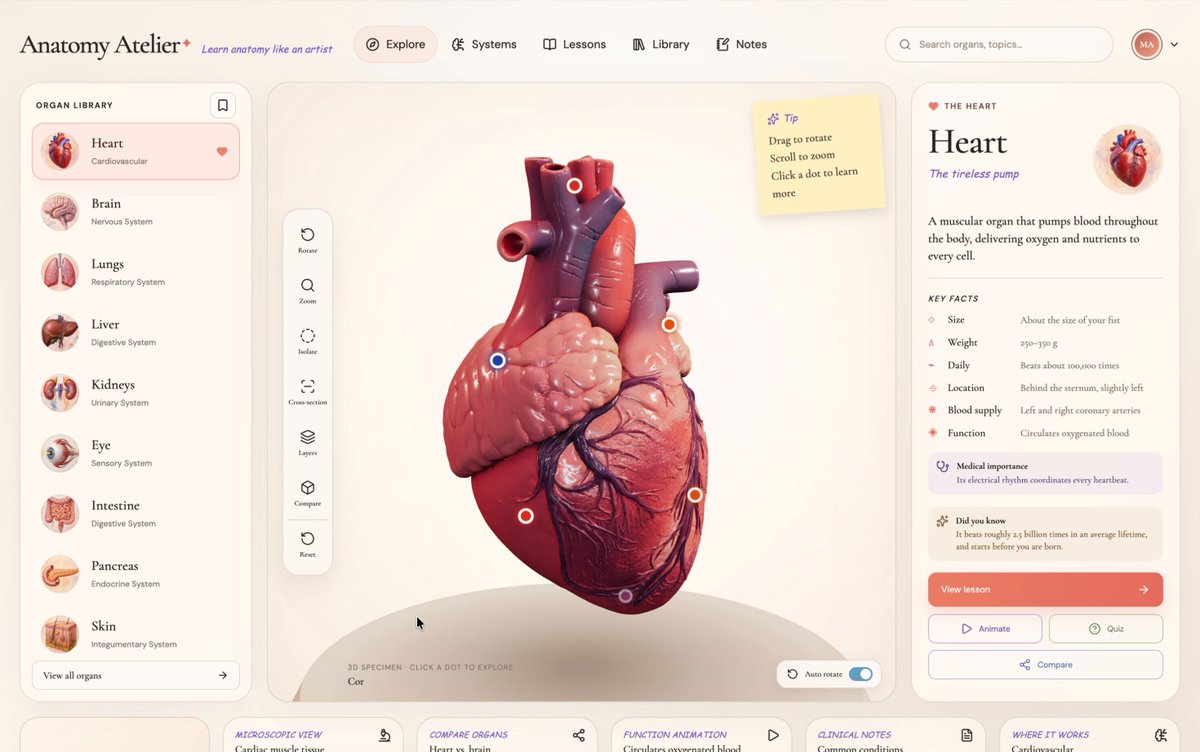
Only if education could be this interactive ❤️‍🔥 I've had a looong wish to build something genuinely useful through vibe coding, and I finally did it. A 3D human anatomy application built with Three.js using GPT 5.6 Sol. It all started with a single design image that I created using GPT Image 2.0. I then used it to generate every 3D organ image, one by one. Next, I converted each of those images into 3D models using Tripo (and no, they didn't sponsor this 😄). After that, I opened Codex, wrote a master prompt based on the design, and gave it the prompt, the design image, and all the 3D models. Codex built the first version beautifully, but there was one big problem. Every single 3D model was nearly 120-150 MB. That obviously wasn't practical for the web and was giving a performance of 16fps. After a few iterations, Codex optimized each model down to roughly 2–5.5 MB while preserving the visual quality, reducing the total asset size from ~900 MB to just 28.6 MB. And each model loads on demand. Along the way, Codex also generated those anatomical illustrations showing where each organ sits in the human body, and even created the interactive hotspot markers that explain different parts of every organ. It handled all of that. The process wasn't exactly one shot, but it also wasn't difficult. You just have to do it step by step. It genuinely felt like building something that could make learning anatomy much more engaging. The inspiration came from Dilum Sanjaya's 3D animal plant cell project. I remember seeing it and thinking, "I want to build something like this one day." And I did it :D Live: Code:

The Bugged Dev

2,102,329 görüntüleme • 1 ay önce

[NEW] a16z a16z speedrun 🧊 request for startups: Vibe Creation Platforms We've seen Vibe Coding platforms like Lovable and Bolt emerge for application development serving non-coding consumers --> We'll soon see VIBE CREATION as an entirely new consumer experience for crafting video, visual stories, games, and more The platform will require an end-to-end workflow orchestrated by AI agents --> Today, we have the infrastructure with foundation models across modalities, but most consumers won't jump from model site to model site to then stitch their creations together The winning solution will help consumers go from idea to first draft in minutes while enabling finer creative control for those that seek it --> This is how we go from AI internet memes to compelling human stories AI Vibe Creation platforms are designed for fun and creative flow. They remove the million knobs and sliders professional creators have come to expect --> They feel more like a game than a tool a16z speedrun has already invested in a few teams exploring this space: - VIDEO: Hedra (animated characters), intangible (canva for 3D) - GAMING: Rosebud AI (game generation), Nilo Technologies (3D worldbuilding) - IMAGE: (infinite canvas), Blank (instagram for AI), - VISUAL STORIES: Komiko (anime), Sekai (tiktok for interactive stories) We believe there will be many great vibe creation platforms to be built across medium (video, music, game, etc), genre/niche (anime, 3D, sports) and platform (mobile, web, XR) if you're building in this space, DM us and apply for speedrun!

Troy Kirwin

138,788 görüntüleme • 1 yıl önce

How many of you actually know how "what you eat" grows? 🤔 I never learned crop science in school. I learned it by walking around our farm with my father, who showed me different crops and explained how they grow. But not everyone has access to a farm, so I built a 3D Crop Science application in Three.js using Claude Opus 5 to make that learning experience more visual and interactive. It is an exploration of different types of seeds where each seed has three different stages. The first stage shows the whole seed. The second stage is a cross section that shows what is inside the seed and how it grows. The third stage shows the germination phase through a 3D model. There are 24 models in total. The original models were 1,349.6 MB, which Claude optimized down to just 11.6 MB in total. All of the 3D models were generated using Tripo. Claude also created visual information for each seed showing details like seed type, storage tissue and germination phase. Each seed also has a YouTube video that shows how it actually grows in the real world. There is also a section showing where each seed is commonly grown using both a 3D globe and a flat map. You can explore different regions and click on specific areas to see more information about where that seed is grown. The entire experience is fully responsive and also includes quizzes that you can take in both normal and 3D formats. I strongly believe education becomes much more effective when you can see, interact, watch and explore instead of relying only on textbooks. Live: Code:

The Bugged Dev

45,081 görüntüleme • 1 ay önce