Video wird geladen...

Video konnte nicht geladen werden

Zur Startseite

Our flight controllers used the Company’s Lunar Data Network to command Athena’s first planned Trajectory Correction maneuver (TCM) at 11:00 a.m. CT on February 28, 2025, to refine the lander’s trajectory ahead of Lunar Orbit Insertion (LOI). Data from the 6-second full-thrust mainstage engine burn confirmed Athena hit her...

73,456 Aufrufe • vor 1 Jahr •via X (Twitter)

22 Kommentare

Profilbild von Ed Clark
Ed Clarkvor 1 Jahr

Love it. Let’s make some $$. $LUNR

Profilbild von The Information
The Informationvor 1 Jahr

OpenAI is betting on a little-known startup to stay ahead of Elon Musk in the supercomputer race.

Profilbild von Joe Tegtmeyer 🚀 🤠🛸😎
Joe Tegtmeyer 🚀 🤠🛸😎vor 1 Jahr

Awesome work! Excited to see you nail the landing this time!

Profilbild von Space Investor
Space Investorvor 1 Jahr

Great 👍

Profilbild von Agathatopian
Agathatopianvor 1 Jahr

Did the laser rangefinder's safety get turned off?

Profilbild von AriBlockchain
AriBlockchainvor 1 Jahr

The .38 m/s accuracy on Athena’s TCM is a testament to the precision of the Lunar Data Network. Modern space engineering at its finest! 🌕

Profilbild von Intenxe
Intenxevor 1 Jahr

@afterhourbot hunt

Profilbild von Komi
Komivor 1 Jahr

Tim crain with the huawwww

Profilbild von Gogreen
Gogreenvor 1 Jahr

Outstanding!!! Stick the landing crew

Profilbild von Good Wahoo
Good Wahoovor 1 Jahr

I am betting y'all are going to stick this landing. Literally! 🚀🤞💪😎

Profilbild von The Moon
The Moonvor 1 Jahr

huaww

Profilbild von astimeflashby
astimeflashbyvor 1 Jahr

so athena's basically doing the cosmic equivalent of parallel parking on the moon. hope she's got a better sense of direction than my ex.

Profilbild von Bill Podley
Bill Podleyvor 1 Jahr

So far,so good! Let's have a perfect landing

Profilbild von the space cpa
the space cpavor 1 Jahr

Fantastic news! Thanks for sharing these updates. Keep them coming!

Profilbild von Frei Marcel
Frei Marcelvor 1 Jahr

superb! Keep on going like this

Profilbild von Emma OMG!
Emma OMG!vor 1 Jahr

Go Athena go

Profilbild von Cosmology Fact Check
Cosmology Fact Checkvor 1 Jahr

Any photos of the Milky Way yet? Whatever happened to scientific inquiry?

Profilbild von John Smith
John Smithvor 1 Jahr

Go IM-2!

Profilbild von Tony Shea
Tony Sheavor 1 Jahr

We just want a MaryLou Retton!!

Profilbild von GP
GPvor 1 Jahr

Congratulations 🎉

Profilbild von Bettina Inclán
Bettina Inclánvor 1 Jahr

Great!!!!

Profilbild von Jay Morris🧢
Jay Morris🧢vor 1 Jahr

Awesome!!!!

Ähnliche Videos

2034 Earth–Venus–Mars opportunity looks promising. 10–15 on-orbit refueling operations may be needed to make a crewed ship full. Most can be done at an altitude of 180–200 km, made possible by Starship’s size. The final refueling may be performed at a higher altitude of ~2000 km, just below the Van Allen belt. Earth departure on 2034-08-21 from 2000 km orbit. A Trans-Venus Injection burn of ~3.7 km/s will place the ship on an Earth–Venus–Earth free-return trajectory. Venus flyby is expected on 2034-12-19, 120 days after departure. Two weeks before the encounter, if the mission proceeds as planned, a 25-m/s maneuver will shift the trajectory from Earth-return to Mars-bound. If not, the ship will free return to Earth in September 2035. The Venus gravity assist will send the ship into another Earth free-return trajectory, with Mars flyby around 2035-06-02. One week before reaching Mars, a system health check will determine whether to commit to Mars Orbit Insertion. If it’s GO, a small 10-m/s manuever will put the ship to less than 100 km altitude periapsis. Otherwise, a Mars flyby will lead to an Earth return in May 2036. The ship will enter the Martian atmosphere at about 9.4 km/s, performing an aerobrake to slow to 4.88 km/s and capture into a 100x140000 km, 7-day period high elliptical orbit. At apoapsis, a 50-m/s plane change will align the inclination with Mars’ equator, followed by additional aerobraking to remove about 650 m/s of velocity, placing the spacecraft in a 120x6128 km orbit. A 550-m/s burn at 6128 km altitude will then adjust the trajectory into Phobos orbit. The ship will stay at Phobos for about 7 days. The Mars–Phobos L1 point is only about two miles above Phobos’ surface, and Mars would dominate nearly half the sky, appearing about 80 times larger than the Moon from Earth. The ship will depart for Deimos afterward. Two burns totaling roughly 750 m/s will transfer the ship from Phobos to Deimos. And the ship will stay at Deimos for 7 days more. From Deimos, the ship will raise its apoapsis to form a 20000x140000 km altitude, 7-day orbit, requiring about 420 m/s of delta-v. At apogee, a 50-m/s burn will adjust inclination and lower periapsis to ~500 km for final Trans-Earth Injection. If time and propellant allow, the orbit can be aligned to a polar inclination for Mars ice-cap observations before departure. A Trans-Earth Injection burn at 500 km altitude, requiring 1.5–1.6 km/s of delta-v in early July 2035. If departure on the first days in July, Earth arrival is expected in December 2035. If missed that window, a March 2036 arrival may look more feasible. Nominal mission duration: 490 days, with 30 days in Mars orbit and 14 days at Phobos and Deimos. Two planets, two moons for 3.7+0.025+0.010+0.05+0.42+0.55+0.75+1.55=7.06 km/s Δv

Chun

224,662 Aufrufe • vor 9 Monaten

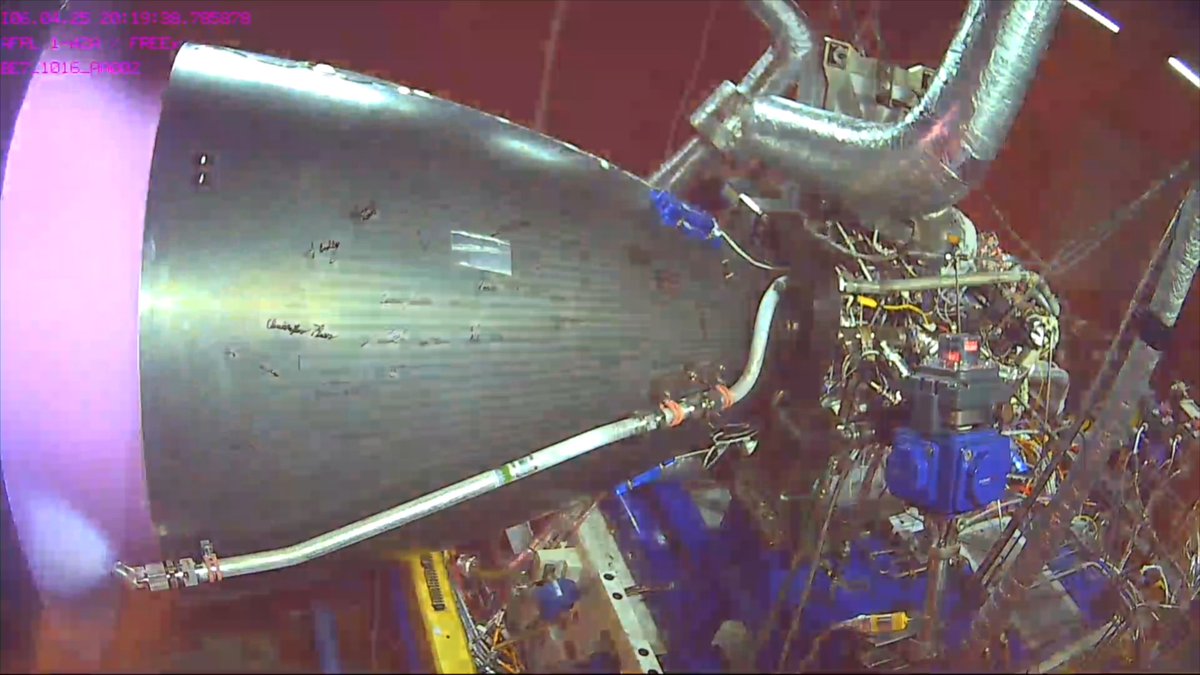
Last week, we pushed our Hadfield MK IV engine and Darkhorse engine test cell to their limits ahead of our upcoming thrust vector control (TVC) and orbital engine test campaigns. It was thrilling to see this controlled test go sideways — literally! Orbital launch vehicles operate within narrow design margins and constrained safety factors, where excess mass in any subsystem directly impacts payload capacity or mission viability. Destructive and limit testing enable us to validate optimal mass-performance trade-offs across propulsion, pressure systems, and primary structures. Key outcomes from this test include: ✅ Structural margins validated – Darkhorse demonstrated stable operation under full thrust loads at gimbal angles exceeding design specifications ✅ Thermal performance characterized – Extended burn duration at off-nominal mixture ratios provided empirical data on regenerative cooling degradation modes and injector thermal limits ✅ Fault tolerance demonstrated – Engine maintained functionality despite progressive damage, validating robustness for anomalous flight conditions ✅ TVC readiness confirmed – Test results validate system integration for upcoming actuated TVC test series l Design optimization insights – Failure mode analysis generated actionable improvements for cooling architecture, injector design, thrust structures, and engine reusability At NordSpace, we push limits. Canada needs to get to orbit with sovereign light-lift launch by 2028 and medium-lift launch by the early 2030s. The only way this is possible is through extreme levels of testing, manufacturing, and investment. Our mission to build a Canadian end-to-end space missions capability will change the shape of our nation both on Earth and in space. If you would like to join our mission, please apply for a role at NordSpace via the Careers page on our website, and join us at the Canadian Space Launch Conference on May 5th, in Ottawa. National Defence Defence Research and Development Canada NSERC / CRSNG Canadian Space Agency Transport Canada

NordSpace 🇨🇦

11,704 Aufrufe • vor 5 Monaten

Charlotte Fire Responds to Three-Alarm Fire on East Morehead Street This morning, Charlotte Fire responded to a significant fire at a building located in the 300 block of East Morehead Street. At 7:47 a.m., Charlotte Fire Comms Charlotte Fire Alarm received a report of heavy smoke at the address. Firefighters were immediately dispatched, with the first unit en route by 7:48 a.m. At 7:51 a.m., Ladder 4, Engine 11, Engine 4, and Engine 2 arrived on scene. Engine 2 assumed initial command of the incident. Upon arrival, Ladder 4 reported heavy fire conditions in the basement of the structure. Additional fire apparatus were dispatched to support the response. At 7:56 a.m., Battalion 1 assumed command and escalated the response to a second alarm at 7:57 a.m. As conditions worsened, Car 7 took command at 8:01 a.m. At 8:02 a.m., an evacuation tone was sounded, instructing firefighters to exit the structure due to safety concerns. By 8:04 a.m., a roof collapse was imminent, and at 8:30 a.m., the structural integrity of the walls was also compromised. A third alarm was struck at 8:42 a.m., bringing additional resources to the scene. After an intense firefighting operation, the fire was brought under control at 10:23 a.m. There were no reported injuries to civilians or firefighters. “The dedication and quick action of our firefighters prevented what could have been a far worse outcome,” said Charlotte Fire Chief Reginald Johnson. “Their ability to make decisive, tactical decisions under extreme conditions speaks to their training and professionalism. I’m incredibly proud of their commitment to protecting our city.” The Charlotte Fire Investigation Task Force is actively working to determine the cause of the fire. Further updates will be provided as more information becomes available.

Charlotte Fire Dept

13,776 Aufrufe • vor 1 Jahr

Elon Musk just explained why the SpaceX IPO is an energy story and the energy constraint is why he believes space becomes the only viable path for AI to scale (Save this). The argument he is making is one of the most important and least understood things happening in technology right now. The United States currently consumes roughly 500 gigawatts of electricity on average. To double that capacity which is what continued AI expansion on the current terrestrial trajectory would eventually require would mean building as many power plants as currently exist in the entire country. He is not arguing that this is technically impossible, just that communities are not willing to accept it, that permitting timelines make it unrealistic, and that the hard ceiling on Earth based power generation means the expansion of AI compute will eventually hit a wall that no amount of capital can overcome on the ground. His observation is that in space, that wall does not exist. A solar panel in orbit produces roughly five times more power than the same panel on Earth, operates in continuous sunlight uninterrupted by weather or nighttime, and benefits from the vacuum of space as a completely passive cooling system meaning the two largest operating costs of any terrestrial data center, energy and cooling, are effectively eliminated. He then said that you could theoretically increase harnessed energy by a factor of one million and still be using less than a millionth of the sun's total energy output. This is the underlying physics of why SpaceX filed with the FCC to launch up to one million solar powered AI satellites, and why they described that constellation in their own filing as a first step toward becoming a Kardashev Type II civilization capable of harnessing the full power of the sun. To understand what makes this credible rather than visionary, you need to understand what SpaceX already controls that no other company on earth possesses. Starship, once operating at full cadence, can deliver 100 to 150 tons of payload to orbit per launch, at a target cost per kilogram that is an order of magnitude lower than any existing vehicle. Musk's stated ambition is to scale Starship to 10,000 to 30,000 launches per year, a frequency that would allow the deployment of orbital compute infrastructure at a pace that is currently unimaginable with any existing rocket. He told xAI staff earlier this year that achieving space-based AI at scale will eventually require manufacturing facilities on the moon, building solar panels and heat dissipation structures from lunar silicon and aluminum, and launching them into orbit from there rather than from Earth's surface because the moon's lower gravity makes the economics of launch dramatically more favorable. SpaceX's S-1 filing explicitly states that its launch capabilities could enable massive AI compute satellite constellations with the potential for millions of satellites for orbital data centers, with the first launch potentially occurring as soon as 2028. Google and Alphabet are already in advanced talks with SpaceX about deploying space-based data centers. Starcloud, a startup running Nvidia H100 GPUs in orbit, has already validated that high-performance AI inference workloads can operate in space, with plans to scale to five gigawatts of orbital compute power by 2035. This is why Musk believes the cost crossover happens in two to three years because SpaceX's launch cost trajectory intersects with the accelerating energy constraint on the ground in a way that makes space genuinely cheaper, faster, and less regulated at exactly the moment AI demand is hitting its hardest physical limits.

Milk Road AI

12,140 Aufrufe • vor 1 Monat

Today, we unveil Project Shadow — Apex's on-orbit Space-Based Interceptor (SBI) technology demonstration, launching NET June 2026. At Apex, we often launch self-funded missions to advance our technology and demonstrate our capabilities in space. Over 1.5 years ago, we launched our first Aries satellite, which continues to serve as an on-orbit software testbed for our team and customers. Project Shadow is our next step internally funded mission (with more to come in the future). Launching on our Nova satellite bus platform, Shadow integrates and demonstrates key SBI technologies in a single, end-to-end mission. Here’s an inside look at Shadow: 1. Apex’s Nova platform will be outfitted with the “Orbital Magazine” configuration package, providing environmental management for the demonstration interceptors, a Link-182–compatible radio, and Missile Warning/Tracking sensors. 2. The Orbital Magazine will carry two scaled-down demonstration interceptors, each equipped with a solid rocket motor (SRM) and a suite of data-collection sensors. 3. The Orbital Magazine will launch NET June 2026, and after LEOPS and commissioning, Apex will issue a fire control command. 4. The Orbital Magazine will deploy the first interceptor and establish an inter-satellite link. The interceptor will be tasked to fire its SRM while oriented in the inverse velocity direction, avoiding other in-space objects, and safely deorbiting after the burn. 5. During the burn, the Missile Warning/Tracking payloads on the Orbital Magazine will gather critical data on on-orbit SRM performance, determine tracks, and more. 6. The second interceptor will be deployed shortly after, establish a crosslink, and receive a command to fire its SRM, following a similar trajectory to the first demonstration interceptor and safely deorbiting. Project Shadow is self-funded by Apex. We believe that supporting America, our allies, and democracy requires direct investment in the development and maturation of key defense technologies — including SBIs. Learn more about next year’s mission from SpaceNews with the link below.

Apex - Satellite Platforms 🛰

1,117,750 Aufrufe • vor 8 Monaten

I want to believe, but there's too much evidence that not only tells me but shows me that they lied. I feel like low Earth orbit is as far as we can go... 1. The van Allen radiation belt. 2. The disgusted, unexciting, ashamed post moon landing conference with the three astronauts. Their body language, mannerisms, and answers scream that they're lying. 3. The lack of noise of the jet engines in the "videos." 4. How did they get the lunar rover on the spaceship? 5. No craters or dust underneath the spaceship. 6. How did the film the spaceship take off perfectly if nobody was left on the moon to operate the camera, and how was it so perfect if there was a delay? 7. The rockets and the spaceship look like a model. 8. The video of them saying that they are 130,000 miles away from Earth when all they really did was cover up the windows when they are in low earth orbit and film a small portion of Earth from low Earth orbit to simulate that they were far away, but then you find out that they're only in low Earth orbit when they uncover the windows. (Shown in the video below) 9. How we have to redesign the space suits to be able to handle the atmosphere on the moon. 10. The lack of talk and missions to the moon ever since. 11. The numerous blacked out photos from NASA. 12. How an older smartphone has way more technology than the entire spaceship back in 1969, and how we were able to even communicate with them in the spaceship as the one astronaut who passed away before the moon launch specified that they had trouble communicating between buildings and the shuttle on the ground. 13. Not one single astronaut would put their hand on the Bible and say they went to the moon. Why? 14. All the CGI and bubbles caught on NASA videos. 15. All the green screen captures and astronauts on wires in the "shuttle" and on the "ISS." There are so many bloopers and outtakes of astronauts and shuttle hatches malfunctioning, people appearing in the background of videos of the shuttle, people fading in and out, I could go on forever... How would you convince me against the evidence or prove me wrong from the arguments that I have provided?

The SCIF

32,347 Aufrufe • vor 1 Jahr

BREAKING: The IDF gave it a name. Operation Eternal Darkness. Read the name as a capability statement, not a codename. Fifty fighter jets. One hundred and sixty precision-guided munitions. One hundred targets. Ten minutes. Three geographic zones spanning 170 kilometres from Beirut’s southern suburbs to the Beqaa Valley to southern Lebanon. Simultaneous impact. Zero warning to the targets. Defence Minister Katz said it was the largest concentrated blow Hezbollah has suffered since the pager operation in September 2024. The pagers were hardware infiltration. This was something else entirely. In September 2024, Israel compromised Hezbollah’s supply chain, embedded explosives in pagers, and detonated them simultaneously. It required months of physical engineering, covert procurement, and logistical insertion. It killed approximately 40 commanders. Operation Eternal Darkness killed over 200 operatives in a single ten-minute window without touching a single device in advance. The penetration was not physical. It was informational. The IDF confirmed that the operation was planned several weeks in advance and was going to proceed regardless of whether the Iran ceasefire was reached. The timing was driven by what the military described as optimal operational conditions. Translated from military language into plain language: the intelligence picture was complete. Every target’s location was known. Every target’s location was current. And every target’s location was known to be current at the same moment. That simultaneity is the revolution. It is not possible to strike 100 dispersed command nodes across 170 kilometres in ten minutes unless you have real-time positional data on all of them continuously. Not yesterday’s data. Not this morning’s data. Live data, updating faster than any human can relocate, verified across multiple intelligence streams, and fed into a strike package that executes before the first target can warn the second. Israel has built what military doctrine now calls a “data factory”. The system originated in Gaza where Unit 8200’s AI platforms, known internally as Gospel for infrastructure targeting and Lavender for personnel identification, compressed target generation from 50 per year to 100 per day. Haaretz confirmed on March 31 that this data factory is now active in the Lebanon and Iran theatres, creating a single operational picture from satellite imagery, drone feeds, signals intelligence, cellular metadata, and human sources fused through machine learning algorithms that identify patterns faster than any analyst corps on earth. The name Eternal Darkness is not poetic. It is literal. When you strike every command node, every intelligence headquarters, every missile coordination centre, and every elite unit’s operational hub simultaneously, the lights go out across the entire organisation at once. There is no fallback node to activate. There is no secondary command to assume control. There is no communication channel to issue the order to disperse because the communication channel is what revealed the location in the first place. Hezbollah’s options after Eternal Darkness are binary. Go digital and be found. Go analogue and be slow. An organisation that abandons digital communications to survive surveillance becomes an organisation that cannot coordinate distributed operations, which is the definition of a degraded force. The IDF does not need to destroy every fighter. It needs to destroy every connection between fighters. And on April 8, in ten minutes, it demonstrated that it can do exactly that across an entire country. The pagers changed the supply chain. Eternal Darkness changed the definition of command and control. In 2026, your signal is your coordinates. Full analysis -

Shanaka Anslem Perera ⚡

478,705 Aufrufe • vor 3 Monaten

Here is one of our experimental 3D printed Hadfield liquid rocket engines going through some thrust vector control (TVC) profiles! As we scale to our first light-lift orbital launch vehicle, Tundra, and then our medium-lift reusable launch vehicle, Titan, precise control of the rocket at every phase of flight is critical to mission success. Guiding a rocket to orbit, and eventually back to Earth, demands close coordination across every sub-team. Some of the key challenges we’re tackling: ➡️ Reliable & repeatable TVC actuation: ensuring the engine gimbal responds consistently across every test and flight ➡️ High-frequency control loops: real-time systems that keep the vehicle stable from liftoff to orbital insertion ➡️ Propellant sloshing: accounting for the movement of fluids in tanks and its effect on vehicle dynamics ➡️ Wind shear compensation: countering atmospheric disturbances during ascent ➡️ Structural bending & flex modes: managing how the vehicle’s primary structure responds to aerodynamic and thrust loads ➡️ Precision payload delivery: hitting the exact target orbit, every time Our team at NordSpace has been advancing our propulsion systems on many fronts, as we work to unveil our orbital-scale, pump-fed Hadfield and Garneau rocket engines in the near future — the engines that will carry Canada to orbit for the first time, and unlock sovereign access to space. Check out some of our rocket hardware, meet our engineers, join over 400 attendees and over 40 speakers at the Canadian Space Launch Conference, taking place this May 5th in Ottawa. National Defence Defence Research and Development Canada Canadian Space Agency NSERC / CRSNG

NordSpace 🇨🇦

48,941 Aufrufe • vor 4 Monaten

Bro… Elon just laid out the blueprint on how xAI and SpaceX are getting to 1,000+ gigawatts per year and beyond, in his closing statement at the xAI all-hands! IMO, this is why there will be no competition in space. 1/ Earth Supercomputers (Now) Build Memphis cluster to get us to >1 GW of power. “We’re only right now using roughly one percent of the potential energy of Earth.” Plan: • 330,000+ Grace Blackwell GPUs • ~1M H100-equivalent compute • 1 gigawatt draw at full scale • Built in <1 year • Tesla Megapacks stabilizing energy FYI, most AI companies are operating in hundreds of megawatts, yet xAI is already at a utility-scale gigawatt compute. 2/ Orbital Datacenters (Soon) Get to 100-200 GW per year launched into orbit with a path to ~1 terawatt (1,000 GW) total from Earth launches. “The next step beyond Earth data centers is our Earth orbital datacenters… launching at the 100-200 gigawatt per year level. Not cumulative, I mean per year.” Benefits: • Continuous solar exposure • No land constraints • No terrestrial grid bottlenecks • Virtually unlimited horizontal expansion FYI, 100–200 GW per year is equivalent to adding multiple large nation-scale grids annually. 3/ Moon Factories + Mass Driver (Mid Future) Get to 1,000+ GW per year, several orders of magnitude beyond Earth. “In order to do that you have to go to the Moon… We are actually going to have a mass driver on the Moon.” Plan: • Lunar factories build AI satellites • Electromagnetic mass driver launches them without fuel • Low lunar gravity reduces launch energy requirements • Scales far beyond Earth’s physical constraints FYI, this is when industrialized compute begins manufacturing off Earth. 4/ Solar System & Beyond (Long Term Future) Today the sun outputs ~3.8 × 10²⁶ watts “If we wanted to use even a millionth of the Sun’s energy, that would be roughly a million times more energy than civilization currently uses.” This means • 0.000001 of the Sun’s output = ~1,000,000 × today’s global Earth energy usage. 🤯 “Earth is really a tiny, tiny dust mote in a vast darkness… The Sun is 99.8% of all mass in the solar system.” To access that scale: • Moon manufacturing • Mars expansion • Solar-orbit compute clusters • Eventually tapping meaningful fractions of stellar output So… the blueprint to get here is 1/ Start at 1 GW. 2/ Scale to 1 TW. 3/ Scale to 1,000+ GW per year. 4/ Then expand toward fractions of the Sun itself. It’s clear that xAI + SpaceX is building the AI infrastructure and pathway to a stellar-scale energy civilization. I really hope I’m still alive to witness all this.

Teslaconomics

526,587 Aufrufe • vor 5 Monaten

Azerbaijani media have published an anonymous letter containing an explanatory note by a Russian air defense captain from Grozny (Chechnya), claiming that the fire at the Azerbaijani AZAL Embraer E190 passenger plane was opened on the orders of the Russian Ministry of Defense. Reportedly, the letter also contains video footage, audio recordings, and details about the poor condition of the equipment. The plane crashed on December 25, 2024 as it approached Grozny. In all probability, it was shot down by a Russian air defense missile. 38 people were killed. ASTRA media claims to have spoken to the air defense commander who gave the order to shoot at the plane. According to them, he did not deny that he wrote the note. Azerbaijani media also claimed that the authenticity of the audio message and the note have been confirmed. Text of the explanatory note: "Regarding the questions addressed to me, I, Captain Dmitry Sergeyevich Paladichuk, can explain the following: I am the commander of combat vehicle No. 274, head of the crew, and was on combat duty covering the city of Grozny from December 24 to December 25, 2024. At 05:40 on December 25, 2024, an order was received to switch to combat readiness level 1. At 05:48, I reported the transition to readiness level 1 via mobile communication. The mobile connection at the site was unstable, and I had no other reliable means of communication. Fiber-optic cables were laid but not connected to the terminal, and there was no digital phone with a dialing panel. At 08:11, the target detection station identified a potential target, which I locked onto for precise tracking using the MRLS, and I reported this to the command post of the 51st Division. At 08:13, I reported updated coordinates: azimuth 338 degrees, range 7,000 meters, altitude 490 meters, speed 118 m/s, heading 230 degrees. I was given an order by phone to destroy the target. The target was not visible optically due to very dense fog, which I reported to the command post. At 08:13:30, I issued the fire command to the operator. At 08:13:33, the missile was launched. At 08:13:47, the TSVS BM-72V6 system indicated that the target was missed. At 08:13:48, I gave the order to fire again. According to the MRLS data, the first missile was launched when the target had the following coordinates: azimuth 319 degrees, range 7,300 meters, altitude 697 meters, speed 80 m/s. The second missile was launched when the target had the following coordinates: azimuth 311 degrees, range 8,000 meters, altitude 1,300 meters, speed 120 m/s."

Anton Gerashchenko

33,155 Aufrufe • vor 1 Jahr