Video wird geladen...

Video konnte nicht geladen werden

Zur Startseite

Pulsar’s Sunbird programme achieved first plasma in March 2026, demonstrating initial confinement and particle acceleration using krypton. Upcoming testing will add plasma diagnostics, superconducting magnets, RF and rotating magnetic-field heating, and thrust measurements. The programme aims to advance toward aneutronic fusion propulsion while studying neutron-induced damage to reactor walls...

102,934 Aufrufe • vor 6 Tagen •via X (Twitter)

0 Kommentare

Keine Kommentare verfügbar

Kommentare vom Original-Post werden hier angezeigt

Ähnliche Videos

Researchers at Tokamak Energy have captured for the first time a real-time, high-speed video of plasma behaviour inside their ST40 spherical tokamak, tracking visible green and red light emissions as the fusion process occurs. This visual insight comes via a camera operating at thousands of frames per second, offering unprecedented detail of how the plasma evolves, interacts with the surrounding lithium blanket and outer regions, and ultimately radiates energy. The imaging enables scientists to observe how the ultra-hot core transitions outward into cooler zones, how magnetic confinement shapes the plasma behaviour, and how impurities or outer-region interactions influence the process. By giving a ‘star-in-a-donut’ view of fusion in action, this breakthrough adds a new diagnostic tool to the development of fusion energy, helping engineers refine the magnetic confinement, optimise plasma stability and better understand the heat and light flows at play. It was slowed down by 100x. All this was for 0.3s A tokamak is one of the most advanced devices ever created to achieve controlled nuclear fusion, the same process that powers the Sun. Its goal is simple in principle but incredibly challenging in practice: heat a gas until it becomes plasma, raise that plasma to over 100 million degrees, and confine it long enough for hydrogen nuclei to fuse and release energy. Because no material container can survive such temperatures, a tokamak uses powerful magnetic fields to hold and shape the plasma like an invisible cage. The device has a distinctive doughnut-shaped (toroidal) chamber surrounded by magnetic coils. When the machine is switched on, electric currents and external magnets work together to create helical magnetic fields that trap the plasma and keep it away from the walls. As the plasma spirals around these magnetic lines, it heats up dramatically. Additional heating comes from methods like radio-frequency waves and neutral-beam injection, pushing the plasma toward the extreme temperatures needed for fusion. Inside this tightly controlled environment, hydrogen isotopes such as deuterium and tritium can collide and fuse, releasing fast neutrons and a burst of energy. The goal of tokamak research is to reach a point where the fusion reactions produce more energy than the system consumes, a milestone known as “net energy gain.” Modern machines like ITER, JET, and Tokamak Energy’s ST40 are bringing this vision closer, using advanced diagnostics, superconducting magnets, and increasingly stable plasma control. 👉

Erika 

162,540 Aufrufe • vor 8 Monaten

Taming the Edge: How lithium could help us control #fusion plasmas. This video captures the first flashes of lithium being injected into the #plasma of our ST40 tokamak, marking the start of our exploration into its effects. Why lithium? In fusion research, we aim for H-mode, a high-performance state with improved plasma confinement. Future fusion power plants are expected to operate in this mode. But H-mode brings a challenge: ELMs (Edge Localised Modes) are bursts of energy at the plasma edge, similar to mini solar flares. These can reduce plasma temperature and damage the divertor with intense heat and particles. Pioneering work by PPPL and others has shown that lithium can suppress ELMs and increase energy confinement time, leading to higher temperatures. On ST40, we’re currently injecting lithium powder during plasma shots to explore its effects. As part of our upcoming ST40 LEAPS upgrade – in partnership with the U.S. Department of Energy and Department for Energy Security and Net Zero – we’ll go further, coating plasma-facing components with solid lithium using the ‘lithium evaporation’ technique. We’ll be experimentally testing several mechanisms. One key focus is how lithium absorbs hydrogen isotopes and reduces their recycling back into the plasma, lowering the density at the plasma edge, leading to a more stable edge pressure gradient. We’re starting to understand more about lithium’s effect on plasma performance, and early results show lithium isn't getting into the plasma core, which is good news for avoiding diluting the fusion fuel in future plants. The physics is complex, and we’re still learning. But each step brings us closer to fusion energy. By incorporating lithium into ST40, the world’s highest field spherical tokamak, we’re advancing our understanding of this critical enabling technology. #Fusion #FusionEnergy #Innovation #Limitless #EnergyTransition

Tokamak Energy

66,652 Aufrufe • vor 1 Jahr

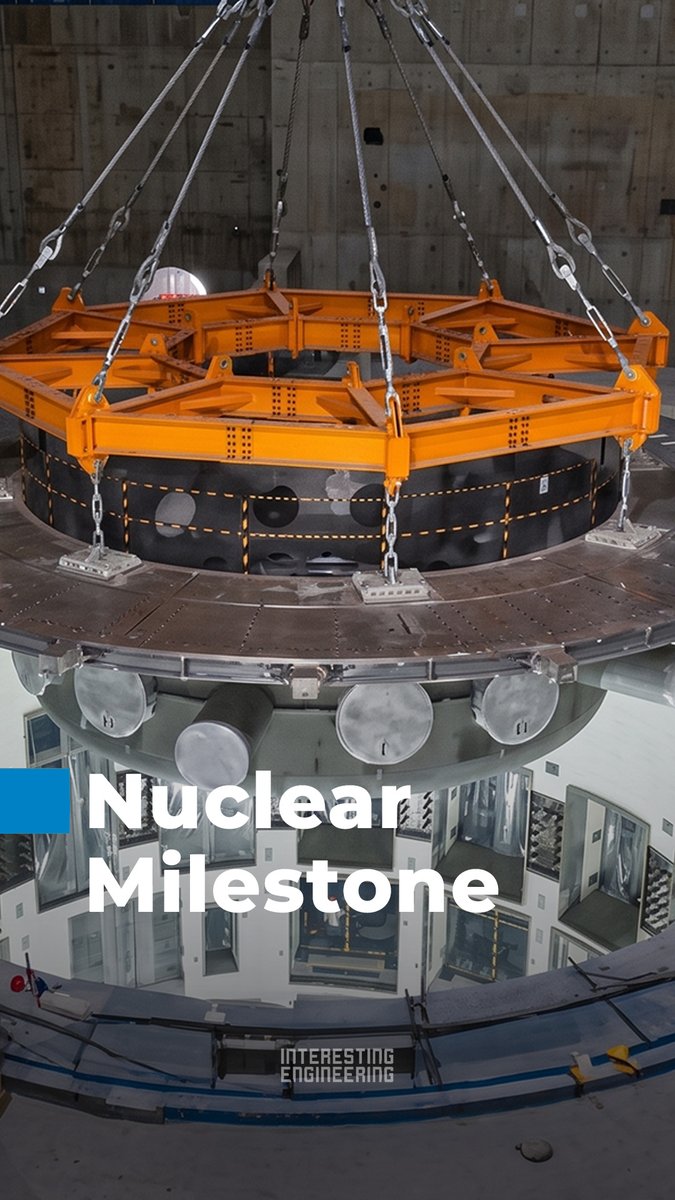
Here we go… This is the moment our ST40 centre column is lifted out. A bit like open-heart surgery on a tokamak. It’s a delicate operation, and a huge milestone for ST40. The centre column has had a tough life, acting as the core of the toroidal magnetic field coil in the world’s highest-field spherical tokamak. After more than 5,000 plasma pulses, it has helped generate magnetic fields above 2 Tesla at the plasma core, confining plasma at temperatures of more than 100 million °C, the threshold for #fusion. Next up, we install the new and improved centre column built by our partners at The Rockwood Group. This is all part of ST40’s major upgrade programme with U.S. Department of Energy and Department for Energy Security and Net Zero, helping transform it into one of the most reactor-relevant fusion devices in the world. What began as an experimental tokamak is becoming something much bigger: a customer testbed for the technologies and expertise needed to put #fusionenergy onto the grid⚡ And for anyone wondering what the centre column actually does… 👇 It forms the inner limb of each turn of the toroidal field coil. Its 24 wedges each carry up to 200 kA of current, generating the powerful magnetic fields needed to confine the plasma. Wrapped around the wedges, a 192-turn central solenoid helps drive and sustain the plasma current, after merging-compression start-up. An impressive piece of equipment with an equally impressive track record! #Fusion #FusionEnergy #Innovation

Tokamak Energy

28,462 Aufrufe • vor 2 Monaten

Nearly two years ago, I reported on how I'd helped my Mum get off 8 painkillers a day because of her arthritis using a device called the "Primer Cube Magnetic Array". A PrimerCube is an open-source device designed to generate strong rotating magnetic fields based on the research of David LaPoint AND RELEASED IN 2019. These devices often use a bowl-shaped array of neodymium magnets mounted on a motor to create specific magnetic field geometries. Magnetic Plasma Control: According to La Point, these bowls create magnetic fields that control plasma, showing that formations in the plasma exist regardless of electrical input, with electricity only acting to reveal them. A friend of mine, Rachel Russell, took it upon herself to manufacture these magnetic wonders and in this video entitled "Say Goodby to Pain Forever?" I meet a bunch of amazing people from around the world to share their stories of how this device has not only eliminated pain, but also been used to: - save and extend a dogs life and cut vet bills - enhance seeds for growing food and yield - massive increases in Bovis Levels (Life Force Energy) - hugely improved SLEEP patterns and quality - improved dreams - improved thyroid function - reduced inflammation - improved skin appearance - parasite reduction - lengthened telemeres - reduced UTIs - improvements in sciatica - improvements in breast-feeding NONE OF THIS IS MEDICAL ADVICE, NOR ARE ANY OF THESE STORIES MEDICAL CLAIMS, MERELY ANECDOTES. DO YOUR OWN RESEARCH AND MAKE UP YOUR OWN MIND. TO LEARN MORE, link in comments below.

Mark Attwood

292,713 Aufrufe • vor 3 Monaten

Helion energy is building what will be the world’s first commercial fusion power plant, scheduled to be finished in 3 years. Great interview by Lex Fridman with David Kirtley (CEO of Helion). Most power plants are heat engines. You burn fuel or run fission, boil water, spin a turbine, and get about 35% electricity while the rest leaves as waste heat. Helion flips the flow. The fusion reaction makes charged particles that push back on a magnetic field tied to a capacitor bank, so you get direct electricity instead of a steam loop. That path can reach about 85% efficiency from fusion energy to electrical output, which means less conversion gear and tighter control over power delivery. 🧪 How the machine works A giant capacitor bank drives coils that both accelerate and squeeze plasma. Two plasmas, deuterium plus helium‑3, are launched from opposite sides and collide in the center. By rapidly reversing the magnetic field in about 1 microsecond, the plasma self-organizes into a field‑reversed configuration that traps itself. Then the machine compresses it hard. Fusion happens, new charged particles appear, and their pressure pushes the magnetic field so the system dumps energy back into the capacitors. It is pulsed, up to 100Hz in tests, so each shot is a clean measure of input versus recovered electricity. 🛡️ Safety and waste There is no chain reaction. The device only holds about 1 second of fuel at any time, so stopping the drive stops fusion. X‑rays and some neutrons exist during operation, so you use shielding and standard controls, similar to particle‑accelerator facilities. When the pulse stops, the radiation source stops. 🖥️ Why data centers care The output is high‑voltage DC sitting on capacitors. You can invert to AC for the grid, or route DC with fewer conversions into rectifier buses for racks. That cuts losses and simplifies backup. The company is targeting 2028 for a first grid-tied plant for a large buyer, which lines up with growing AI power needs. 🧩 What is still hard Helium‑3 is scarce on Earth, so you must produce it or source it. This fuel also likes higher temperatures, roughly 200M-300M degrees, so the pulsed magnets and power electronics must be very fast and very tough. Stability is managed by giving the plasma enough “spin” and length so it behaves like a fast top that stays upright, plus thousands of synchronized switches that fire with microsecond timing. If this architecture keeps showing pulse gain and high‑efficiency recovery, you get a compact generator that skips steam, feeds a capacitor, and delivers clean power in the exact format modern compute wants.

Rohan Paul

63,912 Aufrufe • vor 8 Monaten

💎Scientists and engineers from the UK Atomic Energy Authority (UK Atomic Energy Authority) and the University of Bristol (University of Bristol) have successfully created the world’s first carbon-14 diamond battery. This new type of battery has the potential to power devices for thousands of years, making it an incredibly long-lasting energy source. The battery leverages the radioactive isotope, carbon-14, known for its use in radiocarbon dating, to produce a diamond battery. Several game-changing applications are possible. Bio-compatible diamond batteries can be used in medical devices like ocular implants, hearing aids, and pacemakers, minimising the need for replacements and distress to patients. Diamond batteries could also be used in extreme environments – both in space and on earth – where it is not practical to replace conventional batteries. The batteries could power active radio frequency (RF) tags where there is a need to identify and track devices either on earth or in space, such as spacecraft or payloads, for decades at a time, thus reducing costs and extending operational lifespan. “Diamond batteries offer a safe, sustainable way to provide continuous microwatt levels of power. They are an emerging technology that use a manufactured diamond to safely encase small amounts of carbon-14,” said Sarah Clark, Director of Tritium Fuel Cycle at UKAEA. The carbon-14 diamond battery works by using the radioactive decay of carbon-14, which has a half-life of 5,700 years, to generate low levels of power. It functions similarly to solar panels, which convert light into electricity, but instead of using light particles (photons), they capture fast-moving electrons from within the diamond structure. Professor Thomas Scott, Professor in Materials at the University of Bristol, said: “Our micropower technology can support a whole range of important applications from space technologies and security devices through to medical implants. We're excited to be able to explore all of these possibilities, working with partners in industry and research, over the next few years.” A team of scientists and engineers from both organisations worked together to build a plasma deposition rig, a specialised apparatus used for growing the diamond at UKAEA’s Culham Campus. This development is the result, in part, of UKAEA’s work on fusion energy. The expertise gained in fusion research is helping to accelerate innovation in related technologies.

UK Atomic Energy Authority

12,493 Aufrufe • vor 1 Jahr

Lenz Law "Eddy Current" Experiments 2 of 3 - Ring Magnets and a Spinning Copper Rod (YouTube deleted this experiment as well, labeling it as "medical misinformation.") Around 2010, I wrote a Facebook note titled "Frictionless Flywheel". (Facebook deleted my page of 15 years). In that write-up, I speculated and predicted that... ... if a magnet falls in slow motion down a copper tube... then what would happen if you did the inverse? Drop a magnet ring around a copper rod? It's the same relative motion between the magnet and the copper. So the magnet would tilt at an angle while slightly rotating as it falls in slow motion around the copper. But then I said... "Let's take it one step further... I predict that if you have magnet rings around a copper rod... and then you spin the rod... that the magnet rings would stabilize around the rod from eddy currents." I said, there will be a magnetic bearing effect where the magnet ring will levitate and spin. Because it's following in the wake of the eddy currents produced by the rotating copper. So the magnet should catch up to speed of the copper and match it like the moon to the Earth. Essentially remaining fixed relative to the copper rod... but since the copper is spinning at a high RPM, then the magnet should spin at a high RPM; albeit, with a slight lag. So, abiding by the scientific method, I make an observation of the magnet falling in slow motion. I thought critically about. I get a new idea. Once the new idea passes muster, I allow my self to make a prediction for a scenario that hasn't been tried yet. Worked it out in my mind to see if it was viable. But then I needed to test it. I didn't have the ability to spin a copper rod at a high enough RPM that I theorized would be needed. So I communicated with my friend Josh Toms We had been talking about different experiments for quite a while. Josh is a real experimenter and a good man. He tests things before he speaks on them and when he speaks, it's with an informed opinion. He sent me a copper sphere about 2 inches in diameter and taught me some cool stuff about eddy currents I hadn't seen when sending each other clips of experiments we were working on. I explained the concept of the "frictionless flywheel" and my prediction that the magnets would levitate and stabilize around the copper rod if it was fast enough. So Josh built a platform using an angle grinder as a motor to spin a copper rod. He put very strong NdFeB magnets around the 1 inch diameter copper rod. IT WORKED! Josh brought this platform to the Tesla Technology Conference in Albuquerque, NM in 2010 where we met up. I filmed the demonstration of the platform you see in this video. There was a young boy who was fascinated by some of the magnet demonstrations I and others were giving at the conference. So I was explaining the process of what was happening to the inquisitive kid. Again.. what you notice here is that the eddy currents act as a force field to prevent friction between the magnets and copper. There is a stable gap and "magnetic cushion" that forms after a certain RPM. (Dependent upon the mass/gauss of the magnet in relation to the diamagnetic quality/mass of the copper or material in motion.) And what is super interesting to me is that once again... you can violently shake the entire platform and it WILL NOT disturb the magnets. The will not touch that copper after a certain RPM. You could make violent 90˚ turns and from the perspective of the magnets... it's just moving in slow motion relative to the copper. Just like how the magnet falls in slow motion relative to the copper down the tube. But this is just at a higher velocity relative to a stationary observer viewing the rotating system. But it doesn't matter if it's a centripetally rotating system at a constant velocity or linear acceleration in a particular direction... those eddy currents act as a force field to protect whatever is relative to the magnets and/or copper in those moments. So the claim and prediction that a frictionless flywheel effect and magnetic bearing would take place between a ring magnet and spinning copper rod DEMONSTRATED to be true. Now "PROVING" this scenario means to derive mathematical equations to justify an explanation of how the end results arise. Spinning magnets on a copper rod doesn't prove anything. In science... proof is math. Experiments can never prove anything. Experiments never provide equations or numbers or variables. Experiments provide evidence. You collect the evidence FIRST... AFTER doing real-world, hands-on experimentation. Anything else is just armchair research and talk. You write the proofs on paper to describe how you think things happen. And your proofs must abide by the constraints of the model you use. Sure... you can use a mathematical artifice like Lorentz invariance (relativity) to prove the end results arise because of: dark matter accumulating between the magnet and copper. Or that it must be space-time curvature bending... Or that it must be because of the aether rippling and vortexing... Or because of the dynamic casimir effect or zero point energy. Or anti-gravity. NOPE! None of those things are needed in the explanations I offer for any experiments and real-world data collected. I use the framework of what I call GALILEAN VARIANCE. Good ol' classical physics in 3D Euclidean space. No 4th dimension. No space-time. No aether. No nonsense. Only Newtonian Mechanics and elementary math.... but with a twist! ... and under.. "a new light". I have a completely different interpretation as to what gravity is and the mechanism of how it arises. Issac Newton never claimed to have a theory for the CAUSE of gravity. Newton's brilliant work and optics describes the behavior of matter and energy within a gravitational field. But he never claimed to know what causes gravity. "I have not as yet been able to discover the reason for these properties of gravity from phenomena, and I do not form any hypotheses." - Newton However... I do claim to have an explanation for the cause and mechanism of gravity. And it means a total abandonment of relativity and half of QED. Gravity IS a force! (and an emission) Eddy currents are not gravity. Magnetism is not gravity. And the kicker... gravity is not electric either. It's an illusion. Gravity is not an illusion. But the illusion is that people think gravity is electric. It's not. I have a completely different take. And boy has it gotten me in a lot of trouble and banned from speaking time and time again. But... if the information is valid... then trying to suppress it is like trying to hold an inflated basketball under water. Your arms are gonna get tired eventually and things are gonna come up to the surface with spring-loaded force. Equal to the amount people tried holding it back. The Rebirth of Classical Physics: Time, Light & Gravity

TheRealVerbz (Jason Verbelli)

45,879 Aufrufe • vor 1 Jahr

For years, NordSpace has been building towards one goal: launching Canadian payloads on Canadian rockets from Canadian soil in a way that’s technologically scalable and commercially sustainable through painstaking vertical integration. Today, that vision is rapidly taking shape and we are pleased to share this inspiring video preview of what Canada’s historic first sovereign orbital space launch will look like. Enjoy! Tundra is NordSpace’s domestically designed, built, and operated light-lift responsive orbital rocket. It can carry up to 1,100 kg fully optimized to Low Earth Orbit (LEO) powered by our proprietary Hadfield rocket engines that are 3D-printed, regeneratively cooled, and pump fed representing the most powerful orbital-class propulsion system in Canada. The modular architecture means the same engine powers both the multi-engine first stage and the vacuum-optimized second stage, reducing complexity while creating a direct scaling path toward our future reusable Titan medium-lift vehicle, capable of 5,000+ kg to LEO. The Atlantic Spaceport Complex (ASX), under construction in Newfoundland and Labrador, is positioned at 46 degrees latitude providing launch access to polar, sun-synchronous, and mid-inclination orbits with the widest range of nominal launch inclinations of any Canadian spaceport. It’s the only fully Canadian-owned and purpose-built commercial orbital launch facility in the country with the highest approved launch cadence and safety distances allowing us to maximize the efficiency, reliability, scalability, and unit economics of our entire launch program. What distinguishes NordSpace is our commitment to vertical integration and first principles approach to business and technology. Rockets, spaceport, and spacecraft are all designed, manufactured, and operated in Canada by one streamlined team. We have already demonstrated flight-ready propulsion, completed integrated rocket tests, and have our first pathfinder satellite, Terra Nova, manifested for launch in 2026 with our edge-AI imaging payload (Chronos) for space domain awareness nd our electric propulsion system (Zephyr-EP). With recently announced $8.3 million in Phase 1 federal funding through the Department of National Defence’s Launch the North initiative, NordSpace is targeting Initial Operational Capability by 2028. Canada is about to become a true spacefaring nation, and our future on Earth and in space will never be the same. Let’s give’r! 🇨🇦🚀 National Defence Defence Research and Development Canada Canadian Space Agency

NordSpace 🇨🇦

15,258 Aufrufe • vor 4 Monaten

DARPA's NEW TECH that TERRIFIED CONGRESS. Understand DARPA's Nonsurgical Wireless Brain Computer Remote Interface Neurotechnology that uses light and sounds as weapons that can induce behavior, emotions, read and implant thoughts, pictures, etc. Now, combining this tech with A.I., we have reached unbelievable new levels of science that have opened pandora's box, and some of the things in pandora's box are extremely concerning for the future of humanity. For the past COUPLE of DECADES, DARPA, the DoD, military contractors, and leading universities have been constructing and implementing wireless, invisible weapons against the people right in front of you, and nobody even noticed. The weaponization of this tech is so dangerous that even the U.N. is sounding the alarm because of it's untraceable and unethical capabilities. This is an introduction and overview. Pay Attention. I show you things for a reason. Secretary of Energy Hazel Reid O'Leary, who served under the Clinton administration stated that over 500,000 thousand Americans have been used in human experiments, including mind control and other experiments over a period of four decades without their informed consent. This is only what they admit to, then programs get put under higher classification, or under the guise of "national security," or go black so even members of Congress might not even get access to such programs. Mk Ultra as well, back in the 1960's used over 4,000 military service men without their consent for human experiments such as mind control. No one to this day has been held accountable for these experiments on our military and American citizens. Since the mid 1980's, radio frequency energy has been mastered by professionals in the field and graduates of Yale University and others and have been working directly with the military on mind control operations. The equipment being used needs no implant device, mechanical, or electronic device attached to the human being to be able to induce specific behaviors, moods, even V2K which is "voice-to-skull" technology and the CIA, NSA, DARPA, and our military are extremely interested in this technology Following MK Ultra, attention shifted toward electromagnetic technologies, including extremely low frequency (ELF) and radio frequency (RF) waves, which can influence emotions and project voices into the human mind. The "Frey Effect," discovered in the 1960s, demonstrated that pulsed microwaves could produce audible effects or voices in a subject's head, also known as "voice-to-skull" (V2K). Declassified documents show the U.S. military and intelligence agencies explored and used this tech during the Gulf War in the 1990s. DARPA—established in 1958 to advance cutting-edge military technology—began funding projects that bridged neuroscience and electronics, laying the groundwork for brain-computer interfaces (BCIs). DARPA’s role expanded significantly in the 21st century with programs like the Next-Generation Nonsurgical Neurotechnology (N3) initiative, launched in 2018. N3 aims to develop non-invasive BCIs that allow soldiers to control drones or robots with their thoughts, using techniques like ultrasound, magnetic fields, and nanoparticles to interface with the brain. This builds on earlier DARPA efforts, such as the Revolutionizing Prosthetics program, which enabled thought-controlled artificial limbs. Concurrently, the Obama administration’s BRAIN Initiative, announced in 2013, sought to map the brain’s neural circuits and accelerate neurotechnology development. While framed as a scientific endeavor to treat neurological disorders, its overlap with DARPA funding—$225 million by 2015—imply heavy military applications, including behavior modification and thought decoding. The integration of ELF/RF frequencies with 5G and AI represents the latest frontier. 5G’s high-frequency millimeter waves and dense network of transmitters could, in theory, enhance the precision and range of electromagnetic signals targeting the brain. Paired with AI, which can analyze vast datasets of neural activity in real time, this technology enables remote behavior control and thought reading. DARPA’s N3 program, for instance, envisions two-way communication between brains and machines, potentially allowing external systems to interpret intentions or implant sensory feedback—like voices or emotions. Speculative claims suggest that military and intelligence agencies are weaponizing these tools to suppress fear in soldiers, influence adversaries’ decisions, or surveil thoughts. Today, these technologies raise profound ethical and practical questions. The line between enhancement and control blurs when AI-driven systems could override human autonomy. Reports of "targeted individuals" experiencing voice projection or emotional manipulation fuel speculation and aren't looking unrealistic after all. Arguments that the secrecy surrounding DARPA and CIA projects—echoing Mk Ultra’s hidden abuses—obscures the true extent of weaponization, while proponents frame advancements vital, for national security. The progression from Mk Ultra’s drug experiments and other crude techniques to master mind control have surpassed ELF/RF explorations, and now to DARPA’s AI-enhanced BCIs under the BRAIN Initiative reflects a trajectory toward increasingly sophisticated mind control capabilities. The addition of 5G’s infrastructure and other radar installations around the world amplifies the potential for remote influence, suggesting a future where thoughts, emotions, and behaviors could be manipulated, monitored, and induced. The WEF makes their goals for this tech more than clear on their own website. Privacy will no longer exist. While the military and intelligence agencies undeniably pursue these technologies for strategic advantage, the full scope of their operational use and the line between science fiction and reality is diminishing by the day now that these technologies are fully operational and in use today and have now entered the advertising industry and big tech. I'm sure you can figure out where this is all going, and honestly, it's not good.

The SCIF

162,168 Aufrufe • vor 1 Jahr

Monthly WINR Protocol Development Update: To begin with, the WINR Protocol has distributed $900,000 to token holders, generated more than $500,000 in pure profit for liquidity providers on WLP, acquired more than 5,000 users, and has almost 9% of the supply burned. In the upcoming months, the WINR Protocol, which has been in production for years, will introduce a range of new products and deployments. These developments will represent the practical and technical evolution to V2 of the protocol. Here are the latest updates and further details as they progress: Progress on WINR Bonanza, Casino Hold'em, and Blackjack is nearing completion. These games are in the final stages of testing. Additional games, including a new type of crash game, have been finalized and are set to debut with the JustBet v2 launch. Take a look at the gameplay videos for a preview. These games achieve the long-term goal of providing a full-suite WINR Game Engine SDK, which can be used to build games with complex logic on-chain with modular smart contract infrastructure. For example, any grid slot game that dominates the iGaming industry could easily be developed on-chain using the WINR Bonanza SDK. - Permissionless Frontend Operator SDK Dashboard Release: March is poised to be a milestone month with the launch of the Frontend Operator SDK dashboards. These dashboards will enable any WINR Labs game to be seamlessly deployed on frontends, marking a significant advancement in protocol accessibility and integration for future games developed by independent iGaming developers. The frontend operator can deploy any game they choose through a few simple steps while utilizing 10,000 WINR per game via the WINR Game Factory smart contract. Each operator is assigned a unique smart contract address(es) for every game they deploy, allowing their revenue to be tracked independently. The deployment process includes instructions on integrating the game as a package into the operator's frontend. In subsequent phases, the games will transition through WINR Chain, streamlining user onboarding steps like wallet connection and token bridging to Arbitrum. This abstraction will make it easy for any web2/web3 platform on any chain to seamlessly integrate WINR-based games with just a few clicks. The new budget system changes how the revenue is calculated on the protocol and will see daylight with frontend operator, Solana, and Fantom deployments. This model was first tested with a lightweight version on and gave a lot of actionable feedback. Shifting from the existing bribe model, which in practice distributes almost half of the edge of the games in volume to WINR holders, the brand-new budget system checks the profitability of WLP. It distributes a larger part of the profit to game providers, frontend operators, and, most importantly, WINR holders. Any time a game's budget is in profit, a part of every loss is distributed to stakeholders. Here is an example: 1. The WINR Bonanza Game has a 10,000 budget for a frontend operator. 2. Let's assume the bet amount was $50, and Bonanza paid back $10 on that spin. That leaves $40 of pure profit. 3. This is distributed amongst 50% to WLP, 20% to frontend operators, 20% to WINR holders, and 10% to game providers. 4. To achieve this, V2 of WINR Liquidity Engine (WLP) will have a buffer for purchasing and selling, working in epochs to determine the above distribution and math. - Solana Deployment and Expansions: Solana audits are in their final phase, and frontend tests are ongoing. Solana launch will be alongside the V2 launch of @JustBetOfficial, with a chain switch available on the top bar. The VRF system WINR developed already is seeing requests from builders around the Solana ecosystem, and this will over time add an extra layer of income to the protocol. Solana's bankroll, at first, will be a lighter version of WLP but will inherit the above-mentioned budgeting system to generate income immediately upon launch. - Fantom Deployment and Expansions: Fantom's upcoming Sonic upgrade, with its 200ms finality and fast block production is a perfect chain for WINR Protocol to expand. Through the partnership with WINR Protocol will tap into a brand new user base on Fantom. The bankroll on Fantom will consist of FTM and stables. The launch is planned for late March or early April. This expansion aims to open up new markets and collaborations with fresh teams. which operates independently, will integrate a broad spectrum of WINR technologies, including WINR Account Abstraction, WINR VRF, and WINR games, marking a pivotal step in WINR Protocol’s journey of horizontal expansion. - XAI VRF Deployment Progress Update: The WINR Account Abstraction Wallet and WINR Verifiable Random Function (VRF) deployment on the XAI 🎮⛓️ is well underway, with the majority of the work completed. This step forward showcases WINR's expansion beyond gambling and trading, highlighting the protocol's adaptability and commitment to broadening decentralized services. The process to automize and permissionlessly let game developers start using WINR VRF by paying (and burning) fees in WINR will launch alongside WINR VRF deployment on XAI and expand to further chains to help DApp builders with the tooling they need. This process will work very similarly to frontend operators, where DApp builders will be able to easily deploy their VRF contract, pay the WINR fees, and enjoy the fastest random number generation transaction, as showcased on @JustBetOfficial for some time. - JustBet v2 Development Update: Set to launch in March, the last testing phase with long-time community members of JustBet V2 is underway. Boasting a completely refreshed look, JustBet v2 aims to captivate more users with its modern features, a significant upgrade from the classic JustBet designed in 2019. Expect dynamic animations and a user experience that rivals traditional web2 casinos, setting a new standard for online gambling platforms and serving once again as proof of concept for all the new WINR features and infrastructure set to launch over the coming months. As always, WINR Labs simultaneously develops protocol infrastructure and platform to best address the needs of one and only goal: horizontal expansion. Easter eggs: Upcoming Gitbook update with all the technical information of WINR V2. CEX listing. Detailed product pages on WINR web. Pyth competitions. WIP-4 and WIP-5 are ready to deploy. And an 🪂

WINR

37,891 Aufrufe • vor 2 Jahren

ADMISSIONS STILL ONGOING, SPORTS UNIVERSITY OF NIGERIA (SUN), IDUMUJE-UGBOKO As the Founder of the Sports University of Nigeria , Idumuje-Ugboko, Delta State, I am pleased to remind you that admissions for the 2025/2026 academic session are still open. SUN is the first university of its kind in Sub-Saharan Africa, designed to combine academic excellence with sporting brilliance. Our mission is to ensure young people never have to choose between education and their passion for sports. At SUN, you can pursue both and excel in both. Our Unique Model: Every SUN student combines a compulsory sport with a degree programme. Whether your passion is football, athletics, swimming, tennis, taekwondo, basketball, volleyball, or golf, SUN provides a home for your talent while also allowing you to earn a degree in your chosen field. Academic Programmes: •Sports Science & Sports Programmes: Sports Science & Technology, Sports Administration, Physical & Health Sciences •Allied Health Sciences: Nursing, Public Health, Physiotherapy, Medical Laboratory Science •Mass Communication: Journalism, Film & Multimedia, Broadcasting, Public Relations, Theater Arts •Management & Social Sciences: Economics, Political Science, International Relations, Accounting, Business Administration, Hospitality & Tourism, Marketing, and more •Sciences & Technology: Microbiology, Biochemistry, Computer Science, Cyber Security, Physics with Electronics, Software Engineering •Architecture •Certificate & Diploma Programmes: Sports Coaching, Sports Governance, Sports Marketing, Sports Medicine, Sports Management, Vocational Training, Fitness, and more •Preparatory Studies: For candidates with sporting talent who do not yet meet full academic requirements, covering Basic and Foundation courses Admission Requirements: •Degree Programmes: 5 credits including English and Mathematics in SSCE plus JAMB UTME •Direct Entry: A’ Level, OND, IJMB, JUPEB, or equivalent •Certificate & Diploma: Minimum JSS certificate with verifiable sporting talent Campus Facilities: Our campus offers a secure, serene, and supportive environment with on-site boarding, 24-hour power supply, WiFi, CCTV, modern classrooms, well-furnished hostels, and world-class sporting facilities designed to develop champions. SUN is not just a university, it is a movement to nurture well-rounded Nigerians who will bring honor to their communities, Delta State, Anioma, and the nation. I warmly invite all talented and ambitious young Nigerians and Africans to take advantage of this opportunity. Apply now and be part of this pioneering journey. 👉 Apply now: 📞 For inquiries: Tel: +234 916 717 7777 | +234 916 706 6666 Email: [email protected] | [email protected] 🌍 Follow SUN for updates and opportunities: Facebook: Sports University of Nigeria Instagram: Sports University of Nigeriaofficial X (Twitter): Sports University of Nigeria YouTube: Sports University of Nigeria At SUN, we are raising scholar-athletes who will excel in the classroom, on the field, and in life. Join us and be part of the legacy.

Senator (Dr.) Prince Ned Nwoko

141,116 Aufrufe • vor 9 Monaten

Daily Hard Tech Headlines: - Array Labs has secured a $21M funding round led by Mitsubishi Electric Corporation. The Bay Area startup develops radar satellites. - Quantum Cyber has produced its first mini-interceptor drone at its Connecticut manufacturing facility, marking the start of production at another American drone factory. - The FCC is moving to block new Chinese-made robots, including humanoids, and connected power inverters from sale in the United States. Chinese manufacturers accounted for more than 80% of global humanoid robot shipments in 2025. - Firehawk has secured a contract with the Air Force Research Laboratory focused on advancing high-thrust propulsion. The contract is valued in the multimillions. - Bridger Aerospace, the aerial firefighting firm, has secured a $58M contract from the Texas A&M Forest Service for wildfire response and detection aircraft. - Mesodyne has demonstrated its portable fuel-to-electricity generator with USSOCOM, powering Starlink in 100°F desert conditions while operating aboard a vehicle crossing rough sand dunes. - Harena Rare Earths is developing the Ampasindava project in Madagascar, which contains rare earths critical to permanent magnets used across hard tech. The U.S. International Development Finance Corporation has committed up to $4.84M to advance the project. - HydroSurv, the English unmanned surface vessel startup, has partnered with Hike Metal Products Ltd., the Canadian shipbuilder that will manufacture its vessels in North America. - Greyparrot has secured a $27M Series B. The startup develops computer vision systems for the waste management industry. - The U.S. Department of Energy (DOE) is exploring nuclear industrial cities across Utah, Tennessee, Oklahoma, Louisiana and Idaho, co-locating critical capabilities such as uranium enrichment, nuclear fuel fabrication, used-fuel disposal, nuclear fuel recycling and even data centers tied to off-grid reactors. - The U.S. Department of Energy (DOE) has selected eight teams, including ReJoule, Li Industries, Smartville Inc., Renewance, Inc., Glimpse Engineering, NAECO, LLC, Binit® Group Ltd and Rose City Robotics, to advance technologies for collecting, sorting, transporting and processing used lithium-ion batteries. - Plano, Texas, has approved a $1.44M contract for a Drone as First Responder program that will include four drone docking stations, with Motorola Solutions serving as the provider. - Mocean Energy, the Scottish ocean-tech company developing wave-powered systems, is developing ocean-based data centers and has secured £2.8 million in funding. - Hop Aero has launched out of Y Combinator. The startup is developing hypersonic rocket systems for rapid cargo transport and has secured a $1.25M contract with the United States Air Force. Concept video below.

Atoms Not Bits

10,571 Aufrufe • vor 18 Tagen

Thermodynamic computing is here There is a new computing paradigm emerging from the noise, and its arrival may be as significant as the dawn of deep learning or the advent of cloud virtualization. A new company, Extropic, has just launched its first thermodynamic computer, a device they call a TSU, or Thermal Sampling Unit. While the web is already filling with deep technical dives, what’s more important for most of us is building a clear intuition for what this technology is, how it’s fundamentally different from anything that’s come before, and why it’s generating so much excitement. This isn’t just another chip; it’s a new way to think about computation itself. Seeing is Believing: Solving Puzzles in One Shot To understand what a TSU does, let’s look at two classic, notoriously difficult computer science problems: Sudoku and the Eight Queens problem. When you or I solve a Sudoku, we use a process of sequential logic, guess-and-check, and backtracking. We make an assumption, follow its logical conclusion, and if we hit a dead end, we erase and try again. A classical computer does the same, just much faster. A TSU, however, approaches this in a completely different way. Using a TSU simulator, one can “program” the problem by first clamping the known values—the clues already on the board. Then, you program in the constraints: no duplicate numbers in any row, column, or 3x3 square. With the problem thus defined, the TSU doesn’t “search” for a solution; it anneals one. In a single computational step, the solution simply emerges, backfilling all the empty squares correctly. The same principle applies to the Eight Queens problem, a challenge to place eight queens on a chessboard so that none can attack any other. This is a complex combinatorial problem with 92 distinct solutions. A classical computer would have to iteratively search for these. A TSU, by contrast, can be programmed with the constraints (the “anti-affinity” between queens on the same row, column, or diagonal) and then set to sample the “solution space.” In this context, a valid solution is one with a “problem energy” of zero. The TSU’s physical nature allows it to naturally find these zero-energy states. A simulation of this process shows the TSU discovering all 92 unique solutions, demonstrating its ability to not just find an answer, but to explore the entire landscape of all correct answers. This is a fundamentally new approach, one that bypasses the brute-force, iterative methods we’ve relied on for decades. The Physics of Computation: Using Noise, Not Fighting It This new power comes from a radical design philosophy. For the last 70 years, computing has been about one thing: order. We build chips that are deterministic, logical, and precise. The great enemy has always been noise, heat, and randomness. We spend billions on cooling and error correction to eliminate these very things. Quantum computing, in many ways, is the ultimate expression of this, requiring temperatures near absolute zero to eliminate all thermal noise and achieve quantum coherence. Thermodynamic computing is the polar opposite. It doesn’t fight the noise; it uses it. The TSU is built on the understanding that the natural, stochastic noise from “leaky” transistors—the very randomness we’ve tried to engineer out of existence—is itself a powerful computational resource. Think of it this way: a GPU, which is central to today’s AI, has to simulate noise. When a generative AI model creates a new image or sentence, it’s using complex algorithms to fake randomness. The TSU doesn’t need to fake it; it harnesses the actual physical randomness of thermodynamics. It is a piece of hardware that directly computes with probability. This makes it a hybrid, sitting somewhere between a purely analog computer (which might use light or sound waves to compute) and a digital GPU. It’s a physical device that leverages the laws of physics itself to find solutions, rather than just using logic gates to simulate them. From a Lost Hiker to a Million Bouncy Balls Perhaps the best way to build intuition is with a metaphor. Imagine that solving a complex optimization problem is like trying to find the lowest point of altitude in a 100-square-mile mountainous landscape. Classical computing, using an algorithm like gradient descent, is like being a single hiker dropped into this landscape at night. You have no map or satellite view. All you have is an altimeter and the sensation of the slope under your feet. You can only take one step at a time, always walking downhill, hoping you don’t get stuck in a small local valley when the true, lowest canyon is miles away. Thermodynamic computing is a completely different approach. It’s like having a million bouncy balls and a helicopter. You drop all million balls simultaneously across the entire 100-square-mile landscape. Then, you “turn on an earthquake,” shaking the entire system. The balls bounce and jostle, but as the shaking (the “annealing”) subsides, where do they all end up? They naturally settle into the lowest points. The balls that collect in the deepest valley represent the optimal solution. The TSU is, in essence, a physical device for dropping those million balls at once and letting the laws of thermodynamics find the lowest “energy” state for you, all at the same time. Beyond Puzzles: The Real-World Impact This is far more than just a clever way to solve brain teasers. This ability to instantly find the lowest energy state for a complex, constrained system has staggering real-world applications. One of the most immediate is protein folding. Companies like Google’s DeepMind have made incredible progress with AI like AlphaFold, which predicts protein structures. But this is still a predictive model trained on existing data. A TSU could potentially solve the folding problem directly, treating the protein as a system of atomic affinities and repulsions and finding its most stable, lowest-energy configuration almost instantaneously. This could revolutionize drug discovery and materials science. An even more profound possibility lies in nuclear fusion. One of the greatest engineering challenges in history is controlling the superheated plasma within a tokamak reactor. This requires shaping unimaginably complex magnetic containment fields in real-time to prevent the plasma from touching the reactor walls. This is a real-time optimization problem so complex it’s currently beyond our capabilities. A TSU, however, could be fast enough. Its ability to compute with electricity itself, rather than abstracting the problem through layers of software, might allow it to update the magnetic fields fast enough to stabilize the fusion reaction. One could even imagine a future where thermodynamic computing elements are built directly into the tokamak’s walls, allowing the reactor to physically and intelligently react to the plasma’s state in real time. A ‘GPT-2 Moment’ for a New Era It’s easy to become numb to hype, but what we are witnessing with the TSU feels different. This is what you might call a “GPT-2 moment.” For those who were there, GPT-2 was the first generative AI model that wasn’t just a toy; it was the first time you could play with it at home and see the spark of true generative intelligence. It was the precursor that pointed directly to the GPT-3 and ChatGPT revolution that has since changed the world. This TSU has that same feel. It’s the “SDK” for a new computing paradigm. This technology is as different from classical computing as quantum computing is, but with a critical difference: a team of 15 built this in two years, and it runs at room temperature on your desk. Quantum computing has seen decades of work and billions in funding, and it still hasn’t produced a commercially viable, scalable machine. The TSU is here now. Based on a two-decade-long career at the cutting edge of technology—from seeing the obvious future of virtualization in 2007 to an early conviction in deep learning and GPT—this has all the same hallmarks of a fundamental, world-changing shift. We are not just building faster calculators; we are learning to compute with the universe itself. Pay close attention to this. This is the next big thing.

David Shapiro (L/0)

83,649 Aufrufe • vor 9 Monaten

🇮🇷🇮🇱| Iran’s intelligence exposes the secret Israel-US cooperation between the Negev nuclear center & US labs like Los Alamos + scientists Documents about Israeli scientists (Kaspi, Yahel, Albas, Ilizardi, etc) working on: • Warhead design • Neutron tech • Uranium nrichment Often under cover companies like Ruten. They allege joint bomb projects, hidden tests, and links to institutes like Weizmann (which Iran bombed to dust). — Full translation of this snippet: At the Negev (Naqab) nuclear power plant 1 of the 7 main bases of Israel’s atomic weapons program operates there. A specialist in the network — a mineral chemist by training with expertise in working on microscopic laser materials. Elkorvin had specialized in this, and he worked on this as part of a joint project. The joint project ties the Negev atomic base in the occupied territories to the Los Alamos National Laboratory in the US. The Los Alamos exhibition name is linked to the production date of the atomic bomb: the first US nuclear bombs that killed the people of Hiroshima & Nagasaki were produced at Los Alamos. Elkorvin’s collaboration with Los Alamos is conducted under the cover of a company called Ruten Industries. Ruten should be considered analogous to Los Alamos within the occupied territories: producing specific military components, radiation-detection identification, and similar missions. Current documents show that Ruten sent a shipment to Los Alamos — a shipment consisting of sample chemical materials related to the occupying regime’s atomic weapons program. The cooperation between Los Alamos and the occupying regime includes contracts for production and laboratory-scale bomb testing — tests that were initially conducted with US cooperation in African countries but were later moved to the US after Russian & Chinese satellites identified them, so they could be concealed under the cover of US nuclear tests. These names and faces belong to the Israeli delegation that in 2018 was stationed at Los Alamos to advance these joint projects. One of Elkorvin’s professors, Eilat Kaspi, is directly connected to Los Alamos & effectively oversees Ruten Industries. Eilat Kaspi’s role in Israel’s atomic weapons activities is significant: his work involves measuring & arranging materials in the warhead of modern atomic bombs to achieve maximum explosive yield. • Eyal Yahel — a senior manager at the Negev atomic research center who works on neutron machining, analysis of atomic radiation, and semiconductors, and who serves as a liaison between US atomic weapons production and the occupying regime. The US National Laboratory in Livermore, California, and the Los Alamos National Laboratory are centers that collaborate with Yahel. • Yonatan Albas (born March 1977) is head of the advanced research division of the regime’s atomic energy organization; he works on analysis of nuclear radiation and on controlling and optimizing the quality of atomic weapons. Yahel and Albas are both connected to Ilizar Rid Ilizard, whose specialties include modern atomic bombs, increasing plasma density in atomic bomb fusion reactions, and building infrastructure for testing the quality of atomic weapons — among his most important skills. • Ranzi (born 1974) is another collaborator of the regime in producing weapons of mass destruction. This senior member of the regime’s atomic energy organization works with foundations such as the Weizmann Institute. The Weizmann Institute was one of the foundations involved in producing weapons of mass destruction; it was destroyed during the Islamic Republic’s missile strikes, though the main role of the Weizmann Institute in weapons production was not publicly known until now. Names and faces such as Oldwin, Eilat Kaspi, Eyal Gehil, Yonatan Albas, Ilizardi are only part of the Zionist scientists active in the regime’s atomic weapons program —individuals who are now in the hands of Iran’s Ministry of Intelligence for future action.

Arya - آریا

98,295 Aufrufe • vor 10 Monaten