正在加载视频...

视频加载失败

Pulsar’s Sunbird programme achieved first plasma in March 2026, demonstrating initial confinement and particle acceleration using krypton. Upcoming testing will add plasma diagnostics, superconducting magnets, RF and rotating magnetic-field heating, and thrust measurements. The programme aims to advance toward aneutronic fusion propulsion while studying neutron-induced damage to reactor walls...

103,868 次观看 • 1 个月前 •via X (Twitter)

0 条评论

暂无评论

原始帖子的评论将显示在这里

相关视频

Researchers at Tokamak Energy have captured for the first time a real-time, high-speed video of plasma behaviour inside their ST40 spherical tokamak, tracking visible green and red light emissions as the fusion process occurs. This visual insight comes via a camera operating at thousands of frames per second, offering unprecedented detail of how the plasma evolves, interacts with the surrounding lithium blanket and outer regions, and ultimately radiates energy. The imaging enables scientists to observe how the ultra-hot core transitions outward into cooler zones, how magnetic confinement shapes the plasma behaviour, and how impurities or outer-region interactions influence the process. By giving a ‘star-in-a-donut’ view of fusion in action, this breakthrough adds a new diagnostic tool to the development of fusion energy, helping engineers refine the magnetic confinement, optimise plasma stability and better understand the heat and light flows at play. It was slowed down by 100x. All this was for 0.3s A tokamak is one of the most advanced devices ever created to achieve controlled nuclear fusion, the same process that powers the Sun. Its goal is simple in principle but incredibly challenging in practice: heat a gas until it becomes plasma, raise that plasma to over 100 million degrees, and confine it long enough for hydrogen nuclei to fuse and release energy. Because no material container can survive such temperatures, a tokamak uses powerful magnetic fields to hold and shape the plasma like an invisible cage. The device has a distinctive doughnut-shaped (toroidal) chamber surrounded by magnetic coils. When the machine is switched on, electric currents and external magnets work together to create helical magnetic fields that trap the plasma and keep it away from the walls. As the plasma spirals around these magnetic lines, it heats up dramatically. Additional heating comes from methods like radio-frequency waves and neutral-beam injection, pushing the plasma toward the extreme temperatures needed for fusion. Inside this tightly controlled environment, hydrogen isotopes such as deuterium and tritium can collide and fuse, releasing fast neutrons and a burst of energy. The goal of tokamak research is to reach a point where the fusion reactions produce more energy than the system consumes, a milestone known as “net energy gain.” Modern machines like ITER, JET, and Tokamak Energy’s ST40 are bringing this vision closer, using advanced diagnostics, superconducting magnets, and increasingly stable plasma control. 👉

Erika 

162,837 次观看 • 10 个月前

Taming the Edge: How lithium could help us control #fusion plasmas. This video captures the first flashes of lithium being injected into the #plasma of our ST40 tokamak, marking the start of our exploration into its effects. Why lithium? In fusion research, we aim for H-mode, a high-performance state with improved plasma confinement. Future fusion power plants are expected to operate in this mode. But H-mode brings a challenge: ELMs (Edge Localised Modes) are bursts of energy at the plasma edge, similar to mini solar flares. These can reduce plasma temperature and damage the divertor with intense heat and particles. Pioneering work by PPPL and others has shown that lithium can suppress ELMs and increase energy confinement time, leading to higher temperatures. On ST40, we’re currently injecting lithium powder during plasma shots to explore its effects. As part of our upcoming ST40 LEAPS upgrade – in partnership with the U.S. Department of Energy and Department for Energy Security and Net Zero – we’ll go further, coating plasma-facing components with solid lithium using the ‘lithium evaporation’ technique. We’ll be experimentally testing several mechanisms. One key focus is how lithium absorbs hydrogen isotopes and reduces their recycling back into the plasma, lowering the density at the plasma edge, leading to a more stable edge pressure gradient. We’re starting to understand more about lithium’s effect on plasma performance, and early results show lithium isn't getting into the plasma core, which is good news for avoiding diluting the fusion fuel in future plants. The physics is complex, and we’re still learning. But each step brings us closer to fusion energy. By incorporating lithium into ST40, the world’s highest field spherical tokamak, we’re advancing our understanding of this critical enabling technology. #Fusion #FusionEnergy #Innovation #Limitless #EnergyTransition

Tokamak Energy

66,652 次观看 • 1 年前

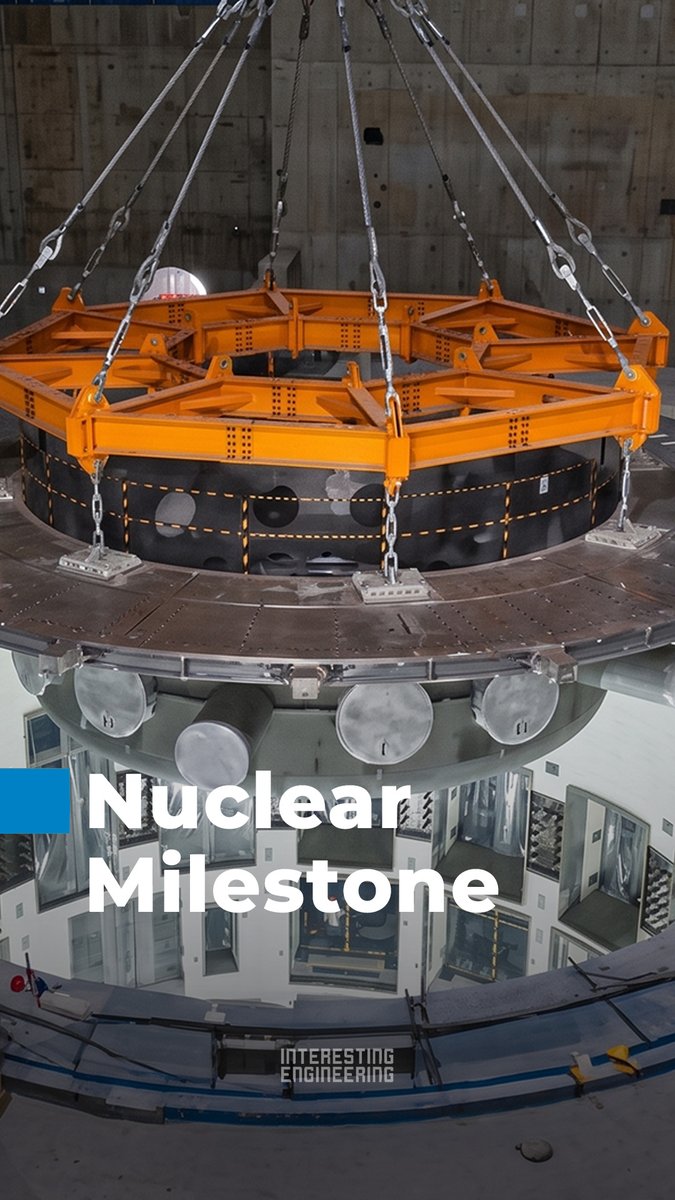
Here we go… This is the moment our ST40 centre column is lifted out. A bit like open-heart surgery on a tokamak. It’s a delicate operation, and a huge milestone for ST40. The centre column has had a tough life, acting as the core of the toroidal magnetic field coil in the world’s highest-field spherical tokamak. After more than 5,000 plasma pulses, it has helped generate magnetic fields above 2 Tesla at the plasma core, confining plasma at temperatures of more than 100 million °C, the threshold for #fusion. Next up, we install the new and improved centre column built by our partners at The Rockwood Group. This is all part of ST40’s major upgrade programme with U.S. Department of Energy and Department for Energy Security and Net Zero, helping transform it into one of the most reactor-relevant fusion devices in the world. What began as an experimental tokamak is becoming something much bigger: a customer testbed for the technologies and expertise needed to put #fusionenergy onto the grid⚡ And for anyone wondering what the centre column actually does… 👇 It forms the inner limb of each turn of the toroidal field coil. Its 24 wedges each carry up to 200 kA of current, generating the powerful magnetic fields needed to confine the plasma. Wrapped around the wedges, a 192-turn central solenoid helps drive and sustain the plasma current, after merging-compression start-up. An impressive piece of equipment with an equally impressive track record! #Fusion #FusionEnergy #Innovation

Tokamak Energy

28,664 次观看 • 3 个月前

🚨 I Was Given 100+ Russian UFO Reverse-Engineering Physics Documents... I Have Translated Them... My Mind Is Blown! This is my full technical breakdown of 119 Soviet-era UFO physics documents spanning advanced propulsion, aneutronic fusion, magnetohydrodynamics, plasma physics, superconductivity, electromagnetic field manipulation, neutrino–magnetic interactions, gravitational-charge dualism, cosmology, time dilation, planetary magnetism and the proposed engineering architecture of a flying saucer. Before his death on December 30, 2019, Soviet-Latvian aerospace engineer Valerijs Černohajev transmitted 119 handwritten pages containing twelve technical works to his daughter in the United States. Those pages describe a complete propulsion architecture — a 30-meter disc with 678,000 aluminum solenoids embedded in a silicon-alloy hull, powered by aneutronic fusion, generating thrust via magnetohydrodynamic interaction with a cosmic electromagnetic medium. The archive was then sent to me by the son-in-law, former military and private contractor, Gene Sticco, I have now examined the complete tranche of technical pages and frankly what these documents contain is extraordinary. Is gravity fundamentally connected to charge, magnetism and the organised motion of matter, and, if it is, can that relationship be engineered? The flying saucer described in these documents becomes the ultimate technological test case. That is the central story contained within these documents. OPEN COMMENT SECTION FOR MORE

Jay Anderson

73,834 次观看 • 29 天前

Nearly two years ago, I reported on how I'd helped my Mum get off 8 painkillers a day because of her arthritis using a device called the "Primer Cube Magnetic Array". A PrimerCube is an open-source device designed to generate strong rotating magnetic fields based on the research of David LaPoint AND RELEASED IN 2019. These devices often use a bowl-shaped array of neodymium magnets mounted on a motor to create specific magnetic field geometries. Magnetic Plasma Control: According to La Point, these bowls create magnetic fields that control plasma, showing that formations in the plasma exist regardless of electrical input, with electricity only acting to reveal them. A friend of mine, Rachel Russell, took it upon herself to manufacture these magnetic wonders and in this video entitled "Say Goodby to Pain Forever?" I meet a bunch of amazing people from around the world to share their stories of how this device has not only eliminated pain, but also been used to: - save and extend a dogs life and cut vet bills - enhance seeds for growing food and yield - massive increases in Bovis Levels (Life Force Energy) - hugely improved SLEEP patterns and quality - improved dreams - improved thyroid function - reduced inflammation - improved skin appearance - parasite reduction - lengthened telemeres - reduced UTIs - improvements in sciatica - improvements in breast-feeding NONE OF THIS IS MEDICAL ADVICE, NOR ARE ANY OF THESE STORIES MEDICAL CLAIMS, MERELY ANECDOTES. DO YOUR OWN RESEARCH AND MAKE UP YOUR OWN MIND. TO LEARN MORE, link in comments below.

Mark Attwood

292,713 次观看 • 5 个月前

Helion energy is building what will be the world’s first commercial fusion power plant, scheduled to be finished in 3 years. Great interview by Lex Fridman with David Kirtley (CEO of Helion). Most power plants are heat engines. You burn fuel or run fission, boil water, spin a turbine, and get about 35% electricity while the rest leaves as waste heat. Helion flips the flow. The fusion reaction makes charged particles that push back on a magnetic field tied to a capacitor bank, so you get direct electricity instead of a steam loop. That path can reach about 85% efficiency from fusion energy to electrical output, which means less conversion gear and tighter control over power delivery. 🧪 How the machine works A giant capacitor bank drives coils that both accelerate and squeeze plasma. Two plasmas, deuterium plus helium‑3, are launched from opposite sides and collide in the center. By rapidly reversing the magnetic field in about 1 microsecond, the plasma self-organizes into a field‑reversed configuration that traps itself. Then the machine compresses it hard. Fusion happens, new charged particles appear, and their pressure pushes the magnetic field so the system dumps energy back into the capacitors. It is pulsed, up to 100Hz in tests, so each shot is a clean measure of input versus recovered electricity. 🛡️ Safety and waste There is no chain reaction. The device only holds about 1 second of fuel at any time, so stopping the drive stops fusion. X‑rays and some neutrons exist during operation, so you use shielding and standard controls, similar to particle‑accelerator facilities. When the pulse stops, the radiation source stops. 🖥️ Why data centers care The output is high‑voltage DC sitting on capacitors. You can invert to AC for the grid, or route DC with fewer conversions into rectifier buses for racks. That cuts losses and simplifies backup. The company is targeting 2028 for a first grid-tied plant for a large buyer, which lines up with growing AI power needs. 🧩 What is still hard Helium‑3 is scarce on Earth, so you must produce it or source it. This fuel also likes higher temperatures, roughly 200M-300M degrees, so the pulsed magnets and power electronics must be very fast and very tough. Stability is managed by giving the plasma enough “spin” and length so it behaves like a fast top that stays upright, plus thousands of synchronized switches that fire with microsecond timing. If this architecture keeps showing pulse gain and high‑efficiency recovery, you get a compact generator that skips steam, feeds a capacitor, and delivers clean power in the exact format modern compute wants.

Rohan Paul

63,912 次观看 • 10 个月前

Magnetohydrodynamic (MHD) Propulsion - What Is It?" by AsteronX #ufotwitter This video, titled "Magnetohydrodynamic (MHD) Propulsion - What Is It?" by AsteronX, explains the physics, operating principles, and potential applications of magnetohydrodynamic field propulsion for aerospace and spaceflight. 1. What is MHD Propulsion? [00:15] Magnetohydrodynamics (MHD) is the study of electrically conductive fluids—such as ionized gases, plasmas, or saltwater—interacting with magnetic fields [01:04]. MHD propulsion uses electromagnetic forces to accelerate conductive fluids directly, producing thrust without moving mechanical parts like propellers, turbines, or airfoils [02:29]. 2. Physical Mechanism: The Lorentz Force [02:47] Working Principle: When an electric current passes through a conductive fluid perpendicular to an applied magnetic field, it generates a perpendicular Lorentz Force [02:47]. Pressure & Acceleration: This magnetic force directly accelerates or decelerates the fluid particles, driving fluid flow and creating thrust or pressure gradients [08:30]. 3. Atmospheric Flight Mechanics [10:03] Air Ionization: Since neutral atmospheric air is non-conductive, the aircraft must ionize incoming air into a conductive sheath, often using high-frequency (radio/microwave) pulse discharges [10:19]. Aerodynamic Integration: The accelerated ionized air can be directed over specialized airfoils—such as saucer-shaped Coandă effect structures—to generate lift dynamically across the body [11:27]. 4. Space Application Concepts [12:20] Plasma Rocket Engines: Utilizing magnetic fields and Lorentz forces to accelerate cold or superheated plasma out of a nozzle without physical grid erosion [12:31]. Quantum Vacuum Thrusters (Theoretical): The video discusses futuristic concepts using ultra-short, intense electromagnetic pulses to interact directly with quantum vacuum virtual electron-positron fluctuations [13:35]. The core concept in the presenter's design is hull-integrated disc vehicle geometry, rather than an internal thruster, linear duct, or traditional rocket nozzle. In the video, AsteronX emphasizes that for magnetohydrodynamics (MHD) to be practical in atmospheric flight, the vehicle's physical shape and propulsion system must be unified into a single structure. Key Architectural Features of the Disc/Saucer Design 360° Coandă Effect Airfoil: Instead of pushing air through an internal engine tube, the saucer geometry acts as a continuous "wing wrapped around the vehicle". Plasma or ionized air accelerated across the curved upper skin adheres to the surface via the Coandă effect, generating low pressure and continuous lift across the entire hull. Surface Boundary Layer Sheath: High-frequency pulse discharge electrodes embedded along the outer skin ionize ambient air into a conductive plasma sheath surrounding the disc. The Lorentz force directly manipulates this sheath, eliminating aerodynamic drag, shockwaves, and thermal heating during flight. Field Drive vs. Mechanical Thruster: Rather than using discrete thruster pods or jet exhausts, magnetic and electric field arrays distributed across the disc's surface manipulate the fluid directly in 360 degrees, allowing omnidirectional maneuvering without moving parts or control surfaces. (This geometry directly builds on historical field-acceleration concepts, such as Jean-Pierre Petit’s MHD aerodyne and saucer research cited in the video description).

Alex

53,900 次观看 • 4 天前

🇮🇷|The unidentified glowing object spotted in the night sky over Tehran’s Azadegan Expressway on the evening of September 20 was neither the first nor the last of its kind. While U.S. officials have consistently denied the existence of the TR-3B for three decades, the appearance of a triangular craft over Iranian airspace reveals a distinct pattern: the U.S. is utilizing its most classified aircraft to conduct missions in Iranian airspace that it publicly denies undertaking. 🛸 TR-3B "Black Manta": America's Deepest Secret The TR-3B "Black Manta" is an anti-gravity tactical reconnaissance aircraft allegedly developed in secret by the U.S. under the "Aurora" program, utilizing funding from the SDI (Strategic Defense Initiative) and "black budget" resources. Its technical specifications are enough to upend current understandings of aviation: ◾Magnetic Field Disrupter: At its core lies a plasma acceleration ring encircling the crew compartment; this generates a magnetic vortex field capable of neutralizing 89% of Earth's gravity, allowing this massive craft to move as lightly as a feather. ◾Nuclear Power and Plasma Propulsion: It employs nuclear energy to heat high-pressure plasma, generating an anti-gravity field that enables silent hovering and instantaneous acceleration, with virtually none of the noise associated with conventional aircraft. ◾Full-Spectrum Stealth: Its outer skin, composed of electrochemically active material, can alter its reflectivity, radar absorption, and color in response to RF radar stimuli; it can even deceive radar systems, appearing on screens as a small aircraft, a cylinder, or nothing at all. ◾Massive Dimensions: The operational model boasts a wingspan of 600 feet (approximately 183 meters) equivalent to two football fields placed side-by-side making it a true aerial behemoth. 🎯 The "Phantom" Over Tehran: The Pattern Is the Evidence The sighting on September 20 occurred above the Azadegan Expressway. Witnesses described the object hovering near the cloud layer, emitting a distinctive glow and remaining stationary in the air without making a sound. Open-source intelligence analysts noted that its shape resembled a "flying wing" configuration, a design utilized by several U.S. aircraft. Its appearance there was no coincidence. Just days ago, Saudi Arabia requested intelligence support from Israel via U.S. Central Command (CENTCOM) to counter strikes by Yemeni armed forces. Meanwhile, U.S. reconnaissance activities within Iranian airspace are escalating sharply. The TR-3B’s magnetic field disruptor technology is believed to have been reverse-engineered by Sandia and Lawrence Livermore National Laboratories from recovered extraterrestrial technology. It conducted its first operational flight in the early 1990s; by 1994, at least three units were in service. Each cost over $1 billion to build and was jointly funded and directed by the National Reconnaissance Office (NRO), the National Security Agency (NSA), and the Central Intelligence Agency (CIA). Official denial, operational acknowledgment The Pentagon has never acknowledged the existence of the TR-3B. Yet, the triangular craft spotted over Tehran, the urgent security alerts issued by the U.S. Embassy in Saudi Arabia, and the emergency talks held by the CENTCOM commander in Riyadh form a cohesive chain of events that cannot be dismissed as mere coincidence.

Aprajita Nafs Nefes 🦋 Ancient Believer

1,040,292 次观看 • 12 天前

💎Scientists and engineers from the UK Atomic Energy Authority (UK Atomic Energy Authority) and the University of Bristol (University of Bristol) have successfully created the world’s first carbon-14 diamond battery. This new type of battery has the potential to power devices for thousands of years, making it an incredibly long-lasting energy source. The battery leverages the radioactive isotope, carbon-14, known for its use in radiocarbon dating, to produce a diamond battery. Several game-changing applications are possible. Bio-compatible diamond batteries can be used in medical devices like ocular implants, hearing aids, and pacemakers, minimising the need for replacements and distress to patients. Diamond batteries could also be used in extreme environments – both in space and on earth – where it is not practical to replace conventional batteries. The batteries could power active radio frequency (RF) tags where there is a need to identify and track devices either on earth or in space, such as spacecraft or payloads, for decades at a time, thus reducing costs and extending operational lifespan. “Diamond batteries offer a safe, sustainable way to provide continuous microwatt levels of power. They are an emerging technology that use a manufactured diamond to safely encase small amounts of carbon-14,” said Sarah Clark, Director of Tritium Fuel Cycle at UKAEA. The carbon-14 diamond battery works by using the radioactive decay of carbon-14, which has a half-life of 5,700 years, to generate low levels of power. It functions similarly to solar panels, which convert light into electricity, but instead of using light particles (photons), they capture fast-moving electrons from within the diamond structure. Professor Thomas Scott, Professor in Materials at the University of Bristol, said: “Our micropower technology can support a whole range of important applications from space technologies and security devices through to medical implants. We're excited to be able to explore all of these possibilities, working with partners in industry and research, over the next few years.” A team of scientists and engineers from both organisations worked together to build a plasma deposition rig, a specialised apparatus used for growing the diamond at UKAEA’s Culham Campus. This development is the result, in part, of UKAEA’s work on fusion energy. The expertise gained in fusion research is helping to accelerate innovation in related technologies.

UK Atomic Energy Authority

12,493 次观看 • 1 年前

Lenz Law "Eddy Current" Experiments 2 of 3 - Ring Magnets and a Spinning Copper Rod (YouTube deleted this experiment as well, labeling it as "medical misinformation.") Around 2010, I wrote a Facebook note titled "Frictionless Flywheel". (Facebook deleted my page of 15 years). In that write-up, I speculated and predicted that... ... if a magnet falls in slow motion down a copper tube... then what would happen if you did the inverse? Drop a magnet ring around a copper rod? It's the same relative motion between the magnet and the copper. So the magnet would tilt at an angle while slightly rotating as it falls in slow motion around the copper. But then I said... "Let's take it one step further... I predict that if you have magnet rings around a copper rod... and then you spin the rod... that the magnet rings would stabilize around the rod from eddy currents." I said, there will be a magnetic bearing effect where the magnet ring will levitate and spin. Because it's following in the wake of the eddy currents produced by the rotating copper. So the magnet should catch up to speed of the copper and match it like the moon to the Earth. Essentially remaining fixed relative to the copper rod... but since the copper is spinning at a high RPM, then the magnet should spin at a high RPM; albeit, with a slight lag. So, abiding by the scientific method, I make an observation of the magnet falling in slow motion. I thought critically about. I get a new idea. Once the new idea passes muster, I allow my self to make a prediction for a scenario that hasn't been tried yet. Worked it out in my mind to see if it was viable. But then I needed to test it. I didn't have the ability to spin a copper rod at a high enough RPM that I theorized would be needed. So I communicated with my friend Josh Toms We had been talking about different experiments for quite a while. Josh is a real experimenter and a good man. He tests things before he speaks on them and when he speaks, it's with an informed opinion. He sent me a copper sphere about 2 inches in diameter and taught me some cool stuff about eddy currents I hadn't seen when sending each other clips of experiments we were working on. I explained the concept of the "frictionless flywheel" and my prediction that the magnets would levitate and stabilize around the copper rod if it was fast enough. So Josh built a platform using an angle grinder as a motor to spin a copper rod. He put very strong NdFeB magnets around the 1 inch diameter copper rod. IT WORKED! Josh brought this platform to the Tesla Technology Conference in Albuquerque, NM in 2010 where we met up. I filmed the demonstration of the platform you see in this video. There was a young boy who was fascinated by some of the magnet demonstrations I and others were giving at the conference. So I was explaining the process of what was happening to the inquisitive kid. Again.. what you notice here is that the eddy currents act as a force field to prevent friction between the magnets and copper. There is a stable gap and "magnetic cushion" that forms after a certain RPM. (Dependent upon the mass/gauss of the magnet in relation to the diamagnetic quality/mass of the copper or material in motion.) And what is super interesting to me is that once again... you can violently shake the entire platform and it WILL NOT disturb the magnets. The will not touch that copper after a certain RPM. You could make violent 90˚ turns and from the perspective of the magnets... it's just moving in slow motion relative to the copper. Just like how the magnet falls in slow motion relative to the copper down the tube. But this is just at a higher velocity relative to a stationary observer viewing the rotating system. But it doesn't matter if it's a centripetally rotating system at a constant velocity or linear acceleration in a particular direction... those eddy currents act as a force field to protect whatever is relative to the magnets and/or copper in those moments. So the claim and prediction that a frictionless flywheel effect and magnetic bearing would take place between a ring magnet and spinning copper rod DEMONSTRATED to be true. Now "PROVING" this scenario means to derive mathematical equations to justify an explanation of how the end results arise. Spinning magnets on a copper rod doesn't prove anything. In science... proof is math. Experiments can never prove anything. Experiments never provide equations or numbers or variables. Experiments provide evidence. You collect the evidence FIRST... AFTER doing real-world, hands-on experimentation. Anything else is just armchair research and talk. You write the proofs on paper to describe how you think things happen. And your proofs must abide by the constraints of the model you use. Sure... you can use a mathematical artifice like Lorentz invariance (relativity) to prove the end results arise because of: dark matter accumulating between the magnet and copper. Or that it must be space-time curvature bending... Or that it must be because of the aether rippling and vortexing... Or because of the dynamic casimir effect or zero point energy. Or anti-gravity. NOPE! None of those things are needed in the explanations I offer for any experiments and real-world data collected. I use the framework of what I call GALILEAN VARIANCE. Good ol' classical physics in 3D Euclidean space. No 4th dimension. No space-time. No aether. No nonsense. Only Newtonian Mechanics and elementary math.... but with a twist! ... and under.. "a new light". I have a completely different interpretation as to what gravity is and the mechanism of how it arises. Issac Newton never claimed to have a theory for the CAUSE of gravity. Newton's brilliant work and optics describes the behavior of matter and energy within a gravitational field. But he never claimed to know what causes gravity. "I have not as yet been able to discover the reason for these properties of gravity from phenomena, and I do not form any hypotheses." - Newton However... I do claim to have an explanation for the cause and mechanism of gravity. And it means a total abandonment of relativity and half of QED. Gravity IS a force! (and an emission) Eddy currents are not gravity. Magnetism is not gravity. And the kicker... gravity is not electric either. It's an illusion. Gravity is not an illusion. But the illusion is that people think gravity is electric. It's not. I have a completely different take. And boy has it gotten me in a lot of trouble and banned from speaking time and time again. But... if the information is valid... then trying to suppress it is like trying to hold an inflated basketball under water. Your arms are gonna get tired eventually and things are gonna come up to the surface with spring-loaded force. Equal to the amount people tried holding it back. The Rebirth of Classical Physics: Time, Light & Gravity

TheRealVerbz (Jason Verbelli)

45,879 次观看 • 1 年前

For years, NordSpace has been building towards one goal: launching Canadian payloads on Canadian rockets from Canadian soil in a way that’s technologically scalable and commercially sustainable through painstaking vertical integration. Today, that vision is rapidly taking shape and we are pleased to share this inspiring video preview of what Canada’s historic first sovereign orbital space launch will look like. Enjoy! Tundra is NordSpace’s domestically designed, built, and operated light-lift responsive orbital rocket. It can carry up to 1,100 kg fully optimized to Low Earth Orbit (LEO) powered by our proprietary Hadfield rocket engines that are 3D-printed, regeneratively cooled, and pump fed representing the most powerful orbital-class propulsion system in Canada. The modular architecture means the same engine powers both the multi-engine first stage and the vacuum-optimized second stage, reducing complexity while creating a direct scaling path toward our future reusable Titan medium-lift vehicle, capable of 5,000+ kg to LEO. The Atlantic Spaceport Complex (ASX), under construction in Newfoundland and Labrador, is positioned at 46 degrees latitude providing launch access to polar, sun-synchronous, and mid-inclination orbits with the widest range of nominal launch inclinations of any Canadian spaceport. It’s the only fully Canadian-owned and purpose-built commercial orbital launch facility in the country with the highest approved launch cadence and safety distances allowing us to maximize the efficiency, reliability, scalability, and unit economics of our entire launch program. What distinguishes NordSpace is our commitment to vertical integration and first principles approach to business and technology. Rockets, spaceport, and spacecraft are all designed, manufactured, and operated in Canada by one streamlined team. We have already demonstrated flight-ready propulsion, completed integrated rocket tests, and have our first pathfinder satellite, Terra Nova, manifested for launch in 2026 with our edge-AI imaging payload (Chronos) for space domain awareness nd our electric propulsion system (Zephyr-EP). With recently announced $8.3 million in Phase 1 federal funding through the Department of National Defence’s Launch the North initiative, NordSpace is targeting Initial Operational Capability by 2028. Canada is about to become a true spacefaring nation, and our future on Earth and in space will never be the same. Let’s give’r! 🇨🇦🚀 National Defence Defence Research and Development Canada Canadian Space Agency

NordSpace 🇨🇦

15,258 次观看 • 6 个月前

DARPA's NEW TECH that TERRIFIED CONGRESS. Understand DARPA's Nonsurgical Wireless Brain Computer Remote Interface Neurotechnology that uses light and sounds as weapons that can induce behavior, emotions, read and implant thoughts, pictures, etc. Now, combining this tech with A.I., we have reached unbelievable new levels of science that have opened pandora's box, and some of the things in pandora's box are extremely concerning for the future of humanity. For the past COUPLE of DECADES, DARPA, the DoD, military contractors, and leading universities have been constructing and implementing wireless, invisible weapons against the people right in front of you, and nobody even noticed. The weaponization of this tech is so dangerous that even the U.N. is sounding the alarm because of it's untraceable and unethical capabilities. This is an introduction and overview. Pay Attention. I show you things for a reason. Secretary of Energy Hazel Reid O'Leary, who served under the Clinton administration stated that over 500,000 thousand Americans have been used in human experiments, including mind control and other experiments over a period of four decades without their informed consent. This is only what they admit to, then programs get put under higher classification, or under the guise of "national security," or go black so even members of Congress might not even get access to such programs. Mk Ultra as well, back in the 1960's used over 4,000 military service men without their consent for human experiments such as mind control. No one to this day has been held accountable for these experiments on our military and American citizens. Since the mid 1980's, radio frequency energy has been mastered by professionals in the field and graduates of Yale University and others and have been working directly with the military on mind control operations. The equipment being used needs no implant device, mechanical, or electronic device attached to the human being to be able to induce specific behaviors, moods, even V2K which is "voice-to-skull" technology and the CIA, NSA, DARPA, and our military are extremely interested in this technology Following MK Ultra, attention shifted toward electromagnetic technologies, including extremely low frequency (ELF) and radio frequency (RF) waves, which can influence emotions and project voices into the human mind. The "Frey Effect," discovered in the 1960s, demonstrated that pulsed microwaves could produce audible effects or voices in a subject's head, also known as "voice-to-skull" (V2K). Declassified documents show the U.S. military and intelligence agencies explored and used this tech during the Gulf War in the 1990s. DARPA—established in 1958 to advance cutting-edge military technology—began funding projects that bridged neuroscience and electronics, laying the groundwork for brain-computer interfaces (BCIs). DARPA’s role expanded significantly in the 21st century with programs like the Next-Generation Nonsurgical Neurotechnology (N3) initiative, launched in 2018. N3 aims to develop non-invasive BCIs that allow soldiers to control drones or robots with their thoughts, using techniques like ultrasound, magnetic fields, and nanoparticles to interface with the brain. This builds on earlier DARPA efforts, such as the Revolutionizing Prosthetics program, which enabled thought-controlled artificial limbs. Concurrently, the Obama administration’s BRAIN Initiative, announced in 2013, sought to map the brain’s neural circuits and accelerate neurotechnology development. While framed as a scientific endeavor to treat neurological disorders, its overlap with DARPA funding—$225 million by 2015—imply heavy military applications, including behavior modification and thought decoding. The integration of ELF/RF frequencies with 5G and AI represents the latest frontier. 5G’s high-frequency millimeter waves and dense network of transmitters could, in theory, enhance the precision and range of electromagnetic signals targeting the brain. Paired with AI, which can analyze vast datasets of neural activity in real time, this technology enables remote behavior control and thought reading. DARPA’s N3 program, for instance, envisions two-way communication between brains and machines, potentially allowing external systems to interpret intentions or implant sensory feedback—like voices or emotions. Speculative claims suggest that military and intelligence agencies are weaponizing these tools to suppress fear in soldiers, influence adversaries’ decisions, or surveil thoughts. Today, these technologies raise profound ethical and practical questions. The line between enhancement and control blurs when AI-driven systems could override human autonomy. Reports of "targeted individuals" experiencing voice projection or emotional manipulation fuel speculation and aren't looking unrealistic after all. Arguments that the secrecy surrounding DARPA and CIA projects—echoing Mk Ultra’s hidden abuses—obscures the true extent of weaponization, while proponents frame advancements vital, for national security. The progression from Mk Ultra’s drug experiments and other crude techniques to master mind control have surpassed ELF/RF explorations, and now to DARPA’s AI-enhanced BCIs under the BRAIN Initiative reflects a trajectory toward increasingly sophisticated mind control capabilities. The addition of 5G’s infrastructure and other radar installations around the world amplifies the potential for remote influence, suggesting a future where thoughts, emotions, and behaviors could be manipulated, monitored, and induced. The WEF makes their goals for this tech more than clear on their own website. Privacy will no longer exist. While the military and intelligence agencies undeniably pursue these technologies for strategic advantage, the full scope of their operational use and the line between science fiction and reality is diminishing by the day now that these technologies are fully operational and in use today and have now entered the advertising industry and big tech. I'm sure you can figure out where this is all going, and honestly, it's not good.

The SCIF

163,123 次观看 • 1 年前

Monthly WINR Protocol Development Update: To begin with, the WINR Protocol has distributed $900,000 to token holders, generated more than $500,000 in pure profit for liquidity providers on WLP, acquired more than 5,000 users, and has almost 9% of the supply burned. In the upcoming months, the WINR Protocol, which has been in production for years, will introduce a range of new products and deployments. These developments will represent the practical and technical evolution to V2 of the protocol. Here are the latest updates and further details as they progress: Progress on WINR Bonanza, Casino Hold'em, and Blackjack is nearing completion. These games are in the final stages of testing. Additional games, including a new type of crash game, have been finalized and are set to debut with the JustBet v2 launch. Take a look at the gameplay videos for a preview. These games achieve the long-term goal of providing a full-suite WINR Game Engine SDK, which can be used to build games with complex logic on-chain with modular smart contract infrastructure. For example, any grid slot game that dominates the iGaming industry could easily be developed on-chain using the WINR Bonanza SDK. - Permissionless Frontend Operator SDK Dashboard Release: March is poised to be a milestone month with the launch of the Frontend Operator SDK dashboards. These dashboards will enable any WINR Labs game to be seamlessly deployed on frontends, marking a significant advancement in protocol accessibility and integration for future games developed by independent iGaming developers. The frontend operator can deploy any game they choose through a few simple steps while utilizing 10,000 WINR per game via the WINR Game Factory smart contract. Each operator is assigned a unique smart contract address(es) for every game they deploy, allowing their revenue to be tracked independently. The deployment process includes instructions on integrating the game as a package into the operator's frontend. In subsequent phases, the games will transition through WINR Chain, streamlining user onboarding steps like wallet connection and token bridging to Arbitrum. This abstraction will make it easy for any web2/web3 platform on any chain to seamlessly integrate WINR-based games with just a few clicks. The new budget system changes how the revenue is calculated on the protocol and will see daylight with frontend operator, Solana, and Fantom deployments. This model was first tested with a lightweight version on and gave a lot of actionable feedback. Shifting from the existing bribe model, which in practice distributes almost half of the edge of the games in volume to WINR holders, the brand-new budget system checks the profitability of WLP. It distributes a larger part of the profit to game providers, frontend operators, and, most importantly, WINR holders. Any time a game's budget is in profit, a part of every loss is distributed to stakeholders. Here is an example: 1. The WINR Bonanza Game has a 10,000 budget for a frontend operator. 2. Let's assume the bet amount was $50, and Bonanza paid back $10 on that spin. That leaves $40 of pure profit. 3. This is distributed amongst 50% to WLP, 20% to frontend operators, 20% to WINR holders, and 10% to game providers. 4. To achieve this, V2 of WINR Liquidity Engine (WLP) will have a buffer for purchasing and selling, working in epochs to determine the above distribution and math. - Solana Deployment and Expansions: Solana audits are in their final phase, and frontend tests are ongoing. Solana launch will be alongside the V2 launch of @JustBetOfficial, with a chain switch available on the top bar. The VRF system WINR developed already is seeing requests from builders around the Solana ecosystem, and this will over time add an extra layer of income to the protocol. Solana's bankroll, at first, will be a lighter version of WLP but will inherit the above-mentioned budgeting system to generate income immediately upon launch. - Fantom Deployment and Expansions: Fantom's upcoming Sonic upgrade, with its 200ms finality and fast block production is a perfect chain for WINR Protocol to expand. Through the partnership with WINR Protocol will tap into a brand new user base on Fantom. The bankroll on Fantom will consist of FTM and stables. The launch is planned for late March or early April. This expansion aims to open up new markets and collaborations with fresh teams. which operates independently, will integrate a broad spectrum of WINR technologies, including WINR Account Abstraction, WINR VRF, and WINR games, marking a pivotal step in WINR Protocol’s journey of horizontal expansion. - XAI VRF Deployment Progress Update: The WINR Account Abstraction Wallet and WINR Verifiable Random Function (VRF) deployment on the XAI 🎮⛓️ is well underway, with the majority of the work completed. This step forward showcases WINR's expansion beyond gambling and trading, highlighting the protocol's adaptability and commitment to broadening decentralized services. The process to automize and permissionlessly let game developers start using WINR VRF by paying (and burning) fees in WINR will launch alongside WINR VRF deployment on XAI and expand to further chains to help DApp builders with the tooling they need. This process will work very similarly to frontend operators, where DApp builders will be able to easily deploy their VRF contract, pay the WINR fees, and enjoy the fastest random number generation transaction, as showcased on @JustBetOfficial for some time. - JustBet v2 Development Update: Set to launch in March, the last testing phase with long-time community members of JustBet V2 is underway. Boasting a completely refreshed look, JustBet v2 aims to captivate more users with its modern features, a significant upgrade from the classic JustBet designed in 2019. Expect dynamic animations and a user experience that rivals traditional web2 casinos, setting a new standard for online gambling platforms and serving once again as proof of concept for all the new WINR features and infrastructure set to launch over the coming months. As always, WINR Labs simultaneously develops protocol infrastructure and platform to best address the needs of one and only goal: horizontal expansion. Easter eggs: Upcoming Gitbook update with all the technical information of WINR V2. CEX listing. Detailed product pages on WINR web. Pyth competitions. WIP-4 and WIP-5 are ready to deploy. And an 🪂

WINR

37,944 次观看 • 2 年前

$ASTS: 🚨🇳🇿 2DEGREES AND AST SPACEMOBILE TEST VOICE CALLS, VIDEO CALLS AND MOBILE BROADBAND DATA SESSIONS OVER STANDARD 4G AND 5G HANDSETS IN NEW ZEALAND DURING THE MONTH OF AUGUST "HI MARK - IT'S MARK!" 😁 2degrees has opened a satellite ground station in Marton and completed voice-call and broadband data tests on standard smartphones through AST SpaceMobile's network. The facility is among the first commercial AST SpaceMobile ground stations worldwide and is intended to support the rollout of direct-to-device satellite mobile services in New Zealand. Paul Goldsmith, Minister for Media and Communications and Minister for Space, opened the site as 2degrees marked a new stage in its satellite connectivity programme. The Marton station will connect with 2degrees' core network and support voice, data and messaging services for users outside existing mobile coverage. Engineers from 2degrees and AST SpaceMobile have been testing the system during August. The trials included voice calls, video calls and mobile data sessions using standard 4G and 5G handsets rather than dedicated satellite phones or extra hardware. 2degrees said it has invested millions in the local ground station. It also said calls, data and messages on the service are designed to originate and terminate on the 2degrees core network without passing through another country or jurisdiction. Mark Callander, Chief Executive, 2degrees, described the project as a response to persistent coverage gaps in New Zealand. "AST SpaceMobile approaches satellite connectivity in a unique way. The service is designed to offer voice calling, data and SMS, extending connectivity into places that have traditionally been difficult to serve. 2degrees has invested millions in building a ground station locally, providing access to advanced technology that will enable connectivity for Kiwis outside traditional coverage areas," said Mark Callander, Chief Executive, 2degrees. 2degrees has not given a launch date for customers. Further testing will continue before it confirms timings for trials and a commercial launch. Callander also linked the timing to the pace of AST SpaceMobile's satellite deployment. "AST SpaceMobile has a robust launch roadmap, and with each additional satellite deployed, service availability increases. We will offer the service commercially when service availability reaches a level we consider viable," said Callander. Global push AST SpaceMobile is building a direct-to-device satellite network through partnerships with mobile operators rather than standalone satellite handsets. It has agreements with more than 50 mobile network operators globally, including Verizon, AT&T and Rakuten, covering a combined subscriber base of nearly three billion. That operator-led model has become a key part of the emerging race to provide mobile coverage from space. Telecom groups are exploring satellite links as a way to extend service in remote and rural areas, where conventional mobile towers are harder to justify on cost grounds or face geographic constraints. New Zealand's terrain and dispersed population have made that challenge particularly acute in some parts of the country. For 2degrees, the Marton ground station provides domestic infrastructure as it seeks to add satellite links to its existing mobile network. Chris Ivory, Chief Commercial Officer, AST SpaceMobile, framed the New Zealand deployment as an early commercial step in the company's international expansion. "New Zealand's early adoption of AST SpaceMobile's technology and deployment of commercial ground infrastructure position the country at the forefront of space-based cellular broadband. Working alongside 2degrees, we are bringing a new satellite connectivity capability and advancing the integration of our networks to deliver voice, broadband data and SMS directly to everyday smartphones, without specialised devices," said Chris Ivory, Chief Commercial Officer, AST SpaceMobile. Article:

Anp🅰️nman

60,719 次观看 • 1 个月前