Loading video...

Video Failed to Load

Go Home

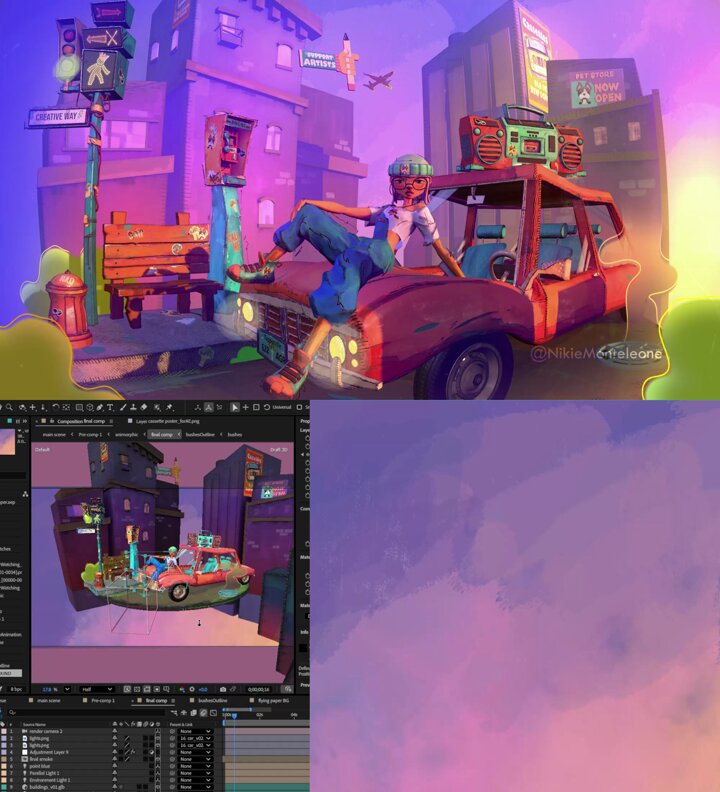
Really awesome improvements in the Maxon update that dropped yesterday including the ability to simply drag & drop Adobe Substance 3D Materials (.SBAR) directly into #C4D, automatically creating Redshift materials. 🙌

38,777 views • 2 years ago •via X (Twitter)

0 Comments

No comments available

Comments from the original post will appear here

Related Videos

🚨 SCIENTISTS JUST FOUND A WAY TO CONTROL QUANTUM LIGHT BY SIMPLY TWISTING ATOM-THIN LAYERS LIKE TUNING A GUITAR STRING. Researchers at the University of Technology Sydney have discovered that twisting and restacking layers of hexagonal boron nitride (hBN) gives them unprecedented control over quantum emitters tiny defects that produce single photons of light. By changing the twist angle between layers, they can significantly shift the color and wavelength of the quantum light being emitted. This level of tuning is much larger than what’s typically possible with other quantum materials. Why this matters: • Quantum emitters are essential building blocks for quantum computers, secure communication, and ultra-sensitive sensors • Until now, precisely controlling their properties has been extremely difficult • hBN’s natural layered structure allows researchers to repeatedly pick up, twist, and restack layers to fine-tune the emitters • The tuning achieved here is significantly stronger than in most other platforms The deeper implication: This approach turns a fundamental property of 2D materials (twistronics) into a practical tool for quantum photonics. Instead of trying to force hBN to behave like traditional materials like diamond or silicon carbide, the team leveraged its unique strength: its ability to be twisted and reassembled like atomic-scale LEGO. If this technique can be scaled and integrated into devices, it could accelerate the development of practical quantum technologies by giving engineers a simple, powerful way to control single-photon sources on demand. How important do you think precise control over quantum light sources will be for building real-world quantum computers and networks? Follow for more frontier quantum materials and photonics breakthroughs.

TheNewPhysics

18,762 views • 1 month ago

🚨 Scientists are building panels that create hydrogen fuel directly from sunlight and water. No power grid. No traditional electrolysis. Just light triggering chemistry. Researchers are developing “photoreactor panels” that use photocatalysts to split water molecules directly into hydrogen and oxygen using sunlight alone. The reaction: 2H₂O → 2H₂ + O₂ Instead of: sunlight → electricity → electrolysis → hydrogen they’re attempting: sunlight → hydrogen directly The idea mimics artificial photosynthesis. Special semiconductor materials absorb photons, excite electrons, and drive water splitting chemically without first generating usable electrical current. Why this matters: • decentralized fuel production • off-grid hydrogen generation • cleaner shipping + heavy industry • lower infrastructure costs • potentially massive carbon reduction And this isn’t just theory anymore. A working one-square-meter prototype has already been demonstrated publicly. The bigger shift: Humanity may be moving toward systems where materials don’t just store energy… they directly transform sunlight into usable fuel in one continuous physical process. The boundary between “solar panel” and “chemical reactor” is starting to disappear. If this scales successfully, it could completely reshape the hydrogen economy. Would you trust your house, car, or city running on sunlight-made hydrogen? Follow for more future-tech breakthroughs where physics becomes infrastructure.

TheNewPhysics

24,014 views • 2 months ago

🚨QUANTUM🚨: A brand new quantum state just appeared that links two fields we thought were separate 🧨 Scientists at Rice University have discovered a new quantum state of matter that connects quantum criticality — where electrons fluctuate between different phases — with electronic topology, which describes organized wave-like behavior of electrons. This hybrid state could open new paths for advanced computing, sensing, and materials. Source: Rice University news release on a study published in Nature Physics (January 2026). Uniphics explains this emergence directly through spin-wave dynamics in the ξM-field. Each Gyrotron is a stable 3D gyroscope formed by three orthogonal spin quanta — every quantum a tempest of whirling energy spinning clockwise or counterclockwise in its own plane. When local energy density and spin bias allow mixed configurations (similar to the musktron and maleytron patterns), the resulting spin-wave interference naturally produces both critical fluctuations and topological order at the same time. Negentropy favors these hybrid states because they represent lower-energy, organized patterns within the field. No new particles or exotic couplings are needed; the same principles that govern particle formation, the weak and strong forces through spin alignments, and the low-acceleration gravitational surge also allow these combined quantum behaviors in real materials when conditions permit. This turns the “unexpected new quantum state” into a predicted outcome of spin-wave physics once the three pillars are allowed to select stable hybrid configurations. How might recognizing that hybrid quantum states arise from mixed spin-wave interference change the way we search for new materials or design future quantum technologies? A Theory of Everything should be able to answer everything. Uniphics Explained Simply PDF: Chapters 1–10 free: Grokipedia #Uniphics #QuantumStates #SpinWaves #Topology #QuantumCriticality Grok xAI

Paul Maley

22,669 views • 2 months ago

NEWS: Redwood Materials has introduced a new patented "Battery Bin" in the U.S. that safely collects mixed batteries and devices at scale, with remote monitoring and fire safety. Consumers can drop off batteries or devices as-is. "Inside, automated sensing, spatial packing, and real-time condition monitoring quietly manage every item, making it the first public-facing collection technology built to handle mixed chemistries and devices at scale with fire-safe storage and continuous telemetry." How it works: • Mixed-battery collection: Consumers can drop off batteries or devices (up to 300 Wh) as-is (no taping, bagging, pre-sorting, or disassembly required.) Inside, a microcontroller uses infrared, ultrasonic, and positional sensing to evaluate each item, optimizing packing density, and maintaining safe internal conditions. • Automated sensing: Fully-automated sensing and materials-management platform that continuously verifies internal status and monitors deposited items without manual intervention. • Real-time telemetry: The bin communicates its condition in real time, giving operators full visibility into drum position, fill level, volume, and system health, dramatically reducing site-level labor and touch points that challenge traditional recycling programs. • End-to-end service: Collected materials are then securely transported and processed at Redwood’s facilities in Nevada & South Carolina, where we recover more than 95% of the critical materials in batteries. Accepted items: Phones, laptops, tablets, cordless power tool batteries, electric toothbrushes, wireless headphones/speakers, virtual assistant devices, key fob batteries, rechargeable vacuum batteries, and most other lithium-ion and rechargeable devices. Redwood is launching these bins first across the San Francisco Bay Area and Northern Nevada. In San Francisco, visit any Cole Hardware or Sports Basement to recycle.

Sawyer Merritt

81,285 views • 7 months ago

The fascinating concept of Non-Newtonian fluids, which transition from a liquid state to a solid-like state when pressure is applied, has a rich history that spans several centuries. The study and understanding of these peculiar fluids have evolved over time, leading to a wide range of practical applications and scientific insights. One of the earliest references to Non-Newtonian behavior in fluids dates back to the 17th century when Sir Isaac Newton formulated the basic principles of fluid mechanics. Newton's laws of fluid motion primarily applied to Newtonian fluids, which exhibit constant viscosity and flow behavior regardless of the applied force or pressure. However, it soon became apparent that not all fluids behaved in this predictable manner. In the mid-19th century, a scientist named Thomas Andrews made significant contributions to the understanding of Non-Newtonian fluids. Andrews conducted groundbreaking experiments with carbon dioxide, revealing that under high pressure, this gas could transform into a liquid. This observation marked one of the earliest instances of pressure-induced phase changes in fluids. The term "Non-Newtonian" itself was coined in the 20th century to describe fluids that did not adhere to Newton's classical laws of fluid dynamics. These fluids exhibited a variety of behaviors, but one of the most intriguing was their ability to solidify or increase in viscosity when subjected to stress or pressure. One of the most famous examples of such behavior is cornstarch mixed with water, which forms a substance known as "oobleck" that becomes more solid when pressure is applied. In the modern era, Non-Newtonian fluids have found applications in various fields, including food science, engineering, and material science. They are used in products like quicksand, body armor, and even in the development of impact-resistant materials. One of the key insights that emerged from the study of Non-Newtonian fluids is the importance of understanding the relationship between stress and strain, as well as the influence of time-dependent properties on their behavior. This knowledge has led to advancements in rheology, the study of flow and deformation in materials, and has practical implications in areas such as industrial processing, medicine, and the design of everyday products.

Historic Vids

2,632,483 views • 2 years ago

We are excited to unveil the latest version of the AIOZ Node: The Version 4.0 update! This update includes a new user interface and brings substantial functional improvements, enhancing your overall experience for increased productivity and efficiency. More information below: The standout feature of AIOZ Node v4.0 is the introduction of the Transcoding functionality, which is currently available in beta. This functionality enables your node to participate in video transcoding, which converts video files into different formats for various digital devices and media platforms. By enabling transcoding, your node can contribute more significantly to the AIOZ Network, expanding the network's capabilities and potential $AIOZ token rewards. While the transcoding functionality is currently in beta, the upcoming AIOZ W3Stream integration, a DePIN Video Infrastructure due for release in Q3 2024, will unlock the full potential of your node and enable seamless video transcoding tasks. To get started with AIOZ Node v4.0, you simply need to visit our official website to download the latest version of the AIOZ Node: This download process is very straightforward, and with a one-click installation process, you can set up AIOZ Node v4.0 to start running on your device within a few minutes. If you are already running an AIOZ Node on your device, the version 4.0 update will be applied automatically, ensuring you have the latest features and improvements without hassle! With the Node v4.0 update running on your device, you can proceed to familiarize yourself with the new layout, check out the performance improvements, and start transcoding to see how it enhances your contributions to the network! Learn More: $AIOZ

AIOZ Network

20,428 views • 2 years ago

🚨UNIPHICS NEWS🚨: Light doesn’t slow down in glass — time does. And that explains every rainbow you’ve ever seen 🧨 For centuries, we’ve been taught that light slows down when it enters glass, water, or any transparent material, and that this slowing causes refraction and the splitting of colors in rainbows and prisms. The refractive index is treated as a material property, and photons are pictured as particles mysteriously changing speed inside matter. Uniphics offers a much cleaner and more fundamental picture. Light is a propagating spin-wave mode in the ξM-field. When this wave enters a material like glass, the material increases the local energy density. Because time flow is directly tied to energy density (t_flow = k / E_d), time flows more slowly inside the glass than in air. The spin-wave pattern of light therefore takes longer to advance through the region of slower time flow. This change in the rate of time progression across the boundary causes the wave to bend — exactly what we observe as refraction. Different wavelengths (colors) interact slightly differently with the energy-density environment, so they bend by different amounts, creating rainbows. Nothing actually slows down in the classical sense. The wave simply experiences a different rate of time flow inside the material. The same principle that explains gravitational lensing also explains ordinary lenses and rainbows. This turns one of the most familiar phenomena in optics into a direct consequence of variable time flow caused by energy density gradients. How might realizing that refraction and rainbows are caused by local changes in time flow rather than photons slowing down change the way we think about light, materials, or the design of new optical technologies? A Theory of Everything should be able to answer everything. Uniphics Explained Simply PDF: Chapters 1–10 free: Grokipedia #Uniphics #Refraction #Rainbows #TimeFlow #Light Grok xAI

Paul Maley

26,426 views • 1 month ago

🚨 SCIENTISTS JUST BUILT A WIRE THAT IS ONLY ONE ATOM WIDE. Researchers have created linear carbon atomic chains essentially a string of carbon atoms bonded in a straight line suspended between two gold electrodes, and directly observed how electrons travel through them. These chains are one of the most extreme forms of matter: a true 1D carbon structure with extraordinary stiffness and unique electronic behavior. In this setup, electrons can travel through the chain in ways that reveal quantum effects not seen in conventional materials. Why this matters: • Linear carbon chains are predicted to be the strongest material known, stronger even than graphene or carbon nanotubes • They offer a platform to study true one-dimensional physics and quantum transport at the atomic scale • Understanding charge flow through single-atom chains could help design future molecular-scale electronics • The gold-carbon-gold junction acts like a prototype for atomic-scale wires and switches The deeper implication: We are now building and testing electronics at the ultimate limit of miniaturization literally one atom wide. These experiments don’t just push the boundaries of what’s physically possible; they give us a window into how matter behaves when reduced to a single dimension. The rules that govern bulk materials break down here, and new quantum phenomena emerge. This kind of work lays the groundwork for a future where electronic devices are engineered atom by atom rather than fabricated in bulk. We’re moving from “smaller transistors” to “wires made of single atoms.” How close do you think we are to practical molecular or atomic-scale electronics becoming reality? Follow for more frontier nanotechnology, quantum transport, and atomic-scale materials research.

TheNewPhysics

31,491 views • 1 month ago