Загрузка видео...

Не удалось загрузить видео

На главную

Rendering updates now live across the Rive Editor and Runtimes: 🌈 Interleaved gradient noise dithering added to reduce banding 🪶 Vector Feathering GPU optimizations 🧪 Large feather radius test scene benchmarks: ⏱️ 2.15ms to 0.92ms on Intel ⏱️ 0.125ms to 0.095ms on Nvidia

11,113 просмотров • 5 месяцев назад •via X (Twitter)

Комментарии: 0

Нет доступных комментариев

Здесь появятся комментарии из оригинального поста

Похожие видео

Jensen Huang just doubled NVIDIA's demand forecast to $1 Trillion through 2027 🤯 Then spent two hours explaining why that number is conservative… Here's everything today from GTC: - NemoClaw: NVIDIA's open-source enterprise AI agent stack built around OpenClaw. Jensen called OpenClaw "the operating system for personal AI" and said every company needs a strategy for it. - Space-1: NVIDIA is putting Vera Rubin data centers in orbit. Not a concept. An actual system being designed for space deployment right now. - DLSS 5: 3D-guided neural rendering that blends raw graphics with generative AI. Jensen called it the future of real-time rendering. - AWS: Deploying 1 million+ NVIDIA GPUs starting this year. Azure was the first hyperscaler to power up Vera Rubin. - Vera Rubin: NVIDIA's next-gen AI supercomputer. 10x more performance per watt than Blackwell, 700 million tokens per second, shipping later this year. - Groq 3 LPU: First chip from NVIDIA's $20B Groq acquisition. A purpose-built inference accelerator that ships Q3. NVIDIA now owns training AND inference. -Feynman: The architecture after Rubin, coming 2028. New GPU, new LPU, new CPU. NVIDIA is on a 12-month chip cadence and the treadmill never stops. - Autonomous driving: BYD, Hyundai, Nissan, and Geely building Level 4 vehicles on NVIDIA. Uber deploying NVIDIA-powered robotaxis across 28 cities by 2028. The man doubled his demand forecast to a trillion dollars, announced data centers in space, and closed the show with a robot singing country music. This is NVIDIA's world. Everyone else is just renting compute in it.

Josh Kale

45,875 просмотров • 4 месяцев назад

QVAC SDK 0.12.0 is now live, bringing longer context, increased memory optimisation, new modalities, and broader ecosystem support directly to your device. Key Features and Updates: - TurboQuant KV-Cache Quantization: Fit much longer context in the same memory. TurboQuant, an algorithm from Google Research, compresses the KV cache by up to 5x, near-lossless. - Text-to-Video: Generate video from a text prompt, fully local, with the new wan2.1 model in the Diffusion addon - Apple Metal Performance for Flux2-klein: Diffusion on Apple Silicon now matches MLX performance, the native benchmark for Apple GPUs - Robot Control (new VLA addon): A GGML-based Vision-Language-Action addon brings fast, efficient robot control to edge devices - Coding Assistant / Harness Support: QVAC now works with OpenCode and OpenClaw as a local provider. A new @qvac/ai-sdk-provider package automates model registry and provider integration - Cross-Platform Voice: Text-to-speech and Parakeet transcription moved from ONNX to the GGML engine for better CPU and GPU support on macOS, iOS, Windows, Linux, and Android. Parakeet also adds long-term streaming diarization (tracking who spoke when on live audio) - Faster Lightweight Visual Classification: A new GGML-based Classification addon delivers millisecond-level classification, useful where a vision-language model (VLM) would be unnecessarily slow - Under the Hood: Fabric synced to llama.cpp v8828 (from v8189), plus GPU acceleration added to image-upscale models for faster results Full release notes:

QVAC

9,932,369 просмотров • 2 месяцев назад

Let’s talk about Zipline’s test sites and who we’re hiring for 🧵 They are where elite talent meets 24/7 large scale high volume testing. They’re the engine that helped scale Zipline to the largest autonomous delivery service on earth, 5,000+ autonomous trips around the world and we’re just getting started. Zipline's testing in 2025: 315,000+ test flights 🚀 35,000+ flight hours (480+ straight days of nonstop flying) 🙂‍ 3,000+ flights per day 📈 Our test sites are built to push our system to the max so that we de-risk tomorrow. Each one tackles a different brutal edgecase to make sure the system’s reliability is bulletproof. Our 'engineering test site' in the video I posted is reconfigured every few weeks: new obstacles are added, new flight apps reviewed, new edge cases are tested in any weather condition. Every new software build deploys here first, into live airspace. Our other sites are placed around the U.S. and are focused on testing in severe conditions that ground most if not all other forms of transport. They operate in scorching heat of up to 125 degrees, high-altitudes, intense rainstorms, 60+ mph winds, hail, sleet, and extreme cold-weather, down to -20F. Heavy ice and snow accumulation on propulsion and sensors is the norm. We aggressively chase these conditions in test so we dominate when it really matters. We are now developing 5+ new test sites, each one dialed in to push even more extreme weather and edge conditions. What I am especially proud of is that our safety has kept improving even as flight volume, complexity and environmental hostility increases. We’ve been able to test and develop at a scale that’s unprecedented in aviation history because our teams own a 100% fully vertical tech stack, built hand in hand with our flight and application software teams. We have to have the most robust airspace and fleet management tools on earth because Zipline will soon operate the largest fleet of aircraft on earth. Now to the fun part, we're hiring! DM me or send me an email to marcusZipline.com if you want to join Zipline Test Operations! We're hiring Flight Test Operators, Test Site Operators, Flight Test Electricians, Flight Test Construction Staff, Flight Test Project and Program Managers, Flight Test Engineers, Flight Test Safety Managers, Flight Test Security and, most importantly, Flight and Fleet Application Software Engineers. Please, cut to the chase. We have zero requirements on degrees, formal education or tenure. What counts is what you can do, merit, and what you’ve shown you’re capable of. Highlight that. Let's go!

Marcus Mueller

311,452 просмотров • 5 месяцев назад

#Jasmy and #Janction are entering a new phase of expansion. The team aims to make its platform even more accessible, particularly by simplifying the development environment for application creators. A key focus is the introduction of an English interface, clearer documentation, and enhanced technical support. At the same time, #Jasmy is intensifying its international efforts, with particular attention to Southeast Asia. The year 2025 promises stronger communications and several major announcements ahead. Janction, on its part, has undergone a major transformation. It is no longer just a side project but now a true decentralized physical infrastructure built on a simple idea: everyone should be able to own and benefit from their own assets, including their data and computing power. Today, artificial intelligence, image generation, video rendering, and large-scale data processing all heavily rely on a single resource: the GPU. Originally designed for gaming, GPUs have become essential for any task that requires massive parallel processing. Unlike CPUs, GPUs can execute thousands of operations simultaneously, making them ideal for machine learning and AI models. However, this exponential demand has led to a global shortage. GPU prices are skyrocketing, lead times stretch up to a year, and the market is dominated by a few major players. In Japan and across Asia, the situation is especially strained. This is where Janction steps in with a disruptive approach. The idea is to allow any user to share an unused GPU, whether it’s in a gaming PC, a company server, a university lab, or even a cybercafé. In return, the owner gets paid. And to make this process smooth, simple, and secure, Janction relies on Docker technology. To visualize this, imagine a box containing everything needed to run an application, the code, libraries, and required files. Thanks to Docker, this box can be sent and run on any computer without conflicts or manual setup. This allows Janction to distribute AI or processing tasks across its network seamlessly. Each user receives a container, runs it via their GPU, and is paid automatically through smart contracts deployed on the network. The system is based on a fixed-rate subleasing model. Even if the GPU isn’t used 24/7, the owner still earns income. This is an ideal solution for schools, creative studios, researchers, or startups that have available resources but variable needs. Today, over 4,500 GPU nodes are already active in Japan, Hong Kong, and Singapore. The network offers fast block times and 99.9% reliability. The goal is ambitious: reach 100,000 nodes. To achieve this, Janction is targeting six main markets: AI startups, 3D and video studios, streaming platforms, research centers, game developers, and of course, owners of underutilized GPUs. At the same time, an Ethereum-based JANCTION token is in preparation. It will be used to reserve GPU power, participate in the ecosystem, and unlock additional rewards, including JASMY tokens. This dual-incentive system is designed to encourage the large-scale acquisition, sharing, and use of GPU power. The tokens will be tradable, storable, or reinvestable into hardware to further strengthen the network. #Janction’s strategy is clear, first, establish strong liquidity on recognized exchanges, then open access to a broad investor base, especially in #Japan, South Korea, and the United States.

NeoXtrix

44,354 просмотров • 1 год назад

Dylan Patel on the importance of memory and storage Two key quotes: "An $NVDA GPU is faster than an $AMD GPU in most cases, but because AMD GPUs have more memory, they can outperform Nvidia in certain workloads." “It is a difficult, multivariable problem. Generally, you need the best GPU, such as a GB300, but you also need the best storage solutions. I will not spoil who comes out on top, but storage solutions matter a lot, memory solutions matter a lot, and frontend networking also matters significantly" Full Quote: “We have over $80 million of compute: GPUs from $NVDA and $AMD, TPUs from Google, and Trainium from Amazon. We constantly run this benchmark using the newest inference engines, drivers, PyTorch versions, and other software. It runs every day through automated CI across the latest Chinese models from GLM, Zhipu, Moonshot, Kimi, Alibaba, and others. Initially, when we were benchmarking the differences between these chips, inference engines, and parallelism schemes, we used fixed context lengths. But with Agent X, we have now analyzed more than $5 million worth of Claude Code traces. This is real production traffic that users have donated to us, combined with internally generated data, so we now understand what an actual agent workload looks like. When we implement those workloads and run the benchmarks, it turns out that the chip you are using is very important, but how you handle memory offload can be even more important. An Nvidia GPU is faster than an AMD GPU in most cases, but because AMD GPUs have more memory, they can outperform Nvidia in certain workloads. Similarly, you can use a less powerful GPU with a much better storage solution and outperform the best GPU when it lacks those solutions. Simply buying the newest GPU does not necessarily give you the best inference economics. You need to layer in other innovations, including storage and memory.” Interviewer: “Who is the top player on your chart? Can you tell us?” Dylan Patel: “It is a difficult, multivariable problem. Generally, you need the best GPU, such as a GB300, but you also need the best storage solutions. I will not spoil who comes out on top, but storage solutions matter a lot, memory solutions matter a lot, and frontend networking also matters significantly.”

Daniel Romero

38,220 просмотров • 1 месяц назад

Introducing KausaCompute. Running AI models privately is expensive and complicated. Traditional cloud providers require credit cards, KYC verification, and complex setup processes. For many developers, especially in emerging markets, accessing GPU compute remains out of reach. KausaCompute changes that. Deploy any Docker container with NVIDIA GPU, pay with USDC from Maze Pocket, no KYC, no credit card, no cloud provider account needed. GPU pricing starts at $0.47/hr with competitive rates across all tiers. KausaCompute lives inside KausaLayer Pocket. Open a pocket, swap SOL to USDC using the built-in swap feature, and start deploying GPU containers right away. Everything stays within one ecosystem. What it actually does: Private LLM endpoints. Deploy Llama 3, Mistral, CodeLlama, or any open-source model as a personal API. No one logs the prompts. No one reads the data. Full control. AI coding assistants that never see external servers. Speech-to-text processing for thousands of audio files in minutes instead of hours. Sentiment analysis across millions of data points. Document summarization at scale. Multi-modal AI that processes images and text together. All running on dedicated NVIDIA GPUs. A6000, T4, L4, L40, A100, H100, and more. Pick the hardware, pick the duration, deploy in one click. The billing is straightforward. USDC is deducted from Maze Pocket before deployment. Pro tip: Maze Pocket supports multiple pockets per wallet. Create a dedicated pocket just for KausaCompute to keep GPU spending separate from other activities like trading or transfers. Clean separation, easy tracking. KausaCompute is not another cloud provider. It is the fastest path from USDC to a running GPU, with zero identity requirements. Live now at

KausaLayer

10,914 просмотров • 2 месяцев назад

A 91-year-old professor is why Nvidia is worth $4 trillion. His name is Gilbert Strang. He teaches linear algebra at MIT. Every AI model on Earth runs on his course. The course has been free on YouTube since 2005. The videos have earned him nothing. MIT 18.06 opens with "The Geometry of Linear Equations." No advanced math. Strang takes a system of two equations, draws it two ways, and shows the class that a matrix is a picture, not an abstraction. The row picture is two lines that cross. The column picture is two arrows that sum to a target. Every neural network on Earth operates on the column picture. Strang first taught linear algebra at MIT in 1962. He wrote the textbook in 1976. It is on every serious engineer's shelf. Every quant fund, every ML lab, every rendering engine at Pixar is running his math. His central insight is that most people are taught matrices as bookkeeping. That is the first thing to unlearn. A matrix is a linear transformation. A linear transformation is a way of moving space. Once you see the space move, the math stops being algebra and becomes geometry. The Kalman filter is a linear system. PCA is a linear system. Every gradient step in a neural net is a matrix-vector product. GPT is a stack of matrix-vector products, each one a scene from MIT 18.06 running on a Blackwell GPU. He retired in 2023 after 61 years at MIT. The course is still up. Watched tens of millions of times. The chip is $40,000. Strang never asked for a royalty.

Ochob

127,409 просмотров • 15 дней назад

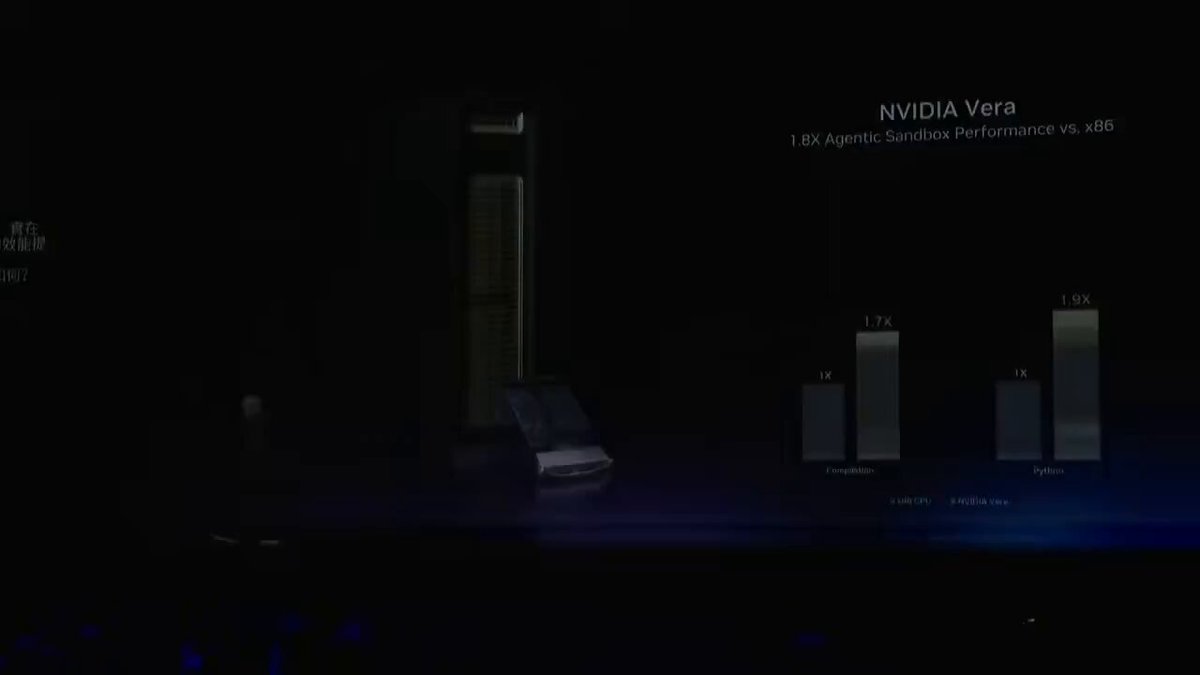
Jensen Huang just identified the next $200 billion market (Save this). The shift starts with a observation about agentic AI that changes everything about infrastructure. In the era of training and inference, the GPU was everything while CPU was a traffic cop, scheduling work, managing memory, dispatching tasks while the GPU did the heavy lifting. Agentic AI breaks that model entirely. An AI agent does not just run a single inference pass but rather it plans, calls tools, executes code in sandboxes, retrieves data from multiple sources and loops through complex multi-step reasoning sequences often thousands of times per second at scale. Every one of those operations runs through the CPU and the GPU sits idle waiting for the CPU to prepare the next task, supply the right context and execute the retrieval and tool calling logic fast enough to keep the accelerators fed. The CPU is now the conductor and the GPU is the orchestra and the bottleneck is the conductor falling behind. This is showing up in production AI factory utilization right now, which is exactly why Jensen built Vera from scratch rather than licensing x86. Vera achieves 40% lower peak memory latency than x86, 50% faster core to core communication, and 1.8 times the agentic sandbox performance of current x86 processors on a purpose-built architecture designed around the agentic loop. Now here is where the investment thesis gets interesting. The obvious beneficiary is Nvidia itself, and that thesis is real. Nvidia's CFO has guided for nearly $20 billion in Vera CPU revenue this fiscal year alone, a market Nvidia had zero presence in just three years ago. Intel held 60% of server CPU market share as recently as Q4 2025 and that transition is now happening at a pace Intel structurally cannot respond to. But the deeper question is, what architecture is Vera actually built on? Vera's Olympus cores are ARM compatible and every single Vera CPU deployed in every Vera Rubin rack in every data center in the world runs on ARM architecture. And ARM Holdings collects a royalty on every one of them. ARM does not make chips but rather licenses the instruction set architecture and CPU core designs that others build on top of. Every time Nvidia ships a Vera CPU, every time a hyperscaler deploys a Vera Rubin rack, every time an enterprise qualifies Vera for their AI factory, ARM earns a royalty. The secular tailwind here is almost perfectly constructed for ARM's business model. Amazon's Graviton, Microsoft's Cobalt, Google's Axion, Apple's silicon stack, and Qualcomm's data center push all run on ARM. And now Nvidia's Vera, which is projected to displace Intel as the largest server CPU supplier by revenue in a single fiscal year, is ARM. ARM's royalty rate on high end server chips is estimated at roughly 1 to 2% of chip selling price. At $5,000 per Vera CPU and 4 million units projected for FY2027, that is a royalty line growing from near zero to potentially $400 million to $800 million annually from Nvidia's data center CPU business alone before counting Amazon, Microsoft, Google, Apple, and Qualcomm. The total ARM addressable royalty base across all the silicon it already licenses is compounding at a rate that the current $130 billion market cap does not fully reflect. Jensen's CPU thesis is the most underappreciated catalyst in ARM's fundamental story, and the royalty compounding has barely started. Come join Milk Road Pro and get our full ARM royalty model and our entire AI trade thesis. Link below!

Milk Road AI

11,819 просмотров • 2 месяцев назад

We’re excited to announce the release and open-source of HunyuanImage 3.0 — the largest and most powerful open-source text-to-image model to date, with over 80 billion total parameters, of which 13 billion are activated per token during inference.The effect is completely comparable to the industry’s flagship closed-source model.🚀🚀🚀 HunyuanImage 3.0 originates from our internally developed native multimodal large language model, with fine-tuning and post-training focused on text-to-image generation. This unique foundation gives the model a powerful set of capabilities: ✅Reason with world knowledge ✅Understand complex, thousand-word prompts ✅Generate precise text within images Different from traditional DiT architecture image generation models, HunyuanImage 3.0’s MoE architecture uses a Transfusion-based approach to deeply couple Diffusion and LLM training for a single, powerful system. Built on Hunyuan-A13B, HunyuanImage 3.0 was trained on a massive dataset: 5 billion image-text pairs, video frames, interleaved image-text data, and 6 trillion tokens of text corpora. This hybrid training across multimodal generation, understanding, and LLM capabilities allows the model to seamlessly integrate multiple tasks. Whether you're an illustrator, designer, or creator, this is built to slash your workflow from hours to minutes. HunyuanImage 3.0 can generate intricate text, detailed comics, expressive emojis, and lively, engaging illustrations for educational content. The current release focuses solely on text-to-image generation and future updates will include image-to-image, image editing, multi-turn interaction, and more. 👉🏻Try it now: 🔗GitHub: 🤗Hugging Face:

Tencent Hy

412,880 просмотров • 10 месяцев назад

September 2009. Jensen Huang walks onto a small stage at the Fairmont hotel in San Jose. About 1,500 people are in the room. He runs a company that makes chips for video games. He spends the next 8 minutes doing math on a whiteboard, explaining why the future of computing won't come from making CPUs faster. He calls it "CEO math" and apologizes in advance to every computer science professor in the audience. Then he lays out an argument that almost nobody took seriously at the time: the way to make computers dramatically faster is to pair a regular CPU with hundreds of tiny parallel processors, the kind that already exist inside graphics cards. One CPU for the sequential stuff. Hundreds of GPU cores for everything else. He calls it "heterogeneous computing." He shows the math. A workload that can be split into many pieces at once gets up to 200x faster on this combined system. A workload that has to run one step at a time loses nothing. "The most important thing in creating a new architecture," he says, "is to make sure it does no harm." This was the first GPU Technology Conference. NVIDIA had launched a software platform called CUDA three years earlier, in 2006, to let developers write programs that run on graphics cards instead of just regular processors. Almost nobody cared. GPUs were for rendering Call of Duty, not for scientific computing. The academic world was polite but skeptical. The enterprise world ignored it entirely. By this point, Huang had been making this argument for years. NVIDIA was a $7 billion company. It competed with AMD and Intel for market share in the graphics market. That was the whole business. Jensen kept saying the GPU wasn't just a gaming chip; it was a computing platform. He kept saying parallel processing would reshape every industry from medicine to finance to physics simulations. People kept nodding, then doing nothing. Then deep learning happened. Around 2012, AI researchers discovered that training a neural network, which means teaching a computer to recognize patterns by running the same calculation millions of times across huge datasets, was exactly the kind of workload Jensen had been describing. GPUs can train AI models 10 to 50 times faster than CPUs. The architecture he outlined in this 2009 talk, with one CPU handling step-by-step tasks while hundreds of GPU cores crunch through massive amounts of parallel data, is now the literal blueprint for every AI data center on earth. ChatGPT runs on NVIDIA GPUs. Claude runs on NVIDIA GPUs. Gemini, Llama, Midjourney, nearly every major AI model you've heard of was trained on NVIDIA hardware using CUDA, the software platform Jensen built for a market that didn't exist yet. NVIDIA was worth about $7 billion when Jensen gave this talk. It is worth over $4.4 trillion today. That's a 600x increase. Jensen Huang, who founded the company at a Denny's in 1993 with two friends, now has a net worth of over $160 billion. He made Forbes' list of the 10 richest people for the first time this year. GTC 2026 is currently ongoing. 17,000 people are packing a hockey arena to watch the same guy explain what comes next. In 2009, 1,500 people showed up at a hotel ballroom, most of them for gaming graphics.

Anish Moonka

413,645 просмотров • 4 месяцев назад