Video yükleniyor...

Video Yüklenemedi

Ana Sayfaya Dön

Some people need to hear this again. I've said it countless times before in pretty much all my videos over the last year(s): If you're serious about software engineering (i.e., you want to get or keep a job or get serious work done) => You NEED to be open...

22,741 görüntüleme • 26 gün önce •via X (Twitter)

0 Yorum

Yorum bulunmuyor

Orijinal gönderinin yorumları burada görünecek

Benzer Videolar

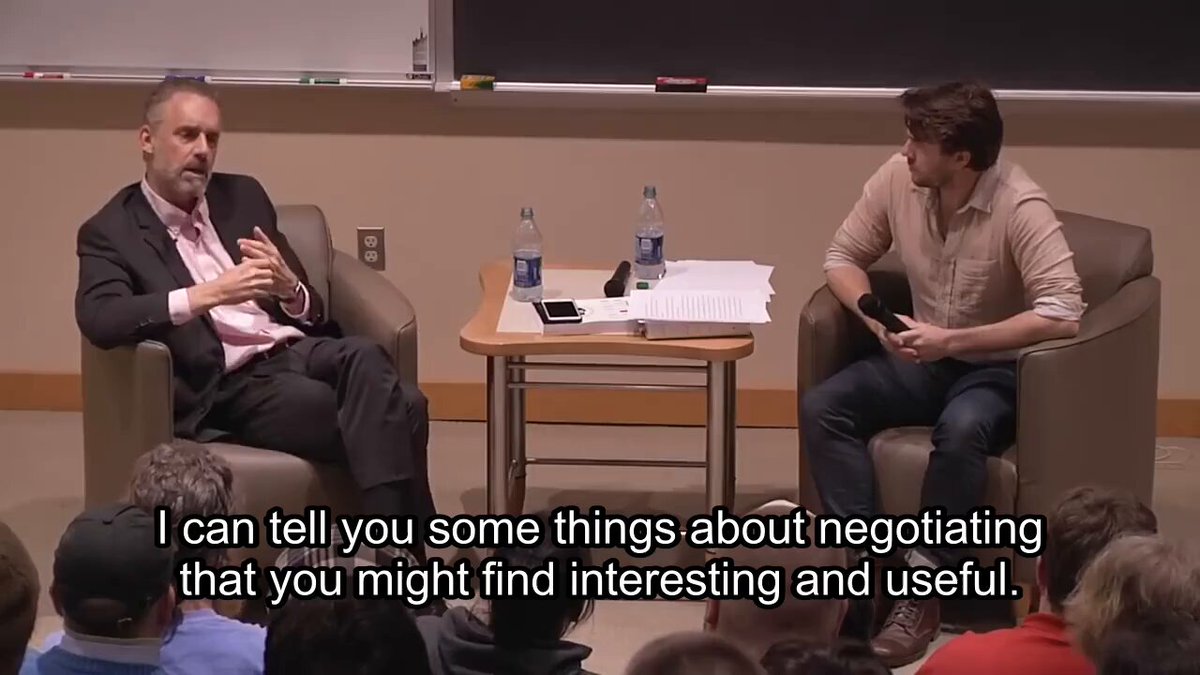
Jordan Peterson: "If you're competent and silent you will be ignored." "You might think well people should reward you because you're competent. And yes of course they should. But if you're competent and silent then you're just part of the background that's keeping everything functioning" On why you cannot negotiate from a position of weakness: "If you want to push your career forward you have to push it forward. You have to be competent and you have to be strategic" "To be strategic when you negotiate for a new position or a new salary you have to be able to say if you don't give me what I want then something you don't like will happen to you" "It's not a physical threat. It's that you have an option" "You have your CV in order. You're educated and competent and desirable to people outside of your immediate job. You're willing to instantly put yourself on the job market" "So that when you go talk to the person you're negotiating with you're credible" On the one thing most people completely miss about negotiation: "It's very seldom that you're talking to the person who's at the top of the pecking order. What you need to do is tell them a story that they can tell to their boss to make you not a problem" "A good story is look we really need this person because they're hyper competent and they have a better offer" "If you go in there with no power you're going to lose. Obviously" He concludes with the one thing every competent person needs to hear: "The first thing you need to know if you're going to negotiate is that you have to be able to say no. And what no means is that you're not going to do it"

Brad

34,669 görüntüleme • 8 gün önce

A young boy's rant about living in USA. Also a message for Indians who are obsessed to go to USA in search of alleged "Better life" There's no point in living in the U.S. anymore. Think about it, bruh, the obsession with productivity, the obsession with money, the obsession with status, the obsession with being better than the next person instead of better together. The obsession with competing with other people instead of just comparing who you truly were to who you were a year ago. Everything is monetized, everything is politicized, everything is divided. Even empathy feels conditional. And what really gets me is the way this country treats immigrants. Or better yet, the way it lies about why it treats immigrants the way it does. They act like people are breaking into some sacred paradise, like people are desperate to get into something holy. For what? For debt? For rent that eats half your paycheck? For healthcare that bankrupts you? For a system that does not protect you unless you're useful to it? Bro, people don't come here because America is amazing. They come here because America marketed itself better than it treated people. Remember, America is not a country, it's a business. And now the mask is slipping. What this country actually values is not freedom, it's control. Not life, labor. Not community, consumption. You're free as long as you don't disrupt anything. You're welcome as long as you're profitable. You're human as long as you're quiet. We only respect you if you're valuable and you're easy to conform and control. And if you don't fit the mold, if you question it, if you refuse to worship the system, you're told to be grateful, you're told to shut up, you're told it could be worse, you're told you're crazy. That's the bar. It could be worse. It could be worse? What? I don't hate America. I'm just disappointed in it, bro, because it could have been so much more. It should be so much more. But instead of evolving, it doubled down. Instead of healing, it hardened. Instead of listening, it punished. Instead of building community, instead of building unity, it sells isolation and calls it independence. And I'm at a point in my life where I don't want to just survive inside a system that drains me and calls it opportunity. I want peace, I want community, I want unity, I want love, I want connection, I want affordability. I want to live, bro, I want to live. I'm tired of living in survival mode, bro. I'm tired of having to constantly brace myself for the worst, bro. And look, if that makes me ungrateful, so be it. So f*cking be it. If that makes people uncomfortable, good, because pretending like this is the greatest country on earth while people are drowning is a load of f*cking bullshit. It is not patriotism, it is denial. And I am done lying to myself about that. And until this country actually values life over profit, safety over status, people over systems, connection over individuality, I don't see a reason to stay quiet and I don't see a reason to stay

Woke Eminent

17,194 görüntüleme • 6 ay önce

Former NBA star Gilbert Arenas says women should be ashamed if they aren't contributing financially or making their man’s life easier “The idea of this is what attracts you to get what I want, it's just prostitution in a sense. But at some point, I don't want you. You're not an equal. You're just a taker. You're not making my life easier. You're making it harder” “If you are a stay at home wife or girlfriend, then you need to understand what that means. When I come home, is the house clean and the suitcase packed? Are the clothes clean and folded? Do your part to make the entity's life easier. That is the point” “If you're not going to put into making money with me, helping me make money, working with me, or working for me. If I have an assistant, as a woman you should be ashamed of yourself. If your NBA husband, your CEO husband, whatever the fuck he is, has an assistant and that's not your fucking job, nah” “Women, if this what you say when someone says, ‘Hey, what do you bring?’ and you say, ‘I bring the table,’ get the fuck out. I have a table, all the fucking chairs, I have the food. Now what do you bring?” “There are eight billion people in the world. As a woman, I don't need you to say, ‘I can't afford that.’ If you can't afford it, find a dude who wants to pay all your bills. I'm looking for someone who wants to be equal because equal means I'm going to treat you equal” “If I'm paying all your bills, you really have no value to me and I'm going to keep fucking whoever I want to fuck. You have no rules over me. Now, if we’re 50-50 you are valued, which means I'm not going to jeopardize this for that”

dank

80,148 görüntüleme • 2 ay önce

Naval Ravikant: "The only true test of intelligence is if you get what you want out of life" "There are two parts to that. One is getting what you want, so you know how to get it. The second is wanting the right things, knowing what to want in the first place. I could want to be a 6'8" basketball player and I'm not going to get that. That's wanting something you can't get. But there's also wanting something that's a booby prize, prizes that are just not worth having, or that create their own problems." Naval explains how people end up in places they never meant to be: "If you're not careful, you can end up in a place in life not only that you don't want to be, but one you didn't even mean to get to. Usually people end up there because they're going on autopilot with societal expectations. Or out of guilt. Or out of mimetic desire, our desires are picked up from other people. Go to law school, go to med school, go to business school. Or it might be what your parents expect. Guilt is just society's voice speaking in your head so you'll be a good little monkey." He shares a problem most people have: "We run on these four-year cycles. You join a startup, you vest over four years. College is four years. High school is four years. You go to law school, that's a 5-year cycle. You become a lawyer, that's a 40-year cycle. These are very long cycles. But the amount of time we spend deciding what to do and who to do it with? Very short. We spend one month deciding on a job where we're going to be for 10 years." Naval's rule: "If you're making a four-year decision, spend a year thinking it through. Really thinking it through. 25% of the time." He explains the Secretary Theorem: "It turns out the optimal time to search is about a third. By a third of the way through, you've seen enough to know what the bar is. Then anybody who meets or exceeds that bar is good enough. But here's the key: it's not time-based. It's iteration-based. You need to take opportunities quickly and bail out quickly. If you look at failed relationships, the biggest regret is usually staying after you knew it was over." Naval reframes the 10,000 hour rule: "Malcolm Gladwell popularized 10,000 hours to mastery. I'd say it's actually 10,000 iterations to mastery. Iteration is not repetition. Repetition is doing the same thing over and over. Iteration is modifying it with learning and doing another version. That's error correction. If you get 10,000 error corrections in anything, you will be an expert." On pessimism vs. optimism: "You want to be skeptical about specific things, every specific opportunity is probably a fail. But you want to be optimistic in the general. Something in here is going to work out. If something fails, it was a learning experience. It was an iteration. As long as you learned something, it's a win. You don't want to jump into the first thing. But once you find the match, you have to be willing to go all in. Move your chips to the center of the table." He concludes: "Most people are stuck in this gray bit. 'I'm half in, but I don't really know.' That doesn't work. It's a barbell strategy, black or white. Explore quickly, cut losses fast. Then when you find the right thing, compound into it."

Jaynit

74,370 görüntüleme • 4 ay önce

Rick Rubin: "Make what you love, not what you think people will like" "If you want to live in a creative way, which will benefit everything in your life, be a better person in your family, do a better job starting a new business, it's all the same. I don't really know anything about music. It's more a way of looking at the world and wanting it to be the best it could possibly be. And doing whatever it takes to be the best it could possibly be." Rubin shares how his career happened: "From the beginning, I never thought any of the things I'm doing were possible or realistic. I just did things out of the love of them, thinking I would have real jobs. That my passion would be my hobby, and I'd have a job to support my hobby. And it just magically turned out different than that without me knowing it was possible." On why some things connect and others don't: "The stars line up at certain times for certain things to happen. Sometimes you can make something great, and it doesn't connect for whatever reason. Sometimes you make two things you think are the two best things you've ever made. One of them connects with the world. One of them doesn't. And it might not have anything to do with what's in the art. It might be that it came out the same day as something else. Or there was a bigger story at the time. There's so much to it that we don't understand." He continues: "All we can do is make something good and put it out and hope for the best. That's all there is. We never know why things work. Even if you make a piece of art and it works, you may not know why." On talent versus work ethic: "There are a lot of talented people who never make it because they don't have the work ethic. It's not just talent, talent's a piece. And you could argue for some people, the work ethic trumps the talent." Rubin explains what real collaboration is: "Having worked with a lot of bands, I see there's often this friction where people are trying to get their idea in. That's not a collaboration. A real collaboration is when everyone who's there is working together towards whatever is the best thing for the whole. Whether it's your idea or someone else's idea, it doesn't matter. If you're invested in the collaboration, you want the best idea to win. You don't want your idea to win." On what makes art great: "What makes it great is the personal. With all of its imperfections. With all of its quirkiness. That's what makes it great. How you see the world that's different from how everyone else sees the world. That's why you're an artist. That's your purpose in sharing your work with the world." He warns against being derivative: "There are these derivative voices where they're finding what they think other people want to hear, and they start saying it because they've heard other people say similar things that are now successful. Even if they have some short-term success doing that, it's not revolutionary. It doesn't change the world. It doesn't last. The people who you first see and you might not like that you come to like because you don't understand them at first, those are the ones that change the world. Those are the ones you dedicate your fandom to for life." Rubin shares his philosophy on taste: "You can't second-guess your own taste for what someone else is going to like. We're not smart enough to know what someone else is going to like. To make something thinking, 'Well, I don't really like it, but I think this group of people will like it,' it's a bad way to play the game of music or art. You have to do what's personal to you. Take it as far as you can go. Really push the boundaries. And people will resonate with it if they're supposed to resonate with it." He describes creativity as catching waves: "We're really talking about magic. The universe conspiring on our behalf if we let it. Being in this flow of catching these waves that anyone can catch. If you're trying to catch it, you're open to it, you see it coming, you take off on every chance you get. And sometimes the ride happens. It's remarkable how it happens. It doesn't come from preconception. It's not an idea. It's through the doing." Rubin explains how ideas exist in the universe: "Have you ever had that experience where you have an idea for something, you don't do it, and then six months later you see someone else has done it? It's not because they took your idea. It's that it's time for that, and you can act on it or not. The best artists are the ones who have the best antenna for this material that's available. It's coming through. The best comedians see the best jokes. They see them coming. We all live in the same world; the way you see it, you have the best joke because you see it best." He closes with how to stay open: "If we listen to what's going on around us, you can overhear a conversation in a coffee shop, and it is the setup for an idea you're working on. You hear a phrase you don't commonly use. My experience is: when you are open and looking for these clues in the world, they're happening all the time. And they're happening often right when you need them."

Jaynit

109,182 görüntüleme • 4 ay önce