Loading video...

Video Failed to Load

Go Home

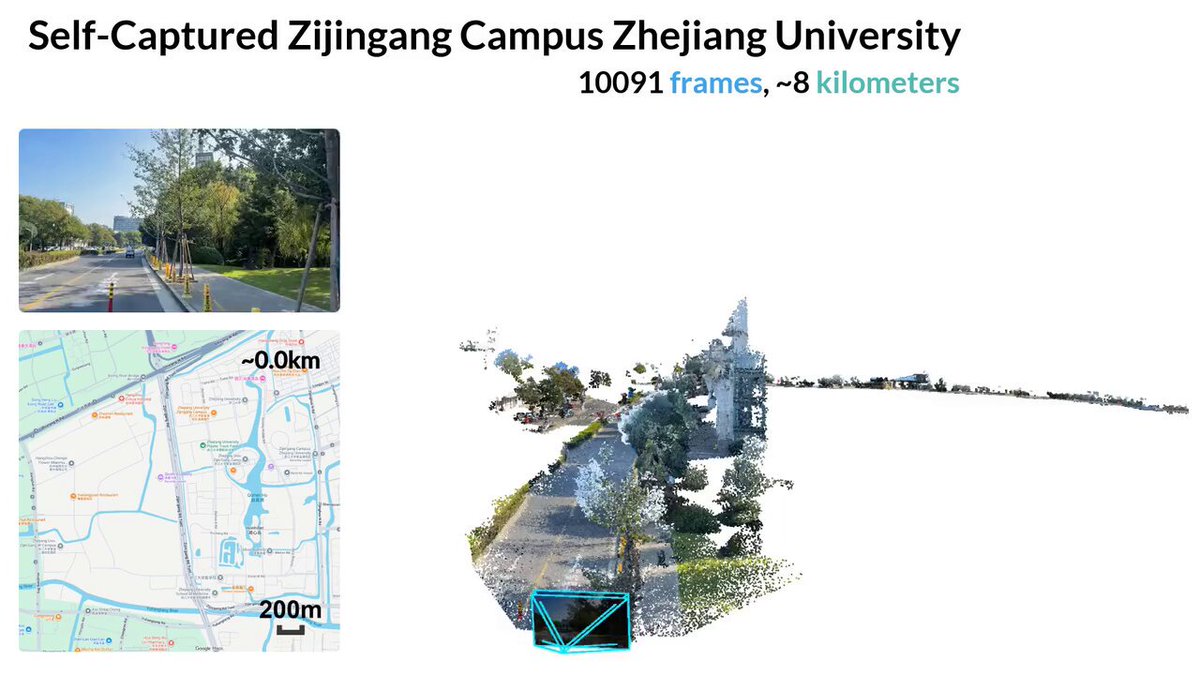
Spatial reconstruction is a long-context problem: real scenes come with hundreds of images. But O(N²) transformer-based models don’t scale efficiently. Introducing: 🤐ZipMap (CVPR ’26): Linear-Time, Stateful 3D Reconstruction via Test-Time Training (TTT). ZipMap “zips” a large image collection into an implicit TTT scene state in a single linear-time operation....

80,294 views • 8 months ago •via X (Twitter)

29 Comments

Haian Jin's profile picture
Haian Jin8 months ago

🧵2/N Key to the speedup: we replace all global attention with TTT layers. Concretely, we first “zip” visual tokens into fast-weight MLPs by updating the weights with all tokens, then applying the updated MLPs back to the tokens. This update-then-apply mechanism plays a role analogous to vanilla bidirectional self-attention, while reducing the computational cost from O(N²) to O(N).

Haian Jin's profile picture
Haian Jin8 months ago

🧵3/N Fast speed without sacrificing quality: With careful designs of TTT, our model shows strong results across multiple benchmarks for both short and long sequence input, while being significantly faster. Left: Our runtime scales linearly; Given 750 images: <10s (ours) vs >200s (VGGT). Right: Our accuracy matches or surpasses quadratic-time SOTA (e.g., VGGT, π³).

Haian Jin's profile picture
Haian Jin8 months ago

🧵4/N Stateful reconstruction: the updated TTT fast weight can be viewed as an implicit scene state. In our paper, we demonstrate the benefits of having a stateful representation in real-time scene state querying and its extension to sequential streaming reconstruction.

Haian Jin's profile picture
Haian Jin8 months ago

For more results and technical details, please visit our project page: This work was done while I was a student researcher at @GoogleDeepMind. I’m very grateful for the inspiring research environment and the invaluable support from my collaborators @ChrisWu6080, @tianyuanzhang99, @RuiqiGao, @jon_barron, @Jimantha, and @holynski_.

ZotGuard's profile picture
ZotGuard8 months ago

VERY COOL!

Mayank Bhaskar's profile picture
Mayank Bhaskar8 months ago

Congratulations on the @CVPR 2026 acceptance! Would you or any of your co-authors like to present your papers in the @Cohere_Labs Computer Vision community? Cohere Labs Community Page: Here's the playlist to previous talks, if you are interested:

dailypapers.io's profile picture
dailypapers.io8 months ago

this is great work

Aryan Pandit ✈️ ECCV '26 🇸🇪's profile picture
Aryan Pandit ✈️ ECCV '26 🇸🇪8 months ago

Great work, seems really interesting!

Ang Cao's profile picture
Ang Cao8 months ago

Very cool work

Haian Jin's profile picture
Haian Jin8 months ago

Thank you, Ang!

ζ Pedram ζ's profile picture
ζ Pedram ζ8 months ago

Woah

Alexandre Devaux's profile picture
Alexandre Devaux8 months ago

Brilliant work! Looking forward to trying the code 🔥

🎶's profile picture
🎶8 months ago

Cool

Yutang Lin's profile picture
Yutang Lin8 months ago

Great work, congrats!

Haian Jin's profile picture
Haian Jin8 months ago

Thank you, Yutang!

Wally's profile picture
Wally8 months ago

Very cool! Been exploring AI-generated impostor pipelines for real-time character rendering and the main pain point is view interpolation artifacts. This looks it could sidestep that entirely, looking forward to play around with the model!

实践哥 Li's profile picture
实践哥 Li8 months ago

I love the zip idea

Brad Dangerfield's profile picture
Brad Dangerfield8 months ago

Sweet!

Utkarsh Mishra's profile picture
Utkarsh Mishra8 months ago

This is one of the most amazing things I've ever seen!

Sam Abdi's profile picture
Sam Abdi8 months ago

Seems really interesting and promising. Good work.

Haian Jin's profile picture
Haian Jin8 months ago

Thank you, Sam!

Daniel Sungho Jung's profile picture
Daniel Sungho Jung8 months ago

May i ask if there is any reason why robot and human motion were in main qualitative results? Any advantage of ZipMap in such scenarios?

Haian Jin's profile picture
Haian Jin8 months ago

Hi! We put them to just show how our methods work for dynamic scenes. We don’t mean to specifically emphasize it.

Daniel Sungho Jung's profile picture
Daniel Sungho Jung7 months ago

Thanks for the reply! I was curious as I am doing the tasks. Looking forward to visiting your poster at CVPR2026 :)

Nigel Higgs's profile picture
Nigel Higgs8 months ago

Hit me with an update when I can use the code

Haian Jin's profile picture
Haian Jin8 months ago

They will be released soon!

Nigel Higgs's profile picture
Nigel Higgs8 months ago

Awesome 👏🏽 just curious how well do you think this would work on video game footage?

Artem Sawistki's profile picture
Artem Sawistki8 months ago

That's dope! Can't wait to see the code

MistFaccoco's profile picture
MistFaccoco7 months ago

nice work!

Related Videos

One-2-3-45: Any Single Image to 3D Mesh in 45 Seconds without Per-Shape Optimization paper page: Single image 3D reconstruction is an important but challenging task that requires extensive knowledge of our natural world. Many existing methods solve this problem by optimizing a neural radiance field under the guidance of 2D diffusion models but suffer from lengthy optimization time, 3D inconsistency results, and poor geometry. In this work, we propose a novel method that takes a single image of any object as input and generates a full 360-degree 3D textured mesh in a single feed-forward pass. Given a single image, we first use a view-conditioned 2D diffusion model, Zero123, to generate multi-view images for the input view, and then aim to lift them up to 3D space. Since traditional reconstruction methods struggle with inconsistent multi-view predictions, we build our 3D reconstruction module upon an SDF-based generalizable neural surface reconstruction method and propose several critical training strategies to enable the reconstruction of 360-degree meshes. Without costly optimizations, our method reconstructs 3D shapes in significantly less time than existing methods. Moreover, our method favors better geometry, generates more 3D consistent results, and adheres more closely to the input image. We evaluate our approach on both synthetic data and in-the-wild images and demonstrate its superiority in terms of both mesh quality and runtime. In addition, our approach can seamlessly support the text-to-3D task by integrating with off-the-shelf text-to-image diffusion models.

AK

179,061 views • 3 years ago

Check out our #ECCV2026 paper "Low-latency Event-based Object Detection with Spatially-Sparse Linear Attention", where we make linear attention sparse in space, recurrent in time, and parallel in training, enabling the first purely-linear-attention-based neural network for asynchronous object detection with #EventCameras, outperforming the previous best asynchronous method with 20x less computation with truly event-by-event inference on CPU! Code released! Paper: Code: Video: Event cameras promise extremely low-latency vision, but to fully exploit them, the neural network must be low-latency too. We introduce #SpatiallySparseLinearAttention (#SSLA) for asynchronous object detection directly from raw events. Linear attention is particularly appealing for event cameras: it can be trained efficiently in parallel on long event sequences, while at inference it operates recurrently, updating its prediction every time a new event arrives. The problem is that conventional linear attention updates its entire state for every event. For object detection, where fine spatial resolution matters, this quickly becomes expensive. Our key idea is simple: an event only carries information about a small spatial region, so why update the entire spatial state? SSLA updates only the relevant parts of the state, enabling fine-grained spatial representations while keeping per-event computation low. We achieve: - >20× lower per-event computation than the strongest prior asynchronous baseline - State-of-the-art accuracy among asynchronous object detection methods - Truly event-by-event inference on CPU, designed to preserve the latency advantage of event cameras Come to our poster on Friday September 11, 2026 from 4-6pm at ExHall #389 Reference: Haiqing Hao, Zhipeng Sui, Rong Zou, Zijia Dai, Nikola Zubić, Davide Scaramuzza, Wenhui Wang Low-latency Event-based Object Detection with Spatially-Sparse Linear Attention ECCV, 2026 Prophesee SynSense University of Zurich UZH Science European Research Council (ERC) UZHai UZH IfI Tesla BYD #EventCameras #ComputerVision #Robotics #DeepLearning #NeuromorphicVision #AI

Davide Scaramuzza

52,969 views • 2 months ago