Video wird geladen...

Video konnte nicht geladen werden

Zur Startseite

🚀 Speed3R (#CVPR2026): sparse feed-forward 3D reconstruction. 12.4× faster on 1000-view sequences with minimal accuracy loss. Plug-and-play on VGGT, π³, etc. 🔗 📄 💻

11,492 Aufrufe • vor 2 Monaten •via X (Twitter)

0 Kommentare

Keine Kommentare verfügbar

Kommentare vom Original-Post werden hier angezeigt

Ähnliche Videos

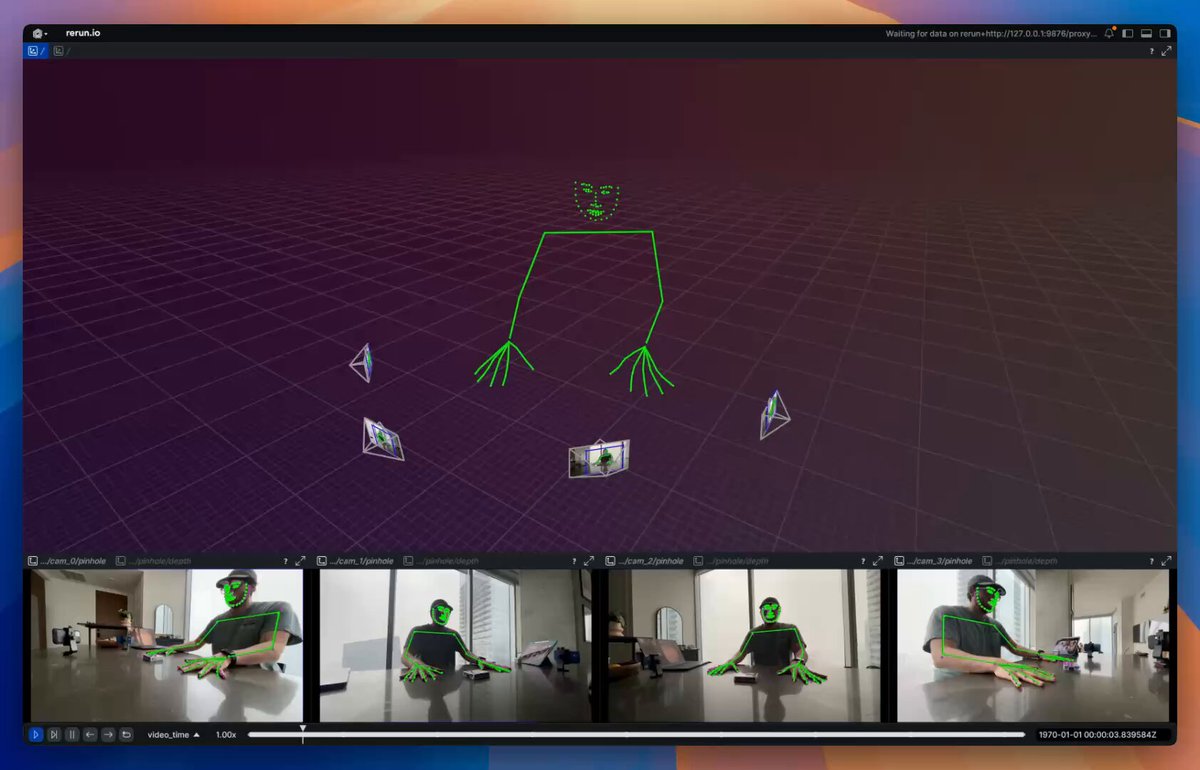
MVP of Multiview Video → Camera parameters + 3D keypoints. Visualized with Rerun The basic pipeline as of right now looks like this: 1. Capture 🔴 – Using 4 iPhones and an Insta360 Go. iPhone videos are captured via Final Cut Pro Multicam for easy sync and the exocentric view; the Insta360 Go is used for the egocentric view. 2. Sync 🕒 – Custom Gradio app using two Rerun viewers and callbacks for easily aligning frame timestamps so the ego and exo views are aligned. 3. Calibrate 🎯 – Use VGGT from Jianyuan and AI at Meta to get intrinsics/extrinsics for sparse cameras. 4. Estimate 3D 🕺 – Use RTMLib whole‑body keypoint estimator on each frame, then triangulate in 3D. What's missing? 1. No temporal coherence: I’m estimating keypoints one frame at a time and one camera at a time. This leads to a lot of jittering. For now, I plan on adding a One Euro Filter to help with jittering. Long term, I'd want to train a multiview keypoint estimator 2. Kinematic fitting is still missing; this is my next goal. The output will be joint angles, as explored in my previous posts. 3. Missing dense point cloud: VGGT seems to fail for me here. I’m looking to explore using MP‑SFM as a method for generating dense multiview depth maps + normals (plus it has a friendlier license compared to VGGT). 4. Eventually, creation of 4D Gaussian splatting using something akin to DN‑splatter—my long‑term goal is a data engine that provides poses/depths/splats/keypoints/etc.

Pablo Vela

42,785 Aufrufe • vor 1 Jahr

🚀Announcing NeRSemble 3D Head Avatar Benchmark v2 Version 2 of the NeRSemble 3D Head Avatar Benchmark systematically evaluates several aspects of 3D head avatar creation. Our goal is to drive progress toward more realistic, robust, and generalizable avatar methods. 🔬Benchmark Tasks The NeRSemble Benchmark v2 features three core challenges: - Dynamic Novel View Synthesis - Monocular FLAME-driven Avatar Creation (updated) - Single-view 3D Face Reconstruction (new) 👉Explore the online leaderboard and submission system: 🆕What's new? 1. New Task: Single-view 3D Face Reconstruction Given a single portrait image, reconstruct an accurate 3D mesh either showing the input expression or a fully neutral one. Unlike prior benchmarks, the NeRSemble benchmark emphasizes diverse and challenging facial expressions, better reflecting real scenarios. For technical details, see the Pixel3DMM paper. 2. Updated task: Monocular FLAME-driven Avatar Creation We have improved the FLAME tracking that is used for both avatar creation from the monocular videos and avatar driving on the hidden test sequences. The updated benchmark task has: - more stable torso tracking - more expressive lip closures during speech - Improved mouth tracking for challenging facial expressions We hope that these improvements to the benchmark help drive the field forward. 🏆 CVPR 2026 Workshop & Prizes The NeRSemble benchmark will be featured at the CVPR 2026 Workshop on Photo-realistic 3D Head Avatars. Participants in the new and updated tasks have the opportunity to win: - 🎁RTX 5080 GPUs (sponsored by NVIDIA) - 🎤15-minute oral presentation at the workshop ⏰ Submission Deadline - May 26, 2026 Reach out to the amazing Tobias Kirschstein and Simon Giebenhain for more details :)

Matthias Niessner

29,954 Aufrufe • vor 4 Monaten

Wow. Recreating the Shawshank Redemption prison in 3D from a single video, in real time (!) Just read the MASt3R-SLAM paper and it's pretty neat. These folks basically built a real-time dense SLAM system on top of MASt3R, which is a transformer-based neural network that can do 3d reconstruction and localization from uncalibrated image pairs. The cool part is they don't need a fixed camera model -- it just works with arbitrary cameras -- think different focal lengths, sensor sizes, even handling zooming in video (FMV drone video anyone?!). If you've done photogrammetry or played with NeRFs you know that is a HUGE deal. They've solved some tricky problems like efficient point matching and tracking, plus they've figured out how to fuse point clouds and handle loop closures in real-time. Their system runs at about 15 FPS on a 4090 and produces both camera poses and dense geometry. When they know the camera calibration, they get SOTA results across several benchmarks, but even without calibration, they still perform well. What's interesting is the approach -- most recent SLAM work has built on DROID-SLAM's architecture, but these folks went a different direction by leveraging a strong 3D reconstruction prior. Seems to give them more coherent geometry, which makes sense since that's what MASt3R was designed for. For anyone who cares about monocular SLAM and 3D reconstruction, this feels like a significant step toward plug-and-play dense SLAM without calibration headaches -- perfect for drones, robots, AR/VR -- the works!

Bilawal Sidhu

704,021 Aufrufe • vor 1 Jahr