Загрузка видео...

Не удалось загрузить видео

На главную

🚀 SURAT ➝ CHENNAI: INDIA JUST HIT FAST-FORWARD Travel time slashed by almost half ⏱️ ~31 hrs ➝ ~17 hrs The Union Cabinet has cleared the 374-km, access-controlled Nashik–Solapur–Akkalkot greenfield highway in Maharashtra a crucial link in the Surat–Chennai High-Speed Corridor. 🛣️ Built for speed & safety 📦 Faster...

47,834 просмотров • 6 месяцев назад •via X (Twitter)

Комментарии: 0

Нет доступных комментариев

Здесь появятся комментарии из оригинального поста

Похожие видео

Congress seems to be the unhappiest when India makes progress. Its latest target is the Mumbai–Ahmedabad High-Speed Rail project. This is not just another infrastructure project. It is a transformative investment in India’s future. The India-Japan partnership remains firmly committed to operationalising the corridor at the earliest. While Japan’s advanced E10 Shinkansen trains are expected in the early 2030s, both countries have pragmatically agreed that services will begin with Indian-developed high-speed trainsets instead of waiting. The message is clear: deliver results first, while simultaneously building India’s indigenous high-speed rail capabilities. The benefits are immense: • It will connect India’s financial capital, Mumbai, with one of its fastest-growing commercial hubs, Ahmedabad, in a fraction of the current travel time. • Cities like Surat, the world’s diamond processing capital, and Vapi, a major industrial and chemical manufacturing hub, will be seamlessly integrated into a high-speed economic corridor. • Travel time will be cut by over four hours, making business travel, investment, tourism and regional connectivity far more efficient. • The project will strengthen manufacturing, create skilled jobs, enhance logistics and accelerate economic integration across one of India’s most productive regions. This is what nation-building looks like: combining global partnerships with Indian innovation, ensuring world-class infrastructure while strengthening domestic technological capability. Which raises a simple question: when a project promises faster connectivity, stronger economic growth, more jobs, and greater self-reliance, why is Congress so determined to ridicule it? Time and again, Congress has chosen to oppose transformational infrastructure instead of supporting India’s growth story. The country deserves better than politics that seeks to undermine progress.

Amit Malviya

21,768 просмотров • 6 дней назад

A 120-km coastal corridor that will transform how Mumbai moves. The Mumbai Metropolitan Region is set for its biggest mobility leap yet — a high-speed coastal corridor that will supercharge the region’s growth. The Government of Maharashtra has cleared the Uttan–Virar Sea Link and its extension to Vadhavan Port, unlocking a 120-km, fully access-controlled coastal expressway that will connect South Mumbai to Vasai, Virar, Palghar and India’s upcoming largest deep-sea port. The Mumbai–Vadhavan Expressway Corridor (MVEC) will not only bring Mumbai closer to its far suburbs, but also serve as a new gateway to India’s growth, integrating major expressways, coastal roads and future national corridors into one seamless, high-speed network for people, freight and industry. At its core is the 24.35 km Uttan–Virar Sea Link, set to become India’s longest sea bridge. With 30+ km of connectors, 6 lanes, emergency lanes, navigational spans and a full Intelligent Transport System, this sea link is designed for speed, safety and smart mobility. Once completed, MVEC will: ✔️ ease congestion on WEH, SV Road and Link Road ✔️cut travel time across the region ✔️ reduce emissions ✔️boost affordable housing, tourism and port-led development ✔️ and create thousands of jobs It will also unlock land along the Uttan–Bhayandar, Vasai and Virar belt, opening new avenues of growth for local communities. With the proposal now recommended to the Government of India, MMR’s next era of connectivity and coastal development has truly begun. A new coast. A new corridor. A new wave of opportunities for millions. #MMRDA #MVEC #MumbaiVadhavanExpresswayCorridor #UttanVirarSeaLink #UVSL #LongestSeaBridge #MMRDA50 #CoastalCorridor120KM #GatewayToGrowth #TransformingMMR #ReimaginingMMR #RebootingMumbai #ReshapingMMR #SeamlessConnectivity #IndiaOnTheMove #SmartMobility #HighSpeedCorridor #BuiltForTomorrow #MumbaiInMinutes #FutureReadyMumbai CMO Maharashtra Devendra Fadnavis Eknath Shinde - एकनाथ शिंदे Dr. Sanjay Mukherjee MAHARASHTRA DGIPR

MMRDA

17,521 просмотров • 8 месяцев назад

Many people still don't grasp just how quickly India is moving 🇮🇳 The new Delhi-Mumbai Industrial Corridor (DMIC) will be completed in the next few years. The $100 billion project started in 2007 and has seen significant Japanese investment since the start. Stretching approximately 1,500 kilometers between the capital city Delhi (metro pop. of 34M) and India's financial capital Mumbai (metro pop. of 21M, this initiative will enhance connectivity and stimulate economic growth by developing smart cities, industrial parks along a new Delhi–Mumbai Expressway and the new Western Dedicated Freight Corridor (railway). The 1350 km 8-lane wide (expandable to 12-lane) expressway connecting the two mega-cities will be completed next year and will reduce the travel time from 24h to 11h. The 1500 km Western Dedicated Freight Corridor (WDFC) will also be completed in 2025. The high-speed line will support freight trains reaching 1,500 m (4,900 ft) length pulled by electric locomotives running at speeds greater than 100 km/h (62 mph). The tracks will be entirely grade-separated and have a generous loading gauge of 3,660 mm width and 7,100 mm maximum height allowing for double-stacked shipping containers to be transported on flatcars. This allows for single trains to have a 400+-container capacity. The corridor will reduce the travel time for containers from 50 h, by the existing freight train, to 17 h while significantly increasing the transport capacity on the route as well as decreasing transport costs. The DMIC megaproject also incorporates 9 Mega Industrial zones of about 200-250 sq. km, 3 ports, 6 airports and a 4000 MW power plant. India is rapidly outpacing China in both demographic and economic growth. The 21st century won't be the Chinese century. It will be the Indian century.

Visegrád 24

207,110 просмотров • 1 год назад

Maharashtra on the Move: From Ports to Prosperity! Inaugurated the ‘Maharashtra Maritime Summit 2025’ with a deep sense of purpose, to transform our maritime strength into a powerful engine of growth for Maharashtra and India. The sea is not just a boundary, it has always been a bridge to opportunity and prosperity. That belief anchors Maharashtra's Maritime Summit, where today’s deliberations focus on how our maritime strength can fuel growth, improve connectivity, and place India at the forefront of global trade. Hon PM Narendra Modi Ji has always envisioned a port-led economy. His vision is reflected in the 'India Maritime Vision 2030' and 'India Amrit Kaal Maritime Vision 2047'. Inspired by this, Maharashtra is shaping a bold maritime roadmap, rooted in a coastline rich with legacy, especially across Mumbai and Konkan. Mumbai is said to be India’s economic, commercial, entertainment, and financial capital. But what truly made it the economic engine and powerhouse are its two crucial pillars—Mumbai Port and JNPA Port. These ports played a foundational role in shaping Mumbai’s position. To lead in global trade, scale, speed, and seamless connectivity are essential. Vadhvan Port marks a major leap forward. With the Government of India as the major partner and Maharashtra holding a 26% share, development is progressing rapidly. Port connectivity is being transformed through expressways, access-controlled roads, and stronger last-mile infrastructure, ensuring faster cargo movement across the State. The Sagarmala project, envisioned and driven by Hon PM Narendra Modi Ji, has given a significant push to expanding rail networks and enabling multi-modal access, with strong support from the Central Government through major infrastructure investments. Near Vadhvan, India’s first offshore airport will soon give us a seamless sea-air cargo hub. Our broader vision includes shipbuilding, ship recycling, and a strong push for water transport, especially in Mumbai and the MMR region—to not just boost trade, but also improve ease of living. Waterways remain the most affordable and sustainable mode of transport. As India works to reduce logistics costs and enhance competitiveness, the role of waterways in driving future growth will be pivotal. India is on track to become the world’s third largest economy. The climb to second and first will be challenging, but the path has been clearly laid out by Hon PM Narendra Modi Ji, and Maharashtra is fully committed to leading the way. All ideas and recommendations emerging from this summit will be studied closely and every meaningful insight will contribute to shaping Maharashtra’s maritime policy, one that lifts the State and the Nation towards true maritime leadership. Minister Nitesh Rane and other dignitaries were present. Narendra Modi Nitesh Rane #Maharashtra #MaritimeSummit2025 #Mumbai

Devendra Fadnavis

103,101 просмотров • 1 год назад

Major Project Update: Thane Coastal Road hits fast forward In just eight months since construction began, Thane Coastal Road-1 has crossed a major milestone, with over 50% of the foundation work for the elevated viaduct now complete and pier cap and I-girder erection progressing rapidly. 👉 The 13.45 km, six-lane, access-controlled greenfield corridor is being built using cutting-edge engineering. For the first time in India, a greenfield road project is using a single-pile, single-pier system with monopile foundations on land. 👉 Designed as a strategic freight corridor, the project will decongest Ghodbunder Road and improve connectivity between NH-160 (Mumbai–Nashik Highway) and Gaimukh along the Thane Creek coastline, with major stretches on viaducts and bridges to safeguard the sensitive mangrove ecosystem. 👉 At Gaimukh, the road will directly connect with the upcoming Gaimukh–Fountain Hotel Tunnel, enabling seamless Thane–Bhayander connectivity. Together, these projects will significantly decongest Ghodbunder Road, transform urban mobility in Thane, and strengthen freight movement towards Wadhawan Port, JNPT, South Maharashtra, and Karnataka. 👉 The corridor will also integrate with key future infrastructure projects including the Thane Ring Metro, Thane Coastal Road-2, the Saket–Amane Elevated Corridor, and the Kasarvadavali–Kharbhav Road, cementing its role as a critical backbone of the region’s next-generation transport network. #ThaneCoastalRoad #MMRDA #InfrastructureIndia #ReimaginingMMR #TransformingMMR #UrbanMobility #BuildingTheFuture #MumbaiMetropolitanRegion #MegaProjects #Maharashtra #TransportInfrastructure #FastForward CMO Maharashtra Devendra Fadnavis Eknath Shinde - एकनाथ शिंदे Dr. Sanjay Mukherjee MAHARASHTRA DGIPR PIB India Infra News India (INI) Indian Tech & Infra Thane Municipal Corporation - ठाणे महानगरपालिका

MMRDA

26,177 просмотров • 5 месяцев назад

Nashik Now Home to World-Class Electrical Equipment Testing and Certification Facility Delighted to witness the 'inauguration and unveiling of the stone plaque of the Central Power Research Institute’s (CPRI) Regional Testing Laboratory at the hands of Hon Union Minister Manohar Lal Khattar ji in Nashik today. This facility is a game-changer for Maharashtra. With this advanced laboratory in Nashik, the State’s industries now gain direct access to world-class testing and faster clearances. Maharashtra is fast emerging as India’s electric vehicle capital, with large-scale EV investments in Pune, Nashik, and Chhatrapati Sambhajinagar. Establishing this EV testing facility will further accelerate this momentum. Under the visionary leadership of Hon PM Narendra Modi ji, the energy sector is undergoing a major transformation. Electricity demand is expected to quadruple in the next 15–20 years. Maharashtra already generates 45,000 MW and has planned expansion until 2035, with investments of nearly ₹2 lakh crore flowing into the sector. The focus is on green energy, reliable power distribution, and affordable electricity. Between 2025–2030, tariffs will be reduced by 2% annually. Farmers will benefit from 16,000 MW projects supplying daytime power, while industries will receive low-cost, sustainable electricity. Nashik is developing as a true 'Junction of Industries', with seven major companies investing in the past six months alone. A new centre for mining equipment manufacturing will also be established here. The Samruddhi Highway will connect Nashik to JNPT and other ports, drastically reducing transport costs. Minister Chhagan Bhujbal, Minister Girish Mahajan, Minister Dadaji Bhuse, and other dignitaries were also present. Narendra Modi Manohar Lal Girish Mahajan Dadaji Bhuse CPRI #Maharashtra #Nashik #Energy #Investment #CPRI

Devendra Fadnavis

12,315 просмотров • 10 месяцев назад

4 hours. Two massive trusses. One major step forward for Mumbai’s next high-speed road corridor. MMRDA has achieved a major construction milestone on the 13.9-km Elevated Eastern Freeway Extension (EFE), with the successful erection of the two Main Trusses of its Segment Launcher, each 59 metres long and weighing 160 tonnes, on the busy Eastern Express Highway. The entire complex operation was completed within a record 4-hour window, with the actual erection of both trusses taking just 1 hour. The operation was executed through meticulous planning, stringent safety measures and seamless coordination between MMRDA and the Mumbai Traffic Police. So, what happens next? With the Main Trusses now in place, the Segment Launcher will begin erecting 1,632 precast segments, each weighing approximately 90 MT, span by span. These will form the 25-metre-wide single-cell segment superstructure, accelerating viaduct construction and taking the project into its next major phase. And what does this mean for Mumbai? The EFE is a fully elevated, 6-lane high-speed corridor connecting Anand Nagar in Thane with Chheda Nagar in Ghatkopar, designed to create a faster, more reliable route while easing congestion on the Eastern Express Highway, one of Mumbai’s busiest transport corridors. Once completed, the EFE is expected to reduce travel time between South Mumbai and Thane to approximately 20–25 minutes, making everyday journeys faster while strengthening connectivity across the Mumbai Metropolitan Region. Watch 4 hours of precision unfold in minutes. ⏱️ #MMRDA #EasternFreewayExtension #EFE #MumbaiInMinutes #MMRDAMovesMumbai #MumbaiInfrastructure #Mumbai #Thane #ReimaginingMMR #RebootingMumbai #ReshapingMMR CMO Maharashtra Devendra Fadnavis Eknath Shinde - एकनाथ शिंदे Dr. Sanjay Mukherjee Maha Mumbai Metro Operation Corporation Ltd MAHARASHTRA DGIPR PIB in Maharashtra 🇮🇳 PIB India

MMRDA

27,098 просмотров • 3 дней назад

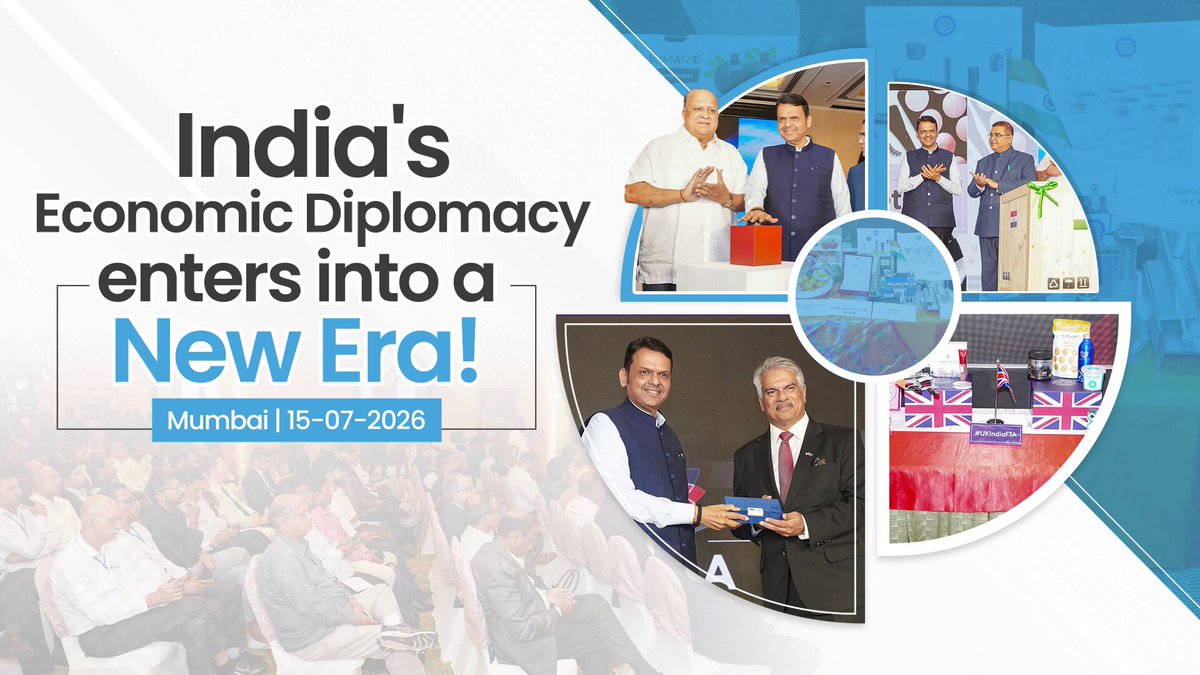
India-UK CETA: A New Wave of Global Opportunities! 🇮🇳🇬🇧 Glad to attend the ceremonial inauguration and cargo exchange, celebrating the entry into force of the India-UK Comprehensive Economic and Trade Agreement. This landmark agreement marks a new chapter in the strategic and economic partnership between India and the United Kingdom. It highlights an India that negotiates with confidence and is increasingly seen as a trusted global partner. Heartiest congratulations to Hon PM Narendra Modi Ji for his transformative leadership and to Hon Union Minister Piyush Goyal ji for his tireless efforts in making this historic agreement a reality. Under the visionary leadership of Hon PM Narendra Modi Ji, India has witnessed a defining transformation since 2014 that has transformed governance, strengthened the economy and elevated its standing in the world. The landmark trade agreements being signed by global powers with India represent another significant milestone in our nation's journey. The India-UK Comprehensive Economic and Trade Agreement is more than a trade agreement. It is an opportunity for exporters, manufacturers, MSMEs, startups, professionals, young entrepreneurs and the agriculture sector to expand their global presence, access new markets and strengthen exports. The agreement will provide new opportunities for Maharashtra in global trade, investment and exports, while enabling industries and agricultural products from the state to gain direct access to global markets. Maharashtra is ready to lead from the front in this new era of opportunity. Its strong manufacturing base, financial strength, world-class infrastructure, thriving startup ecosystem, and leadership in engineering, IT, pharmaceutical and agriculture sectors give the state a unique advantage to benefit from this partnership. The message to industry and entrepreneurs is simple, think bigger, think globally and seize the opportunities created by this landmark agreement. The India-UK CETA will become a gateway for higher exports, greater investment and stronger global partnerships. Minister Mangal Prabhat Lodha ji, Minister Jaykumar Rawal, Trade Commissioner for South Asia and the British Deputy High Commissioner for Western India Harjinder Kang and other dignitaries were present. Mangal Prabhat Lodha Jaykumar Rawal Harjinder Kang UK in Mumbai 🇬🇧🇮🇳 UK in India🇬🇧🇮🇳 #Maharashtra #IndiaUKCETA

Devendra Fadnavis

16,110 просмотров • 8 дней назад

Very Important Read 👇🏻 After 17 days of conflict in West Asia and mounting uncertainty around the Strait of Hormuz - the route that carries nearly 20% of global energy trade - the LPG carrier Shivalik docking at Mundra is far more than a routine shipment. From my perspective, this is a textbook case of how geopolitics, diplomacy and infrastructure come together when it matters most. Shivalik alone has brought about 45000 metric tonnes of LPG, and together with the vessel Nanda Devi, India is receiving close to 92000 metric tonnes roughly equivalent to 66 lakh domestic LPG cylinders. Considering India’s daily LPG demand is around 90000 tonnes, this shipment alone helps stabilise over a day of national consumption during a global supply disruption. What stands out to me is the dual strength behind this success. On one hand, Prime Minister Narendra Modi’s geopolitical credibility, which ensured India could maintain working engagement across a volatile region and secure safe passage for its vessels through a tense maritime corridor. On the other hand is infrastructure readiness the cargo is being received at Adani’s Mundra Port, India’s largest commercial port and the first to cross 200 million tonnes of annual cargo handling. Ports built at this scale are exactly what allow a country to convert diplomatic success into real supply security. Frankly, this is also where I find India’s opposition politics deeply disconnected from reality. For years, we have heard relentless attacks on large infrastructure projects and constant attempts to discredit companies like the Adani Group that are building strategic national assets. Yet moments like this expose the contradiction. When a global crisis hits and energy supply chains are under stress, it is precisely these ports, logistics networks and infrastructure ecosystems that keep the country running. In my view, this episode reinforces a simple geopolitical truth: strong diplomacy secures the route, but nation-scale infrastructure like Adani’s Mundra Port ensures India’s energy lifeline never stops.

The Poll Lady

133,434 просмотров • 4 месяцев назад

There are moments in a project where things stop being theoretical and start becoming real.. That is where winners are really made! That’s exactly where $CARR is right now and why I have spent 3yrs accumulating some decent holdings. Yesterday’s Carnomaly spaces wasn’t just another update, it was a clear signal that the business is accelerating on all fronts simultaneously! Real-world adoption + crypto infrastructure. On the ground in the UK, dealer expansion is already moving up a gear. Detailed plans are in motion and the US team is landing there soon to help drive the rollout. This matters because $CARR isn’t built on speculation, it’s built on vehicle flow, ownership, and actual commercial activity. At the same time, the launch of Roundabout Labs in Dubai is a strategic bombshell! No cosmetic nothing burgers. No experimental partnerships. Structural development. It removes friction. It opens the door to global participation. It allows the crypto side of $CARR to scale without being constrained by a single regulatory environment, which is exactly what a real-world asset platform needs if it’s going to operate globally. And when you connect all the dots, the picture becomes very simple: • US = supply, inventory, real dealer network • UK = supply, inventory, real dealer network • Dubai = speed, crypto innovation, global access • $CARR = the bridge capturing the value between them all And if you step back and look at it objectively: • A blockchain platform bringing the automotive network on chain with real time USDT staking. • A growing dealer network feeding real assets into the system. • A global crypto structure designed for scale. That combination is rare. I know it’s been some time since I posted about crypto but don’t say you haven’t been warned for years about this, because when execution continues at this pace, this doesn’t stay small for long.

All Thyme High

70,700 просмотров • 4 месяцев назад

📍 𝐒𝐡𝐢𝐥𝐥𝐨𝐧𝐠, 𝐌𝐞𝐠𝐡𝐚𝐥𝐚𝐲𝐚 Paving the path for a stronger and more connected Northeast! 🛣️✨ In Meghalaya, laid the foundation stone and dedicated to the nation 6 National Highway projects with a total investment of ₹3,214 crore, alongside Chief Minister Shri Conrad K Sangma Ji, Deputy CMs Shri Prestone Tynsong Ji, Shri Sniawbha Dhar Ji, Meghalaya Vidhan Sabha Speaker Shri Thomas A. Sangma Ji, State Ministers, MLAs, and senior officials at Polo Ground, Shillong. The Pynursla Bypass will decongest the town, speed up tourist travel, and improve connectivity to the Umngot River (Dawki) and the international border. The Jowai Bypass has eased congestion and improved road safety in Jowai. These projects will provide a major boost to international trade and tourism in Dawki, Dalu, and Cherrapunji, while generating large-scale employment and self-employment opportunities. The Tura Bypass will divert traffic from built-up areas, enabling faster and safer travel to the international border near Dalu. The road from the Dhubri–Phulbari Bridge to Selsella–Simbukolgre will strengthen connectivity across West Garo Hills. The Shillong–Dawki Corridor will enhance cross-border connectivity via Tamabil, ease traffic in Upper Shillong, reduce travel time, and strengthen strategic connectivity. The Selsella–Simbukolgre–Goeragre road will further improve connectivity in West Garo Hills and link to the upcoming four-lane Dhubri–Phulbari Bridge over the Brahmaputra. These initiatives will also enhance access to healthcare and emergency services in remote areas through improved connectivity to Shillong and Guwahati, while boosting agricultural incomes and promoting traditional crafts such as bamboo and cane work, Eri silk (Ryndia) handloom, and black pottery. Under the visionary leadership of PM Shri Narendra Modi Ji, we remain steadfast in our commitment to equip Meghalaya and the entire Northeast with world-class highway infrastructure for faster, smoother, and safer travel. #PragatiKaHighway #GatiShakti #BuildingTheNation

Nitin Gadkari

20,787 просмотров • 1 месяц назад

When you walk through the new #NMIAInauguration, you realise how much India has changed. This project was first planned more than 14 years ago, but stayed stuck for years in paperwork, permissions, and politics. For almost five decades, this land saw nothing but delay plans kept changing, approvals moved slowly, and there was no clear direction to finish the job. That changed when Prime Minister Narendra Modi made infrastructure speed and scale a national priority. Under his leadership, and with Adani Group Chairman Gautam Adani leading the development, this airport finally became a reality. Built at a cost of Rs19,650 crore, NMIA is not just an airport it’s a symbol of how India can deliver world-class projects when decisions are fast and focused. A) Digital from Day 1: AI-based queue management, facial-recognition boarding, smart baggage tracking, and digital-twin systems for real-time operations. B) Phase 1 capacity: 20 million passengers per year; 90 million when fully built doubling Mumbai’s total handling capacity. C) Connectivity: Atal Setu (MTHL) links South Mumbai to NMIA in under 40 minutes; a new Thane–NMIA elevated corridor will cut travel to 30 minutes. D) Green design: 100 % rainwater harvesting, solar façades, zero-waste discharge, and a Net Zero Energy target by 2030. E) Jobs & Growth: Over 1 million direct and indirect jobs, boosting Navi Mumbai, Ulwe, and Panvel into India’s next big growth corridor. The terminal’s lotus-inspired design blends India’s cultural identity with modern engineering. For decades, this site was a story of waiting. Today, it’s a story of delivery. This is the difference between delay and direction between slogans and solutions. This is how New India builds with data, discipline, and determination.

Facts

119,999 просмотров • 9 месяцев назад

Palghar is becoming Maharashtra's next growth engine. This district is not just a part of Maharashtra's growth story. It is the chapter that will define it. Under the visionary leadership of Hon. PM Shri Narendra Modi Ji, projects that once seemed distant possibilities are today taking concrete shape. Reviewed key aspects of the proposed Vadhavan Port at Chinchani Beach, including internal road network, forest clearances, power supply, rail connectivity, land acquisition, water supply, skill development and compensation for fishermen. Spread over 1,448 hectares with an estimated cost of ₹76,220 crore, this greenfield port will handle next-generation vessels with a 20-metre deep draft, making it capable of berthing the world's largest ships, something no Indian port can offer today. At three times the capacity of JNPA, it will rank among the world's top 10 ports and is expected to generate 10 lakh jobs. What matters equally to me is how we build this. Through open dialogue, fair rehabilitation, ITI upgradation, skill training and a dedicated fisheries institute, we are committed to ensuring that the people of this land, our tribal communities, our fishermen, our youth, are not just witnesses to this progress but its primary beneficiaries. Also inspected the ongoing construction work and reviewed the project layout of the Boisar Station under the Mumbai-Ahmedabad Bullet Train Project. Work is progressing well and officials have been instructed to maintain pace and quality within the decided timelines. Once operational, Boisar will connect to BKC in under thirty minutes, opening up this entire region economically. This is a project that will genuinely change the character of Palghar. Also reviewed the site of the proposed offshore Airport in Palghar district, which is going to be India's first offshore airport. This project adds a critical third dimension to this connectivity picture. Situated in proximity to the Dedicated Freight Corridor, the Bullet Train, the Uttan-Virar Sea Link, the Mumbai-Vadodara Expressway and the Mumbai-Ahmedabad National Highway, it will significantly improve connectivity while easing the growing passenger load on Mumbai Airport. The pre-feasibility report has confirmed the site as viable and the DPR has been ordered today. Also discussed the MMRDA-developed Narangi Creek Bridge, a ₹850 crore, 4.10 km project that will directly connect Vasai-Virar with Saphale, Palghar and Boisar, reducing travel distance by nearly 40 km and travel time by around 45 minutes. Also held detailed discussions on the Uttan-Virar Sea Link, a proposed six-lane project worth approximately ₹58,754 crore that once complete will directly connect to the Mumbai-Ahmedabad National Highway, making travel between South Mumbai and Ahmedabad faster, safer and more convenient. Inspected the construction and reviewed progress on the Vadodara-Mumbai section of the Delhi-Mumbai Expressway, one of India's most ambitious infrastructure undertakings. A defining feature of this 8-lane greenfield corridor is its direct connectivity to JNPA, enabling faster, more efficient and cost-effective freight movement from North India and giving a major boost to the country's logistics chain. It will also offer a reliable alternative to the congested Thane-Bhiwandi-Ghodbunder routes, with travel time between Vadodara and Mumbai set to reduce from 8 hours to approximately 4 once complete. Vadhavan Port, Bullet Train, Offshore Airport, Delhi-Mumbai Expressway, Uttan-Virar Sea Link, Narangi Creek Bridge, Virar-Alibaug Corridor. Each project is significant on its own. Together, they are building the Fourth Mumbai, a new economic centre of gravity rising in Palghar, under the visionary leadership of Hon PM Shri Narendra Modi Ji and the resolve of a government that has cleared decades of stalled decisions. Palghar is emerging as a major growth engine for Maharashtra, opening new opportunities in ports, transport, industry, exports and employment.This is the Maharashtra we are building, and Palghar is leading the way. Minister Ganesh Naik ji, Minister Nitesh Rane, MP Dr Hemant Savara, MLA Rajendra Gavit and senior officials were present. 🙏 जय महाराष्ट्र Ganesh Naik Nitesh Rane Dr. Hemant Savara Mp Rajendra Gavit Official #Maharashtra #Palghar #InfrastructureDevelopment

Devendra Fadnavis

55,848 просмотров • 25 дней назад

🇨🇳 CHINA'S MAGLEV HITS 700 KM/H IN 2 SECONDS - PLANNING 1,000 KM/H - WHILE AMERICA ARGUES ABOUT FIXING POTHOLES China just tested a maglev platform that accelerates to 700 km/h (435 mph) in 2 seconds. Target speed: 1,000 km/h (621 mph). That's faster than commercial aircraft. On the ground. The acceleration alone is borderline violent - 0 to 435 mph in two seconds is 9.8g. Fighter jet territory. Passengers would need specialized seating just to survive the launch. But let's address reality: This is a test platform. Prototype speeds don't mean operational trains. China announces ambitious projects constantly. Some materialize (their existing 430 km/h maglev in Shanghai works). Others disappear quietly. The pattern though? They're attempting scale nobody else is. High-speed rail connecting every major city. Maglev research pushed to extremes. Infrastructure spending that makes Western investment look microscopic. Meanwhile in America: Amtrak averages 105 km/h between cities. California's high-speed rail project started in 2008, burned $10+ billion, and hasn't moved a passenger. The fastest train in the U.S. hits 240 km/h for exactly one 54-mile stretch. China's going for 1,000 km/h. Even if they only achieve 800 km/h operationally, that's still triple America's maximum. Here's why this matters beyond trains: Infrastructure capacity signals industrial capability. If China can build and operate 1,000 km/h trains, they can manufacture the precision components, power systems, and control mechanisms that transfer to aerospace, military, and manufacturing. The U.S. won the 20th century partly because it built the Interstate Highway System when others couldn't. China's betting the 21st century winner will be whoever builds impossible infrastructure first. They might fail. Engineering challenges at 1,000 km/h are extreme - air resistance, track precision, emergency braking, passenger safety. But they're trying while America argues whether to fix the L train in New York. Even Chinese failure puts them ahead. You learn more from attempting the impossible than from successfully maintaining mediocrity. Source: Xinhua, CGTN

Mario Nawfal

818,048 просмотров • 6 месяцев назад

From Enterprise to Excellence: Maharashtra’s New Growth Story! Maharashtra’s strength has always gone beyond numbers — though the figures speak volumes. Contributing 40% to India’s GDP, attracting 31% of FDI, leading in start-ups with 25% of India’s share, the highest number of unicorns, MSMEs, and as the largest bearing oil exporter, the state stands as the country’s economic powerhouse. But the true strength lies in the enterprising spirit of its people — those gathered here and countless others who’ve built this thriving ecosystem. This dialogue is a convergence of ideas, aspirations, and decisive action. The goal is clear — to make Maharashtra the most dynamic, investor-friendly, and sustainable destination in India. Over the past decade, this industrial ecosystem has expanded beyond MMR and Pune, transforming regions once seen as remote. Gadchiroli is fast emerging as India’s new steel hub. Amravati has built a full textile value chain under PM MITRA. Chhatrapati Sambhaji Nagar is shaping up as the country’s EV capital. Nashik leads in defense manufacturing, with a dedicated corridor taking shape. Pune, Navi Mumbai, and Raigad continue to drive advanced industries, while the upcoming Vadhvan Port — three times bigger than JNPT — will redefine Maharashtra’s logistics and trade future. Even as industries flourish, sustainability stays at the core. By 2030, 52% of the state’s power will be green. Gadchiroli’s mining sector is shifting to clean fuels, and plans are in place to plant one crore trees to enhance ecological balance and environmental sustainability. Complementing this growth is MAITRI — Maharashtra’s true single-window system that offers end-to-end, hassle-free integration for investors, ensuring ease of doing business in the truest sense. India today stands as the world’s next big growth story — and Maharashtra must be the first chapter of that story. The remarkable progress seen over the last 10 years has been made possible by the dynamic leadership, progressive policies, and unwavering support of Hon PM Narendra Modi Ji. Maharashtra remains fully committed to contributing to his dream of a $5 trillion economy, a Viksit Bharat, and building a Viksit Maharashtra that leads from the front — in enterprise, innovation, and sustainable, inclusive growth. Hon Governor CP Radhakrishnan ji, DCM Eknath Shinde, Minister Uday Samant and Minister Jaykumar Rawal were present. Governor of Maharashtra Eknath Shinde - एकनाथ शिंदे Uday Samant Jaykumar Rawal MIDC India #Maharashtra #MagneticMaharashtra #MadeForBusiness

Devendra Fadnavis

110,554 просмотров • 1 год назад