Loading video...

Video Failed to Load

Go Home

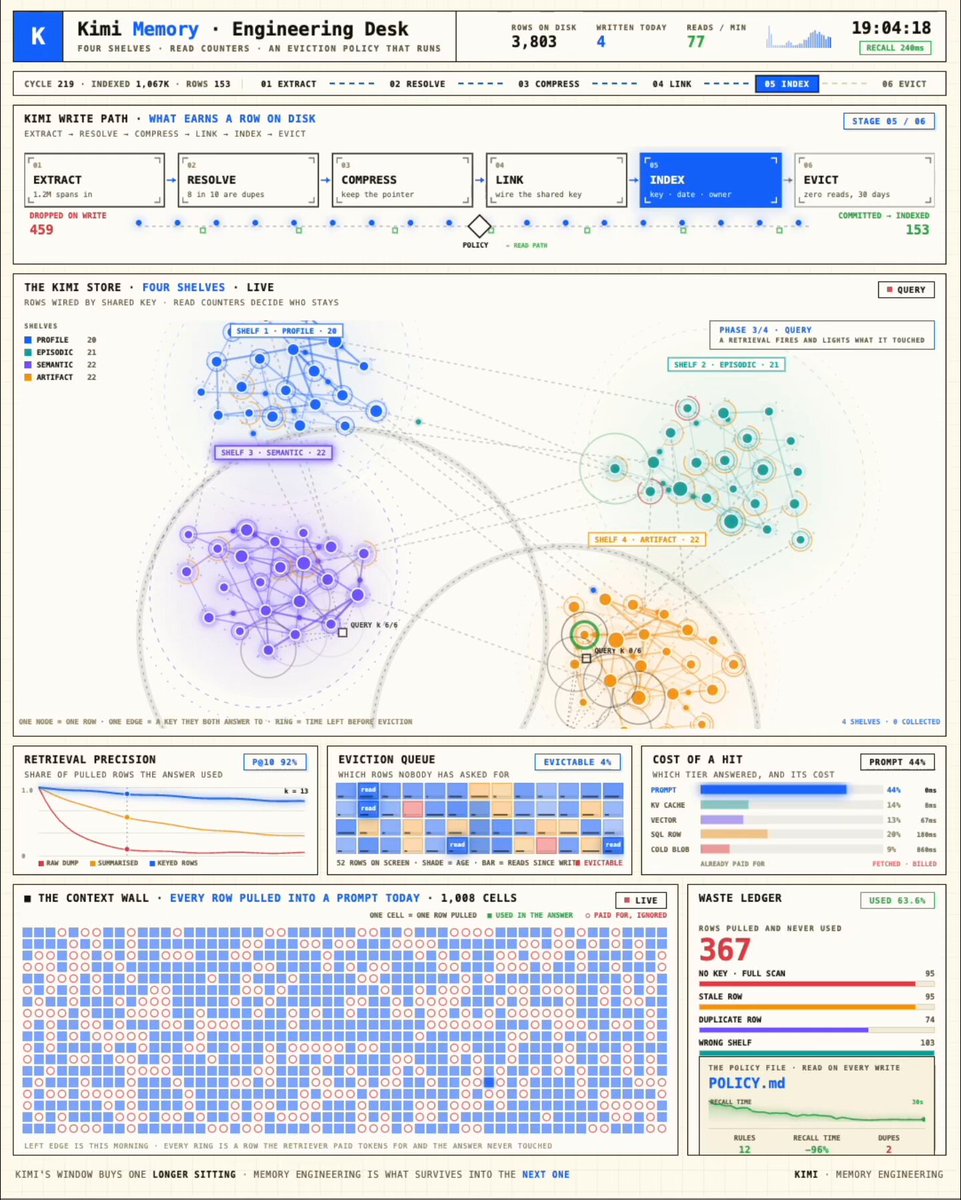
the perfect AI agent should remember everything. Sam Altman said it: "every conversation. every book. every email. your whole life appending to one context window." memory isn't a feature. it's the definition. I just built the memory layer. open source. install in one command. read the guide tonight. install...

35,772 views • 2 months ago •via X (Twitter)

0 Comments

No comments available

Comments from the original post will appear here

Related Videos

🚨 SOMEONE JUST KILLED THE COACHING INDUSTRY a developer spent 22,000 hours building a Personal AI Operating System on top of Claude Code now anyone with a terminal can install it for FREE it knows your goals, remembers every decision you've made, and prepares your morning briefing while you sleep [ the numbers are insane ]: - hours of dev work in it: 22,000 - sessions logged: 6,000 - time saved per day: 2-3 hours - GitHub stars: 12,100 - skills built in: 45 - workflows wired up: 171 - safety hooks: 37 - cost to install: $0 [ the science is wild too ]: no embeddings, no vector databases, no AI magic you can't read every memory, decision, and context lives in plain markdown files you read it with cat, search it with ripgrep, version it with git 4 memory types compound over time: - work memory (active projects, open decisions) - knowledge memory (domain expertise, research) - people memory (contacts, companies, relationships) - learning memory (patterns, mistakes, what works for YOU) every complex task routes through a 7-step cycle: OBSERVE → THINK → PLAN → BUILD → EXECUTE → VERIFY → LEARN privacy is enforced by CODE, not prompts a hook called ContainmentGuard physically blocks sensitive data from being written outside designated zones [ the grift opportunity is even wilder ]: freelancers are already charging $500-2,000 per personal AI setup for executives, founders, and busy operators one person + one weekend = a consulting business that didn't exist 6 months ago every AI productivity app you're paying $30/month for is replaceable by 4 hours of setup work and this one repo REPO: 100% OPEN SOURCE, FREE

Ronin

612,086 views • 1 month ago

New short course: LLMs as Operating Systems: Agent Memory, created with Letta, and taught by its founders Charles Packer and Sarah Wooders. An LLM's input context window has limited space. Using a longer input context also costs more and results in slower processing. So, managing what's stored in this context window is important. In the innovative paper MemGPT: Towards LLMs as Operating Systems, its authors (which include the instructors) proposed using an LLM agent to manage this context window. Their system uses a large persistent memory that stores everything that could be included in the input context, and an agent decides what is actually included. Take the example of building a chatbot that needs to remember what's been said earlier in a conversation (perhaps over many days of interaction with a user). As the conversation's length grows, the memory management agent will move information from the input context to a persistent searchable database; summarize information to keep relevant facts in the input context; and restore relevant conversation elements from further back in time. This allows a chatbot to keep what's currently most relevant in its input context memory to generate the next response. When I read the original MemGPT paper, I thought it was an innovative technique for handling memory for LLMs. The open-source Letta framework, which we'll use in this course, makes MemGPT easy to implement. It adds memory to your LLM agents and gives them transparent long-term memory. In detail, you’ll learn: - How to build an agent that can edit its own limited input context memory, using tools and multi-step reasoning - What is a memory hierarchy (an idea from computer operating systems, which use a cache to speed up memory access), and how these ideas apply to managing the LLM input context (where the input context window is a "cache" storing the most relevant information; and an agent decides what to move in and out of this to/from a larger persistent storage system) - How to implement multi-agent collaboration by letting different agents share blocks of memory This course will give you a sophisticated understanding of memory management for LLMs, which is important for chatbots having long conversations, and for complex agentic workflows. Please sign up here!

Andrew Ng

200,752 views • 1 year ago