Загрузка видео...

Не удалось загрузить видео

На главную

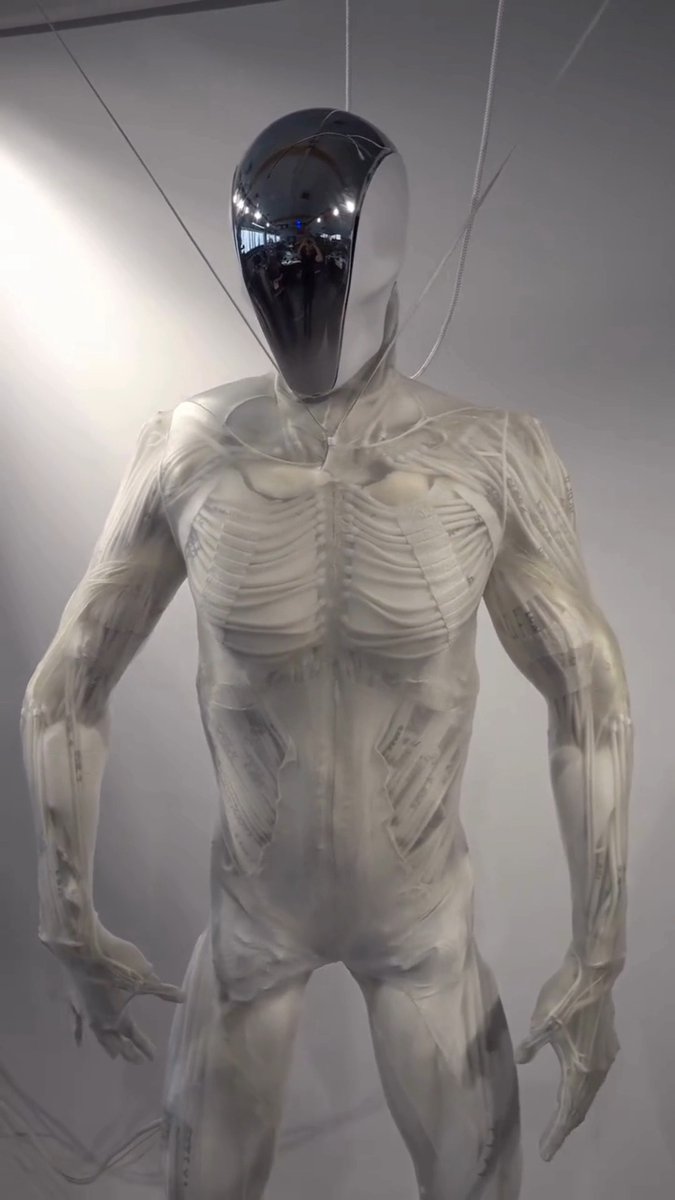
This is just crazy! Clone just introduced the Torso 2, a groundbreaking android that sets a new standard for robotics. This advanced prototype features 910 artificial muscle fibers, 164 degrees of freedom, and 182 sensors for precise feedback control, enabling fluid, human-like movement. With an actuated lumbar spine and...

29,566 просмотров • 1 год назад •via X (Twitter)

Комментарии: 10

Фото профиля Three Year Letterman
Three Year Letterman1 год назад

@clonerobotics Kill it with fire

Фото профиля Mark Kelly
Mark Kelly1 год назад

@clonerobotics Like the opening scenes from the WestWorld series....

Фото профиля Zaven Grigoryan
Zaven Grigoryan1 год назад

@clonerobotics This year was a milestone for generative AI, the next one will bring robots to mass use.

Фото профиля Ed Krassenstein
Ed Krassenstein1 год назад

@clonerobotics Yeah just imagine teaming AI with robots.

Фото профиля AI Leaks and News
AI Leaks and News1 год назад

@clonerobotics Clone is cooking

Фото профиля james Patterson
james Patterson1 год назад

@clonerobotics It didn’t take you long to ride the dick off of your new robot

Фото профиля Walt Wang
Walt Wang1 год назад

@clonerobotics Zombie apocalypse movies are going to be so much better. 😂

Фото профиля Brandon Edwards
Brandon Edwards1 год назад

@clonerobotics No, thanks. I choose life.

Фото профиля Roughneck Rooster
Roughneck Rooster1 год назад

@clonerobotics Geezus Fucking Christopher! Why is this happening??? We've even been warned!

Фото профиля what in the what
what in the what1 год назад

@clonerobotics

Похожие видео

A Breakthrough in Robotics: Spherical Gears Enter Mass Production Spherical gears, the kind of joint that would allow a robot to move like a human shoulder, have been notoriously difficult to manufacture with high precision. That's changing, thanks to a new design and a path to mass production that could have a huge impact on robotics. The breakthrough comes from a new design called the ABENICS spherical gear, developed by researchers at Yamagata University. This innovative mechanism enables a joint to move in three degrees of freedom without the slippage issues of earlier designs. It achieves this by using a "cross-spherical gear" that meshes with one or more "monopole gears." Mass production is now on the horizon. Although the initial manufacturing of the gears was inefficient, Nissei Corporation improved the process and established the necessary technology. The companies Kanematsu and Nissei have now entered the marketing phase, with production expected to begin in 2027. The impact of this technology is significant. Mass-produced spherical gears are expected to enable highly versatile and efficient robotic limbs. ► Humanoid and Mobile Robots: The design allows for compact, high-torque ball joints ideal for creating versatile and efficient robotic limbs. ► Aerospace: Potential applications include deployment mechanisms for satellite solar panels. ► Other Industries: The technology is also being explored for its potential to enhance productivity in healthcare, nursing care, and restaurants.

RoboHub🤖

384,888 просмотров • 1 год назад

This is the Scorpion Hexapod, a six-legged robotic scorpion created at Ghent University UGent Campus Kortrijk in Belgium. It was built by students Stephan Flamand Robbe Terryn and Pieterjan Deconinck as part of an Embedded Prototyping / Mechatronics Design project. What it is • A biomimetic robot inspired by the body and movement of a real scorpion • A hexapod, meaning it walks on six legs • A university prototype, not a commercial robot • Built to test animal-inspired movement, sensors and interactive behavior • Designed more for robotics research and education than real-world work Main hardware • 6 walking legs for crawling movement • 2 front claws for the scorpion look • Moving tail with a stinger-style mechanism • Sensors in the body, legs and claws • Arduino-based electronics for control • Front camera and proximity sensing • Battery pack for mobile operation • 3D-printed modules for legs and tail • Laser-cut ABS body parts • Thermoformed shell for the white outer body What it can do • Walk across the floor using its six legs • Move its tail like a real scorpion • React when a person gets close • Detect when someone covers its front sensors • Strike with its tail in the demo • Leave a red mark using a marker pen attached to the stinger • Operate through remote control • Perform some simple autonomous reactions Why it was created • To explore bio-inspired robotics • To show how digital fabrication can produce complex moving robots • To combine 3D printing, laser cutting, Arduino electronics and sensors • To teach students how to design a complete mechatronic system • To improve on an older robotic ant project that had weak autonomy, short battery life and motor problems • To create an interactive robot that reacts to humans in a visible way Important note • It was not built for combat • It was not made for industrial deployment • It is not a military robot • It is an educational robotics prototype made to demonstrate movement, sensing and interaction

Techniahqrobot | humanoid robots

28,176 просмотров • 2 месяцев назад

Japan Just Built a HouseBot You Control Without Speaking and It Changes Everything! Donut Robotics has officially unveiled its first bipedal humanoid, Cinnamon 1, and instead of focusing on louder voices or bigger motors, the company went in the opposite direction. Silence. Cinnamon 1 introduces what Donut Robotics calls Silent Gesture Control, a system that allows the humanoid to be guided using simple hand and finger movements rather than spoken commands. This approach feels especially well suited for real world environments where traditional voice control falls apart. Busy factory floors. Construction sites filled with constant noise. Even quiet indoor settings where voice commands feel awkward or intrusive. It also opens the door for far more accessible human robot interaction, particularly for users with impairments. While the current Cinnamon 1 hardware is built on an OEM platform, the intelligence driving it is where Donut Robotics is placing its long term bet. The team is actively developing custom Vision Language Action AI that allows the robot to interpret what it sees, understand intent, and respond with physical action. The goal is not just smarter robots, but robots that feel more natural. Even more ambitious is the company’s plan for full domestic production. Donut Robotics has stated its intention to localize both manufacturing and AI development in Japan, reinforcing the country’s reputation for precision engineering and thoughtful robotics design. If timelines hold, Cinnamon 1 units are expected to begin deployment in factories and construction environments by the end of 2026. That puts this humanoid squarely in the category of near term reality rather than distant concept. The takeaway is simple but important. As humanoid robots move out of labs and into daily work environments, the winners may not be the loudest or flashiest machines. They may be the ones that understand us without a word being spoken.

The AI Robot Guy on X

257,928 просмотров • 8 месяцев назад

This is WILD! MIT just solved one of the hardest unsolved problems in robotics (Save this). For decades, the fundamental problem with soft robots and wearable exoskeletons has not been compute or AI, it has been actuation. The moment you try to give a soft robot meaningful strength, you run into the same wall every engineer has hit since the field began, fluid-driven systems require external pumps, hydraulic reservoirs, and heavy infrastructure that makes the entire thing impractical to wear or embed into fabric. MIT's new Electrofluidic Fiber Muscles solve that problem by eliminating external infrastructure entirely. The key insight is electrohydrodynamic pumping using electric fields to generate pressure directly from electricity, with no moving parts, no motors, and no external fluid reservoir. The fibers are less than 2 millimeters thick, can be woven into fabric like ordinary textile, and operate in complete silence because nothing physically moves inside them, it is just ions propelling fluid through a closed circuit. The performance numbers published in Science Robotics are not conceptual, they are empirical results from actual hardware. These fibers achieve a power density of 50 watts per kilogram, matching skeletal muscle, with a contraction strain of 20% and a response time of 0.3 seconds. A single bundled configuration lifted 4 kilograms, 200 times its own weight while a separate configuration drove a robotic arm through a 40-degree bend compliant enough to safely complete a human handshake. Another configuration launched objects in under 100 milliseconds, which is faster than a human flinch reflex. The design mirrors biological muscle architecture in a way that prior artificial muscle approaches never achieved. The fibers are organized into antagonistic pairs, one contracts while the other extends, exactly like biceps and triceps and because the system runs in a closed loop, the relaxing fiber serves as the fluid reservoir for the contracting one, which is what allows the whole system to operate untethered with no external tank. The applications are not hypothetical but rather are the exact use cases the industry has been waiting years for the hardware to catch up to. Exoskeletons for physical labor, prosthetic limbs that move with the natural compliance of biological tissue, assistive garments for patients with motor disorders, and soft robots capable of safe physical contact with humans are all immediately unlocked by a muscle technology that is silent, lightweight, and weavable into clothing. The deeper significance is what this technology does when it meets the AI robotics wave that is already underway. Every major humanoid robot program, Figure, 1X, Boston Dynamics, Tesla Optimus is currently bottlenecked by the same hardware limitations these fibers address, actuators that are too rigid, too loud, too heavy, or too dependent on infrastructure to operate naturally alongside humans. Electrofluidic fiber muscles do not just solve a materials science problem but rather they remove one of the last physical barriers between robots that live in labs and robots that live in the world.

Milk Road AI

1,208,301 просмотров • 4 месяцев назад