Video wird geladen...

Video konnte nicht geladen werden

Zur Startseite

Today we’re launching markopolo.ai an AI that creates deeply personalized campaigns that run themselves. Convert 30-40% of warm leads vs. the industry standard of 10-15%. People don’t abandon because they don’t want the product. They abandon because the follow-up is generic, late, or in the wrong channel/language. So me,...

97,764 Aufrufe • vor 9 Monaten •via X (Twitter)

0 Kommentare

Keine Kommentare verfügbar

Kommentare vom Original-Post werden hier angezeigt

Ähnliche Videos

I just built a Brand Operating System inside Claude Cowork 🤯 A connected system of files that every skill automatically reads from, so your hook writer, brief generator, and script writer all speak in your exact brand voice. All inside Claude Cowork. Perfect for DTC brands and agencies tired of generic AI output that sounds like every other brand in their category. If you're opening a new Claude chat and re-explaining your brand, re-pasting your voice guidelines, and re-describing your customers every single time, a Brand OS fixes the entire loop: → Build 3 foundation files once per brand → Every skill you create reads from the Brand OS automatically → Hook writer pulls your voice + customer pain points → Brief generator pulls your positioning + angles → Script writer pulls the brief + brand DNA → Every output is calibrated to your brand on the first pass No re-briefing Claude on every chat. No editing for an hour to fix generic AI phrasing. No creative that sounds like it could belong to any brand. What you get in the playbook: → The exact Brand OS file structure I use → Templates for all 3 files you can fill in for any brand → The architecture that makes every Claude skill 10x sharper → The exact setup for agencies running a Brand OS per client For agencies: this is how you build a perfect, reusable knowledge base for every client on your roster. Set up the Brand OS once per client, and every campaign after that is already calibrated. I put together a full playbook with the file templates, the architecture, and the exact setup process so you can build your own Brand OS for your brand or your clients. Want it for free? > Like this post > Comment "OS" And I'll send it over (must be following so I can DM)

Mike Futia

30,269 Aufrufe • vor 4 Monaten

This is insane. An AI agent can run every boring job in outbound. We spent the last 6 months building ours. Here are my 8 favorite agents to build: Replies get sorted before we open the inbox. Campaigns go live from one command. Weak inboxes pull themselves out before they hurt a domain. Here are the agents behind it: 1. Reply Agent Reads every reply and drafts the response. A human reviews, edits, and sends. 2. Mailbox Health Agent Watches inbox and domain health. It predicts when you need new mailboxes, then buys and warms them. 3. Campaign Optimizer Agent Checks every live campaign every 6 hours. If 500+ leads were emailed and replies are under 4%, it tests new copy, replaces inboxes replying under 1%, and shifts sending to better hours. 4. Lead Qualification Agent Scores each lead by company size, industry, and tech stack. It enriches the record, updates your CRM, and only loads qualified leads into campaigns. High-priority prospect? You get a Slack ping. 5. Meeting Booking Agent Finds meeting requests inside replies. It books the slot, writes prep notes using the lead's background, sends reminders, and logs the outcome. 6. Pipeline Progression Agent Tracks opens, clicks, and website visits. It moves the CRM stage, triggers the next sequence, and creates a task when a lead shows real intent. 7. Copywriting Agent Writes cold emails and follow-ups in the campaign's voice. 8. Analytics Agent Watches campaign metrics in real time and explains what to fix in plain language. We built ours with custom code. Smartlead's SmartAgents let you build agents like these from a plain-English prompt, inside the platform where your campaigns already run. If you repeat an outbound task more than twice a week, that is an agent you have not built yet. Which one would you build first?

Hosun Chung

156,625 Aufrufe • vor 1 Monat

Today, we’re releasing Athena (mvrko-sim-1), the flagship Large Event Model from markopolo.ai that beats GPT-5.6, Claude Opus 4.8, and Claude Sonnet 5 in OPeRa public benchmark for Shopping behaviour prediction! Athena introduces a completely different approach to understanding digital behavior. Most systems record actions after they happen. Athena models the sequence behind them to predict what a shopper will do next and exactly where they will do it, before the action even takes place. Athena vs. frontier models: We evaluated Athena on the full OPeRA test set alongside GPT-5.6, GPT-4.1, Claude Sonnet 5, and Claude Opus 4.8. Athena achieved 24.5% strict exact match scoring the highest among the five models evaluated. Athena is not a general-purpose language model. It is a Large Event Model built to understand behavior as a connected sequence. It combines the page someone is viewing, the actions that brought them there, and the goal they are trying to complete and then predicts the exact next browser action and target element. That distinction matters. Today’s digital systems largely react after someone clicks, abandons, purchases, or leaves. Athena creates the foundation for systems that can understand what is likely to happen before the outcome. Together with Rubaiyat, and the team at markopolo.ai, we built Athena from years of work on shopper behavior, digital journeys, and behavioral intelligence. Commerce was our first proving ground. Great thing is, we’re now releasing Athena publicly so builders can adapt the model to new datasets, industries, and problems. We’re seeing early usecases in Cyber Security, Gaming, Mobile App Ecosystem, Retail and more! Athena is now live on Hugging Face! We built the foundation for relevance and predictability! Now, let’s see what the world builds on top of it. Links in the first reply.

Tasbin

55,854 Aufrufe • vor 29 Tagen

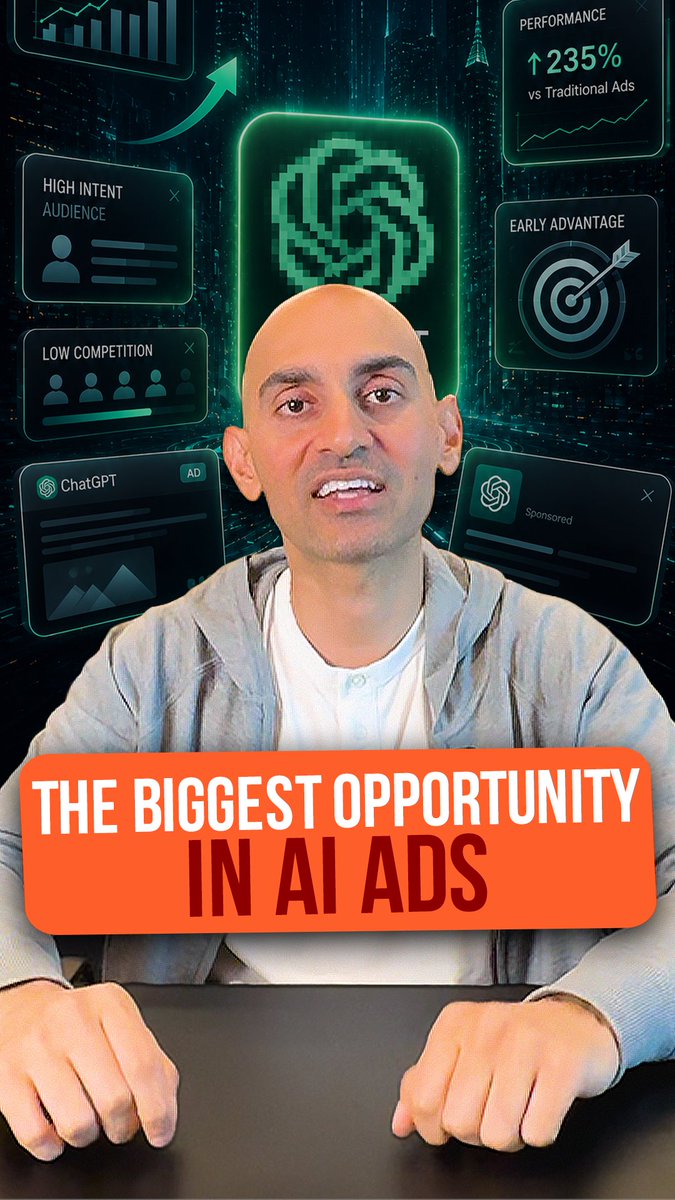
For the first time ever, you can buy ads inside ChatGPT. And because the platform is still new, almost nobody has figured out how to use it properly yet. That means the opportunity is wide open. Here’s what changed. OpenAI launched a self-serve Ads Manager, making ChatGPT ads accessible to businesses that previously would not have been able to participate. You no longer need to be a massive brand with an enormous advertising budget. But these ads work differently from Google. Google usually matches an ad to the words someone searches. ChatGPT looks at the larger context of the conversation and what that person is trying to accomplish. That creates a new challenge: how do you know which conversations your business should appear in? You start with real demand. What are people already searching for in your industry? What questions are they asking? What problems are they trying to solve? And what language do they use to describe those problems? That’s where Ubersuggest comes in. Use it to find the topics people search for most, see how competitive they are and identify where your competitors are already getting attention. Then turn those insights into the conversation themes, ad angles and landing pages you use for your ChatGPT campaigns. The technology is new, but the principle is not: Understand what people want, learn how they talk about it and show up when they are ready to make a decision. The companies that learn this early will have an advantage while everyone else is still trying to understand how it works.

Neil Patel

12,249 Aufrufe • vor 24 Tagen

AI ads will flood your timeline in 2026. That is guaranteed. But the problem is – most AI ad tools don’t work. They produce generic AI slop in large volumes… except that nobody clicks or converts. Agencies are better. But slow and expensive + They can't keep up with how fast we need to test. Last night, I was reading about how DoorDash cut its Customer Acquisition Cost by ~40%, and it hit me. AI + expert people is the solution. It is so obvious, but nobody bothered to pay attention. That’s why all these AI ad companies like Icon, MakeUGC, and Creatify came and went. DoorDash is using Airpost - AI that generates the volume, but actual strategists came from people who've spent $350M+ on ads to make sure it's not garbage. Here's how it actually works: 1. You Connect product URL, assets, past ads. pulls it all in and connects to your ad accounts. It takes about 30 minutes. 2. It scrapes your product, analyzes what's worked, spots gaps in your angles, and builds a "living brief" you can tweak anytime. 3. AI generates dozens of ad scripts like Hooks, angles, variations…using your footage plus their library of 400,000+ UGC clips. 4. Real strategists filter the junk. These are People from Ready Set, Tubescience, who've run campaigns for DoorDash, hims, Coinbase. They know what converts. 5. Airpost sends you 10-100 ready-to-run ads every week. 6. When an ad wins, Airpost AI auto-generates variations. When your messaging changes, ads update with it. No starting over. That's it. No back-and-forth for weeks. No hoping your AI prompt works. Cloaked spent $1M+ on ads made with Airpost. Dr. Squatch uses it to test 100s of variations for their wide range of target audiences. Doordash observed a ~40% drop in CAC. The thing that sold me? 100% of client renewals. Zero churn. Almost impossible to believe, but it's true. In a world where every AI ad tool is dead in 6 months, that says something. If you're a founder or growth marketer spending $250K+/month, you can’t miss this. PS :) I'm giving away a video tutorial on how to set up Airpost's TikTok Creative Intelligence Agent that tracks trends, finds winning hooks, and spots what's working for DTC brands right now. Like, Repost and Drop "CREATIVE" in the comments + follow, and I'll send it over. . . .

Beginnersblog

45,429 Aufrufe • vor 7 Monaten

I just built a self-improving second brain in Claude Code 🤯 A brain that runs your brand: every tool reads from it, it's wired to your live data, and it gets smarter every week. All running on the Claude Agent SDK. Perfect for DTC brands and agencies whose AI output sounds generic because every new chat starts from zero. If you're re-explaining your brand to AI every single time — re-pasting the voice guidelines, re-describing the customer you've described a hundred times, re-uploading the same positioning doc you uploaded yesterday, and still editing for an hour to strip out the generic phrasing... A brand second brain fixes the entire loop: → Build 3 foundation files once: brand DNA, voice, and customer → Every skill you create reads from them automatically → Wire in live data — your ad account, competitor ads, customer reviews → A weekly routine refreshes the brain with what's actually working → Every output comes back on-brand on the first pass No re-briefing AI on every chat. No hour of editing to undo generic phrasing. No brain that goes stale the week after you build it. What a second brain gives you: → The exact 3-file foundation that runs the whole system → The skill structure that makes every tool brand-aware by default → The live-data wiring that keeps it grounded in reality → The weekly self-improvement loop that keeps it sharp → The cold-start sequence to stand it all up from zero Built 100% in Claude Code. I put together the full playbook with the file structure, the wiring, and the exact setup. Want it for free? > Like this post > Comment "BRAIN" And I'll send it over (must be following so I can DM)

Mike Futia

17,996 Aufrufe • vor 2 Monaten

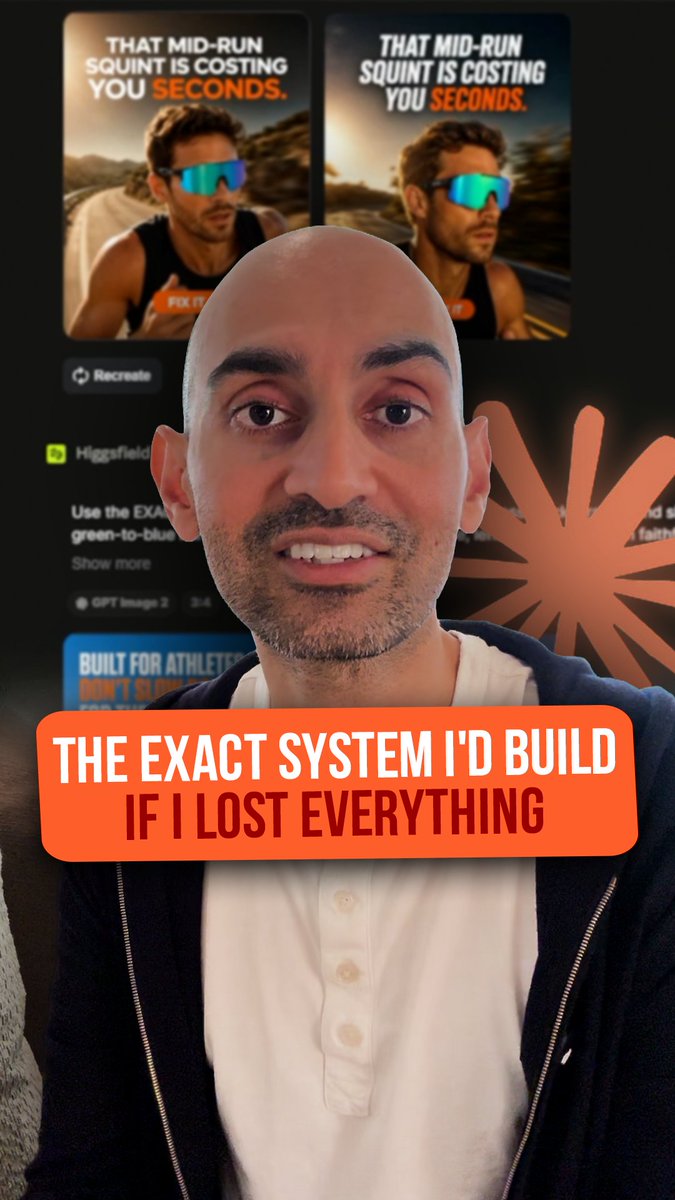
If I had to start from zero tomorrow and bring in new customers fast, here's exactly what I'd build. Top to bottom. I'd start with the ad. Open ChatGPT or Claude, paste in what you sell and who you sell it to, ask it to write you ten different hooks for a Meta ad. Pick the best three. Then jump into or one of the AI video tools and have it generate the visual. Thirty minutes, you've got a real ad ready to run. You run that ad to one landing page. Not your homepage. One page, one offer, one call to action. Headline that stops the scroll, a few lines of value, an email or phone field, a button. That's it. Build it in HighLevel in about twenty minutes, drag, drop, you're done. The second someone enters their email, they drop into your CRM, automatically tagged with where they came from. Now the part most people skip, the follow-up. The moment that form is filled, a sequence kicks off automatically. Email and SMS, spaced over five to seven days. First message thanks them and delivers what you promised. Then a story. Then social proof. Then an objection you know they have. Then the offer. They don't have to think about you. You're showing up in their inbox and their texts at exactly the right time. The last message has a calendar link or a buy button right inside it. They tap, they book, or they buy. Done. The whole flow runs on its own from the ad all the way to the sale. You build it once. It works while you're sleeping. AI does the creative work. The system runs the customer journey. You spend your time on strategy. That's the play.

Neil Patel

39,323 Aufrufe • vor 1 Monat

$PLTR One of the most important parts of the new Karp interview today: “I’ve been in business for a very long time. The reality is, critical infrastructure does not run these models without an application layer. That application layer is our ontology. There’s a reason for it. Some people love me and some people hate me. They’re not buying it because of that. They’re buying it because they have to be made safe. The “I’m gonna trust you because you’ve never lied” bs thing, that just doesn’t cut it at this level.” While you have self proclaimed experts trying to analyze Karp’s communication style for his arguments, it’s obvious to me how many of those experts are missing. the. point. If your best rebuttal is that you don’t like how someone said something vs answering what they said…well good luck in trying to make a compelling case for your side. Many of these “experts” don’t realize that Karp’s style of communication is AUTHENTIC to him and all of his attributes that got millions of individual people to invest in his passion for Palantir in the first place. His argument is that these models DO NOT WANT to help you or your enterprise, they want to sell tokens. They aren’t building trust. They are extracting every little bit of value with fake “forward deployed shops” when most companies have no idea what it means to engage in the art of forward deployed engineering because that would require CARING about your customers for months, many times years, WITHOUT getting paid but just focusing on providing outcomes. Karp is saying the truth and he’s backing that truth with 20 years of a company that has been solely focused on outcomes and has the growth to show how much customers also deeply, deeply care about those outcomes in a world of pure extraction from the frontier model companies. That’s the point and that’s what most of these people are completely missing…which is why Palantir keeps winning. They are making the case for what actually matters in the age of AI.

amit

192,771 Aufrufe • vor 2 Monaten

Rahul Vohra on how to measure product/market fit Rahul Vohra is the founder and CEO of Superhuman. He was looking for a metric to measure product/market fit so that he and his team could optimize, and he came across the following methodology from Sean Ellis: Simply ask your users: “How would you feel if you could no longer use the product?” with three options: (1) not disappointed, (2) somewhat disappointed, or (3) very disappointed. It turns out that the benchmark for product/market fit across hundreds of venture-backed startups is 40% of respondents saying “very disappointed”. And as Rahul puts it: “If more than 40% of your users would be very disappointed without your product, then you should focus on growing your company. If less than 40% of your users would be very disappointed without your product, then you’ll probably struggle to grow.” 40% may not sound like a lot, but it’s an incredibly hard benchmark to beat. For example, Slack posed this to 731 customers early in the company’s history, and 51% said they would be very disappointed without Slack. One might expect a terrific product like Slack to have a score of 60-80%, but that wasn’t the case. Rahul’s explanation of why the response options are focused on disappointment rather than happiness is interesting too: “I think the reason behind that is that if you ask people how they feel about a product and you give them positive potential responses, I think it invites more bias. People are more likely to be polite. And it also doesn’t get to the heart of the matter which is: how necessary has your product become in people’s lives? If you’re trying to build a company that’s going to stand the test of time, you really do have to build a product that matters and that people ultimately come to depend on because it’s just so incredible at what it does. And that’s what this question gets to the heart of.”

Michael McGuiness

67,106 Aufrufe • vor 2 Jahren

“India is not divided by language on the ground… it is divided by politics on social media.” This video itself proves one simple thing: A Tamil Nadu street vendor came to another state, spoke Hindi normally, interacted with customers, sold food, earned money, and people happily bought from him. No hate. No fight. No force. That’s how real India works. The common Indian understands one thing very clearly: Language is a tool for communication, not a weapon for division. If someone goes to Tamil Nadu and learns a few Tamil words out of respect good. If someone from the South speaks Hindi in North India for business convenience also good. If someone uses English because it connects more customers again normal. This is called practicality and coexistence. But the problem starts when political groups, extremist regionalists, and agenda-driven NGOs turn language into an emotional battlefield for votes, identity politics, and division. One day they say: “HINDI IMPOSITION!” Another day the same people use Hindi or English for: • business • YouTube content • movies • tourism • customer dealing • jobs • social media reach Why? Because market decides communication naturally. Nobody forced this vendor. Nobody attacked him for speaking Hindi. Customers understood → business happened. That is organic India. India has always been multilingual: Tamil, Hindi, Marathi, Bengali, Punjabi, Telugu, Kannada, Malayalam, Gujarati, Sanskrit every language is part of Indian civilization. The real civic sense is: “Respect every language, force none.” The moment politicians start telling people: “You are different from them.” “North vs South.” “This language vs that language.” …they create unnecessary poison among people who otherwise live, travel, work, eat, and do business together peacefully every day. A Tamil person working in Delhi, a Punjabi working in Bengaluru, a Marathi businessman in Hyderabad, a North Indian worker in Chennai this is not division. This is India functioning as one nation.

First Witness X

103,534 Aufrufe • vor 3 Monaten