Загрузка видео...

Не удалось загрузить видео

На главную

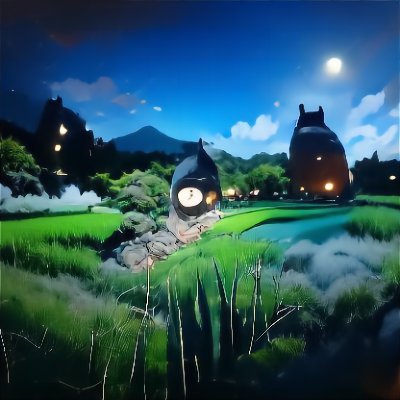
Upscale-A-Video: Temporal-Consistent Diffusion Model for Real-World Video Super-Resolution paper page: Text-based diffusion models have exhibited remarkable success in generation and editing, showing great promise for enhancing visual content with their generative prior. However, applying these models to video super-resolution remains challenging due to the high demands for output fidelity...

32,849 просмотров • 2 лет назад •via X (Twitter)

Комментарии: 1

Фото профиля Constantine Nekh
Constantine Nekh2 лет назад

Seems very promising!

Похожие видео

MagicAnimate: Temporally Consistent Human Image Animation using Diffusion Model with Gradio demo local demo: This paper studies the human image animation task, which aims to generate a video of a certain reference identity following a particular motion sequence. Existing animation works typically employ the frame-warping technique to animate the reference image towards the target motion. Despite achieving reasonable results, these approaches face challenges in maintaining temporal consistency throughout the animation due to the lack of temporal modeling and poor preservation of reference identity. In this work, we introduce MagicAnimate, a diffusion-based framework that aims at enhancing temporal consistency, preserving reference image faithfully, and improving animation fidelity. To achieve this, we first develop a video diffusion model to encode temporal information. Second, to maintain the appearance coherence across frames, we introduce a novel appearance encoder to retain the intricate details of the reference image. Leveraging these two innovations, we further employ a simple video fusion technique to encourage smooth transitions for long video animation. Empirical results demonstrate the superiority of our method over baseline approaches on two benchmarks. Notably, our approach outperforms the strongest baseline by over 38% in terms of video fidelity on the challenging TikTok dancing dataset. Code and model will be made available.

AK

810,578 просмотров • 2 лет назад

DreamCraft3D: Hierarchical 3D Generation with Bootstrapped Diffusion Prior paper page: present DreamCraft3D, a hierarchical 3D content generation method that produces high-fidelity and coherent 3D objects. We tackle the problem by leveraging a 2D reference image to guide the stages of geometry sculpting and texture boosting. A central focus of this work is to address the consistency issue that existing works encounter. To sculpt geometries that render coherently, we perform score distillation sampling via a view-dependent diffusion model. This 3D prior, alongside several training strategies, prioritizes the geometry consistency but compromises the texture fidelity. We further propose Bootstrapped Score Distillation to specifically boost the texture. We train a personalized diffusion model, Dreambooth, on the augmented renderings of the scene, imbuing it with 3D knowledge of the scene being optimized. The score distillation from this 3D-aware diffusion prior provides view-consistent guidance for the scene. Notably, through an alternating optimization of the diffusion prior and 3D scene representation, we achieve mutually reinforcing improvements: the optimized 3D scene aids in training the scene-specific diffusion model, which offers increasingly view-consistent guidance for 3D optimization. The optimization is thus bootstrapped and leads to substantial texture boosting. With tailored 3D priors throughout the hierarchical generation, DreamCraft3D generates coherent 3D objects with photorealistic renderings, advancing the state-of-the-art in 3D content generation.

AK

161,530 просмотров • 2 лет назад

SORA by Hand ✍️ OpenAI’s #SORA took over the Internet when it was announced earlier this year. The technology behind Sora is the Diffusion Transformer (DiT) developed by William Peebles and Shining Xie. How does DiT work? 𝗚𝗼𝗮𝗹: Generate a video conditioned by a text prompt and a series of diffusion steps [1] Given ↳ Video ↳ Prompt: "sora is sky" ↳ Diffusion step: t = 3 [2] Video → Patches ↳ Divide all pixels in all frames into 4 spacetime patches [3] Visual Encoder: Pixels 🟨 → Latent 🟩 ↳ Multiply the patches with weights and biases, followed by ReLU ↳ The result is a latent feature vector per patch ↳ The purpose is dimension reduction from 4 (2x2x1) to 2 (2x1). ↳ In the paper, the reduction is 196,608 (256x256x3)→ 4096 (32x32x4) [4] ⬛ Add Noise ↳ Sample a noise according to the diffusion time step t. Typically, the larger the t, the smaller the noise. ↳ Add the Sampled Noise to latent features to obtain Noised Latent. ↳ The goal is to purposely add noise to a video and ask the model to guess what that noise is. ↳ This is analogous to training a language model by purposely deleting a word in a sentence and ask the model to guess what the deleted word was. [5-7] 🟪 Conditioning by Adaptive Layer Norm [5] Encode Conditions ↳ Encode "sora is sky" into a text embedding vector [0,1,-1]. ↳ Encode t = 3 to as a binary vector [1,1]. ↳ Concatenate the two vectors in to a 5D column vector. [6] Estimate Scale/Shift ↳ Multiply the combined vector with weights and biases ↳ The goal is to estimate the scale [2,-1] and shift [-1,5]. ↳ Copy the result to (X) and (+) [7] Apply Scale/Sift ↳ Scale the noised latent by [2,-1] ↳ Shifted the scaled noised latent by [-1, 5] ↳ The result is "conditioned" noise latent. [8-10] Transformer [8] Self-Attention ↳ Feed the conditioned noised latent to Query-Key function to obtain a self-attention matrix ↳ Value is omitted for simplicity [9] Attention Pooling ↳ Multiply the conditioned noised latent with the self-attention matrix ↳ The result are attention weighted features [10] Pointwise Feed Forward Network ↳ Multiply the attention weighted features with weights and biases ↳ The result is the Predicted Noise 🏋️‍♂️ 𝗧𝗿𝗮𝗶𝗻 [11] ↳ Calculate MSE loss gradients by taking the different between the Predicted Noise and the Sampled Noise (ground truth). ↳ Use the loss gradients to kick off backpropagation to update all learnable parameters (red borders) ↳ Note the visual encoder and decoder's parameters are frozen (blue borders) 🎨 𝗚𝗲𝗻𝗲𝗿𝗮𝘁𝗲 (𝗦𝗮𝗺𝗽𝗹𝗲) [12] Denoise ↳ Subtract the predicted noise from the noised latent to obtain the noise-free latent [13] Visual Decoder: Latent 🟩 → Pixels 🟨 ↳ Multiply the patches with weights and biases, followed by ReLU [14] Patches → Video ↳ Rearrange patches into a sequence of video frames.

Tom Yeh

238,166 просмотров • 2 лет назад

InstantDrag Improving Interactivity in Drag-based Image Editing discuss: Drag-based image editing has recently gained popularity for its interactivity and precision. However, despite the ability of text-to-image models to generate samples within a second, drag editing still lags behind due to the challenge of accurately reflecting user interaction while maintaining image content. Some existing approaches rely on computationally intensive per-image optimization or intricate guidance-based methods, requiring additional inputs such as masks for movable regions and text prompts, thereby compromising the interactivity of the editing process. We introduce InstantDrag, an optimization-free pipeline that enhances interactivity and speed, requiring only an image and a drag instruction as input. InstantDrag consists of two carefully designed networks: a drag-conditioned optical flow generator (FlowGen) and an optical flow-conditioned diffusion model (FlowDiffusion). InstantDrag learns motion dynamics for drag-based image editing in real-world video datasets by decomposing the task into motion generation and motion-conditioned image generation. We demonstrate InstantDrag's capability to perform fast, photo-realistic edits without masks or text prompts through experiments on facial video datasets and general scenes. These results highlight the efficiency of our approach in handling drag-based image editing, making it a promising solution for interactive, real-time applications.

AK

71,232 просмотров • 1 год назад