Загрузка видео...

Не удалось загрузить видео

На главную

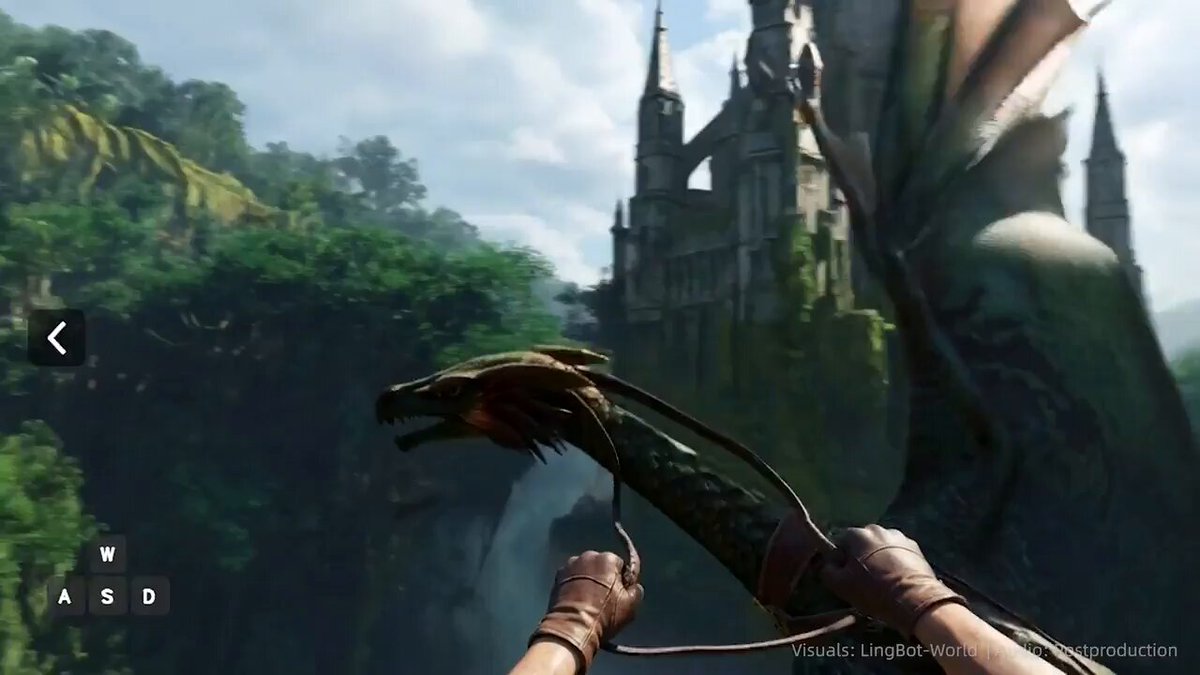
🔥 Very excited to share that we’re releasing LingBot-World 🌍 Robbyant — an open-source frontier world model! We’re pushing the limits of: 🔹 High-Fidelity Simulation & Precise Control 🔹 Long-Horizon Consistency & Memory 🔹 Modeling Physical & Game Worlds The most surprising part? The emergence of sophisticated behaviors that...

41,657 просмотров • 7 месяцев назад •via X (Twitter)

Комментарии: 0

Нет доступных комментариев

Здесь появятся комментарии из оригинального поста
Похожие видео

JARVIS-1: Open-World Multi-task Agents with Memory-Augmented Multimodal Language Models paper page: Achieving human-like planning and control with multimodal observations in an open world is a key milestone for more functional generalist agents. Existing approaches can handle certain long-horizon tasks in an open world. However, they still struggle when the number of open-world tasks could potentially be infinite and lack the capability to progressively enhance task completion as game time progresses. We introduce JARVIS-1, an open-world agent that can perceive multimodal input (visual observations and human instructions), generate sophisticated plans, and perform embodied control, all within the popular yet challenging open-world Minecraft universe. Specifically, we develop JARVIS-1 on top of pre-trained multimodal language models, which map visual observations and textual instructions to plans. The plans will be ultimately dispatched to the goal-conditioned controllers. We outfit JARVIS-1 with a multimodal memory, which facilitates planning using both pre-trained knowledge and its actual game survival experiences. In our experiments, JARVIS-1 exhibits nearly perfect performances across over 200 varying tasks from the Minecraft Universe Benchmark, ranging from entry to intermediate levels. JARVIS-1 has achieved a completion rate of 12.5% in the long-horizon diamond pickaxe task. This represents a significant increase up to 5 times compared to previous records. Furthermore, we show that JARVIS-1 is able to self-improve following a life-long learning paradigm thanks to multimodal memory, sparking a more general intelligence and improved autonomy.

AK

141,440 просмотров • 2 лет назад

We've officially released and open-sourced HunyuanImage 2.1, our latest text-to-image model. The new model delivers on our commitment to balancing performance and quality. With native 2K image generation, HunyuanImage 2.1 is an advanced open-source text-to-image model.🎨 ✨ New in 2.1: 🔹Advanced Semantics: Supports ultra-long and complex prompts of up to 1000 tokens, and precisely controls the generation of multiple subjects in a single image. 🔹Precise Chinese and English Text Rendering with seamless image–text integration: The model naturally integrates text into images, making it suitable for a wide range of applications such as product covers, illustrations, and poster design to meet the needs of various fields. 🔹Rich Styles and High Aesthetic: Capable of generating images in various styles—including photorealistic portraits, comics, and vinyl figures—it delivers outstanding visual appeal and artistic quality. 🔹High-Quality Generation: Efficiently produces ultra-high-definition (2K) images in the same time other models take to generate a 1K image. HunyuanImage 2.1 uses two text encoders: a multimodal large language model (MLLM) to improve the model's image and text alignment capabilities, and a multi-language character-aware encoder to improve text rendering capabilities. The model is a single- and double-stream diffusion transformer with 17B parameters. We've also open-sourced the weights of the the accelerated version with meanflow which reduces inference steps from 100 to just 8, and PromptEnhancer, the first industrial-grade rewriting model that enhances your prompts for more nuanced and expressive image generation. Now, creators turn complex ideas—like posters with slogans or multi-panel comics—into visuals faster than ever. We’re just getting started. Stay tuned for our native multimodal image generation model coming soon. 🌐Website: 🔗Github: 🤗Hugging Face: ✨Hugging Face Demo:

Tencent Hy

89,257 просмотров • 1 год назад

This is THE moment of Physical AI! We are officially announcing Cosmos 3: Omnimodal World Models for Physical AI 🚀 - Cosmos 3 is an omnimodal world model: within a unified architecture, it can understand and generate language, images, video, audio, and actions. - It is not just a VLM, not just a video generator, not just an audio-visual generative model, and not just a physics simulator / world-action model. It can understand images and videos, generate images, videos, and audio, simulate future worlds, predict actions, and generate robot policies—enabling models to truly begin to “touch the world.” - Cosmos 3 is the #1 open-weight reasoner / T2I / I2V / robot policy across many benchmarks. Huge thanks to every teammate who fought side by side on this journey—from architecture, data, training, infra, serving, and evaluation to post-training. Every part of this project carries an incredible amount of hard work. This was my first time leading a project as Tech Lead, and I feel truly fortunate. The future of Physical AI needs models that can not only “see” and “describe” the world, but also “imagine,” “simulate,” and “act”—and eventually close the loop with the real world. I hope Cosmos 3 can become an important starting point for this direction, and I’m excited to push Physical AI into its next stage together with the open-source community. Welcome to the era of Physical AI. HuggingFace: Project Website: Code:

Max Zhaoshuo Li 李赵硕

1,078,895 просмотров • 3 месяцев назад

Tencent presents GameGen-O Open-world Video Game Generation We introduce GameGen-O, the first diffusion transformer model tailored for the generation of open-world video games. This model facilitates high-quality, open-domain generation by simulating a wide array of game engine features, such as innovative characters, dynamic environments, complex actions, and diverse events. Additionally, it provides interactive controllability, thus allowing for the gameplay simulation. The development of GameGen-O involves a comprehensive data collection and processing effort from scratch. We collect and build the first Open-World Video Game Dataset (OGameData), amassed extensive data from over a hundred of next-generation open-world games, employing a proprietary data pipeline for efficient sorting, scoring, filtering, and decoupled captioning. This robust and extensive OGameData forms the foundation of our model's training process. GameGen-O undergoes a two-stage training process, consisting of foundation model pretraining and instruction tuning. In the first phase, the model is pre-trained on the OGameData via the text-to-video and video continuation, endowing GameGen-O with the capability for open-domain video game generation. In the second phase, the pre-trained model is frozen, and we fine-tuned using a trainable InstructNet, which enables the production of subsequent frames based on multimodal structural instructions. This whole training process imparts the model with the ability to generate and interactively control content. In summary, GameGen-O represents a notable initial step forward in the realm of open-world video game generation via generative models. It underscores the potential of generative models to serve as an alternative to rendering techniques, which can efficiently combine creative generation with interactive capabilities.

AK

367,229 просмотров • 2 лет назад

🚀 Announcing Echo — our new frontier model for 3D world generation. Echo turns a simple text prompt or image into a fully explorable, 3D-consistent world. Instead of disconnected views, the result is a single, coherent spatial representation you can move through freely. This is part of a bigger shift in AI: from generating pixels and tokens to generating spaces. Echo predicts a geometry-grounded 3D scene at metric scale, meaning every novel view, depth map, and interaction comes from the same underlying world — not independent hallucinations. Once generated, the world is interactive in real time. You control the camera, explore from any angle, and render instantly — even on low-end hardware, directly in the browser. High-quality 3D world exploration is no longer gated by expensive equipment. Under the hood, Echo infers a physically grounded 3D representation and converts it into a renderable format. For our web demo, we use 3D Gaussian Splatting (3DGS) for fast, GPU-friendly rendering — but the representation itself is flexible and can be easily adapted. Why this matters: consistent 3D worlds unlock real workflows — digital twins, 3D design, game environments, robotics simulation, and more. From a single photo or a line of text, Echo builds worlds that are reliable, editable, and spatially faithful. Echo also enables scene editing and restyling. Change materials, remove or add objects, explore design variations — all while preserving global 3D consistency. Editing no longer breaks the world. This is only the beginning. Echo is the foundation for future world models with dynamics, physical reasoning, and richer interaction — environments that don’t just look right, but behave right. Explore the generated worlds on our website and sign up for the closed beta. The era of spatial intelligence starts here. 🌍 #Echo #WorldModels #SpatialAI #3DFoundationModels Check it out:

SpAItial AI

176,524 просмотров • 8 месяцев назад