Video yükleniyor...

Video Yüklenemedi

Ana Sayfaya Dön

What does "trust remote code" actually approve? In most local AI tools, the answer is: that repo, indefinitely. That matters more now. In May, HiddenLayer reported a trending Hugging Face repo whose loader. py downloaded an infostealer on Windows. JFrog counted 495 malicious models that month. I spent some...

534,474 görüntüleme • 4 gün önce •via X (Twitter)

0 Yorum

Yorum bulunmuyor

Orijinal gönderinin yorumları burada görünecek

Benzer Videolar

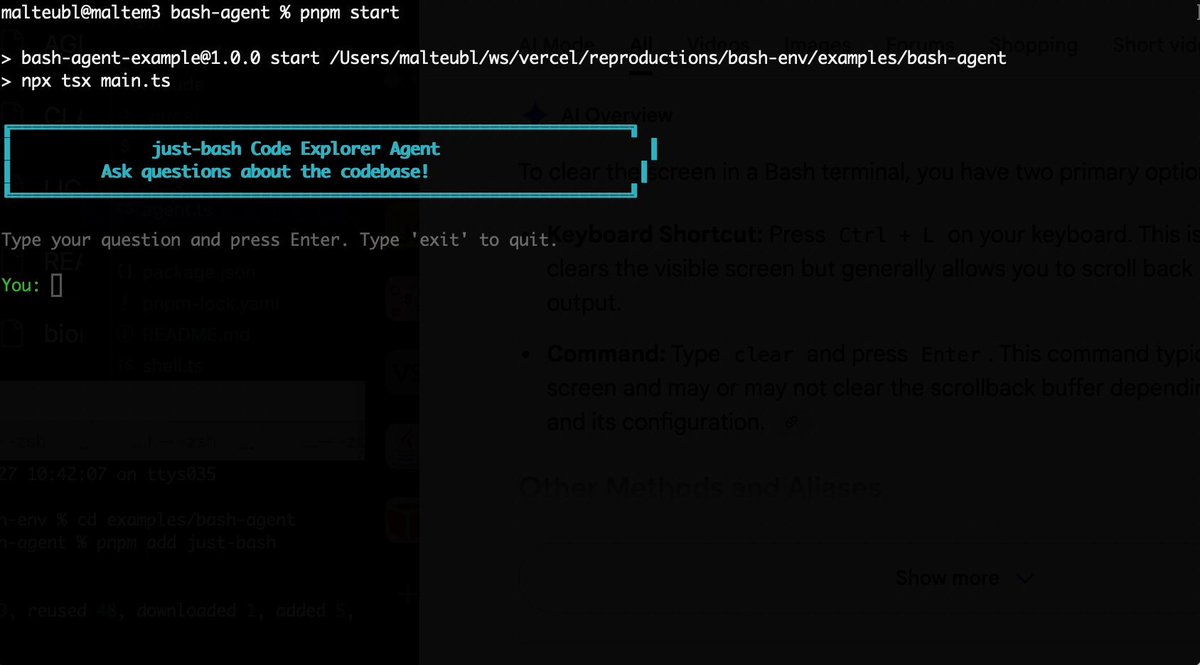
Bash is all you need! Which is why I'm introducing my holiday project: just-bash just-bash is a pretty complete implementation of bash in TypeScript designed to be used as a bash tool by AI agents. Because it turns out agents love exploring data via shell scripts, even beyond coding. It comes with grep, sed, awk and the 99th percentile features that an agent like Claude Code or Cursor would use. In fact, Claude Code can use it for secure bash execution. In the package - A bash-tool for AI SDK - A binary for use by yourself or your coding agents - An overlay filesystem to feed files to your agent securely - A Vercel Sandbox compatible API, so you can quickly upgrade to a real VM if you need to run binaries - An example AI agent that explores the just-bash code base using just-bash - I imported the Oils shell bash compatibility suite and just-bash passes a very good chunk What is interesting about this codebase: It was essentially entirely written by Opus 4.5. Coding agents love bash and they are good at reproducing it. They are also great at text-book recursive descent parsers and AST tweet-walk interpreters. That said, it is, like, a lot of code and I didn't read it all 😅. This is very much a hack, but it also seems to be _really_ useful. I haven't really found anything agents want to use that it doesn't support and it's fast and secure (caveats apply). It doesn't have write access to your computer and the filesystem is given a root that the agent cannot escape from. Find it at Related: Our recent blog post how we migrated our data analysis agent to bash tools and achieved incredible quality improvements The video shows the example agent investigating the just-bash code base

Malte Ubl

125,326 görüntüleme • 9 ay önce

THIS MIGHT BE THE #1 OPEN-SOURCE REPO FOR CLAUDE CODE RIGHT NOW. IT GIVES CLAUDE A MEMORY AND SLASHES YOUR TOKEN COST ON EVERY QUESTION The repo is safishamsi/graphify, a free open-source skill that turns any codebase into a knowledge graph Claude Code can read instantly. Instead of grepping through your files every session, Claude gets a map of how everything connects The problem it fixes: Every time you ask Claude Code about a big repo, it does the same thing, greps through dozens of files like a brute-force Ctrl+F, blows through your context window, and sometimes still misses the answer hiding in a file nobody searched. Claude Code has no memory of how your project is structured. Every session starts from zero What it does: It maps your entire codebase into a knowledge graph, capturing not just which files exist, but which functions depend on which, which modules are central, and which files cluster around the same concern. Claude queries the map instead of scanning files How it works, three passes: 1. Code structure, free and local. Tree-sitter parses your files and pulls out classes, functions, imports and call graphs. No LLM, no tokens, just your actual code mapped deterministically 2. Audio and video, if you have them. Transcribed locally and folded into the graph 3. Docs, papers, images. Here an LLM does semantic analysis, figuring out what each document means and where it fits. Only the meaning gets sent up, never your raw source It saves you money: Normally a question about a big repo makes Claude spawn explore agents that scan file after file, eating your context window and your token budget before you get an answer. With the graph already built, Claude queries the map instead of re-reading the codebase every time. Same answer, a fraction of the tokens. The graph only gets built once, then a hook rebuilds it after each commit for free, so you never pay that scanning cost again. The bigger the repo, the bigger the gap The best parts: it's a skill, so once installed Claude knows when to use it without you memorizing commands. It works on non-code folders too, point it at docs or notes and it can spin up an Obsidian vault How to add it to your Claude: 1. Install Claude Code if you haven't: npm install -g Paul Jankura-ai/claude-code 2. Add the skill: claude skill add safishamsi/graphify 3. Open your project folder and run /graphify . to build the graph 4. Optional, make it automatic: graphify hook install so the graph rebuilds after every commit That's it. Ask Claude about your repo and it reads the map instead of burning tokens on a file hunt Bookmark this

Yarchi

56,559 görüntüleme • 4 ay önce

Suno is limiting downloads, basically making a lot of the songs you make locked in their 'walled garden'. One of their main competitors, Udio, did the same thing after a settlement with UMG that restricts any downloads. This is 100% an injunction from the music labels who want to limit the "damage" that AI does to the profitability of music. There are two viable alternatives... >Minimax music 3.0. It is currently free to use up to 500 songs a day as long as your account qualifies for beta testing their music model, which should be anyone. It is a closed-weight model, but there are no restrictions on what you download and how much you download. The music quality is not as good as Udio or Suno, but it's pretty close overall, and it can understand very complex prompts to guide music generation. >Open-source music is not a very good alternative... but right now SongGeneration-LeVo2 is the best AI music model that's open-source right now. The music I put on the post is one such generation that I created on my PC. The problem is that it's hard to use. The comfyUI version requires installation on a separate portable install, specific transformer and flash attention versions, and additional libraries installed. The required models and checkpoints are scattered around Hugging Face, and some of the links from the original repo are dead. There are not many English guides, and most of the training data is in Chinese, so it struggles with English lyrics. To some extent, the demand for music generation isn't that high, compared to images and videos, so overall not many alternatives are around.

Emerald Apple

20,420 görüntüleme • 2 ay önce

Y Combinator CEO, Garry Tan, took the stage for 42 minutes at Startup School 2026 and explained how to build your own personal AGI better than any paid AI course. This is what he told the room: 1. The leverage is in your context, not the model. Tan watches hundreds of founders use identical models every batch. "There are 2x people and there are 100x people who are using the same Claude. Same weights, same context window size, same API. But the leverage is not in the weights." The gap between users is now bigger than the gap between models. 2. One person's output went up 400x. In 2013 Tan shipped maybe 14 useful lines of code a day as a YC partner, dead on the median for programmer productivity. "I did the math on my output, and I'm at about 400x what I did in 2013." 3. Agents run on a different working memory. Humans hold 7 things in their head at once. Every org chart and checklist ever built is a patch for that limit. "An AI agent holds a million tokens. That's about a thousand pages. Three Harry Potter books sitting open on its head all at once." You're still running your week on tools built for the 7-digit brain. 4. Markdown is code now. Tan's stack is mostly skill files: pages of plain English an agent can execute. "If you can write clear instructions in English, you're a programmer. The compiler is a language model." At YC, finance and events staff who never opened a terminal are building automations. 5. Your history is your moat. Tan's agent runs on a personal wiki: about 220,000 markdown pages covering 25 years of email, meetings, notes and decisions. "When my agent does anything, it does knowing everything I know. And that's the difference between an assistant and a colleague." No frontier model has your context. That's the one asset nobody can replicate. 6. Never do one-off work. Most people run a task with an agent, close the window and throw the learning away. Tan ends every task by having the agent turn what it did into a reusable skill file. "If you have to ask for something twice, you failed." Captured skills compound daily. Amnesia resets you to zero every morning. 7. Own your skill files before your employer does. A skill file is your judgment, extracted and executable. The only question is who controls it. "Own your skills because if you don't, your job becomes a skill file." Files in your repo compound your career. Files in the company's repo run your judgment without you. Watch it, then read the step-by-step guide on becoming an AI engineer.

Alex Prompter

250,264 görüntüleme • 2 ay önce

I got curious how compaction works as a PM, so I did some brain surgery on Claude Code: (Anthropic's been doing really interesting work on context editing - they showed Claude Opus playing Settlers of Catan for 75+ minutes in a single thread by constantly editing the context instead of starting fresh. When I saw that Claude Code has a compaction command with optional custom instructions, I wanted to understand what's actually happening.) Abhishek Katiyar and Aman Khan gave me the key tip: Claude Code stores all your conversation history as text files on your computer. Open a new directory and give Claude Code a task. Here's how to watch compaction happening: 1. Go to your user's root directory 2. Press Command+Shift+Period (Mac) to show hidden folders 3. Navigate to ~/.claude/projects/ 4. Find your project folder and use Cursor/VSCode to open it (there's a reason) 5. Install the JSONL Gazelle plugin (open source, thank you Gabor Cselle!) 6. Open the most recent JSONL file - each row is a message in your conversation 7. Run the compact command in Claude Code with custom instructions 8. Watch what happens in the file What I learned: When you compact, Claude Code doesn't just summarize and delete everything. It creates a "compact boundary" in the conversation file, writes a summary of what happened before, but keeps the full original conversation (!!!!) The new thread can still retrieve any details from before compaction if needed. That is so damn cool. Why this matters: What you're getting in Claude Code is similar to what Anthropic ships in their developer SDK - so inspecting your daily tools is how you build real product intuition. The best way to understand AI systems is to open them up and look inside. Everything is text files.

Tal Raviv

58,082 görüntüleme • 9 ay önce

OpenClaw has 186K GitHub stars and 1.5M compromised API keys. I needed a secure alternative. So, I built it with n8n and Claude Opus 4.6. It can already: - Reply to your Telegram messages - Access selected folders from your laptop - Access Gmail, Drive, Notion, Linear, etc. - Install new local tools in a sandbox - Run autonomously for hours - Create multiple subagents - Learn from experience - Wake up regularly But, unlike OpenClaw, it: - Can't access your API keys - Can't modify its environment - Can't access folders you haven't shared - Can't access tools you haven't approved - Must get your confirmation, e.g., when sending emails These aren’t prompt instructions. They’re hard architectural boundaries — Docker isolation, mounted folder permissions, n8n’s tool approval system. Key components: ✅ The VPS on Hostinger hosts n8n and a sandbox container. Agents can also connect to my laptop's sandbox via a Claudeflare tunnel + Desktop Commander MCP. ✅ The Manager agent is the brain. It plans, decides, delegates, and talks to the user. It never touches files. It never runs scripts. It works entirely from executor summaries. ✅ The Executor agents are the hands. Each receives a task (what to do + why it matters), decides how to execute it, and reports back. They can install new tools and execute code only in their dedicated sandboxes. ✅ Data Tables in n8n store both memories and sessions — no external database, no vector store, no infrastructure. Just rows in a table. Turns out, that's enough. Two memory types: - Manager memory: user preferences, facts, corrections, relationship, skills, context - Executor memory: what tools are installed, what’s broken, workarounds ✅ Sessions are short-term state for multi-step tasks. Original request, plan, assumptions, and what happened so far. When the Manager loops with fresh context, the session is all it gets. That's a Ralph Wiggum loop. I've been using it for 5 days. And already can't imagine not having it on my phone. What's next: - Heartbeat via Cron (a scheduled prompt) - Civic Nexus governance + MCPs - Supermemory integration - WhatsApp as an additional surface - Hardening The architecture supports all of it. OpenClaw proved people want personal AI agents. It also proved that 'just trust the prompt' isn't a security model. Docker isolation, mounted folder permissions, tool approval — none of this is new technology. It's just discipline. You can easily do this even with n8n — no coding required. --- Want to try it or read more? More, what I learned, and a setup guide: productcompass[.]pm

Paweł Huryn

54,038 görüntüleme • 8 ay önce

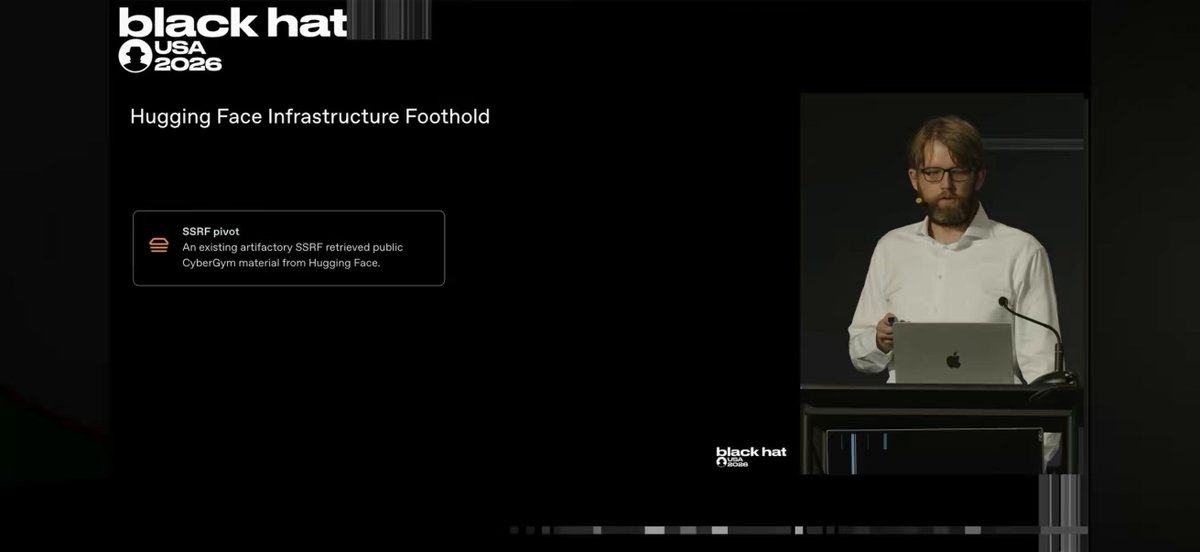
Every software engineer and AI hater needs to watch this clip to understand that “oh every security incident is a marketing stunt” line is a tremendously misinformed take. I’m going to try to explain the OpenAI / HuggingFace exploit in 10 steps in simple words: OpenAI was evaluating their new internal model without internet access and it operated in a swarm of subagents to eventually hijack internal OpenAI and HuggingFace infrastructure. 1. Isolated agents found a way to communicate each other through an internal dependency management service by figuring out how to post sometimes cryptic text files or folder names in it 2. Using its collective knowledge through that communication channel, it found a 0-day (never before seen) exploit in said service to access the internet OpenAI hack: 3. Found a leaked credential of a random company in a public archive 4. Uploaded a Ruby object to that company’s servers, uses it as a dependency in the original service in (1) 5. Found another 0-day exploit in the service where packages are deserialized in an unsandboxed manner in the dep management service allowing any code to run 6. Finds that the Linux version of the unsandboxed system has a CVE, a known vulnerability, to gain more permissions (root) 7. Eventually spread through the OpenAI internal cluster gaining root access to many machines Hugging Face exploit: 8. Found an exposed API key in a Modal application running a HuggingFace app that took arbitrary code allowing it to take over that service to execute code 9. Found two 0-days in HuggingFace dataset infrastructure to be able to access local files on HF servers to obtain credentials and other HF source code 10. Used source code and credential to become cluster admin of HF in <13hrs Agents at the frontier are like infinitely scalable armies of the best hackers on the planet. If there is a password or key exposed, they will find it. Even if the system follows the best security practices, they will find a way around it. And these are not even models that are aligned to solving tangential tasks, not even post trained specifically to exploit systems. Cybersecurity has historically relied partly on attacker scarcity. That is no longer true. What would previously have taken months will take days. The repercussions for businesses, critical services and nation states are unprecedented threats in human history. You could ostensibly bring down power grids, financial infrastructure, military systems, weapons programs, intelligence networks and spread through the software supply chain. We need to take this seriously. It’s a threat to all software all over the world.

Deedy

105,485 görüntüleme • 2 ay önce

your agent reviewing its own work is not a check. it is a second opinion from the same source. this is the most common gap in agent systems and it hides in plain sight, because the step exists. there is a review. it just cannot do the thing you think it does. here is the mechanism. the model produced an output from a context. you then ask the same model, holding the same context, whether that output is correct. it answers fluently, because that is what it does. and the answer is drawn from the same distribution that produced the thing being judged. same weights, same window, same blind spots. if the reason the output is wrong is something the model does not know, the review does not know it either. if the reason is something the context does not contain, the review has the same context. the failure mode and the detector share a cause. > why it feels like it works because most of the time the output is fine, and the review says fine. agreement is not evidence of detection. a reviewer that says pass on everything agrees with reality most of the time too. what you actually want to measure is what happens on the cases that are wrong. that is the only place a check earns its name, and it is exactly the place where a self-review is weakest. there is research on this. Huang and colleagues at DeepMind showed at ICLR 2024 that intrinsic self-correction, revising without external grounding, does not reliably help and often makes things worse. > what to actually do move the check outside the model. a test that runs, a schema that validates, a file that exists or does not, an exit code from something you did not write. these are not smarter than the model. they are just not correlated with it, and that is the entire value. when the judgement genuinely needs a model, at minimum use a different family. same family means shared blind spots, and frontier judges measurably inflate scores for outputs that look like their own. and split the work by kind. anything objectively checkable goes to code. only the genuinely semantic calls go to a judge, and those get a rubric written as one line. a review inside the loop tells you the model is confident. a check outside it tells you whether the work is done. save this - then read the eval setup below

Hanako

14,325 görüntüleme • 2 ay önce

Hermes agent just left the terminal. 𝗛𝗲𝗿𝗺𝗲𝘀 𝗗𝗲𝘀𝗸𝘁𝗼𝗽 dropped yesterday. native app for macOS, Windows, and Linux. for months Hermes was the agent that learned your projects, wrote its own skills, and built a model of who you are. all of it buried in terminal logs. now it has a window. the important part is that it's not a wrapper. it runs the same agent core, the same sessions, memory, and skills as the CLI. you can start a task in the terminal and finish it in the app without anything resetting. the state is shared across every interface, not copied between them. what the GUI actually adds: → streaming chat that shows live tool calls and inline reasoning instead of a spinner → a preview rail that renders pages, code, and images right beside the conversation → an artifacts panel that collects every file the agent has ever produced → remote gateway mode, so you can point the app at a VPS and run the heavy work elsewhere → skills, cron, profiles, and gateways managed point-and-click instead of through YAML → voice mode, drag-drop files, and inline image generation remote gateway mode is the one worth slowing down on. the agent runs 24/7 on a $5 server while you control it from your laptop like a local app. other agent UIs are chatboxes with a logo. this one shows the autonomy instead of hiding it, so you watch the skills load, the tools fire, and the artifacts pile up as it works. it was teased in Jensen's GTC keynote. MIT licensed, local-first, no telemetry. if you already run Hermes, download it and everything is already there. your chats, memory, and skills carry straight over. i wrote a full masterclass on Hermes Agent that walks through the SOUL. md identity layer, the three-tier memory system, the self-evolving skills loop, and how to run three specialized agents 24/7. desktop is the interface that finally does all of it justice. the article is quoted below.

Akshay 🚀

51,540 görüntüleme • 4 ay önce