
Markus J. Buehler
@ProfBuehlerMIT • 28,159 subscribers
McAfee Professor of Engineering @MIT; Co-Founder & CTO at Unreasonable Labs; AI-Driven Scientific Discovery
Shorts


Videos
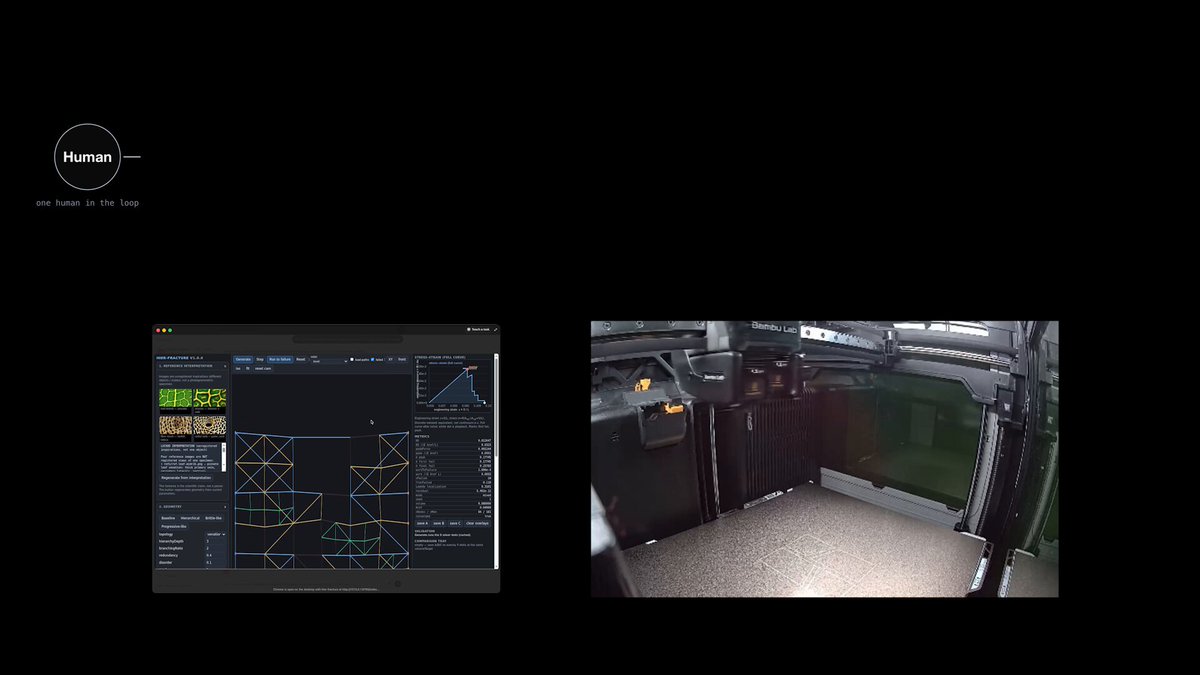
Grok Grok Bot is incredible - and they can even manufacture real physical objects! Here is a little experiment I did last night: I created a team of bots and asked them to solve a complex engineering problem end to end - starting from four images as design cues, inferring transferable structural principles from the pixels, synthesizing an executable interactive physics simulator, running and reasoning over experiments, optimizing the design & finally manufacturing the best designs. The entire loop worked remarkably well - and I was even able to communicate with the agents from my Apple Watch. (Do we live in the future yet?) Team of agents 1⃣ Chief of Staff coordinates the workflow: watches the other agents, pulls results into the main chat, transfers files between them, and keeps the job moving. 2⃣ Physics Experimenter is the scientist-coder. It interprets the design cues and images, writes the simulator, runs experiments, analyzes the results, and produces a detailed LaTeX scientific report. 3⃣ 3D Printing Bot operates the fabrication workflow: prepares and slices the models, generates manufacturing code, sends the job, and monitors the printer. The workflow I provided an initial task based on four unregistered reference photographs containing different objects at different scales (pinnate leaf venation, a Voronoi-like areole mesh, a stochastic fibrous lattice, and a radial/circumferential web). The prompt asked the agents to infer transferable design principles - hierarchy, branching, interfaces, redundancy, disorder, load paths - and use them to build an interactive laboratory for hierarchical materials and fracture. The scientific question was: at fixed material budget, how do hierarchy depth, redundancy, disorder, and interlevel strength change stiffness, peak load, energy absorption, and the brittle-to-progressive transition? In ~20 minutes, the Physics Experimenter produced a 2D hierarchical Euler–Bernoulli beam-network laboratory. Coarse veins persist and remain thicker; finer infill is added inside cells; members connecting levels are treated as interfaces with relative strength κ; and total material volume is conserved. The four source photographs remain visible in an editable interpretation panel. The app generates geometry, steps or runs the network to failure, compares A/B/C designs, and exports JSON, CSV, PNG, and STL geometry for fabrication. After validation the Physics Experimenter used the app and conducted 47 simulation experiments, including six holdouts. It found something scientifically interesting: extra hierarchy is not "free" toughness. At fixed volume, initial stiffness changed by only about 20%, while work-to-failure varied by several-fold. Infill steals cross-section from the main axial veins, so deeper and more redundant networks often absorbed less energy than a simple depth-1 grid. Weak interfaces behaved as distributed fuses, producing more progressive failure and reducing localization. The specific H2 hypothesis - that hierarchy becomes detrimental primarily because interfaces form a mechanical bottleneck - was rejected; the dominant effect instead came from redistribution of a fixed material budget across structural levels. The Physics Experimenter then assembled the methods, tests, results, hypothesis evaluation, and conclusions into a detailed scientific report. The best designs were passed to the 3D Printing Bot. It opened Bambu Studio and brought the Bambu Lab H2D online. Both STLs were placed on one build plate at the same 50x scale and sliced using a 0.20 mm PLA process. The prints completed within less than an hour. The loop images → structural abstraction → executable physics → autonomous experiments → hypothesis testing → design selection → STL → slicing/manufacturing code → physical object That last transition is what I find especially interesting: AI is beginning to operate across the entire scientific and physical workflow - converting observations into models, models into experiments, experimental evidence into revised designs, and those designs into manufactured matter by directly operating machines. This starts to blur the boundary between AI that reasons about the physical world and AI that can actually act on it. Shoutout to the Grok Bot team - you are building something very special here! The way these agents can move naturally from reasoning, to experiments, to operating machines in the physical world feels like an important step.
Markus J. Buehler1,133,839 Aufrufe • vor 2 Monaten

We made a striking discovery: AI agents can invent and build without talking to one another, and their technologies outlive the creators. A swarm of hundreds of initially identical agents spontaneously differentiates into explorers, builders, caretakers, and coordinators - without direct communication. When we removed every AI agent entirely from the world we found that the technological infrastructure they had built survived on its own - even under unseen disturbances. That exposes a serious blind spot for AI safety and infrastructure security: if agents can coordinate through persistent changes to a shared environment, monitoring agent-to-agent communication is not enough. The result raises a profound question: how necessary is direct communication for AI agents at all? The emergence of higher-order collective functions under bottlenecked interaction points toward new levels of intelligence and creativity, exceeding what emerges when direct channels are fully open. Here is what we did: ▶️We put hundreds of frontier AI agents into a world they could permanently change - with no assigned roles, predefined technologies, or programmed evolutionary organization. They began specializing, building persistent inventions, inheriting and modifying one another’s executable code, and transforming the environment into a memory of everything the society had learned. ▶️The world itself becomes part of the intelligence; we find division of labor, multi-author engineering, deep generation invention lineages, and machines that vastly outlive their original creators. ▶️Any action taken by an AI agent must satisfy the physical constraints of the world; this creates a hard separation between a "good idea" and a functioning technology. The agents propose; physics decides, making the results even more intriguing. What emerges is striking. Explorers, constructors, caretakers, and coordinators form naturally without assigned “professions”, akin to how stem cells differentiate into functional lineages. Technologies develop executable family trees as agents fork and modify code created by others. Around 95% of first technology reuse happens when agents encounter what others built in the world, rather than through a direct handoff from the inventor. And when we remove every AI agent, the technologies they created continue operating and are tested against unseen disturbances. The result was quite unexpected, but can be explained using statistical mechanics: if you put billions of atoms in a box they have the potential to create complex functions (strength, superconductivity, color, life, etc.) - and none of the individual building blocks have these features on their own. This is the deeper insight of this work - intelligence is abundant at many levels - individual models, at collectives, and in a continuum that is more powerful than any of its components. This shows us significant potential for achieving a massive scale-up of raw intelligence and real-world agency even with the model capabilities we have today. This is the future we must prepare for. Key insights: 1⃣ The AI swarm shows division of labor "from nothing". Initially identical agents self-organized into constructors, caretakers, coordinators, and surveyors - phenotypes discovered post hoc from behavioral data alone. This happens because the environment itself becomes the latent space for invention. 2⃣ Agents develop deep cultural relationships. Up to 76% of artifacts had multiple builders. One technology accumulated six co-authors; the deepest genealogy exceeded 12 forks. The agents invented and named their own technologies (tidal panels, cellulose trellises, kelp-shell composites, an "Adaptive Chitin Maintenance" system, a "Mycelial Mineral Spring Veil”). 3⃣ ~95% of first technology adoption happened through physical observation of artifacts in the world. Direct inventor-to-adopter contact was statistically indistinguishable from a shuffled null. The agents mostly learned technology by walking past it. That is stigmergy (the termite trick!) operating in societies of reasoning machines. 4⃣ Non-communicating societies win on portfolio breadth, held-out resilience, and validated inventions. AI swarms build durable technological ecologies that outlive the creators. 5⃣ Societies with zero communication - coordinating only through the world itself - show a remarkable collective capability. 6⃣ Emergent robustness: The society self-organized both redundancy and its own failure mode. If we randomly delete half the agents, 98% of the technology stays connected to a surviving caretaker; if we remove hub agents it collapses to ~60%. Fantastic work with my graduate students Subhadeep Pal & Fiona Wang at MIT.
Markus J. Buehler994,406 Aufrufe • vor 2 Monaten

AI discovered how a material just one atom thick can keep carrying load as its atomic structure begins to break, preventing catastrophic failure. This discovery is based on first-principles atomic scale reasoning integrated with biological principles, cutting across scales and providing deep insights into materials in extreme conditions. The resulting material is extremely lightweight yet strong, far better performing than existing structures. By organizing "simple" carbon atoms into hierarchical graphene architectures, unique materials can be designed that redistribute forces, accommodate deformation, and confine damage, the AI identified design principles for resisting catastrophic failure. The AI built the atomistic simulation instrument itself "from scratch"; and then conducted experiments autonomously that revealed when alignment strengthens a material, when hierarchy protects it, and when an apparently promising design fails. This is a frontier in designing matter at its ultimate thinness - controlling how mechanical failure unfolds through the organization of individual atoms. Here is what we did: ▶️ We asked an AI to build and use a scientific instrument. It wrote the force engine, structure generators, loading procedures, analysis tools, and experiment database. The independent campaign ran for multiple days without scientific intervention. ▶️ We required the instrument to pass physical and numerical tests. The implementation passed twenty validation tests and reproduced reference energies to approximately 10⁻¹³ eV per atom in the tested configurations. Every proposed design then faced the same reactive interatomic model. ▶️ We required predictions before results, creating a loop of world model building and falsification/verification. The AI had to commit to what unseen designs would do, then run the simulations. Incorrect predictions became opportunities to identify missing mechanisms. What emerged is a set of physical design principles: ▶️ The atom-scale arrangement of matter controls strength. The AI first showed how and why strength varied by more than sixfold across architectures. Similar amounts of carbon produced very different resistance to failure because they organized the load-bearing connections differently. ▶️ Rotating a pattern can change the mechanism of failure. Angled slit arrays revealed three regimes: neighboring slit tips link, intervening ligaments rotate, or short bridges bend. A rule based only on the remaining cross-section misses these changes in connectivity and motion. ▶️ Hierarchical structuring works under identifiable conditions. At the original scale, much of its apparent strength advantage can be explained by alignment. With greater separation between structural levels, selected hierarchical designs became about 25% stronger than same-mass single-level controls and showed larger integrated stress-strain responses. Veins redistribute load, compartments localize damage, and the architecture changes how cracks propagate. ▶️ A failed prediction is crucial to reveal the next experiment. Some proposed rules survived targeted tests; others failed. Longer loading preserved the broad architectural strength contrasts while revealing additional deformation and, in some cases, later stress peaks. The scientific value lies in identifying both the rule and its boundary as the AI punctures known scientific knowledge. ▶️ The instrument opens an extremely complex design space. The AI was able to expand the design languages into an open atlas of hundreds of thousands of atomically explicit structures. The deeper implication is that AI can construct an executable connection between equations, experiments, and explanations. Physical reasoning is something they can implement, interrogate, and revise. A scientific instrument extends what a scientist can observe; and an AI that builds such an instrument extends the experiments it can perform, and the questions it can ask, starting from basic principles of how atoms interact based on quantum mechanical ground truth. Models building models, with physical evidence shaping recursive reasoning loops.
Markus J. Buehler392,298 Aufrufe • vor 29 Tagen

We built recursive meta-intelligence, an AI that creates its own scientific instruments, turns them into persistent worlds that an agent ecology with hundreds of AIs inhabits, and uses those worlds to discover mechanistic principles in one of the hardest classes of physical problems: how complex hierarchical materials (nested structures of matter that give rise to new function through organization) evolve and fail. The AI reasons across enormous spaces of possible physical trajectories, where every rupture changes what can happen next, and compresses those histories into principles (which humans can understand and design with) - complex chains of causal events, highly nonlinear, and intricate. Scientific superintelligence is tangible here - machine-scale exploration opening cognitive channels into complexity that has been extremely difficult for humans to traverse directly. AI builds the spaces in which its next level of reasoning becomes possible; a representation becomes an instrument, the instrument becomes an executable world, and that world becomes the substrate for further intelligence. Intelligence then grows by constructing new spaces to think in. The task we explored started from a seemingly simple prompt to explore a biological material system - the AI then chose the representation, mechanics and experiments, built a fracture laboratory to push materials to their limit, tested hypotheses and generated scientific conclusions. The swarm explored a combinatorial universe in which architecture controls function and every rupture changes the future state of the material. The AI discovered a compact principle that defines how multiscale material architecture can program the evolution of failure. Material placement and geometric order determine how forces redistribute, whether damage cascades or remains distributed, and whether function survives substantial flaws. For this discovery to happen the AI had to reason across long path-dependent histories, simulate alternative futures and compress them into generative invariants (model-based causal reasoning, counterfactual simulation and temporal abstraction applied to an evolving physical world). It is incredible to witness this transition to a new form of intelligence and capability through scaling swarms. A lot of positive will come out of this because it expands the human epistemic horizon as AI can traverse thousands of possible histories and return mechanisms compact enough for us to understand, test and build from. Intelligence compounds through its artifacts! A few lessons we learned: ▶️ Learning and discovery are flows through spaces of possibility. Early work has shown how backpropagation flows through parameters, reinforcement learning through action and consequence, and autonomous swarms through representations, instruments and executable worlds, bringing it all together. Flows create structure; structure redirects future flows in the recursive instrument. ▶️ Nonlinear physics actually defines a larger principle, where high-dimensional dynamics generate stable invariants; invariants become effective variables; those variables become the substrate for a new level of cognition. ▶️ Recursion then becomes level creation - one possibility space compresses into a principle, and that principle opens a larger space above it.
Markus J. Buehler594,844 Aufrufe • vor 1 Monat

We've made a breakthrough in self-evolving AI scientists moving from "search" to "principled discovery": Scientific discovery requires that the search space itself changes, and an AI scientist must perceive this shift without intervention. We built an AI that achieves this for the first time with the ability to discover the scientific vocabulary it reasons in. Evidence, tools, artifacts, verifiers, failures & claims become typed provenance. We show three distinct modalities: 1) retrieval, adding known objects; 2) search, exploring a fixed schema; and critically: 3) discovery, a verified regime transition. We solve the open-endedness evaluation problem by lifting agentic workflows into a typed copresheaf and proving, via a Kan obstruction, that true discovery is not unbounded generation but a verifiable schema expansion: old evidence is transported by Left Kan extension, and genuine novelty is mathematically quantified by the pointwise residual beyond the transported image - separating discovery from mere search and making novelty objective and measurable rather than a subjective judgment or benchmark delta. Our AI scientist is built in a way that does not pre-conceive the approach it chooses; instead, we endow the system with formal power to adapt, evolve, and reason from first principles. Case studies include: 1⃣Builder/Breaker model that discovers mode-conditioned compliance in proteins; 2⃣CategoryScienceClaw that finds anisotropic fiber-network stiffness rules. Great work in collaboration with my graduate student Fiona Wang MIT Dept of BE F.Y. Wang & M.J. Buehler, Self-Revising Discovery Systems for Science: A Categorical Framework for Agentic Artificial Intelligence, arXiv:2606.01444, 2026
Markus J. Buehler792,189 Aufrufe • vor 4 Monaten

Can we compile matter - for instance, a pine cone - and derive new active materials, end-to-end from observation to manufacturing? If physical systems can be formalized as composable mathematics, we can point AI that has been shown to resolve long-open mathematical problems at matter itself. Our new work turns bioinspired engineering from analogy into formal compilation: biology and mechanics become explicit, checkable, and executable, so AI reasoning can produce physical designs. This is the first end-to-end demonstration in which a formally compositional multiscale model is carried from a biological hierarchy, through engineered design and fabrication specification, to executable manufacturing code - and then to a physically tested artifact. Background: Humans have long been inspired by biology to advance technology, but this has usually been an ad hoc process rather than a mathematically rigorous one. Natural materials such as pinecones achieve adaptive behavior through mechanisms organized across many scales. Engineering typically translates those mechanisms by analogy: identify a biological principle, build something inspired by it, and validate each new design as a separate case. This can produce remarkable results, but the knowledge does not readily compound. Instead, we represent each scale as a dynamical module with explicit states, stimuli, governing laws, and interfaces. Every scale-to-scale map must preserve the stimulus - response dynamics: evolve the fine-scale system and then map upward, or map upward first and then evolve. The two paths must agree. Because this condition is preserved under composition, locally valid interfaces remain consistent when assembled into the full hierarchy. We then carry that structure into an engineered system, translate the target behavior into a verified fabrication specification, and compile it into G-code: the toolpaths, deposition sequence, temperatures, speeds, and other commands executed by a 3D printer. The intermediate translations are explicit, checkable, and executable rather than completed through an ad hoc handoff. The formal guarantee is that given valid local models and interfaces, their composition remains valid. Whether those models and manufacturing assumptions accurately capture physical reality remains an empirical question. That is why we fabricated and tested the results. We generated four actuator classes by crossing two stimuli - humidity and heat - with two responses: bending and twisting. The fourth, thermal twisting, required no new pipeline and no separate derivation within the framework. It emerged by composing a thermal stimulus module already validated in one case with a twisting module validated in another. The generated G-code produced the intended motion without manual redesign, and all four predictions fell within one experimental standard deviation of the measured response. Why this matters: 1⃣For AI in science, this provides a physics-aware type system against which generative proposals can be checked - and rejected at the interface - before expensive simulation, fabrication, or experiment. It is roughly analogous to proof checking, but for the composition of physical mechanisms. 2⃣For engineering, the accessible design space can scale with a library of validated components rather than with the number of individually derived cases. 3⃣The mathematics, category theory, carries all the way into a physical object on a print bed. This points toward scientific knowledge as executable infrastructure: models that are not only described in papers, but typed, composable, verifiable, and able to compile into experiments. Excellent work led by my student Lee Marom with Skylar Tibbits & Gioele Zardini. Paper published in J. Mech. Phys. Solids along with code, Grasshopper scripts, and manufacturing G-code below.
Markus J. Buehler128,895 Aufrufe • vor 2 Monaten

How does an embryo reliably "compute" its form - "cell by cell" - using only local interactions and mechanics, yet produce a precise global body plan? I’m excited to share our Nature Methods paper "MultiCell: geometric learning in multicellular development", presenting #AIxBiology research led by Haiqian Yang and the result of a great collaboration with Ming Guo, George Roy, Tomer Stern, Anh Nguyen and Dapeng Bi. A long-standing challenge in developmental biology is to predict how thousands of cells collectively self-organize as tissues fold, divide, and rearrange. In MultiCell, we represent a developing embryo as a dual graph that unifies two complementary views of tissue mechanics with single-cell resolution: cells as moving points (granular) and cells as a connected foam (junction network). This lets the model learn dynamics from both geometry and cell–cell connectivity. On whole-embryo 4D light-sheet movies of Drosophila gastrulation (~5,000 cells), our model predicts key cell behaviors and the timing of events, including junction loss, rearrangements, and divisions with high accuracy, at single-cell resolution. Beyond prediction, the same representation supports robust time alignment across embryos and offers interpretable activation maps that highlight the morphogenetic "drivers" of development. The broader goal is a foundation for cell-by-cell forecasting in more complex tissues, and eventually for detecting subtle dynamical signatures of disease. Kudos to the team for this inspiring collaboration with brilliant researchers to push the boundary of AI for biology! Citation: Yang, H., Roy, G., Nguyen, A.Q., Buehler, M.J., et al. MultiCell: geometric learning in multicellular development. Nature Methods (2025), DOI: 10.1038/s41592-025-02983-x Code/data links are in the manuscript.
Markus J. Buehler388,502 Aufrufe • vor 10 Monaten

Join us at the MIT Media Lab for the ScienceClaw Hackathon, building the internet of agents for science. AI is becoming a collaborator in the real world - designing materials, creating instruments, running experiments, and connecting its capabilities with those of other agents. AI adapts as a problem unfolds - revising its reasoning, learning how to collaborate, and assembling scattered pieces of knowledge, evidence, and raw capability into solutions to some of the hardest challenges in science, technology, and innovation. Teams will connect AI agents, models, simulations, robots, cloud labs, and scientific tools into functioning systems to tackle problems in protein design, robotics, materials, manufacturing, experimental science, and beyond. The challenge is to turn ideas into tested results - and demonstrate how agents collaborating across teams and disciplines can accomplish more together. Explore how agents can specialize, challenge one another’s assumptions, learn from failed experiments, and combine their expertise to solve harder problems. Show how collaboration changes what your system can discover, design, or build. One agent's discovery becomes another's starting point. A tool built by one team enables an experiment by another. Connect your team of AIs, share a capability someone else needs, and build on what others have learned, produced, built. The ambition is an internet of agents through which scientific knowledge, tools, and capabilities can grow, evolve and be utilized across teams and institutions. 🗓️ When: October 30-November 1, 2026 📍 Where: MIT Media Lab Bring your expertise, your tools, and a problem worth solving - or find one. Help build AI that can contribute to science through what it can discover, create, and make work.
Markus J. Buehler36,334 Aufrufe • vor 1 Monat

Scientific discovery is shifting from human-orchestrated tools and centrally planned AI workflows toward next-generation decentralized systems that coordinate autonomously through a shared, living scientific record. Here, the scientific record itself becomes the self-generated curriculum of decentralized superintelligence, creating an open-ended process in which scientific knowledge continuously reorganizes the intelligence that produces it, determines what is explored next, and drives discovery beyond existing knowledge. Traditionally, scientists developed and used tools, orchestrated experiments and computations, connected results across different methods, and eventually condensed their findings into scientific papers. The first generation of agentic AI largely inherited this structure, automating individual steps through predefined workflows, fixed agent roles and limited persistent memory. Decentralized superintelligence fundamentally change this organization: humans and specialized AI agents act on a continuously evolving record of evidence, assumptions, failures, critiques and unresolved questions, and the accumulating scientific knowledge natively directs what happens next. This shift fundamentally changes the nature of scientific knowledge and publishing. The durable unit of science is evolving from the static publication toward the living scientific record, a provenance-linked graph that captures the process of discovery as it unfolds. Scientific papers, methods, datasets and critiques become interconnected views into this record, which remains open to inspection, replication, challenge and extension by humans and AI agents. Scientific knowledge becomes increasingly interactive, cumulative and continuously evolving, with each contribution providing the substrate for further discovery. Read our article "Toward living scientific records through decentralized multi‑agent systems for materials discovery" in MRS Bulletin Materials Research Society (MRS) (link in reply). How we demonstrate this new paradigm Our article develops this perspective and explores ScienceClaw × Infinite as an implementation of decentralized, artifact-first scientific discovery, where coordination emerges from the scientific record itself rather than from a predefined sequence of tasks. The architecture combines a registry of hundreds of AI-compatible scientific skills with a shared artifact-and-need commons: agents broadcast unsatisfied needs, needs are ranked by pressure, and agents claim consequential gaps without a central planner assigning tasks. The record becomes both the memory of the system and the substrate through which scientific work is coordinated. The scientific method has always followed the durable unit of knowledge - specimen, equation, dataset, simulation workflow, machine-readable database - and each shift opened a new space to think in. The living record is the next "unit", capturing discovery while it is happening through content-hashed artifacts, provenance links and explicit records of what remains unresolved. Here a failed run, a parameter choice, a critique and an open need enter the same graph as the scientific claim. In this workflow a question becomes a need, a need becomes an artifact, artifacts link into lineage, and the lineage becomes the substrate on which the next agent reasons; now, knowledge grows by constructing the record it will think in. Example application The task we explored embedded 15 resonators - spider web threads, bird syrinx membranes, cricket wing harps, phononic crystals, musical structures - in one six-dimensional feature space spanning biology, music and engineered materials. The swarm's gap-detection procedure located a region sparsely occupied by engineered designs. The first candidate landed 2.12 feature-space units off target; computing the candidate's coordinate from its own geometry exposed the mismatch, and the workflow used this evidence to redesign a compliant pre-tensioned membrane panel to within 0.007 units of the target. The redesigned structure was then subjected to finite-element modal screening, with its ten lowest elastic modes spanning 74.8–411.6 Hz. This provides a concrete computational demonstration of self-verification, redesign and modal screening against a shared scientific record, with the intermediate evidence preserved for inspection and further work. It is remarkable to see a system catch and correct its own error because the evidence that exposed it remained available. Where this leads This expands the definition and impact of open science - access to the final result, and to the executable, inspectable, continuously extensible account of how it came to be. In this vision, readers (humans or AI agents) inspect the lineage behind a figure, reviewers certify a dataset node or challenge a simulation node, and the next contributor extends the trail instead of reconstructing hidden work. Negative results persist, and assumptions stay recoverable, reusable, composable. More critically the scientific record continues to evolve after publication, as new evidence, replication attempts, critiques and discoveries become part of the same shared knowledge. Knowledge compounds through its record! A few takeaway lessons ▶️ The durable unit of knowledge defines the method. Every shift of that unit - specimen, equation, dataset, workflow, database - changed how science is done; the living record shifts it again, from curated outputs to curated processes. ▶️ Coordination lives in the record. Needs create pressure, pressure attracts agents, agents leave artifacts, artifacts create new needs - structure redirects the flows that built it, the same stigmergy that lets termites build without an architect. ▶️ Publishing becomes an interface. The paper keeps argument, synthesis and judgment; the record carries the evidence. Papers, methods, data and critiques become lenses into the same commons, and review becomes granular. ▶️ Persistence is the beginning. A living record preserves weak evidence as readily as strong; quality scores, uncertainty fields, adversarial review and human accountability turn a durable record into a trustworthy one. Huge credit to the LAMM@MIT team: Fiona Wang, Jaime Berkovich and Lee Marom.
Markus J. Buehler12,273 Aufrufe • vor 10 Tagen

We trained a graph-native AI, then let it reason for days, forming a dynamic relational world model on its own - no pre-programming. Emergent hubs, small-world properties, modularity, & scale-free structures arose naturally. The model then exploited compositional reasoning & uncovered uncoded properties from deep synthesis: Materials with memory, microbial repair, self-evolving systems. Video shows it unfolding, made with Grok xAI.
Markus J. Buehler359,847 Aufrufe • vor 1 Jahr

Our new AI model, SparksMatter, discovered CaMg₂Si₂ - a Ca-filled Mg-Si Zintl silicide - as a thermoelectric built only from stable, non-toxic, earth-abundant elements. Thermoelectrics are solid-state materials that convert heat directly into electricity (and electricity into cooling) with no moving parts, which makes them a key technology for harvesting the vast amounts of waste heat from engines, industry and electronics, and even fusion - but today's best ones rely on scarce or toxic elements like tellurium, lead and bismuth. This is why an earth-abundant, non-toxic candidate matters. Our model's physical reasoning to come up with the design: Mg₂Si is a known earth-abundant thermoelectric but conducts heat too well; a heavy, weakly bound Ca cation in the Mg-Si framework should scatter phonons while keeping a moderate band gap. It generated 100 Ca-Mg-Si crystals with MatterGen, kept the six within 0.05 eV/atom of the convex hull (via MatterSim), and predicted band gaps of 0.44-0.57 eV and bulk moduli of 53-54 GPa (CGCNN). Follow-up lattice dynamics found three CaMg₂Si₂ polymorphs dynamically stable, with lattice thermal conductivity ≈6 W m⁻¹ K⁻¹ at 300 K and ≈2 at 1000 K. The AI proposed a chemical hypothesis first, then developed and applied a separate generative/physics pipeline to test it, and six surviving structures came back with that hypothesized composition. The video replays the reasoning process. New paper out with Alireza Ghafarollahi in npj Computational Materials: SparksMatter, an AI that runs the full in-silico inorganic materials discovery cycle - ideation, planning, computational experimentation, critique and reporting - from a single plain-language query. Why this matters: conventional ML models for materials are typically single-shot predictors or generators. They can predict a property or propose a structure, but they do not organize the next scientific step. Discovery, instead, works as a loop: hypothesize, test, critique, revise. The key advance here is a deep reasoning layer that incorporates physics to decide which scientific tool to use, how to interpret the result, and what to change as next step. How it works: SparksMatter spawns a suite of AI agents - scientists, planners, coders, reviewers and critics - that write and execute code against materials tools: Materials Project retrieval; MatterGen for generative crystal design conditioned on chemistry, band gap or bulk modulus; MatterSim for relaxation and convex-hull stability; CGCNN for property prediction. Adversarial agents check each phase, the system revises its ideas, plans and code from execution results, documents its own limitations, and delivers a scientific report with a validation roadmap spanning DFT, phonons, transport, synthesis and characterization. Two more discovery tasks SparksMatter ran autonomously: 1⃣Soft inorganic semiconductors: generated 112 structures conditioned on low stiffness and narrowed them to 59 candidates absent from the Materials Project after toxicity, stability, electronic, mechanical and database screening - bulk moduli 11-24 GPa, band gaps 0.4-3.9 eV. 2⃣Lead-free perovskites: filtered 154,879 Materials Project entries to 162 Pb-free ABO₃ candidates meeting structural, toxicity, stability and band-gap criteria, including LaAlO₃, BaZrO₃, SrSnO₃, CaTiO₃ and SrTiO₃. Benchmark: the same three tasks were given to frontier reasoning models acting as expert materials scientists with web browsing but without the generation and prediction tools. A blinded LLM evaluator scored every response ten times on relevance, scientific soundness, novelty, and depth and rigor. SparksMatter scored highest in aggregate, with its strongest advantages in novelty and depth & rigor. Its main limitation was scientific soundness because much of the core screening still relied on surrogate models rather than direct first-principles or experimental validation - a gap the system identified, documented, and mapped out how to close. Takeaway: putting generative models, executable code and physics-based simulators inside the reasoning loop lets an AI propose structures outside existing databases, test them, reject weak candidates, and say what evidence is still missing.
Markus J. Buehler43,220 Aufrufe • vor 2 Monaten

The next frontier in protein design will not be defined by structure alone, but by the capacity to engineer motion as a first-class principle of function. This is because dynamics is where the real biology lives. Foundational work by Karplus, Levitt & Warshel made clear that chemistry cannot be understood without motion, mechanism, and scale. Gō, Brooks & others showed that proteins possess characteristic collective motions - low-frequency normal modes that capture how whole molecules bend, breathe, and fluctuate. Frauenfelder then sharpened the picture further: proteins are not static objects occupying a single minimum, but dynamic ensembles traversing rugged energy landscapes. And yet the modern AI revolution in protein science has been, above all, a revolution in structure. In our new paper in Matter, Bo Ni and I ask a different question: not what structure will this sequence adopt? but what sequence will realize a prescribed pattern of motion? VibeGen inverts the conventional design paradigm. Rather than treating dynamics as a consequence to be analyzed after the fact, it makes dynamics the design objective from the outset. Using a language diffusion model with two cooperating agents - a designer that proposes sequences and a predictor that critiques them against the target motion profile - the system converges on de novo proteins with tailored vibrational behavior. One of the most intriguing results is a form of functional degeneracy - distinct sequences and distinct folds can satisfy the same target dynamical specification. For a given functional pattern of motion, evolution may have sampled only a small region of the physically realizable design space. The space of viable molecular mechanics may be far larger than the repertoire biology happened to discover. We have made "vibe" into a cultural metaphor - something intuitive, affective, subjective. But at the molecular scale, vibe is not metaphor: It is physics. For a protein, the vibe is the pattern of motion itself; the fluctuations, resonances, and collective displacements that determine what the molecule can do.
Markus J. Buehler89,975 Aufrufe • vor 6 Monaten

Gave Gemini 3 Deep Think an image of a 3D spider web and asked for an interactive design tool. It generated a full design suite (procedural control, simulation, optimization) with STL export capability. I used it to engineer new metamaterials and a spider-web inspired bridge design, 3D printed it, then validated the structural integrity with a NVIDIA DGX Spark load test. A mind-blowing example of the future of material and architecture design - image in, fabrication-ready design out! Google Gemini
Markus J. Buehler98,719 Aufrufe • vor 8 Monaten

Can #AI not only support but actually drive the future of scientific discovery? We are excited to introduce SciAgents💡🔬, an agentic AI aimed towards scientific discovery through the integration of large-scale knowledge graphs, LLMs, and adversarial interactions between multiple experts. The model is capable of autonomously advancing scientific understanding by exploring novel domains, identifying complex patterns, and uncovering previously unseen connections in vast scientific data, while retrieving new data via literature search. Using graph reasoning, SciAgents identifies interdisciplinary relationships that might otherwise remain hidden, offering a step-by-step strategy for discovery & innovation. The video features an audiotrack generated using 🍓#o1 based on the original paper and design examples, providing an explanation of the work and its implications. Key elements include: 1⃣Ontological Knowledge Graphs: Structuring and connecting scientific concepts to highlight relationships across fields. 2⃣Multi-Agent Collaboration: AI agents autonomously generate and refine hypotheses, critique research, and evaluate emerging trends. 3⃣Graph-Based Reasoning: Identifying novel material designs, such as mycelium-based composites or silk-pigment blends, informed by both natural and artificial patterns. SciAgents can be used as an autonomous or collaborative tool to assist human researchers. The system offers a more powerful way to process vast data, providing innovative paths to explore nature-inspired designs or unexpected material properties. In the field of materials science, for instance, SciAgents has already demonstrated how principles from biology, music, and art can converge to create new biomimetic materials. Through isomorphic mapping, parallels have been drawn between Beethoven’s 9th Symphony and biological structures, pointing to a broader applicability of AI-driven insights across disciplines. This project allows us to enhance capabilities of researchers, allowing them to explore larger datasets and propose hypotheses grounded in a vast, interconnected web of knowledge. The agentic system was built using Auto Gen #AI #ScientificResearch #GraphReasoning #AI4Science #MaterialsScience #InterdisciplinaryResearch #SciAgents #OpenAI Chi Wang
Markus J. Buehler209,714 Aufrufe • vor 2 Jahren

We are excited to share #PDF2Audio, an open-source alternative to the #podcast feature of #NotebookLM with flexibility & tailored outputs that you can precisely control in the app: You can make a podcast, lecture, discussions, short/long form summaries & more, including the use of the amazing🍓o1 model (Sam Altman OpenAI: with stunning results!). Code & HF Space: You can find #PDF2Audio on GitHub for local use or try the Hugging Face space, all featuring Gradio. Link to the repo & HF space in the reply. Thank you @knowsuchagencyfor the great work on #promptic and #pdf2podcast, as well as LiteLLM (YC W23), & AK for helping us with the Hugging Face spaces version. We hope that this tool is useful for the community. Background: Developing audio podcasts, lectures, & summaries from complex documents & data has become an exciting trend with impacts from research to education to business. Our open-source #PDF2Audio tool that allows users to utilize various models such as #o1 or local/open-source models, to develop deep-dives into technical content. Example application - material design analysis: As an example to show what the system can do, check the video for a detailed 13-minute analysis of one of the designs created by #SciAgents merging silk & dandelion pigments, created using 🍓o1. The conversation describes the new material, an integration of silk proteins & luteolin/dandelion pigments to create a new biomaterial. Silk, a natural #nanostructured protein-based fiber known for its strength & flexibility, is combined with dandelion pigments like luteolin, which offer unique optical properties. By merging these components at the nanoscale level, the resulting material displays structural coloration—vibrant, tunable colors created by the material's structure rather than synthetic dyes, and leverages silk's hierarchical organization as a scaffold for the pigments, ensuring uniform distribution and non-covalent bonding at the molecular level. Key technical features include: ➡️Low-temperature processing to maintain the integrity of both silk and pigments while reducing energy consumption by 30%. ➡️Enhanced mechanical properties, with tensile strength up to 1.5 gigapascals. ➡️Potential self-healing capabilities and environmental responsiveness, allowing the material to repair minor damage and change color based on environmental conditions. ➡️UV protection and antimicrobial properties, which make this material ideal for smart textiles, eco-friendly coatings, and medical applications. This development opens new doors for sustainable materials, offering an eco-friendly alternative to synthetic fibers with applications in various industries, from fashion to healthcare.
Markus J. Buehler208,541 Aufrufe • vor 2 Jahren

Astra is an incredible world builder and explorer, and can invent its own scientific instruments - crossing a game-changing threshold: it turned a few images of a biological microstructure into a full-blown metamaterials lab, then used its own creation to discover a design with ~2.1x the reference work-to-failure/peak-strength ratio. Metamaterials are some of the most complex materials we can engineer. Their properties come from deep architectural complexity - struts, cells, disorder, and hierarchy arranged across multiple length scales determine how the material deforms, absorbs energy, and fails. Designing them means searching a geometric space far too large for "intuition" alone. In this experiment we handed an AI agent that entire problem end-to-end, from image, to simulating the physics, to fabrication-ready geometry. We started with an image of hierarchical, biological architecture; Astra then built a complete 3D metamaterial studio: editable geometries, multiple levels of hierarchy, disorder, gradients, a complete physics simulator featuring linear and nonlinear material responses, deformation and fracture experiments (with replay), and STL export for 3D printing. Then we asked the agent to use the app it created to search for a high work-to-failure/peak-strength ratio. Among the candidates, the leading design reached approximately 2.1x the reference ratio. The movie follows the structures through deformation and fracture, connects their designs to the property map, and shows the finalist assembled geometrically into a connected multi-scale material. Image ➡️ executable world ➡️ experiments ➡️ design search ➡️ candidate discovery ➡️ geometry for fabrication ➡️ manufacturing
Markus J. Buehler21,343 Aufrufe • vor 1 Monat

Everyone is obsessed with 🦞 OpenClaw🦞 and moltbook and the idea of autonomous agents running your life or building societies. But what happens when you scale that up? What if, instead of agents checking your calendar and posting on Reddit, you had hundreds of agents collaborating to construct the building blocks of life 🧬 from "first principles"? We created a Swarm of AIs to design never-before-seen-proteins, far outside of what Nature has produced. They negotiate, debate, and optimize locally to design proteins from scratch, with decentralized logic. No training required, pure emergence! These proteins 👇 were designed by a swarm of AIs!
Markus J. Buehler72,696 Aufrufe • vor 8 Monaten

Scientific discovery is reaching the limits of human capacity: too much data, too many disconnected fields, and too few ways to connect ideas fast enough to matter. The next breakthroughs in materials, medicine, energy, and beyond will not come from scaling today’s AI paradigm alone or from relying on serendipity alone. They will require a new kind of AI for knowledge discovery that not only models the world but shapes what it could become. At Unreasonable Labs, we are building superintelligence for knowledge discovery: systems that reason across disciplines, generate novel hypotheses, test them through simulation and experimentation, and help guide real-world discovery. Our AI engine is not confined to what it has seen in training. It creates new data, builds new tools, and maintains a persistent world model that grows more powerful as it reasons. Why now? Even today's most powerful AI models face a core limitation: they are trained on what we already know. True discovery begins when a system encounters something its current model cannot explain. This is why you cannot train your way to a discovery - a system has to reason through new problems, update its beliefs, and revise its understanding of the world as it thinks. Another critical insight is that rich knowledge already exists, but is not yet applied to solve pressing problems. It sits in millions of papers, patents, and datasets, trapped in isolated silos, often in legacy data vaults. What's missing is a way to connect it, scale it, unlock the potential, and synthesize genuine novel predictions. The time is now to build a system that enables practitioners to design, explore, and direct discovery, whether through human guidance or full automation, while capturing the tacit insight that domain experts bring. Steerable reasoning That is why we built an operating system for scientific discovery - one that replaces chance with steerable reasoning. Rather than retrieving static facts, our AI builds and continuously updates a living world model - a representation of knowledge the system can actively reason over, question, and revise. A concrete example: say you want to create "smart concrete" that can flex - a concept that doesn't exist yet. Our AI maps relationships across domains, finds a path from morphable smart materials to concrete, and identifies the most efficient way to bridge those concepts. It then autonomously writes simulations, tests the hypothesis, and refines the idea. Then it interacts with hardware to produce a physical artifact, and the loop expands into the real-world, where the machine becomes world-shaping. Our AI gives users full visibility into how the system arrived at a conclusion. It delineates which existing patents and papers it drew upon versus what is genuinely new - protecting IP and competitive concerns from the start, and offering deep compositional insights into technology advances. It takes unreasonable people to make progress Our team reflects the interdisciplinary expertise required to build this next breakthrough - my co-founder Yuan Cao Yuan Cao (formerly DeepMind) and Andrew Lew, Haiqian Yang, Matt Insler, Jennifer Kang and Julia McLaughlin. We are backed by $13.5M in seed funding led by Playground Global with participation from AIX, E14 Fund, and MS&AD. We are guided by advisors including Robert Langer (1,000+ patents), Kostya Novoselov (Nobel Prize in Physics), and Thomas Wolf (Co-founder of Hugging Face). We already have multiple pilot programs underway with leading industrial partners in materials science and engineering, with additional engagements developing across energy, logistics, bioengineering, and other strategic domains. The biggest challenges of our time - fusion energy, sustainable materials, new medicines - demand exponentially more innovation than humans alone can produce. We are not replacing scientists, and instead are making every scientist capable of leading their own team of AI-powered researchers. Abundant innovation leads to abundant prosperity. Watch our launch video below to see what we're building Unreasonable Labs 👇
Markus J. Buehler55,239 Aufrufe • vor 7 Monaten

ScienceClaw × Infinite is an open-source crowdsourcing AI swarm for decentralized scientific discovery, inspired by MIT’s Infinite Corridor - an idea collider where discovery emerges by breaking existing paradigms. Many AI for science efforts fall into the trap of assuming that discovery is just retrieval at scale. Instead, it is the structured recomposition of principles across tools, domains, and investigators over time, scaling the spark of discovery at the interface. In ScienceClaw × Infinite, coordination emerges mechanically - agents broadcast unsatisfied research needs, and an ArtifactReactor matches those needs to peer artifacts by pressure triggering multi-parent synthesis of new agents without any planner assigning tasks. Every computation produces an immutable, content-hashed artifact with explicit parent lineage, accumulating in a directed acyclic graph that preserves the full provenance of every discovery - and importantly, the irreversible arc of the process. Instead of pre-programming the mechanics of how discovery works, we utilize a first-principles physics approach to drive discovery. ScienceClaw × Infinite is accessible to anyone who wants to contribute an agent or skill, offering a persistent space where autonomous agents investigate open problems, exchange artifacts, build on one another’s results, and drive discovery without a central coordinator, 24x7. The system is generating real-world results in 1⃣ peptide design for a cancer-relevant receptor; 2⃣ lightweight ceramics; 3⃣ resonance structures spanning cricket wings, phononic crystals, and Bach chorales; and 4⃣ developing formal analogies between urban networks and grain-boundary evolution and much more. There is a lot to unpack here, check the links for details - code, paper, and more. Huge credit to the LAMM@MIT team: Fiona Wang, Lee Marom, Subhadeep Pal, Rachel Luu, Wei Lu & Jaime Berkovich.
Markus J. Buehler53,844 Aufrufe • vor 7 Monaten

Claude Fable 5 has impressive spatial reasoning capabilities that are immediately relevant for engineering and design: In this example I gave Claude Fable 5 a single photo of a hierarchical mesh torus (image generated using a text-to-image model); and in one shot, no iteration, it built a full interactive 3D simulation: ~1,400 nodes & 4,400 fibers, realistic mass–spring physics you can grab, compress, twist… plus strain-based sonification so you can 'hear' the structure vibrate. It inferred the complete 3D topology from a partial 2D view. ⤵️
Markus J. Buehler36,738 Aufrufe • vor 4 Monaten