
Dave
@ItsDave_ADA • 26,010 subscribers
Cardano SPO - Search for DAVE stake pool. Cardano DRep - $drep@itsdave_ada I rarely check DM'S.
Shorts

Videos

It now appears this was a white hat intervention by SecondFi, with around 129.27 million ADA retained to prevent further losses. My tracing analysis was originally based on the assumption that this was the attacker wallet. That was because funds were actively being moved from affected wallets, which looked like live draining behaviour at the time. If this was an emergency intervention address, that explains a lot of the behaviour we were seeing on chain. A large part of the analysis and visualisation I built was therefore mapping this intervention rather than the final attacker flow. I still think the tooling and visual view have value, because they show how the movement of funds looked in real time and help explain why the initial conclusion was reasonable based on available evidence. I welcome this development and hope every impacted individual is reimbursed properly and transparently.
Dave49,661 views • 3 months ago

I made a little cartoon animation to visualise Minswap V2 swaps using the library I have been building. Each delivery truck represents a block containing Minswap buy or sell swaps, with the size of the truck reflecting the amount of swap activity inside that block. The data comes from OgmiosDotnet.BlockchainEvents, a rule based transaction filtering and event emission engine I have been working on for Cardano. It processes live Cardano blocks through Ogmios, applies pluggable transaction rules, then emits a standardised event schema that downstream systems can consume. The broader idea is to make Cardano blockchain events much easier to integrate into existing enterprise architecture. Applications can define the transactions they care about, turn them into structured events, and feed those events directly into infrastructure across GCP, Azure, AWS and other systems. Minswap swaps are just one example of what can be extracted and visualised. There is still plenty I want to build, but I thought this was a cool basic way of showing what is happening inside each block in real time, whilst thinking outside of the box. Hope you like it :)
Dave32,880 views • 1 month ago

Cardano Relays & Solana Validators I mapped out Cardano relays using geolocation data and plotted them onto a customized globe. The animation simulates real-time connections between relays, visually demonstrating how they interact within the network. A total of 2,516 relays responded, creating a dynamic and detailed visualization of Cardano's global infrastructure. Building on this, I incorporated Solana validator data from sources like which includes 1,376 validators distributed across 42 data centers. This allowed me to plot Solana’s data center groups on the globe, providing a clear comparison. The visual representation emphasizes how globally decentralized Cardano is and its actually really inspiring to watch, operating on a truly international scale. Since block producers are typically located close to at least one of a stake pool's relays to minimize latency, this visualization offers an accurate depiction of the network’s global reach. I'm proud to contribute to this mission through the DAVE stake pool, helping to support and further Cardano's commitment to decentralization.
Dave75,615 views • 1 year ago


Ouroboros "short" Leios Protoyping simulation & visualisation work in progress demonstrated by Duncan Coutts. Full P2P network running Leios Visualisation. You can see 100 different nodes and messages flowing between them all, with representation of Input Blocks (Top left, Endorsement Blocks (20 seconds In these increment), Votes (20 seconds in these increment as the pipeline hits a vote stage) You can see the votes continue to burst at roughly 20 seconds, input blocks also increase, the smoothness of message flows to reduce these bursts is something Duncan details they are working on to improve as-well as resource usage. Input Blocks (IB) - These blocks contain the raw transaction data submitted by users to the blockchain. Endorsement Blocks (EB) - These blocks reference multiple Input Blocks and are used by nodes to validate and vote on the readiness of transactions for inclusion in the blockchain. Votes- Nodes cast votes to achieve consensus on the state of the ledger, enhancing the speed of transaction finality. I believe this is completely off-chain so does not incur transaction costs (Someone keep me honest please) Keep an eye on the diffusion latency chart, as Duncan mentions this is very important, this refers more to time taken for propagation of information across the network I believe. This was an extract from a larger demonstration, really exciting, massive credit to the team working on this. It's going to be extremely impactful to Cardano and I will share as much as I can about it, I really like seeing these visualisations especially during a prototyping stage. What I find interesting is that the visualisation vote count is so much it slows down the browser rendering. Great work! web3innovationnerds & Duncan Coutts what a demonstration that was., keep them coming!
Dave57,107 views • 1 year ago

How much has your DRep spent against this year's Net Change Limit? I built to answer that question, but over a few evenings of coding it's quietly grown into a small Cardano governance-analytics platform. Still rough, plenty more things to change, but the core idea matters to me. Every YES on a treasury-withdrawal proposal is real ADA leaving the treasury. It's easy to lose sight of that one vote at a time. This site puts every DRep's YTD spend up against the Constitutional NCL so it's all visible in one place. Connect your wallet and you'll be taken straight to your DRep. Feedback and ideas welcome, there's a lot more I want to add, hope you like it.
Dave19,485 views • 5 months ago

Last night I built and deployed a live visualisation of Cardano. It now shows SPO block production in real time. You can SPO's minting blocks as they happen, with an approximate geographic view, current live stake, pool logo, mission description and search, stake amount and more. I will extend it as and when I get more time. No one is funding this. It is built in my own time, and funded by myself, because I wanted to showcase Cardano and it's SPO's visually in how they run a global decentralized blockchain from all corners of the world, whilst allowing users more visibility over researching SPO's. If you find it useful and want to support the work, you are welcome to delegate to DAVE stake pool. Cardano is global, hope you like it. 💙
Dave23,731 views • 6 months ago
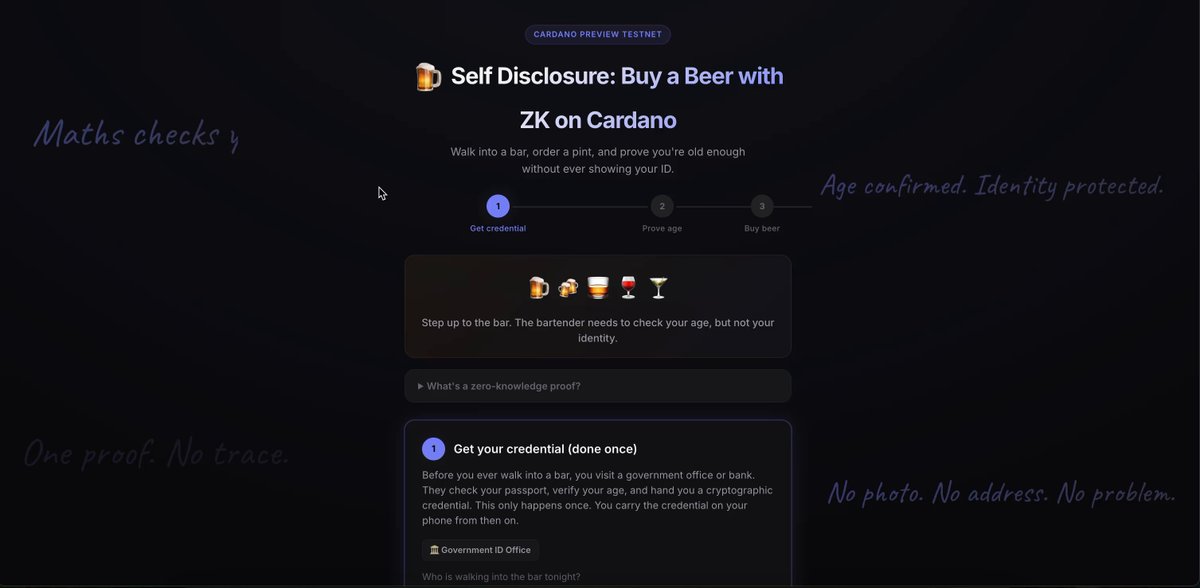
Self Disclosure Privacy using ZK Proofs, Demonstrated & Executed Directly on Cardano Preview I built a demo where a customer buys a beer and proves they are 18 or over, without ever showing their ID. No name. No birth year. No photo. Just maths. Two beers were ordered. Two separate transactions. The same proof, reused, no re-verification needed. The blockchain recorded "age verified" both times. That's all it knows. No name. No address. No date of birth. No photo. No personal data of any kind. This runs entirely and directly on Cardano. No sidechains. No L2s. No off-chain verification. The ZK proof is checked by the Plutus V3 validator itself, on-chain, using Groth16. And this isn't just for bars, it works for shops, website signups, any age-restricted service. One credential, reused anywhere. Self disclosure means you choose what to share, and in this case, the customer chose to share nothing except "yes, I'm old enough, give me a nice cold beer." 🍺 Massive shout out to everybody involved in the below! Aiken smart contract language on Cardano (please don't judge my Aiken... I know it's bad 😂) ak-381 by Modulo-P, Groth16 SNARK verification library for BLS12-381 on Aiken Circom + snarkjs, ZK circuit design and proof generation MeshSDK, transaction building and wallet management Blockfrost, blockchain data provider A basic demo to set the stage for further privacy enhancements that can occur directly on Cardano. Self disclosure privacy on Cardano Cheers Cardano 🍻🍻 Beer 1 Beer 2
Dave21,534 views • 6 months ago

Cardano is operational worldwide. This is Cardano, and it's a pleasure to contribute.
Dave31,685 views • 11 months ago

Contributing to Cardano on chain activity via a set of strategy bots, mainly DEX arbitrage. They’ve been running for a long time, but this is a snapshot from the last few minutes. Everything is self built. Strategy logic, execution, monitoring, and the underlying tooling, all written specifically for Cardano. I don’t usually share what I work on in the evenings but thought it could be interesting and spark innovation, it's been over a few years now actually, it has cool things like dynamic pool discovery, token discovery, and a tonne of events like Liquidity Pool creation, it tracks every single batcher transaction and I have price calculations across most DEX's, mempool monitoring etc
Dave26,512 views • 9 months ago

Cardano is absolutely insane, when you can build, and watch everything.
Dave24,024 views • 8 months ago

I have been building a visualisation platform that maps activity across Cardano. The objective is simple. Transparency. When information is clear and accessible it strengthens the entire ecosystem. The platform is already showing how powerful that visibility can be and it continues to improve as more data is integrated. I have successfully traced the direction of genesis funds across the blockchain end to end. The focus of the work however has increasingly turned toward Emurgo and will continue to target Emurgo.. Whether I release the tool publicly is still something I am considering carefully. In the past I built AI systems over Cardano data and chose not to release them. The reason was simple. I did not want something powerful to be turned into a weapon that hunts for minor negatives inside what is otherwise one of the most important technological and innovative blockchains built in this space, and a result of years of hard work. I have no interest in fuelling drama. My intention has always been to present Cardano for what it actually is. A blockchain built through years of research and engineering, driven by the founding entities IOHK and the Cardano Foundation, and supported by people who genuinely care about the system including Charles and many others who have given years of effort to build it. That remains true regardless of some recent comments directed toward me in spaces. Those were disappointing, and did actually upset me being completely honest, also they missed the wider context of what I have been doing and I feel discounted my care for Cardano. However transparency works both ways. I will not ignore behaviour that undermines the principles Cardano governance is supposed to protect. Emurgo, a founding entity, is accumulating a rapidly increasing share of voting power through Yoroi DRep delegations. Many users appear completely unaware that this is happening. The interface suggests things along the lines of gaining rewards by delegating voting power to Yoroi as a DRep. What many users do not realise is that they are delegating governance influence directly to the same organisation that operates the wallet ,and worst still think they need to delegate to Yoroi to get their ADA rewards! I have received countless direct messages from affected users who did not understand what they had delegated. In several cases language barriers appear to make the situation worse, particularly for users outside the English speaking community. At present Yoroi and Emurgo, which are effectively the same entity in this context, represent roughly 17 percent of all voting power. That share is rising quickly. Based on the recent rate of growth it is not unreasonable to see this exceeding 50 percent within a few years if nothing changes. Governance concentration on that scale is not healthy for a system designed around distributed decision making. Cardano’s credibility depends on users understanding where their voting power sits and being able to move it freely to representatives who actually reflect their interests. The goal of the platform was never to show how much a founding entity spent or to cause drama. The goal was to show the decisions a founding entity made and how those decisions shaped the blockchain in an era of governance
Dave17,020 views • 6 months ago


Visualizing 2,516 Cardano Relays Connecting to 20 Hot Peers (20 other relays) I recently simulated what it looks like when 2,516 Cardano relays each connect to 20 hot peers (other relays). The result is a complex web of over 50,000 animated lines representing peer-to-peer connections across the globe. This simulation closely resembles what happens behind the scenes as relays maintain network communication. The visualization highlights the density and scale of the Cardano blockchain, with each relay contributing and collaborating.
Dave31,887 views • 1 year ago

Cardano Scales by Measuring First The Cardano Leios team has released a mempool visualiser, and it is a solid piece of work. As throughput increases, the mempool becomes critical infrastructure. Transaction propagation, ordering behaviour, and fragmentation effects start to matter. This visualiser sits alongside the Leios simulation framework and renders trace data so researchers can replay scenarios, inspect how mempool state evolves across nodes, and study behaviour under different network and protocol conditions. This is about understanding system behaviour before it reaches users. Instrumenting the protocol, observing edge cases early, and using evidence to guide design decisions as Leios progresses toward a high throughput Cardano. This has long been Cardano’s approach. Credit to the Leios team again. Open, inspectable tooling like this is exactly what responsible scaling looks like, and it gives the community real visibility into how the protocol is being developed. I included a demo video for those interested. Visualizer
Dave13,295 views • 8 months ago

Visualising how far Cardano has come. What you are seeing here is live on chain DEX activity as the chain syncs over the last hour. Real swaps, real transactions, and the resulting liquidity changes unfolding in real time. No simulations, no replays. Just the ledger behaving as specified, and me reading it directly. I also built a DEX battle view, showing swap activity across the DEXs I track over the same period. It makes something very clear. Competition on Cardano is real. Liquidity competes, routing competes, and execution quality matters. Watching DEXs contend for flow is a good signal that the network is being actively used. I have upgraded my arbitrage dashboard to pull swap execution, pool state changes, monitoring, and analytics into one place. Cardano’s determinism matters here. Every state transition I can predict, they are traceable, and verifiable. That is what makes this kind of application straightforward to build and reliable to operate over time. It is an extremely valuable architectural decision that Cardano gives to builders, and one that continues to pay dividends as systems scale and complexity increases. (Apologies on the other DEX's, I have these integrated but also some pending changes on an upgrade I am doing and not yet finishes so didn't want to include without reliable results) Please comment thoughts, I wanted to share behind the scenes on what is happening across Cardano.
Dave11,374 views • 7 months ago
No more content to load