

The Bugged Dev
@thebuggeddev • 14,044 subscribers
A Human Bugged by Bugs | Software Developer | Design Engineer | Building with AI | Learning Three.js 🥳
Shorts


Videos

I feel like we haven't seen enough of what Gemini 4 Argon can actually do ❤️🔥 I gave it one image of a Gothic Victorian carriage and asked it to build the whole thing as an interactive 3D experience. Just one image and this is what you get. A 174,000 face model from scratch, complete with opening doors, hinged windows, working wheel physics, suspension, flickering lanterns and even custom sculpted skulls. All of this generated through code. No blender. Argon absolutely delivered with this one too. Many more such experiments are on the way :D
The Bugged Dev126,670 просмотров • 4 дней назад
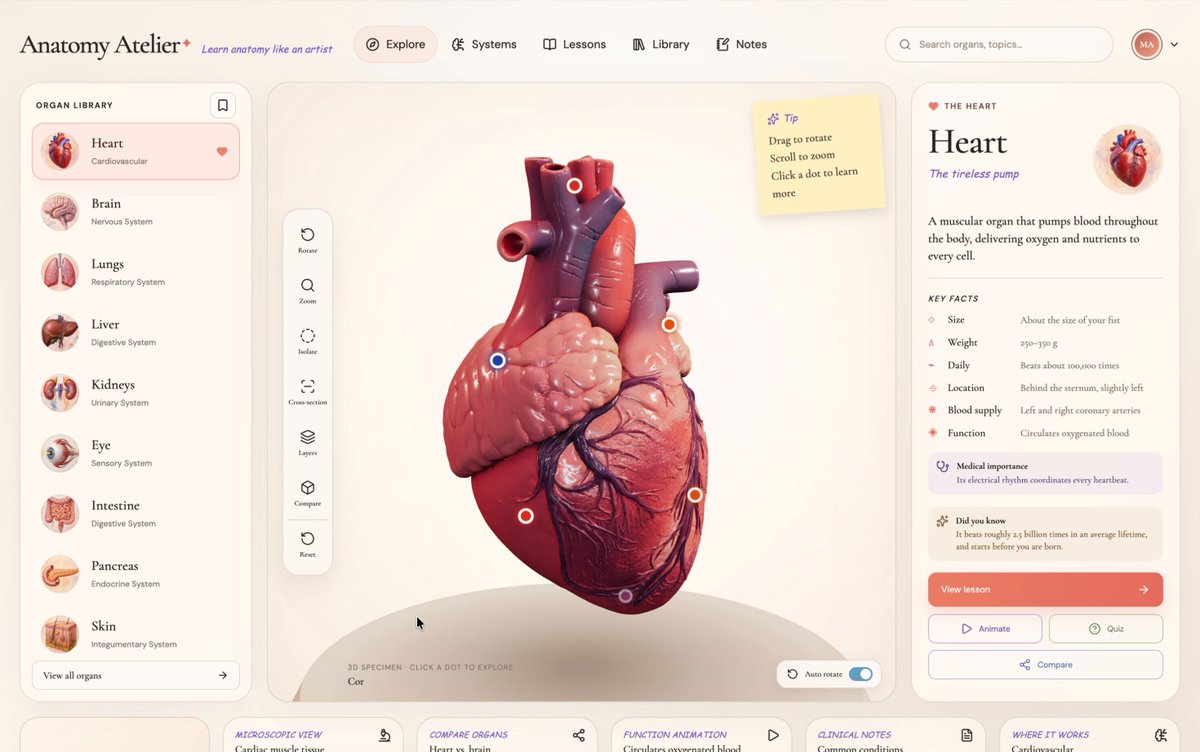
Only if education could be this interactive ❤️🔥 I've had a looong wish to build something genuinely useful through vibe coding, and I finally did it. A 3D human anatomy application built with Three.js using GPT 5.6 Sol. It all started with a single design image that I created using GPT Image 2.0. I then used it to generate every 3D organ image, one by one. Next, I converted each of those images into 3D models using Tripo (and no, they didn't sponsor this 😄). After that, I opened Codex, wrote a master prompt based on the design, and gave it the prompt, the design image, and all the 3D models. Codex built the first version beautifully, but there was one big problem. Every single 3D model was nearly 120-150 MB. That obviously wasn't practical for the web and was giving a performance of 16fps. After a few iterations, Codex optimized each model down to roughly 2–5.5 MB while preserving the visual quality, reducing the total asset size from ~900 MB to just 28.6 MB. And each model loads on demand. Along the way, Codex also generated those anatomical illustrations showing where each organ sits in the human body, and even created the interactive hotspot markers that explain different parts of every organ. It handled all of that. The process wasn't exactly one shot, but it also wasn't difficult. You just have to do it step by step. It genuinely felt like building something that could make learning anatomy much more engaging. The inspiration came from Dilum Sanjaya's 3D animal plant cell project. I remember seeing it and thinking, "I want to build something like this one day." And I did it :D Live: Code:
The Bugged Dev2,120,021 просмотров • 2 месяцев назад

Why do we still buy stadium tickets without ever seeing what the view from the seat actually looks like? ☠️ So I prototyped an idea. A 3D seat view experience for a football stadium built with Fable 5 + Three.js, where you can preview exactly what you'll see from your seat before buying. The entire 3D experience was working after the first prompt, and the whole prototype came together in just five prompts. This is the kind of 3D experience I'd love to see more of, tbh. Feels so good. Right now, buying a ticket gives you almost no sense of what the experience will actually feel like. We're still relying on static seat maps, charts, and boring UI layouts, when interactive 3D experiences could make that decision so much easier. If you think, 3D development has the potential to create genuinely useful experiences. This feels like the direction we should be heading. 3D is the future. I can already imagine this for cinemas, cricket stadiums, Wimbledon, concerts, and so many other venues. I'm planning to take this further. What should I build next? More stadium features, or should I try another venue? Let me know :D Code: Live:
The Bugged Dev1,809,090 просмотров • 3 месяцев назад

Maybe if physics had always been this easy to visualize and learn, we might have had more physicists than ever. AI is making learning so much easier to understand and actually fun. This is an electromagnetic field visualization built using Claude Opus 5.5. I do not think I have ever understood this subject better than I did by simply seeing it visualized like this 😅
The Bugged Dev195,117 просмотров • 20 дней назад

Will Astra kill us in the future? 😱 Maybe Maybe not. But it absolutely killed this by recreating Barcelona’s Camp Nou in 3D with 86,964 individually selectable seats ❤️🔥 You can literally pick any seat and see what your view would look like from that exact position inside the stadium. You can also switch between daylight, golden hour, and floodlit night modes to get a much more realistic feel. I very much loved how it optimized the website’s performance by reducing the overview seat geometry from 2,087,136 triangles to 695,712, which is around a 67% reduction, without reducing the number of seats. The stadium itself is built using procedural geometry and custom BufferGeometry, while Astra used InstancedMesh, spatial batching, and custom distance based LOD to efficiently render and manage nearly 87K selectable seats without creating tens of thousands of separate scene objects. For interaction and realism, it also uses optimized raycasting with broad phase batch rejection, TSL and WebGPU materials, shader driven surface detail, and proper seat level camera transitions. A month ago, I built an imaginary stadium using Claude Fable 5. It was great too, but this feels much more realistic. Astra went further by adding proper doorways, staircases, concourses, tier structures, tunnels, railings, and other architectural details you would expect in an actual stadium. Really classy. We should do this for more stadiums and eventually rethink the ticketing experience altogether. Live:
The Bugged Dev228,179 просмотров • 1 месяц назад

My honest take on Kimi.ai K3 👀 As soon as I got access to Kimi, I put it through the exact same 3D football stadium challenge I had previously given Claude Fable 5. Fable 5 finished in under an hour. Kimi took almost 3 hours 🥵 At first, that was a very bad impression but i decided to see what's taking it this much of time. It was running E2E tests, validating desktop, tablet, and mobile, taking screenshots, finding failures, fixing them, even adapting for low end hardware and low FPS before moving on. All these that Fable 5 never did. None of it because it wasn't able to run this WebGL app on a headless browser. Kimi also shipped a clean React + Three.js codebase with proper components while Fable, as you might have checked codebase, generated one big HTML file with everything stuffed in. With all of this happening, it felt like I was doing more "Vibe Coding" with Fable 5 and more "Vibe Engineering" with Kimi K3. It feels like it's spending more time making sure the code actually works and easily scalable. Really impressed so far. More Kimi K3 experiments coming soon. Code (Kimi): Code (Fable): Live (Kimi hosted):
The Bugged Dev580,126 просмотров • 2 месяцев назад

Can GPT-6 Astra actually create a 3D model like this? 🤔 I’ve been seeing people hype GPT-6 Astra looooot when it comes to 3D modeling, but can it really create 3D models with this level of detail? Wish i had access to try it,.. anyway, I created this one using Tripo as my lil submission to Tripo’s Companion Challenge where you have to create a 3D companion of your choice. I generated a bunch of different imaginary companions using GPT Image 2.0, from cute little dragons and humans to these adorable animals. After trying out a lot of different ideas, I finally settled on this panda in a bamboo forest look. I love how quickly you can go from having a random idea in your head to actually seeing it come to life, these days. That part is honestly so much fun. Now I just need to animate this little guy and turn it into an animated panda game or maybe 3D print it out haha #tripop2
The Bugged Dev162,154 просмотров • 1 месяц назад

Casually vibe coded Trevor Noah's latest website "Books" page using Fable 5 😍 I really loved the effects and animations on the website and immediately wanted to see if I could recreate them with AI. Pretty close in just a couple of prompts, isn't it? Everything is built in Three.js with no 3D assets for the books. Claude built the whole thing using pure math and animated it nicely with GSAP. Feels so realistic and close to real book. Pretty fun to see how close you can get to the kind of work agencies charge thousands of dollars for, just by describing what you want :D Live: Code:
The Bugged Dev240,894 просмотров • 2 месяцев назад

You won't believe but Fable 5 one shotted this ❤️🔥 It's an infinite physically rolling paper strip that prints an endless images in its wake built in Three.js entirely. I had seen this concept on Pinterest and thought, "This would be incredible if it were real." and gave that idea to Claude, and within minutes I had this. It's so so easy to bring ideas to life using AI these days. Live: Code:
The Bugged Dev225,989 просмотров • 2 месяцев назад

What used to take Blender can now start with one sentence 🥶 I literally typed the movements I wanted 3D model to do in plain English and within seconds Tripo had those same movements running on the 3D model. Seriously within seconds. Not exaggerating. Until now, I had to use high end models like Astra or Fable to do these kinds of animations on a 3D model. It not only cost a lot of tokens but also took a way looong time This new workflow feels way crazy to me. Super fast and Stupid easy to use. Now I’m just making Sukuna dance, do karate and try every ridiculous move that comes to mind 😂 Also, not to forget, did you notice how well Tripo handled the textures here? It feels like Sukuna came straight out of a comic. So goood. You can check here:
The Bugged Dev35,227 просмотров • 14 дней назад

Something feels seriously off with Claude Fable 5.1 🙄 I recreated the exact same 3D stadium I had built with Fable 5 just to see how much better 5.1 would be. Instead, Fable 5.1 took more than > 1 hour and hit the max limit 2 or 3 times on a single prompt. Fable 5 basically had the whole website ready in one shot and its output was actually much better. Fable 5.1 felt good with metal but added these weird black things that look like basket wings... genuinely have no idea what those are. Not good. And this observation isn’t just for one website. I saw similar behavior with a much simpler hero page where Fable 5.1 maxed out on a single prompt, something I never really experienced with Fable 5 for similar other websites Also, 3D models and animations of that other website also looked noticeably worse compared to what Fable 5 used to produce. In fact, they were even worse than what I’ve seen Opus 5 do. I’ll keep testing it, but so far Fable 5.1 feels less like an upgrade and more like a regression to me, tbh.
The Bugged Dev99,417 просмотров • 1 месяц назад

I genuinely never thought this would be possible 😱 AI just built a full embroidery editor that runs entirely in the browser. Freaking crazy. And no, it’s not GPT 6 Astra. It’s Claude Fable 5.1. Also, No Three.js. No WebGL. No shaders. Just Canvas 2D and math. You literally draw using a needle cursor and the app converts your path into actual embroidery stitches like running, back, chain, cross, satin, French knots and lazy daisy. Even the fabric is generated pixel by pixel. Two overlapping sine waves create a height field for the horizontal and vertical threads. Then a fake normal is calculated and lit from one direction. Basically a bump map with zero GPU rendering. The embroidery thread itself is rendered in 6 passes. Shadow, core color, twisted ply lines, dark edge and two highlight layers based on the light angle. That’s why it actually looks like embroidery floss instead of a simple marker stroke. And trust me, I've zero sense or knowledge of any of this. ZERO. All built. All working. All by AI. And somehow it’s all inside one HTML file. Nothing bigg. Absolutely insane what’s possible now. You can really genuinely take a random idea and bring it to life. And that too in < 1 hour. And who knows, this could actually be pretty useful for fashion designers and embroidery artists maybe? Live:
The Bugged Dev65,903 просмотров • 1 месяц назад

Your our history shouldn’t be taught in a boring way 🫠 I’ve always loved history, but I could never imagine what life actually looked like back then. So I built Empire Atlas, a 3D interactive explorer of 8 historical empires using Three.js and Kimi.ai K3 🔥 It lets you explore how people lived, what their homes looked like, their maps, daily life, interiors, and more. Properly researched. But the craziest part is that this was near one shot vibe coded with Kimi K3 🤯 When I previously built a 3D anatomy app with GPT 5.6 sol, I had to iterate on performance and optimization. With Kimi, the moment I handed over the 3D assets (generated using Tripo), prompt and design (by GPT Image 2.0), it created an 11 step engineering plan to build the entire thing. The very first step it did was optimizing the assets. It took nearly 500MB of 3D assets and brought them down to just 17.8MB using mesh simplification, Draco compression, and 1024px WebP textures. Absolutely nuts. It also generated 56 historical images across the 8 empires showing daily life, maps, interiors, and more using its image plugin with batch processing. Those were converted to WebP too, bringing the total image size to around 10MB. That’s a huge reason the experience loads so fast on website. It's engineering workflow or intelligence has really impressed me so far. The only downside is that it took more than 5 hours, though 😅 Anyway, back to history. In Empire Atlas, you can explore 8 different empires and see how people and our ancestors lived at that time. I really love those textures I was able to create using Tripo. You can explore their homes in 3D, and there’s so much more we could do with this. We could extend these houses into fully explorable interiors and create increasingly realistic reconstructions of what life actually looked like. And maybe create fun education games too. I genuinely think this can make history education so much more immersive. Much more than showing black and white images in boring textbooks. Go explore your history now 👇 Live: Code:
The Bugged Dev122,233 просмотров • 2 месяцев назад

How smoking every day year after year affects your lungs visualized in 3D using GPT 6 Astra 🫁 Nah, that’s not 10 different models there or any shady dark magic. It’s just ONE model that I built using Tripo. Astra worked directly on that glb model using Three.js, added morph targets, and used TSL shaders to show how smoking affects the lungs in real time. The whole model is also 84% compressed using Meshopt and WebP compression. I feel like experiences like this can make it much easier for students to understand what smoking actually does to your lungs over time and maybe even help a few people quit. This is how AI can be put to good use, imo. Live:
The Bugged Dev72,664 просмотров • 1 месяц назад

Eh, i'm really not impressed by GPT 5.6 sol lol. Asked it to recreate a 3 screen app design with image generation skill. Given how well it performs on benchmarks, I expected a lot more but the results were pretty ehhh. Not even close. Maybe I need to try harder but then... wasn't it supposed to do better?
The Bugged Dev154,388 просмотров • 3 месяцев назад

You said it would take another 1–2 years before AI could properly edit meshes, handle rigging, and do all of this… and Tripo just did it already 🤯 It looks like they’ve casually launched P 2.0 alongside Edit Mesh, Smart UV and Auto Rigging. Just look at how detailed and clean these edits are while preserving the rest of the model almost perfectly. The original model had four fingers. After editing, it now has five,.. while everything else stays consistent. And somehow, it even managed to silently the number of faces and vertices in the process. You may not realize it but we’re getting incredibly close to a real revolution in 3D modeling.
The Bugged Dev48,121 просмотров • 29 дней назад

Claude Opus 5.5 built a fully working 1857 Napoleon load field cannon in 3D 🤯 And no, no Blender, no 3D assets, no textures. Just procedural Three.js WebGPU and TSL shaders for everything. Also those technical drawings are live orthographic renders of that same model, so you can actually see how elevation, pressure, trajectory and firing change in real time. This is where AI is making learning ridiculously easy. Instead of just reading what a field cannon was, how it worked, you can now generate it, interact with it and understand it visually. Future of learning is going to be super duper crazy.
The Bugged Dev19,531 просмотров • 11 дней назад

Probably I vibe coded a lil startup here? 😭 It has been such a loooong wish of mine to build some kind of 3D experience where I could customize a T-shirt in literally any way possible and it’s finally here. Built with Three.js using GPT 6 Astra, this is a full 3D T-shirt customization studio where you can visualize and customize a realistic shirt directly in the browser. That T-shirt itself was modeled by Astra using Tripo right inside Codex through Tripo Plugin. And you can pretty much do anything with it. You can paint directly on any side of the shirt using different brushes and colors, or even spray paint it in real time just like you would spray on a wall. There are also stickers generated using GPT Image 2.5 that you can place anywhere on the T-shirt, resize, reposition, recolor, layer, and customize however you want. On top of that, there’s support for things like fabric customization, sizing, layers, colors, and even wind simulation to push the realism a little further. Once you’re done, you can export the entire design as a 3D view or export individual images of the T-shirt so you could technically take the design, print it, and maybe even sell it. One of my favorite parts is how the spray painting effect works directly on the 3D T-shirt in real time. I also loved seeing how Astra managed to keep the whole experience performant across devices using a custom BVH implementation along with several CPU side optimizations. And the process of building it was super simple. I generated the initial studio design using GPT Image 2.5, gave that image to Astra with the Tripo Plugin enabled, and it basically handled everything from there. I didn’t have to separately generate a 3D reference, upload it to Tripo, download the asset, give it back to Astra, or manually coordinate any of that. Astra handled the entire flow on its own without needing any additional input from me. Really happy with both the process and how the final result turned out. Live:
The Bugged Dev52,858 просмотров • 1 месяц назад

This is one of the wildest things I have built with AI so far 😱 Asked Claude Fable 5 to create a fully interactive 3D crime investigation board using Three.js and it did it in ONE Prompt. It took one more prompt to give it a polished UI inspired by a reference design that I created with GPT Image. What surprised me most was not how it looked. It was how it worked. Fable built a complete Verlet rope physics system with 46 particles in every thread. It handled gravity, damping, distance constraints and all other features of file upload, text and everything. The threads/ropes even lift naturally with pinned evidence instead of clipping through it. I never asked it to implement any of that. I only described the experience I wanted. Maybe that's how we should work with AI. Instead of writing long long specs, we should explain what we want as an experience and let AI do its thing. Anyway, every day Fable 5 raises the bar for what I think AI can build. More to this Live: Code:
The Bugged Dev105,432 просмотров • 3 месяцев назад
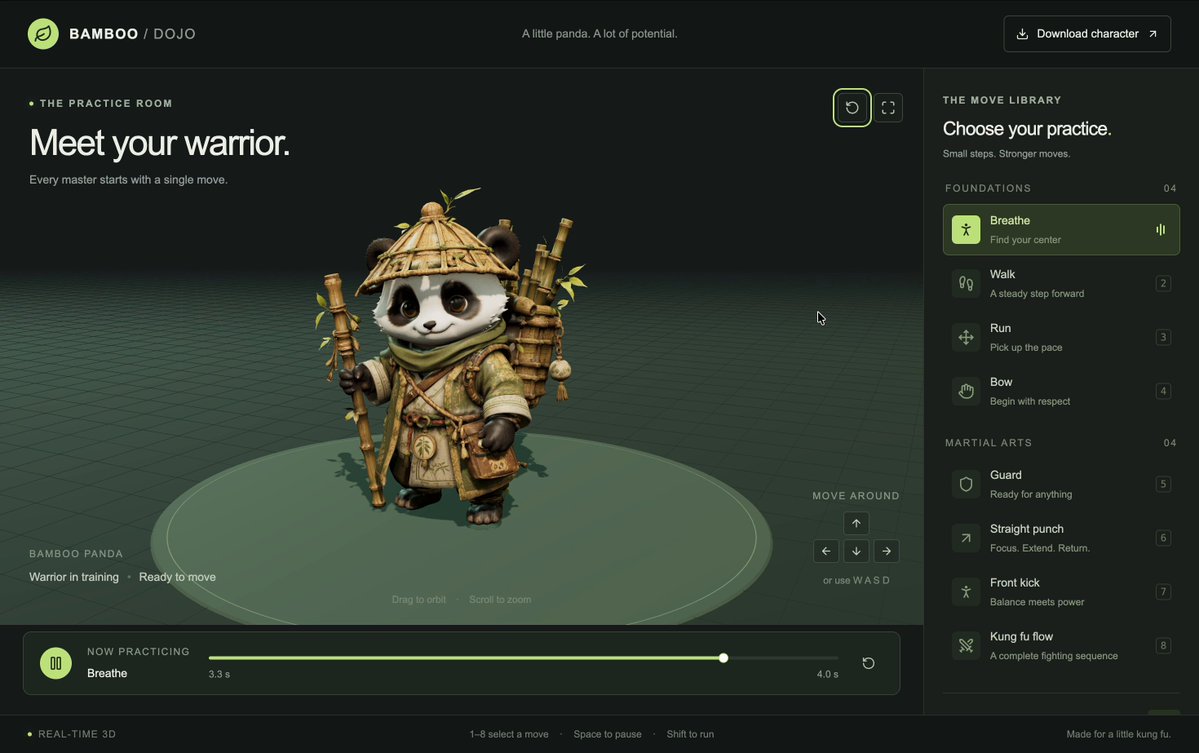
Goddamn, GPT-6 Astra is something really Astraordinary 😱 I gave it a 3D model and asked it to auto rig the character and add animations like walking, running and a few Kung Fu moves... and IT ACTUALLY DID IT!! No big prompts or anything. Just simple trash talk mentioning what to do. Okay, wait wait wait. Welcome to the dark reality. It took me 3 sessions to get this result and somewhere it is still very much broken 😂 But this is genuinely a great step forward for the 3D modeling field. I had tried rigging the same model using Kimi K3 and the results were bad. Almost awful. So far, Astra does feel much more promising than the other models I have tested so far. More tests coming
The Bugged Dev48,598 просмотров • 1 месяц назад