Video yükleniyor...

Video Yüklenemedi

Ana Sayfaya Dön

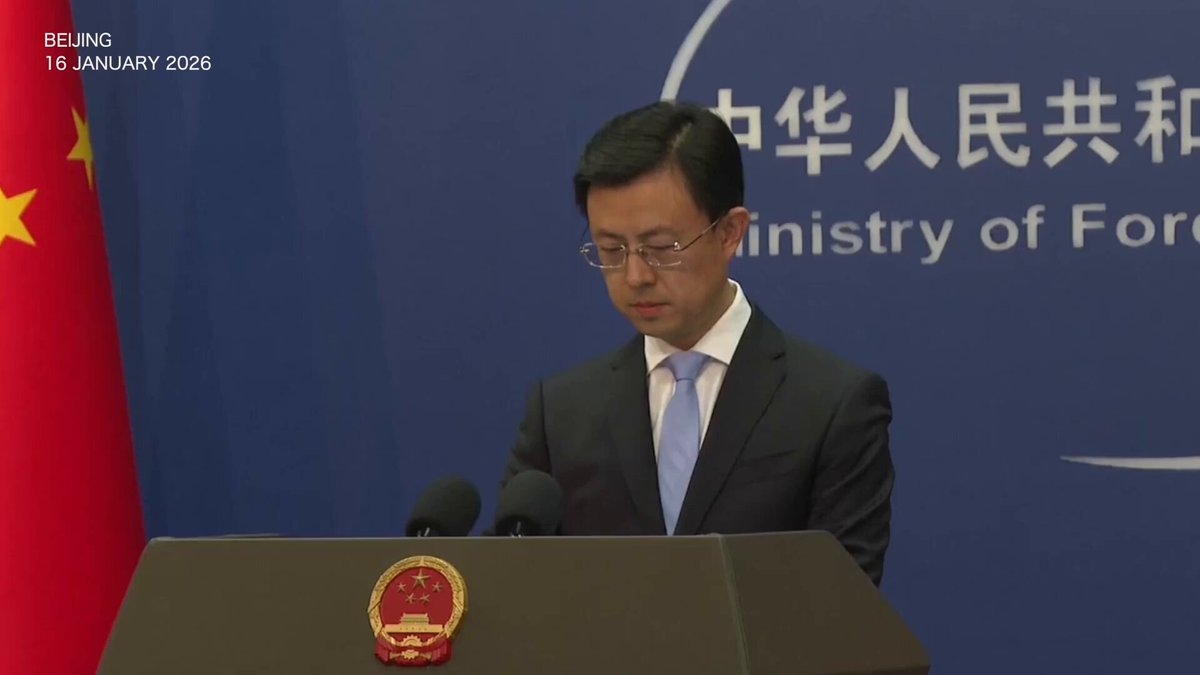
🇨🇳🇯🇵 A declining, geopolitically sidelined former fascist empire will always lash out at a stronger neighbor, not because it matters, but because it cannot accept its own irrelevance. Sanae Takaichi and her fascist supporters keep performing this ritual aggression as if shouting at China might convince the world, or...

26,517 görüntüleme • 8 ay önce •via X (Twitter)

0 Yorum

Yorum bulunmuyor

Orijinal gönderinin yorumları burada görünecek
Benzer Videolar

China’s warning about Japan’s re-militarization is not just a warning to Tokyo. It is a warning to the entire region. Japan’s economy has fallen back to roughly its 1992 level in nominal dollar terms, while China has grown into the world’s second-largest economy. China’s military spending has long remained below 1.5% of GDP. Even if Japan pushes defense spending to 5% of its GDP, it still cannot match China’s scale, industrial capacity, military R&D, shipbuilding, missile production, or strategic depth. So let us be honest: Japan’s re-militarization is not a real military threat to China. Japan cannot fight China. The real danger is to the smaller countries that keep telling China to “move on” from history. Japan once invaded, occupied, burned, raped, enslaved, and massacred across Asia. China. Korea. The Philippines. Indonesia. Singapore. Malaysia. Vietnam. Myanmar. Cambodia. Laos. Half of Asia remembers what Imperial Japan did. Or at least it should. The reason Japan has behaved like a “peaceful country” after 1945 is not because Japanese militarism suddenly grew a conscience. It is because the postwar order pulled out the beast’s fangs. And because China became too strong to be swallowed again. Now, as the U.S.-led order weakens, Japan’s Neo-fascist forces are testing the cage. They call it “defense.” They call it “counterstrike capability.” They call it “normalization.” But Asia has heard these words before. Japan has always known how to dress aggression in polite language. Today Japan does not dare confront China directly. So it provokes China, hides behind Washington, cries about Chinese “bullying,” and performs weakness for the Western press. That theater creates a useful illusion: Japan is peaceful. China is aggressive. But the real historical danger is not that Japan will defeat China. It is that Japan will once again turn its militarism toward countries that cannot fight back. And here is the part those countries should understand: China will not sacrifice Chinese soldiers to protect client states that choose the “Indo-Pacific” containment camp and help Tokyo and Washington pressure China. The Chinese people would not allow it. If some countries believe they can cut themselves off from China, stand with Japan, erase history, and become “higher-class Asians” under the U.S. umbrella, then they should prepare to live with the consequences. Japan was restrained by defeat. Not by remorse. And when the leash loosens, the first victims are rarely the strong.

𝘊𝘰𝘳𝘳𝘪𝘯𝘦

29,439 görüntüleme • 3 ay önce

🇯🇵 Why Japan’s Decline Is Psychological, Not Just Economic Everyone talks about Japan’s economic stagnation — lost decades, shrinking influence, declining industries. But there’s a deeper layer almost nobody touches: Japan’s geopolitical identity crisis is inseparable from its hostility toward China. Not because China threatens Japan. But because China shattered the psychological structure Japan has lived inside for 80 years. 1. Japan once believed it understood how Asia should work. Modern Japan’s national mindset is built on one story: • The U.S. defeated us. • The U.S. rebuilt us. • The U.S. protects us. • The West accepts us as the “civilized Asian,” the honorary white nation. Japan internalized this hierarchy. And then it projected the same logic onto China. Japan slaughtered 35 million Chinese. Ran Unit 731. Used women as sexual slaves. But Tokyo always believed: “I am richer, I am more advanced, I have better reputation. So China should ‘move on’ the same way I moved on under U.S. rule.” Japan thought dominance creates obedience. Because that is how it behaved toward America. 2. When China was weak, Japan mistook silence for acceptance. For decades, China didn’t have the power to push back internationally. Japan interpreted this as: • “China accepted our narrative.” • “China doesn’t dare confront us.” • “The war is over — we won the moral argument.” This is absolutely not reconciliation; it is merely a power illusion. Japan became comfortable believing: “If China must bow to someone, it should bow to me, just like I bowed to America.” 3. Then China rose — and Japan’s entire worldview collapsed. China didn’t just grow. China overtook Japan in every pillar of national power: • GDP • Manufacturing • Technology • Diplomacy • Military • Global influence China now competes with the United States itself — the very empire Japan historically imitates. And this is where the psychological rupture begins: Japan cannot emotionally process a world where China stands on the same level as America. Because in Japan’s internal hierarchy: • America is the master. • Japan is the apprentice. • China is supposed to be below both. But suddenly… the “student of America” watches the “victim of Japan” surpass them both in power and prestige. For many Japanese nationalists, this feels like an existential insult: “How dare China rise to the level of my master? How dare China erase the hierarchy that defines me?” So the hatred intensifies. Not just political hatred — existential hatred. 4. And the irony? China never asked Japan to kneel. China only asked Japan to face history. But to Japan, acknowledging history means acknowledging loss of superiority. So instead, resentment grows. And Japan’s geopolitical relevance shrinks even faster. 5. Japan’s economic decline is inseparable from this psychological stagnation. - While China built entire industrial ecosystems, Japan clung to nostalgia and Western validation. - While China out-innovated, out-built, out-scaled, Japan obsessed over keeping China “in its place.” Japan’s decline is not just economic, it is a refusal to accept a world where it no longer defines Asia.

𝘊𝘰𝘳𝘳𝘪𝘯𝘦

179,313 görüntüleme • 7 ay önce

For five thousand years, China has understood one simple truth: history is not a toy. It cannot be bent for politics, edited for convenience, or erased for someone else’s narrative. That’s why, the moment Trump launched “Trade War 2.0” in his second term and began spreading blatant lies about COVID-19, China stopped giving him diplomatic courtesy. A civilization that survived dynasties, invasions, famine, plague, and rebirth does not need to tolerate the delusions of a man who thinks history begins with his tweets. China remembers 2020 clearly. China documented every case, every death, every hospital bed that overflowed. And years from now, when people look back at the pandemic, they will find something striking: China kept the most complete records. Others kept the most convenient ones. This is exactly why Beijing refuses to let Trump rewrite the past, refuses to let Western media manufacture “alternative timelines,” and refuses to let Japan whitewash its history of aggression. A nation that writes its own history — in its own hand, word by word — does not outsource truth. So when the Foreign Ministry calls out lies today, it isn’t just diplomacy. It is civilizational self-defense. It is the insistence that memory cannot be colonized. China will not allow slander to replace fact. China will not allow forgetting to replace evidence. China will not allow those who failed their own people to lecture the world about pandemics. A civilization that knows its past refuses to let others falsify it.

𝘊𝘰𝘳𝘳𝘪𝘯𝘦

26,200 görüntüleme • 8 ay önce

Beijing rejects the West’s new “tribute system” lie. China stood at the height of world civilization for most of its long history. Yet it did not bomb half the world like the United States, a country with only 250 years of history and only 17 years without war. It did not colonize the entire Earth like the British Empire. China became the center of an Asian civilizational order — not a global machine of plunder. That is what the West still cannot understand. They look at China through their own jungle logic: If you are strong, you must dominate. If you rise, you must conquer. If others trade with you, they must be your “tribute system.” But no. Chinese civilization has always despised bullying the weak, worshiping power, and kneeling to foreigners. That is why Chinese people instinctively look down on self-colonized traitors, reverse nationalists, and postwar Japan — people who sold their spine and called the leash civilization. China’s moral line is very clear: What is ours, we will not give up an inch. What is not ours, we do not covet. That is why China defeated India and Vietnam, but did not occupy an extra inch beyond its own claims. Unlike Israel. Unlike Japan. Unlike America. Ask ordinary Chinese people whether China should invade another country, and 99% would reject it. Ask them whether China should defend itself from humiliation, invasion, and national collapse again, and 100% would rather pay the price. The West cannot imagine a powerful China that does not behave like the West. They look at China and see themselves. They fail to understand that China is a civilization masquerading as a nation. A civilization does not need to conquer or tame others. It commands its own gravity.

𝘊𝘰𝘳𝘳𝘪𝘯𝘦

19,670 görüntüleme • 2 ay önce

China has been relatively restrained toward the Philippines because Manila is still an ASEAN member. But this is changing. The Philippines is no longer just making noise in the South China Sea. It is trying to manufacture territorial claims over Chinese waters, coordinate with external powers, and even work with Japan — a defeated fascist state that once slaughtered Asians and burned half the region — to pressure China over territory that does not belong to them. That crosses a line. The key phrase in this Chinese report is not just “illegal claims.” It is this: undermining the post-WWII international order. That is the real signal. China is no longer treating the Philippines as a small neighbor being manipulated by Washington. It is beginning to treat Manila as part of the same fascist militarism chain as Japan: using colonial-era arrangements, foreign backing, and legal theater to challenge the territorial order created after Japan’s defeat. The Philippines was shaped by Spanish and American colonial rule. Its boundaries were defined by treaties. None of those treaties gave it Huangyan Dao. None of them gave it China’s Nansha Islands. Proximity is not sovereignty. If proximity decided ownership, the world map would collapse overnight. So when Manila claims Chinese islands because they are “closer,” it is not defending international law. It is trying to rewrite it. And when it does so alongside Japan, the symbolism becomes even uglier: a former colony and a former fascist aggressor trying to divide the waters of a WWII victor. China’s patience is not weakness. Reports like this are not just academic documents. They are legal groundwork. And once Beijing starts framing your actions as a threat to the postwar international order, you are no longer just playing a media game. You are being placed in the same historical category as the countries that tried to overturn Asia by force. China is putting the Philippines in Fascist Japan’s historical shadow.

𝘊𝘰𝘳𝘳𝘪𝘯𝘦

18,095 görüntüleme • 2 ay önce

🇨🇳🇯🇵 Westerners keep asking: “Why are Chinese people so obsessed with every piece of their territory?” Let me answer this in a way they might finally understand. Because for China, land was never a trophy. It was never something you took when you were strong and gave up when you were tired. For thousands of years, our land was an inheritance. not from governments, but from ancestors. From farmers, from villages, from dynasties that rose, collapsed, and rebuilt themselves from ash. Every generation guarded the soil handed down by the last. Not because of nationalism, but because this is how a 5,000-year-old civilization stays alive. Meanwhile in the West, especially in settler states, land is just… negotiable. Stolen yesterday, abandoned tomorrow. I once heard an American say: “If California left, who cares? You can take it.” Of course he thinks that. His country is built on land taken by force, not land remembered through ancestors. You cannot lose what you never loved. China is different. We don’t guard territory because of politics. We guard it because we survived a century where others carved us apart, piece by piece, while calling it ‘civilization’ and ‘law’. We learned the lesson with blood: A nation that allows one inch to be taken, will eventually lose the right to stand. And here is the part Western moralists love to ignore: They cry for Palestine, claiming stolen land must be returned. But when China says Taiwan’s story is the same, suddenly “history doesn’t matter”. When Japan claims amnesia, they applaud. When China remembers, they panic. Why? Because a Japan that forgets is useful. A China that remembers is uncontrollable. And China today is—finally—at the stage where no one gets to tell us which parts of our history we are allowed to keep. This is not “aggression,” it is a civilization refusing to let its wounds be rewritten by former empires. So if you really want to understand why Taiwan is not negotiable, start here: For China, territory is memory. And memory is something we no longer allow others to steal.

𝘊𝘰𝘳𝘳𝘪𝘯𝘦

548,041 görüntüleme • 10 ay önce

Elon Musk’s point about China is worth thinking about not because “China is peaceful,” but because China’s historical experience is fundamentally different from the Western imperial model we often use to interpret it. For much of its long history, China’s biggest wars were fought within China, not across oceans to build overseas colonies. Think about the scale of its history, the Three Kingdoms, the An Lushan Rebellion, the Mongol conquest, the Ming–Qing transition, the Taiping Rebellion, and countless periods of fragmentation and reunification. Some of these conflicts produced demographic catastrophes on a scale that is difficult to comprehend today. Elon frequently cited “70%” figure is debatable and shouldn’t be treated as a precise historical statistic. But the broader pattern is real, some of China’s bloodiest chapters were civil wars, rebellions and struggles over the reunification of the Chinese heartland. That matters because history shapes strategic culture. China is a continental civilisation with thousands of years of written history, repeatedly experiencing fragmentation, famine, invasion, reconstruction and reunification. Its strategic instinct has often been about maintaining internal cohesion, securing its borders and building economic strength. This doesn’t mean China has never expanded, fought neighbours or exercised imperial power, it absolutely has. And history is not destiny… But I think the mistake is assuming that China’s rise automatically follows the same trajectory as 19th-century European imperialism, overseas colonies, resource extraction and permanent expeditionary warfare. Look at what China has poured enormous resources into over the past few decades: high-speed rail, ports, manufacturing, cities, energy infrastructure, technology and industrial capacity. That tells us something, the question isn’t whether China is “good” or “bad”, the more useful question is what kind of superpower is China becoming? If we want to compete with China, collaborate with China, invest in China or simply understand China, we need to stop projecting our own historical experience onto it. You cannot understand a civilization with 5,000 years of history by viewing it through a 200-year-old Western lens.

Alvin Foo

325,653 görüntüleme • 21 gün önce

🇯🇵 Japan wanted Munich to be a stage; 🇨🇳 China made it a mirror. For decades Japan performed amnesia, but the moment its PM openly claimed a right to intervene in “Taiwan affairs,” history walked back into the room. Wang Yi didn’t escalate, he just diagnosed. A Fascist country that refuses to face its war crimes, but believes it can decide China’s sovereignty, is not seeking “stability,” it is rehearsing old ambitions in new language. And here is the part the West rarely understands: Japan should be grateful for the Chinese government’s restraint, and for how much anti-Japanese sentiment it has contained for decades. Japan mistakes its “politeness” and “obedience” for virtues that erase the past. They don’t. Westerners who never lived through Nanjing, who never saw Unit 731, who never heard the last cries of comfort women, cannot feel what 35 million Chinese deaths carved into our memory. But Chinese people know: beneath the romance of falling cherry blossoms is blood-soaked soil, and beneath the elegance of a kimono are the lice of a past Japan refuses to wash off. On Chinese social media, the mainstream view has been consistent for years: the historical reckoning with Japan is unfinished. And this time, it won’t be outsourced to America. It will be carried out by Chinese people themselves, a completing of the Pacific War that history never allowed China to finish, so these scars do not pass to the next generation. When China warns Japan today, it is not hostility. It is memory refusing to be buried.

𝘊𝘰𝘳𝘳𝘪𝘯𝘦

85,739 görüntüleme • 7 ay önce

Westerners still ask the same question like it’s clever: “Does the rest of the world actually want to be like China? No democracy, repressive on speech and human rights?” They’re looking at the 21st century with 19th and 20th century glasses. The assumption is that 1.4 billion Chinese must be suffering under some evil CCP. Black-and-white thinking that doesn’t fit reality anymore. China’s going to build its own system. It might not match the Western model — and that’s fine by them. When China was weak and divided, nobody was exporting human rights or democracy to them. The British forced opium on China in exchange for tea. Western powers seized territory, set up settlements, and burned the Summer Palace. It remains now unrestored as a permanent reminder of history for Chinese to never be blinded by hubris again. Now the same voices show up acting as saviors: “Don’t you want a better government? What’s wrong with you?” The condescension is unreal says Kishore. China will choose its own path. It may not be perfect in Western eyes, but it’s theirs. Unlike America, they don’t pretend their civilization is a universal model the whole world must copy. They do what works for China. You do what works for you. They’re not exporting their system to anyone. No threat. No need to feel insecure about China succeeding on its own terms. The West needs to drop the savior complex and get used to it. The 21st century isn’t yours to dictate anymore. Paraphrasing Kishore Mahbubani answering questions about China in 2020.

Larry 長祥

66,269 görüntüleme • 2 ay önce