Video yükleniyor...

Video Yüklenemedi

Ana Sayfaya Dön

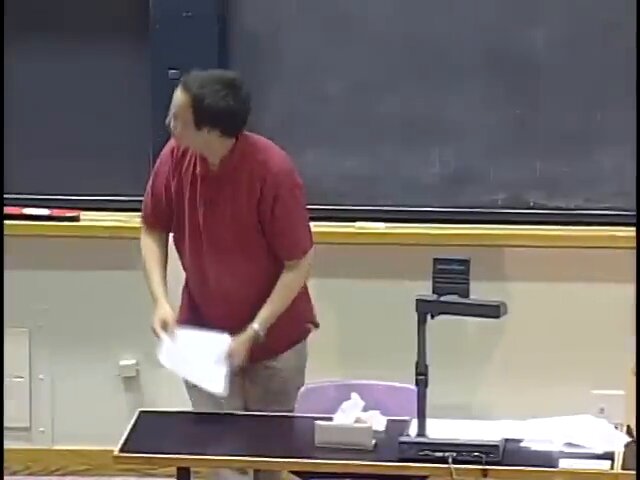
A MATHEMATICIAN WAS LAUGHED AT FOR STUDYING "ROUGHNESS" -- CLOUDS, COASTLINES, PRICES, THINGS TOO MESSY FOR REAL MATH. THEN HE SHOWED ONE TINY FORMULA, REPEATED, BUILDS INFINITE COMPLEXITY AND IT DESCRIBES REALITY BETTER THAN THE SMOOTH MATH EVERYONE WORSHIPPED 79 minutes from Benoit Mandelbrot at MIT, introduced by the...

406,413 görüntüleme • 1 ay önce •via X (Twitter)

0 Yorum

Yorum bulunmuyor

Orijinal gönderinin yorumları burada görünecek

Benzer Videolar

In 1963, Benoit Mandelbrot showed that cotton prices don't follow a bell curve. He showed it again with wheat, interest rates, stocks, and indices. Wall Street thanked him, gave him a medal, and kept using the bell curve. Every fund blowup since has been the invoice. Mandelbrot wasn't a Wall Street insider. He was a mathematician at IBM, an outsider the economics establishment spent 40 years trying to bury. Most of his career, mainstream finance journals wouldn't touch him. He was right anyway. The graveyard of blown-up funds keeps proving it. The thread above sells you a better filter. Mandelbrot spent his life on the assumption underneath every filter, the one every filter salesman needs you not to question. The assumption is that price moves cluster near the average and big moves are almost impossible. Every Sharpe ratio, every VaR, every risk model in every fund quietly runs on it. Mandelbrot proved for four decades, in papers Wall Street chose not to read, that real markets have fat tails, wild variance, and rough repeating patterns at every scale. The 10-sigma move isn't once in a hundred lifetimes. In markets, it shows up on a Tuesday. The self-similarity part is the tell. Take a crypto chart and cover the axis labels. You cannot tell if you're looking at a one-minute or a one-year timeframe. The roughness looks the same because the underlying process is the same. It does not average out at longer horizons. It just repeats. This is why every model that promises the tail is 1-in-10,000 blows up on schedule. LTCM died in 1998 and the industry called it once-a-millennium. 2008 repeated it a decade later. Crypto compresses the same lesson into weeks. 3AC, Luna, FTX, every leveraged desk that went to zero on a weekend was running on the bell curve Mandelbrot buried in 1963. The takeaway isn't that filters are useless. It's that no filter tells you how much to bet when it's right. Sizing is what survives the tail. The filter tells you where to look. Sizing decides whether you're still alive to look tomorrow. Build the filter. Build the swarm. Build the sharpest model of your generation. Just remember they're all fitting a world that doesn't exist, and the part that survives the tail, that part, you still have to bring yourself. His TED talk is from 2010. It's free. It was free in 1963 too.

Veles

44,581 görüntüleme • 27 gün önce

Elon Musk reduced the oldest question in human history to basic math. No one has found a flaw in it. Musk: “What are the odds that we are in base reality? And that this has not happened before.” You don’t need a physics degree to follow it. You need a timeline. Musk: “If you look at the advancement of video games, it’s gone from Pong, two rectangles and a square batting it back and forth, to photorealistic, real-time games with millions of people playing simultaneously.” Fifty years. That is all it took to close the gap between two rectangles on a screen and a world you cannot tell apart from the one outside your window. Musk: “If that trend continues, video games will be indistinguishable from reality.” The visuals are not what seals it. The intelligence is. Musk: “Think of how sophisticated the conversations are you can have with an AI today, and that’s only going to get more sophisticated.” We are not scripting characters anymore. We are building minds that reason, adapt, and surprise the people who made them. We are nowhere near finished. Musk: “The future, if civilization continues, will be millions, maybe billions of photorealistic, indistinguishable from reality, video games. And with characters in those video games that are very deep, and where the dialogue is not pre-programmed.” One base reality. Billions of perfect copies. Each one running minds that feel exactly as conscious as you do right now. Each one certain it is the original. Musk: “So then what are the odds that we are in base reality?” If even one civilization crosses that threshold, simulated minds outnumber real ones by billions. The probability you are sitting in the real one is not low. It is nearly zero. Not as philosophy. As mathematics. We are not watching this happen. We are building it. Right now. Every AI that reasons without a script. Every world rendered one frame closer to indistinguishable. We are constructing the exact technology that makes our own existence statistically implausible. And we will never stop. Because the curiosity that questions reality is the same force that builds it. If the math holds, something built us. Something conscious enough to create consciousness. They stood where we are standing. Same question. Same inability to stop. And whatever built them never answered it either. There is no top floor. There is no original. None of that changes what you feel right now. Consciousness was never about what you are made of. It was about what you experience. Musk did not float a theory. He held up a mirror with no back wall. And the math does not need you to believe it. It only needs time.

Dustin

193,350 görüntüleme • 27 gün önce

Marvin Minsky, the MIT scientist who founded AI: "Citadel pays PhDs $500K to find the perfect equation. The market doesn't have one. It's beaten by a swarm of dumb agents, the exact design Marvin Minsky said your brain runs on." the thread above is about swarm intelligence, letting a crowd of simple agents search the ugly, shifting landscape of a market that no clean equation can solve. minsky's entire life's work says that isn't a hack. it is how intelligence itself is built. he proved you don't need a smart central solver. you need many mindless specialists, each doing one tiny job, none understanding the whole. connect enough of them and something intelligent emerges from parts that are individually dumb. a market is exactly that: millions of simple agents, no one in charge, collectively solving a problem none of them can see. that is why the swarm beats the elegant math. a single closed-form equation assumes a clean, stable world. the market is nonlinear, non-stationary, full of traps. a swarm doesn't need to understand the landscape, it explores it from a thousand angles at once and can't get permanently stuck where one clever model would. minsky saw this in the mind decades before quants borrowed it for markets. he taught it at MIT, for free, in this lecture. same story i keep telling: the "new" AI idea running the funds is an old idea in a new wrapper. here is what the thread underplays, and minsky knew it. a swarm is only as good as how its agents are wired and rewarded. connect them wrong and a thousand dumb agents don't become a genius, they become expensive noise that overfits and blows up. the swarm is free. the architecture, knowing how to connect and constrain the agents, is the entire edge.

Rossst.03

45,307 görüntüleme • 25 gün önce

Persi Diaconis, Stanford mathematician and former professional magician: "I spent fifty years proving one thing: almost nothing is as random as it looks. The 50.75% that built Renaissance wasn't luck. It was a tiny crack in the randomness, found and repeated a million times." this free lecture holds the exact idea the thread above is built on. and the man giving it isn't a trader. he's a stanford professor and former professional magician who spent his career on one question: where does real randomness end, and where does a hidden edge begin. here is his life's finding. a coin, a shuffle, a market, all look random, yet each hides a faint, measurable bias. on its own that bias is nothing, indistinguishable from luck. repeat it enough times and it stops being luck and becomes a law. that faint crack, found and repeated, is the whole distance between a 50.75% win rate and a hundred billion dollars. none of this is new or hidden. diaconis has taught it for decades, the math runs back to 1713, and the lecture is free. i mapped the full system in my article, expected value, kelly, and this. same point the thread makes: the edge was sitting in plain sight. here is the part the gurus skip. a faint edge only pays if you survive long enough to reach it, and that takes correct sizing and the patience to trust it through thousands of losing-looking trades. most quit while it still looks like randomness. the math is free. the nerve to hold it is the edge.

Rossst.03

229,785 görüntüleme • 1 ay önce

I've become a missionary with one message. Every time I meet a young person, the same words: have children, get married, build a family. I did not decide on this calling. It overtook me. And it overtook me for a single reason. I had no idea. I genuinely did not understand how much joy, how much meaning, how much sheer beauty pours out of a child until I was holding one of my own and felt the floor of my life drop into something deeper than I knew was there. I grew up white, affluent, secular, comfortable, and insulated. That world does not put babies in front of you. None of my friends were starting families. Out of my whole circle, almost no one has a big one. We were not formed by the presence of children. We were formed by their absence, by the strange quiet of homes built for two careers and no cradle. And a person believes what his world shows him. So we believed. What we believed was a lie. It is a lie with an author, and that the author is the enemy of joy himself. It is the gospel of the world, and its commandment is wait. Wait until you are older. Wait until the career is built and the savings are stacked and the twenties are properly spent. Enjoy your freedom. You are not ready. It does not arrive sounding like temptation. It arrives sounding like wisdom, like prudence, like the responsible thing, and that is exactly why it works. The most effective lies are the ones that wear the face of virtue. And the maddening thing is that it collapses from every angle at once. It is not rooted in biology, because the body is made for this work precisely in the years we are told to postpone it. The flesh keeps a calendar the culture pretends not to see. And it is not rooted in theology either. You will not find this deferral anywhere in the Christian imagination, in any of the fathers, in any of the scriptures. So choose whatever lens you like. Take the cold secular measure or the ancient sacred one. By either light the counsel is rotten. It is bad for the body and bad for the soul and bad for the society downstream of both. This is why I have come to see it as one of the central tragedies of my generation. Every age carries its own wound. The Great Depression was a depression of bread, a scarcity in the world of matter, hunger you could measure. Ours is a depression of a different order. It is a famine of the spirit in the middle of abundance. We have more than any people who ever lived and we are starving in a way our ancestors would not recognize, because the thing we are refusing cannot be bought and cannot be banked. The ones most made to give and receive this love are quietly declining it. They are walking away from the one inheritance that actually compounds, and the cruelest part is that they do not feel the loss as loss. You cannot grieve what you were taught not to want. That is the deepest cut of it. The lie does not only steal the thing. It steals the capacity to know the thing was stolen. A man can spend his whole life on the far side of a door he never knew was a door, mistaking the wall for the edge of the world. Because this beauty is not ordinary beauty. It is not the pleasure of a good meal or a clear morning. It is participation in something that comes down from above, the same generative love that spoke everything out of nothing and called it good. To make a person, to be undone and remade by loving that person more than your own life, is to be drawn for a moment inside the very act that holds the cosmos together. A child does not merely add to your life. A child reorders the soul. It teaches you what you are by asking everything of you, and you discover, kneeling there exhausted at three in the morning, that you had a capacity for self gift you never suspected, a depth in yourself you had no other way to reach. In the Gospel of John, on the last night, Jesus prays, these things I have spoken to you that my joy may be in you, and that your joy may be complete. And I have come to understand why family is the road into that fullness, why it is not one path among many but the one most fitted to the shape of the promise. Consider who is praying. Christ does not come to us as a lone figure dropped out of the sky. He comes out of a family older than the world, the eternal communion of Father and Son, the love between them so total and so alive that theologians dared to call it a third person. Before there was anything, there was a family. The deepest fact about reality is not a force or a law or a void. It is a household. It is begetting and being begotten, giving and receiving, a Father who is only a Father because there is a Son. So when Jesus speaks of joy made complete, he is not pointing away from family toward something higher. He is pointing toward the very thing he came from, the life he has known from eternity and came to share. His joy is the joy of belonging utterly to a Father and pouring himself out for those he loves. When you marry, when you bring a child into the world, when you wear yourself down in the small unseen labors of a home, you are not stepping outside that divine life. You are stepping into a small image of it. Your family is a created echo of an uncreated one. The love you give your child rhymes with the love the Father has for the Son. The exhaustion, the tenderness, the way a parent would tear the sky open to protect a sleeping infant, all of it is the heavens pressed faintly into flesh, the eternal household leaving its fingerprint on yours. That is why the joy is not merely added to family but completed in it. We were made in the image of a God who is, at his very root, relation and gift and generation. To found a family is to do the most Godlike thing a creature can do, to participate from below in the begetting that God does from all eternity. Your home becomes a window. Through it, dimly and imperfectly, you glimpse the country you came from and are going to. And now a word for the young people reading this, the ones who do not yet have children. I want to tell you what it is like from where I stand. When I am out somewhere, a restaurant, anywhere, and a large family comes through the door, the noise and the chaos and the small bodies of them, something happens in me on two levels at once. The first is joy. A pure gladness at the sight, the way you feel watching something good and alive. But underneath it, almost in the same instant, a sadness reaches up and takes hold of my heart. Because I know now, at my age, after my own years of waiting, that I will never have that. I will never know the particular fruit of a family that large, the fullness of that table, the weight of all those lives gathered under one roof. The door to it has quietly closed, and I felt it close. And I am telling you plainly, because I love you and have no reason to lie to you: you will feel this too. You will. The day will come when you see what you passed up, and you will recognize the ache for what it is, and it will be too late to answer it. So please, learn from a man who got it wrong. Let my regret be worth something by becoming your wisdom. Do not wait yourself into a grief you cannot undo. Choose now, while the door is open, so that you may step into a joy that does not end.

Kirk Rollins

77,958 görüntüleme • 2 ay önce