正在加载视频...

视频加载失败

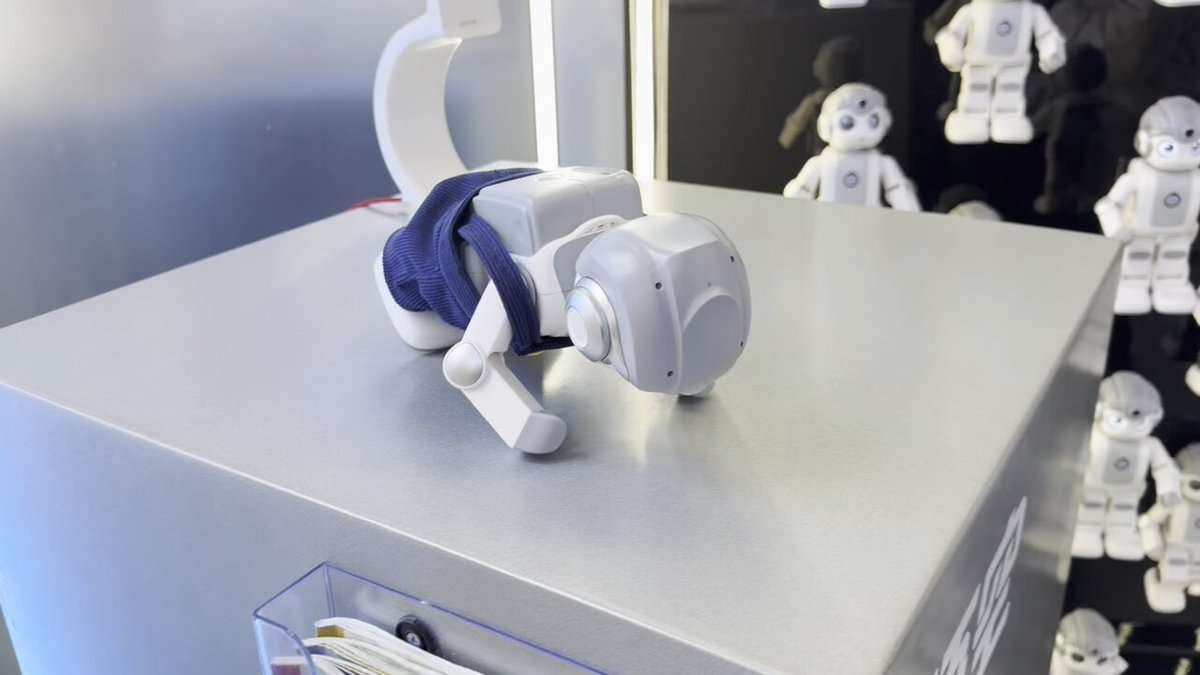
A monowheel security robot from Estonia! 🇪🇪 Rollo Robotics just raised €3.7M pre-seed led by FoodLabs and PROTOTYPE to bring the world's first stable autonomous monowheel robot to market. Founded by Arno Kütt (the mind behind Cleveron) and Sander Sebastian Agur, this Estonian startup has cracked what they call...

18,863 次观看 • 6 个月前 •via X (Twitter)

0 条评论

暂无评论

原始帖子的评论将显示在这里

相关视频

Something big is happening in robotics - and it’s hiding in plain sight. This post is not about dancing robots but in the data that powers them. Open robotics datasets have exploded this year, turning the field into a more scalable and collaborative ecosystem. In just two years, Hugging Face datasets grew from 11k to over 600k - and robotics is by far the fastest-growing segment. We went from 1k robotics datasets in 2024 to 27k in 2025! For comparison, text generation, the second-largest category, has only around 5k datasets in 2025. That gap is massive. Open datasets are important because robotics lives and dies by real-world robot data - video, actions, sensors, failures. By making this data easy to upload, reuse, and benchmark, researchers, startups, and large players are now releasing real-robot datasets that would have stayed locked inside labs just a few years ago. Major contributors include NVIDIA, LeRobot initiative, and a rapidly growing maker community. This surge is also enabled by cheaper video storage, better tooling, and an open-source AI culture now spilling into the physical world. And it really matters: open robotics data dramatically lowers entry barriers, accelerates learning-by-doing, and speeds up progress toward generalist and humanoid robots. Robotics won’t scale through hardware alone - but to a large extent through shared data. Viz below from AI World - link to the story and more viz/filters in comment.

Pierre-Alexandre Balland

185,895 次观看 • 6 个月前

A Letter to Our Community: The Road Ahead for Robotics To our Community and Partners, As we step into 2026, our mission at Axis is clearer than ever: Constructing the definitive End-to-End Scaling Layer for Robotics. Our goal is to accelerate the transfer of diverse human intelligence into Robotics General Intelligence (RGI). By owning the critical path of intelligence creation, we are turning the physical limitations of robotics into a scalable, software-driven future. Here is our strategic outlook and roadmap for the year ahead. The Core Thesis: Simulation is the Only Way Out The path to RGI is currently blocked by Data Scarcity, Generalization Fragility, and Hardware Fragmentation. At Axis, we believe Simulation is the only way out. Our Simulation Data Platform and Data Augmentation Engine transform raw data into "Synthetic Gold". Backed by academic milestones like Roboverse, Skill Blending, and GraspVLA, we have proven that pure simulation can achieve the generalization required for the real world. We don’t just collect data; we architect it. The Engine: Why Crypto? We believe RGI should come from all, not a few. Crypto is not just a feature; it is the primitive that powers our entire ecosystem flywheel: - Incentive Mechanism: Democratizing contribution and rewarding the trainers and developers. - Assetization: Turning proprietary data and refined models into liquid, ownable assets. - Verifiable Workflow: We are opening the "Black Box" of AI. By bringing total transparency to the Task Generation → Data Collection → Model Training pipeline, we ensure every byte of intelligence is verifiable, traceable, and secure. 2026 Strategic Deliverables This year, we are committed to delivering three foundational pillars: - The World's Largest Training Dataset for Robots: A robot training set—diverse, high-quality interaction data at an unprecedented scale. - A Robotics Foundation Model: A universal robotic brain trained on our pure simulation and synthetic data, capable of robust cross-embodiment transfer and open-world adaptability. - Evolvable Robot Hardware: Robots deployed with Axis models that autonomously evolve through continuous interaction, turning every deployment into a self-improving node within our RGI network. The Ultimate Vision We are building more than models; we are architecting the Distributed Machine Economy. A future where every dataset, model, and robotic embodiment is a verifiable asset in a global, autonomous network. Thank you for building the future of intelligence with us✌️📷

Axis Robotics

27,858 次观看 • 6 个月前

🚨 BREAKING: NVIDIA just announced the Isaac GR00T Reference Humanoid Robot. The first fully open humanoid robot reference design built on Jetson Thor, and it's going straight to the world's top research institutions. This is Jensen Huang's bet on open physical AI infrastructure. The hardware stack is serious: → Unitree H2 Plus chassis, 6 feet tall, 150 pounds, 31 degrees of freedom → Sharpa Wave tactile five-finger hands, 22 degrees of freedom, bringing total to 75 across the full body → NVIDIA Jetson AGX Thor onboard compute, 2,070 FP4 teraflops of AI performance, 128GB unified memory → Multi-view sensing, stereo head camera, wrist cameras, IMU Alongside this announcement, Unitree also introduced the H2 Plus as a standalone product, a frontier humanoid combining Unitree's own body, Sharpa's five-finger hands and NVIDIA Robotics Jetson Thor compute into one fully integrated research platform. The full Isaac GR00T software stack ships with it, teleoperation for data capture, open foundation models, Isaac Sim for training, Isaac Lab for evaluation, and accelerated ROS middleware for deployment. The complete loop from data to real-world robot in one unified platform. ETH Zürich, Stanford Robotics Center, UC San Diego and Ai2 are already on board as launch research partners. NVIDIA Robotics did to AI what it's now doing to robotics, build the platform, open the ecosystem, let the world build on top of it. Whoever owns the infrastructure layer wins. NVIDIA knows this better than anyone. 👀 Read more here: ~~ ♻️ Join the weekly robotics newsletter, and never miss any news →

Lukas Ziegler

15,928 次观看 • 1 个月前

I spent a month in Shenzhen visiting factories and robotics companies, and the contrast with the U.S. was striking. While Figure and Boston Dynamics hide their humanoids behind closed doors, Chinese companies have massive showrooms open to the public. But what really stood out wasn't just the transparency, it was how good they are at selling. Take UBTech: they've already sold 1,200 humanoid units at $200k each to factories. And here's the kicker, these robots aren't even that useful yet. They can only pick up and drop boxes at 1/10th the speed of a human, and factories still need to hire system integrators to train them for specific tasks. My theory is that these factories are terrified of getting left behind in the robotics/AI wave. They're investing in new tech not because it's ready, but because they can't afford to wait. The second surprise was the breadth of their robotics portfolio. These companies aren't just building humanoids, they're deploying service robots everywhere: restaurants, hotels, apartments. Consumer robots are cleaning houses, pools, pet waste, dishes. They're covering the entire spectrum. But the education piece shocked me most. I picked up what I thought was a high school or college robotics textbook, it was for primary school. The government mandated AI and robotics education starting in elementary school. Almost every single school in China now has AI and robotics curriculum, complete with education robots so kids can learn by building. They're creating a generation that grows up fluent in robotics and AI. China owns the supply chain and the hardware stack. But here's what I think people are missing: the race isn't just about who can build robots faster or cheaper. The U.S. advantage has always been in the layer between hardware and human, the interaction design, the software intelligence, the intuitive interfaces that make complex technology feel natural. China is building the physical infrastructure, but they're also learning fast. Every deployed service robot, every classroom full of kids building with education kits, every factory running humanoids, that's all data collection at scale. The window for the U.S. to establish its wedge is narrowing. It's not enough to be better at AI or software anymore. We need to be building the integration layer, the intelligence that makes physical AI actually useful, not just impressive in a showroom. Because right now, China isn't just manufacturing robots. They're manufacturing a robotics-native culture, and that might be the most defensible moat of all.

Miyu Horiuchi

90,718 次观看 • 5 个月前

It has been a privilege to collaborate with Amanda Davies and Ghaleb Krame, Ph.D. on research that explores one of the most significant emerging security challenges of our time. We are honored that our paper, “A Framework for Predicting Adoption of AI-Enabled Autonomous Drone Capabilities by Transnational Organized Crime and Foreign Terrorist Organisations”, has been accepted for presentation at EMCIS 2026, the 23rd European Mediterranean & Middle Eastern Conference on Information Systems, to be held in Paris this August. What makes this particularly meaningful is that the research was completed and submitted well before the issue entered the center of public policy discussions in Washington. Our study examined the pathways through which transnational criminal organizations could evolve from conventional drone operations toward increasingly autonomous and AI-enabled capabilities. Using structured comparative analysis and open-source intelligence, it identified conditions under which such technological adoption could accelerate. Just on June 2, 2026, during testimony before the U.S. Senate Foreign Relations Committee, Secretary Marco Rubio warned that Mexican cartels are already employing drones and that these capabilities could ultimately threaten U.S. interests. While academic research does not seek to predict headlines, its purpose is to identify emerging risks before they become strategic realities. The growing attention from policymakers underscores the importance of rigorous, evidence-based analysis at the intersection of artificial intelligence, autonomous systems, and transnational security. We are grateful to the EMCIS reviewers and organizers for recognizing the contribution of this work and for fostering serious discussion on challenges that will increasingly shape the security landscape of the coming decade. I am proud to serve the interests of the United States through research and analysis focused on the evolving capabilities of Mexican cartels. Working alongside Dr. Ghaleb Krame, Ph.D. , it is a privilege to contribute to a deeper understanding of emerging security threats and to support informed decision-making in an increasingly complex technological and geopolitical environment.

Simón Levy

22,536 次观看 • 1 个月前

Brewing a Better Bite of Meat Here’s why we led the Series A of The Better Meat Co., announced today. I am a meat eater, but I know that eventually, we won't slaughter animals for meat. Although we believe this is inevitable, on Earth and Mars, it takes concerted effort to get us there. And as we saw with electric cars, you have to have a better product to catalyze a change. Saving the world is the byproduct. After investing in some of the pioneers of cellular ag and precision fermentation, we pondered what problem remained unsolved by the mainstream approaches to slaughter-free meat and began a quest for the best cost economics and speed of scaling. For cellular ag and plant-based approaches, cost has been their biggest challenge, and the meat market is highly price elastic. We did a thought experiment: given all of the approaches to alt-protein out there, which will be the lowest cost 50 years from now? We assumed all R&D efforts reach their ultimate end points by then. I think we found the winner: Better Meat goes from seed to harvest in under 17 hours! No plant or animal can compete with that growth rate. The key: growth from cell expansion instead of cell division, part of the magic of the kingdom of fungi. And they have mastered continuous production off simple sugar feedstocks with no waste stream. The only downstream processing is some dehydration. At their current research scale facility, they already beat beef on cost, and soon chicken. Some of the key drivers from their patented process: fastest growth cycle of any organism, continuous production, minimal downstream processing (unlike plant protein isolates, for example, where most of the plant biomass is byproduct), and it’s a nutritious whole food. It’s also shelf stable at room temperature for easy shipping. So, it should scale more rapidly and cost-effectively than other approaches can ever achieve. Oh, and it is delicious and tastes like meat, even better than pure meat in some blended product taste tests (think hamburger or sausage blends). They are a B2B ingredient supplier, and the first to get FDA and USDA approval for blended meat products. The Series A will allow them to scale to tens of millions of pounds of annual production for a number of large food companies. Company: Today’s funding news: • •

Steve Jurvetson

17,016 次观看 • 10 个月前

Today marks General Availability of AgentCore, a set of infrastructure building blocks for developers and companies to build secure, scalable agents. When we first started AWS, the vast majority of developers were spending most of their time on the undifferentiated heavy lifting of infrastructure instead of what differentiated their feature. So, we solved that problem by building primitive building blocks like compute and storage and database that would allow teammates and customers to quickly build and deploy new experiences without having to reinvent the wheel each time. We realized the same thing was happening with AI agents. It's too difficult and it's slowing customers down. That's why we created AgentCore, a set of services to build, deploy, and operate highly capable agents using any framework or model, with enterprise-grade security and scalability. These building blocks (like serverless secure runtime, memory, observability, a gateway that does MCP translation, etc) help customers tackle some of the biggest challenges of going from prototype to production, much more quickly, securely, and scalably. AgentCore has been in preview for several weeks, and customers have been quite excited about it. The AgentCore SDK has already been downloaded over a million times and we're seeing transformative results, such as Cohere Health expecting to reduce medical review times by 30-40% in highly regulated healthcare, and teams at Cox Automotive and Experian are embracing its flexibility to deploy and operate agents at scale. Inside Amazon, our Amazon Devices Operations & Supply Chain team is using AgentCore to develop an agentic manufacturing approach where AI agents work together to automate manual processes – turning what used to be days of engineering time into processes that take under an hour with high precision. Just like AWS changed how companies build and scale applications, we believe AgentCore will do the same for AI agents, enabling the next generation of innovation.

Andy Jassy

24,990 次观看 • 9 个月前

Eleven years ago I founded my first startup. One of the first things I did was to get a desk at the startup coworking space at Google Campus in Old Street. Through that community, I met so many of the people who would shape my career and learned so much about what the startup ethos is truly about. As we have scaled Attio, we've partnered with Google Cloud to build on top of the mind blowing technologies they've created like Spanner, Colossus and Gemini to power a new generation of CRM for our customers. For all these reasons, Google is deeply woven into my startup journey and that makes today's announcement so special to me. I'm beyond excited to announce our $52 million Series B, led by Michael McBride and the GV, along with the continued support of our incredible partners from Redpoint , Point Nine , Balderton Capital and 01A. We're entering a software renaissance driven by AI and we're unbelievably excited about continuing the hard work of delivering the next generation of CRM. We're building a truly AI-native platform that can run code, integrate anywhere and bring unified context for the next generation of autonomous workflows. None of this would have been possible without the support of the more than 5,000 customers who have already chosen Attio as the backbone of their GTM stack. Your belief in our vision is what has made this possible and I can't wait to share more about some of the incredible functionality that's still to come. I'm incredibly grateful for the continued support of alex bard , Patrick Chase, Ricardo Sequerra Amram, Daniel Waterhouse and dick costolo whose belief in Attio from the earliest days has been so essential to our progress so far and to my co-founder Nicolas Sharp, for the many sleepless nights and challenging decisions that got us this far. We've got so much still to build, and we're always hiring, so if you are interested in being part of reinventing the core of the GTM stack, please take a look at For now though, it's back to building!

Alexander Christie

16,506 次观看 • 10 个月前

🚨 THE RACE TO 6G JUST ACCELERATED. Northrop Grumman has developed a W-band GaN chip operating at up to 110 GHz and took it from concept to market-ready hardware in less than six months. The new gallium nitride chip operates in the W-band (75–110 GHz), a frequency range that delivers massive bandwidth, extremely high data rates, and much lower latency than current systems. What makes this impressive is the speed: the chip went from concept to market-ready hardware in less than six months through a U.S. government-backed microelectronics program. That’s unusually fast for advanced defense-grade semiconductors. The chip acts as a high-power signal amplifier that can strengthen wireless links while shrinking the size and power consumption of the hardware. It’s designed for military radar, secure satellite communications, and the coming wave of 6G networks. Why this matters: • W-band offers far more spectrum than current 5G bands, enabling much faster data transmission and higher-resolution sensing • Gallium nitride can handle significantly higher power and frequencies than silicon, making it ideal for these demanding applications • The rapid development cycle shows how public-private collaboration can accelerate critical semiconductor technologies • The same tech that strengthens military radar and satellite links will directly feed into future commercial 6G infrastructure The deeper implication: We’re watching the foundation of next-generation wireless and sensing systems being laid in real time. High-frequency GaN chips like this won’t just improve existing radar and satellite systems they’re likely to become core building blocks for 6G, autonomous systems, and advanced defense platforms. The fact that this moved from lab to market in under six months suggests the pace of high-frequency electronics is accelerating dramatically. The future of wireless isn’t just faster. It’s operating at frequencies most people have never heard of and it’s being built right now. How soon do you think W-band and GaN technology will start appearing in everyday 6G devices? Follow for more frontier semiconductors, defense tech, and next-generation wireless systems.

TheNewPhysics

22,647 次观看 • 1 个月前

American Mining Automation, Maritime Moment, & PE enters Aerospace. Daily Hard Tech Headlines: - Durin, the El Segundo based mining technology startup has raised a $3.4M pre-seed round according to Tech Crunch. The round was led by 8090 Industries. Durin is developing an autonomous drill rig and has announced testing in Nevada as early as next week. - Exowatt has announced a $70M Series A led by Felicis. Exowatt has created a modular solar system that captures and stores thermal energy for reliable, around-the-clock power delivery, suited for data centers and industrial operations. - American Pacific Corporation has announced a $100 million investment to expand ammonium perchlorate production by more than 50 percent at its Cedar City site. The material is critical for solid rocket motors. - Northwood, based in El Segundo, has announced a $30M Series A led by Alpine Space Ventures and Andreessen Horowitz to scale a vertically integrated global network of satellite ground stations and modernize outdated ground infrastructure. - Denmark has announced a $615 million investment in naval expansion, including four versatile vessels for environmental protection and mine deployment, a drone and sonar-equipped ship for underwater monitoring, and 21 new ships for the Naval Home Guard. - Reaction Dynamics, developing hybrid rocket propulsion technology has won $1M in Tim Draper’s global pitch competition, securing $1 million from Draper Associates. - A new directed energy weapon system for C-UAS has been tested by the British Army. The tests focused on countering drone swarms. - Thoma Bravo is acquiring portions of Boeing Digital Aviation technology for $10.55B. - Teledyne Marine has received initial orders for its Compact Navigator, a small form-factor system that supports autonomous navigation in underwater and surface vehicles. - Saronic, the maritime autonomy startup, has unveiled two Autonomous Surface Vessels: one 40 feet long (Mirage) and one 60 feet long (Cipher). Mirage has a range of over 2000 nautical miles and a payload capacity of 2000 pounds. Cipher exceeds 3000 nautical miles in range and carries up to 10000 pounds. - HavocAI has announced that their Seahound is a 38-foot USV designed to operate alongside the 14-foot Rampage, offering expanded operational range and control for large-scale fleets.

Atoms Not Bits

10,470 次观看 • 1 年前

The first generation of DeePle is officially over! To those who minted—welcome! And to those who bought from the secondary market, you have my utmost respect. So... what’s next? I’d like to say this is just the beginning of an evolving project. There will be a second generation with fresh items and unique features, followed by a third, and more. I'm excited to dive deeper into the DeePleVerse and explore all its possibilities, and it would be an honor to have all of you along for the journey. Now, I’d like to share some thoughts and the vision behind this experimental yet fun art project. Over the past years, we’ve seen countless ups and downs, with beautiful and ugly moments unfolding simultaneously in web3. Here’s what I’ve learned along the way: 1/1s and Editions are fantastic for maintaining authenticity and scarcity, especially from incredible artists. However, they can feel too exclusive, making it difficult to build a larger community. On the other hand, PFPs are great for fostering a community, bringing people together around a shared belief. But they often lack the authenticity of fine art and can attract too much speculation. I’ve always wondered how we could bring the best of both worlds together. And that’s how DeePle was born—after much thought and exploration. I wanted to remove the gambling aspect, so there’s no reveal or rarity. I wanted collectors to have full control, allowing them to choose what to mint based on what they see. I also believe it’s crucial to strike the right balance between public and coordinated spots for the drop to avoid creating a speculative atmosphere. While I have some interesting ideas for the future, I’m never going to reveal what’s coming or use the word "roadmap" because I want to avoid creating unnecessary hype and making unrealistic promises. For now, I hope people find value in the experience and become part of the DeePleVerse. The goal is to build a genuine community, step by step, with each new round of drops, and to gradually bring in more people over time. None of this would have been possible without the Shape and Transient Labs. Shape created an impressive and efficient L2 chain that enables the complexity and functionality necessary for this project. And Transient Labs fully understood my vision, creating the perfect tool to bring DeePle to life. I’m incredibly excited for what’s ahead!

DeeKay

74,156 次观看 • 1 年前