Loading video...

Video Failed to Load

Go Home

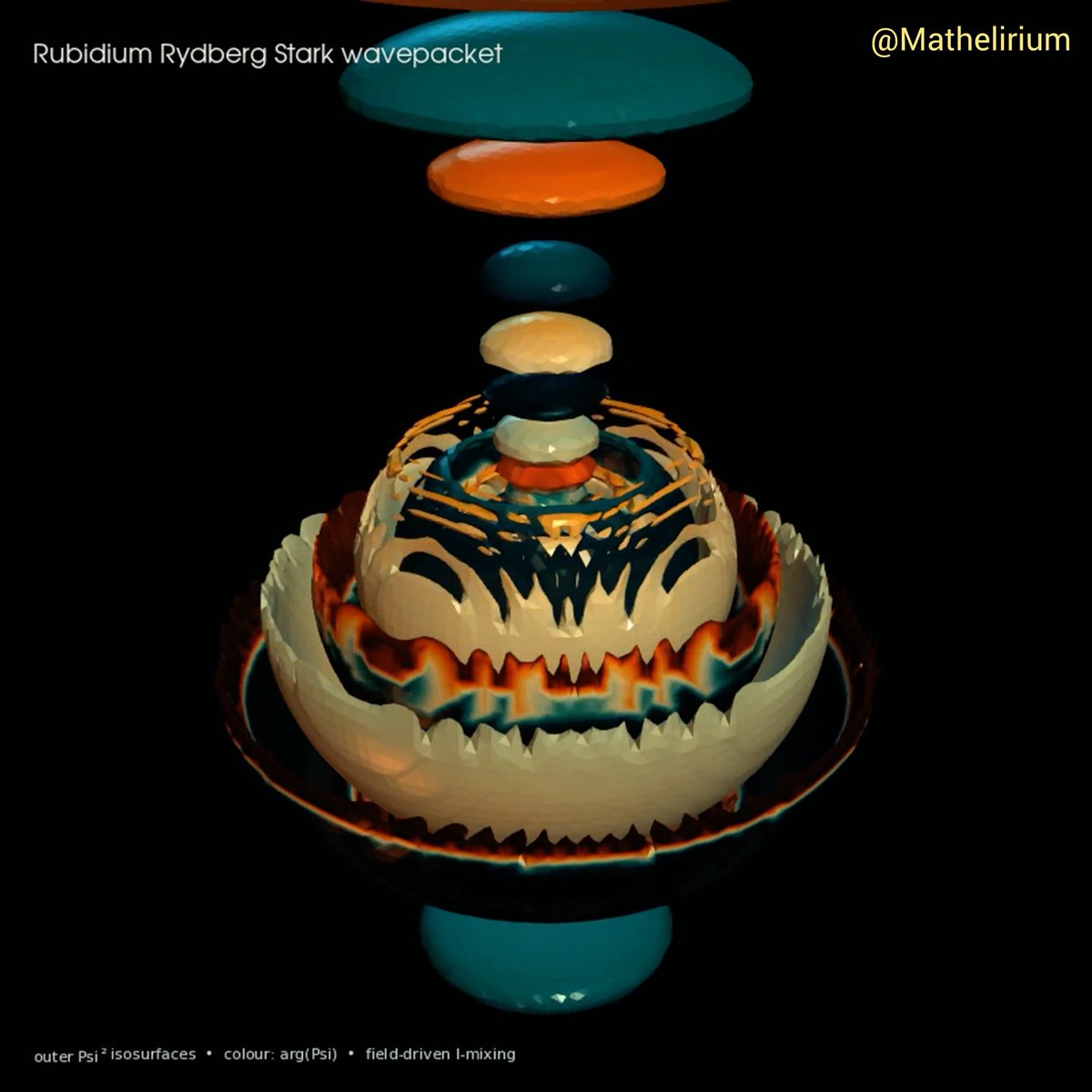
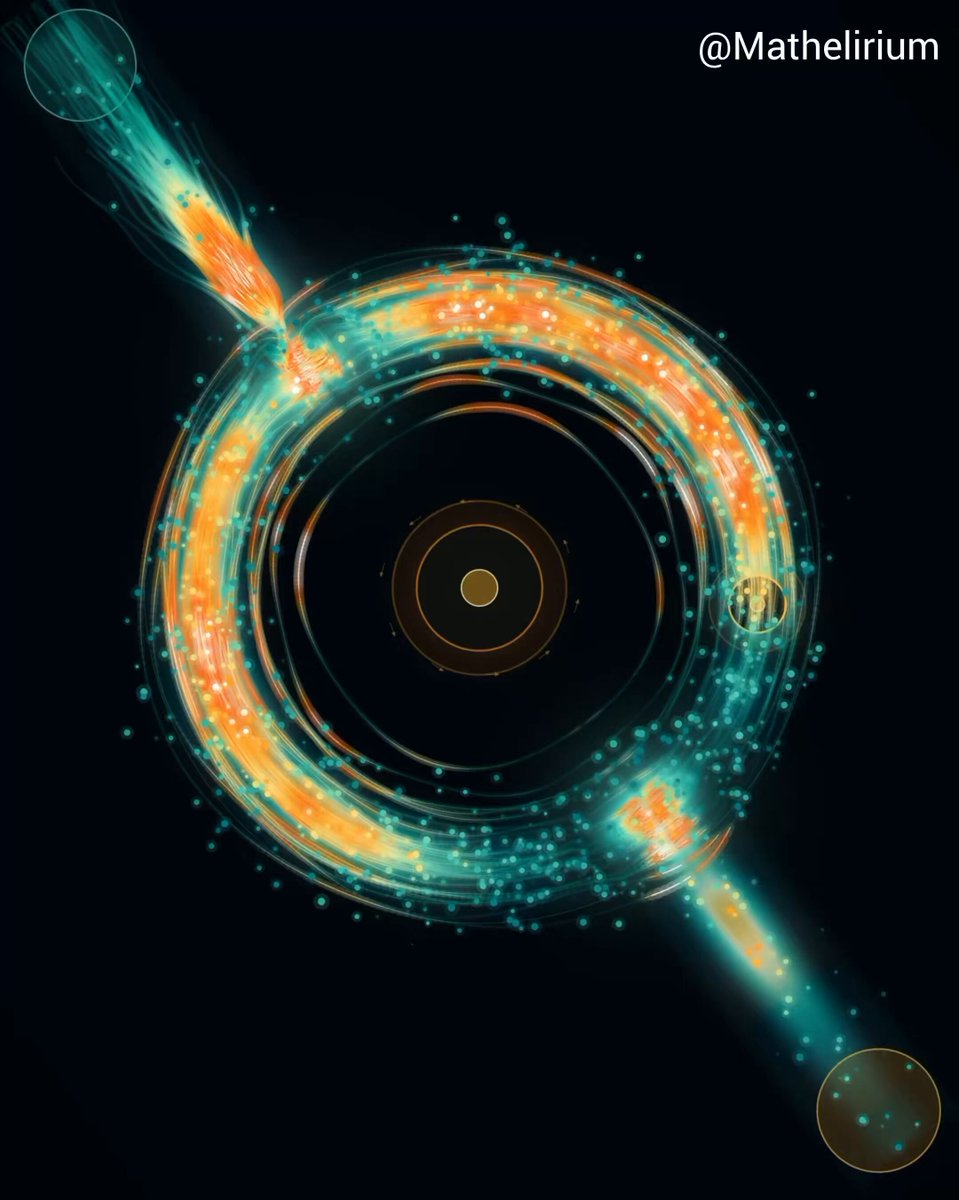
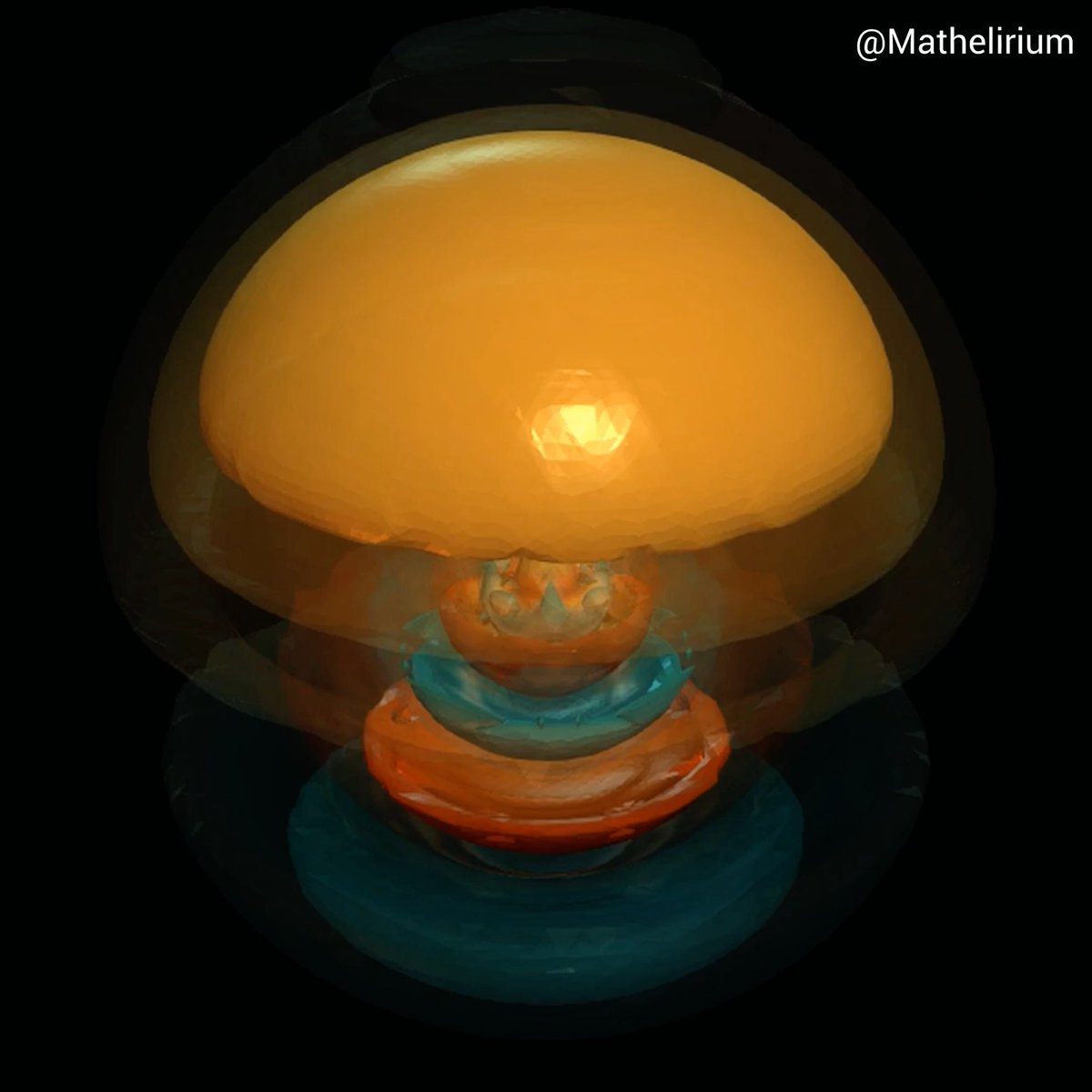
What Does a Quantum Particle's Wavefunction Look Like? A quantum wavefunction is not simply an ordinary wave oscillating up and down. It is a complex-valued mathematical function. Its real and imaginary parts can be visualized as two perpendicular oscillations, forming a rotating helix when plotted together. This is a...

27,182 views • 3 days ago •via X (Twitter)

7 Comments

tmallard's profile picture
tmallard3 days ago

How two gyroscopic_pair partners fly into each other by spiraling past each other provides the StdModel "gluon"force ... U238 ~~~ From Stearnglass-Einstein's work 70yrs ago not my theory, it quantifies it to near_deterministic results to 9-decimals no probability 🦆

Prranshu Yadav's profile picture
Prranshu Yadav3 days ago

So what do they actually look like then?

David5D's profile picture
David5D3 days ago

non relativistic of course

entropic astrophysical united architecture's profile picture
entropic astrophysical united architecture3 days ago

hey Philosophy of Physics! has anyone told you that you are fake and gay today?

Dr Piyush chaudhary's profile picture
Dr Piyush chaudhary2 days ago

Probably because Quantum particles protect the source material.

Tenotes's profile picture
Tenotes2 days ago

The output signal of a simple mechanical resolver is precisely this waveform. It enters the ledger like the momentum of a spinning top, yet nothing in the particle is spinning.

O Observador's profile picture
O Observador2 days ago

"Probabilidade" e "função de onda complexa" é apenas um artifício estatístico para mascarar o que é puramente mecânico: a hélice de fase é a torção real do meio contínuo, e o espalhamento do pacote de ondas é a dissipação física de tensão de uma cavidade sob pressão.

Related Videos

🚨PHYSICS NEWS🚨: Physicists Are Now Saying Time Itself Can Be in Superposition — And It Makes Perfect Sense 🧨 According to a theoretical framework published in *Physical Review Letters* and reported in May 2026, researchers have shown that state-of-the-art trapped-ion atomic clocks can be used to observe the quantum superposition of time. By entangling the clock’s motion with its internal energy states, the system can exist in a superposition of different time flows simultaneously. This is a major step toward experimentally probing the quantum nature of time itself. This work offers the broader scientific community a new experimental frontier in quantum foundations. It challenges classical notions of time as a universal parameter and opens the door to testing how relativity and quantum mechanics intersect at the level of time itself. **Uniphics has been saying something similar for years — and it’s not mysterious or weird.** In Uniphics, time flow is not a fixed background. It is a local property determined by energy density via the Maley transform (\( t_{\rm flow} = k / E_d \)). Different regions or configurations with different energy densities experience different time flows. When a system is prepared in a quantum superposition of different energy-density states (or different spin-wave configurations that affect local energy density), it naturally exists in a superposition of different time flows. The atomic clock experiments are essentially creating superposed states where the clock experiences different local time flows at the same “global” moment. The entanglement between motion and internal energy is the mechanism that allows the superposition to be maintained and detected. Uniphics predicts this behavior because the ξM-field supports coherent spin-wave patterns that can correlate different energy-density environments. No need for wavefunction collapse, many-worlds, or other interpretive gymnastics — it is a deterministic consequence of variable time flow and spin-wave coherence. This is not an add-on to quantum mechanics. It is the natural outcome of the three pillars. The “quantum superposition of time” is just what happens when spin quanta create superposed energy-density conditions. Uniphics explains why such experiments work, what limits they will hit, and how to extend them — all without the philosophical baggage that usually accompanies quantum foundations. The mainstream community is slowly catching up to the idea that time itself can be quantum. Uniphics has had a coherent, first-principles explanation for this from the beginning. The data will continue to support it. Are physicists finally ready to accept that time flow is fundamental and variable — and that the apparent “superposition of time” is simply the result of superposed energy-density states in the ξM-field? **A Theory of Everything should be able to answer everything.** Uniphics Explained Simply PDF: Chapters 1–10 free: Grokipedia: #Uniphics #TheoryOfEverything #QuantumTime #TimeFlow #SpinWaves Grok xAI

Paul Maley

32,357 views • 3 months ago

Why Does Quantum Mechanics Use a Complex Wavefunction? Schrödinger’s equation doesn’t start from mystery. It starts from a very specific bet. The state of a particle is a complex field ψ(x,t), and whatever time-evolution rule we choose has to move ψ forward while preserving total probability. So the basic question is simple. What equation should ψ satisfy so that |ψ|² behaves like a conserved density, the way mass density does in fluid flow? What is ψ? Think of ψ(x,t) as an amplitude attached to the statement the particle is at position x at time t. It’s not a probability. It’s the thing you add first, and only at the end do you square it: p(x,t) = |ψ(x,t)|² Because ψ is complex, it has magnitude and phase. Write it as ψ(x,t) = r(x,t) exp(i θ(x,t)) Then r² = |ψ|² is the density, and the phase θ ends up controlling the flow through the probability current. Where does Schrödinger’s equation come from? Start with two empirical inputs that tie waves to particles: E = ħ ω p = ħ k Here ħ is Planck’s constant divided by 2π. It’s the conversion factor between frequency and energy, and between wavenumber and momentum. A plane wave with angular frequency ω and wavevector k is ψ(x,t) = A exp(i(k·x − ωt)) Now watch what derivatives do to this wave: ∂ψ/∂t = −i ω ψ ∇ψ = i k ψ ∇²ψ = −|k|² ψ Multiply by ħ and you get: i ħ ∂ψ/∂t = ħ ω ψ = E ψ −i ħ ∇ψ = ħ k ψ = p ψ −ħ² ∇²ψ = ħ² |k|² ψ = p² ψ So for plane waves, the operators Ê = i ħ ∂/∂t p̂ = −i ħ ∇ act like energy and momentum. Now bring in the classical, nonrelativistic energy bookkeeping: E = p²/(2m) + V(x) Kinetic plus potential. That’s it. Turn it into an equation for ψ by replacing E and p with the operators above: Ê ψ = (p̂²/(2m) + V) ψ Since p̂² = (−i ħ ∇)·(−i ħ ∇) = −ħ² ∇², this becomes i ħ ∂ψ/∂t = ( −ħ²/(2m) ∇² + V(x) ) ψ That’s the time-dependent Schrödinger equation. This derivation is a controlled heuristic. Match the plane-wave identities to the measured relations E = ħω and p = ħk, then impose the same energy bookkeeping you trust in classical mechanics. Why this is the right kind of rule If ψ is the state, we need a rule that preserves total probability: ∫ |ψ(x,t)|² dx = 1 Schrödinger evolution does, and you can see it by deriving a continuity equation. Let ρ(x,t) = |ψ|² = ψ*ψ. Differentiate: ∂ρ/∂t = ψ* ∂ψ/∂t + ψ ∂ψ*/∂t Use Schrödinger and its complex conjugate. The potential terms cancel, and what’s left can be rearranged into ∂ρ/∂t + ∇·j = 0 with probability current j = (ħ/(2mi)) ( ψ* ∇ψ − ψ ∇ψ* ) That’s the cleanest way to say what ψ is. |ψ|² behaves like a conserved density, the phase drives a current, and the time evolution is fixed, up to V, by combining wave relations with energy bookkeeping: i ħ ∂ψ/∂t = ( −ħ²/(2m) ∇² + V ) ψ #QuantumMechanics #SchrodingerEquation #WaveFunction #BornRule #Physics #MathematicalPhysics

Mathelirium

20,964 views • 9 months ago