正在加载视频...

视频加载失败

Diffusion has shown great promise for generating robot **actions**, can it act as a **world model** to generate the future conditioned on actions? In our work led by han qi Haocheng Yin and in collaboration with Yilun Du, we show a **controllable** action-conditioned video diffusion model can produce photorealistic...

38,586 次观看 • 1 年前 •via X (Twitter)

9 条评论

Abhinav Girdhar 的头像
Abhinav Girdhar1 年前

@hanqi359246 @hcy1n @du_yilun This is a huge step forward! Using diffusion models as world models for action-conditioned predictions could revolutionize robotics. Excited to see how this improves policy learning and control.

SecurityPal 的头像
SecurityPal2 年前

In this episode of the 'In Security' Podcast, coming to you from the Himalayas, @WilHarm3, Operating Partner and CISO at @craft_ventures, and Josh Mullis, Head of Information Security at @productiv_inc, share thoughts on the evolving role of a CISO. 🔗:

LongFang 的头像
LongFang1 年前

@hanqi359246 @hcy1n @du_yilun 😮

VictorGallagher 的头像
VictorGallagher1 年前

@hanqi359246 @hcy1n @du_yilun When I see this I think 3D printer control.

T J 的头像
T J1 年前

@hanqi359246 @hcy1n @du_yilun Melt the glaciers

Rohan Sundar 的头像
Rohan Sundar1 年前

@hanqi359246 @hcy1n @du_yilun 😯

Jason Hall 的头像
Jason Hall1 年前

@hanqi359246 @hcy1n @du_yilun cool work!

Maxime Alvarez 的头像
Maxime Alvarez1 年前

@hanqi359246 @hcy1n @du_yilun Seems like a bit wasteful (for compute) to plan in image space, could we adapt this with V-JEPA which gives us video prediction in a latent space? Or is there a benefit to images?

Heng Yang 的头像
Heng Yang1 年前

@hanqi359246 @hcy1n @du_yilun Great comment. Definitely prediction in latent space should be the way forward. Perhaps not just latent space, but more structured representations that are object-centric/semantic. Images may be just a showcase of possibility and first step.

相关视频

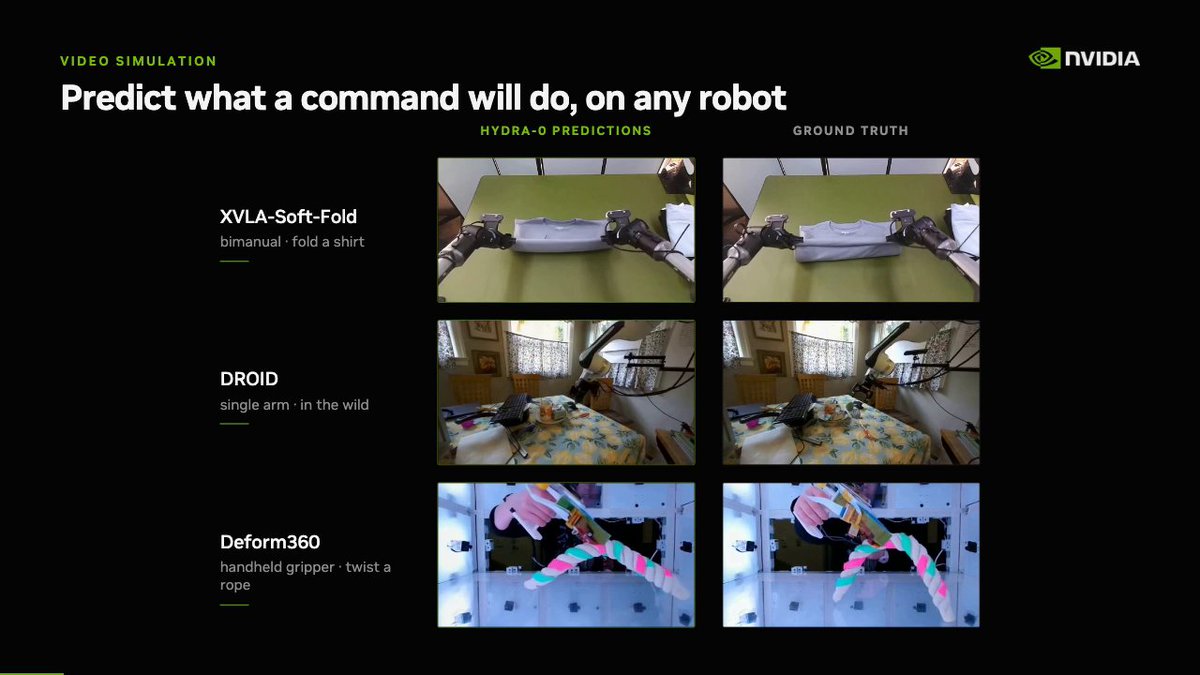
How do you grade a world model? Against what the robot really did. Picture a robot gripper closing on a piece of fruit. In the real world, it fails to grasp it. Now hand the same first frame and the same action sequence to an action-conditioned world model (ACWM). The rollout shows a tidy, successful pick. Nothing on screen looks wrong. That is the moment WorldOracle Bench was built for. Created by AGIBOT and NVIDIA together with Princeton, UT Austin and the University of Toronto, it is an evaluation platform for robot behavior models. It replays the real, recorded actions through a model and checks the predicted future against the paired real execution. The stakes are practical. The paper points to data generation, scalable policy evaluation and closed-loop policy learning as potential uses of ACWMs. If a model gets the physical consequences wrong, everything built on top of it inherits the error. The authors call the property they are testing execution coherence: does the model follow the actions it is given, even the bad ones, across different embodiments and action sources, and over long rollouts? What makes the setup unusual is where the evidence comes from. The paper compares eight existing embodied world-model benchmarks, and none of them combines action-conditioned evaluation, real-world data, failed executions, long episodes, multiple embodiments, multi-view outputs and policy-generated actions. WorldOracle Bench does. Its evaluation set has 335 episodes: 100 on AGIBOT G2, 75 on YAM and 100 with a human hand, all human-operated, plus 60 rollouts where a learned policy drove a real AGIBOT G2 robot. About 40% of the human-operated segments are failures, so a model cannot get by on success stories.

Science girl

82,284 次观看 • 16 天前

Introducing FLUX 3 Action. An open weights 7B World Action Model that achieves first place on the RoboLab benchmark. It outperforms the previous best open model by 6.1 percentage points while using 56% fewer parameters and running up to 3.95x faster.⁠⁠ FLUX 3 Action removes the usual trade-off between world action model performance and VLA speed: it still predicts video and actions together, but plans more than twice as far ahead and runs faster per second of robot motion than the strongest open VLA. Teams can fine-tune FLUX 3 Action on their own demonstrations to create policies for a particular robot and task. Together with NVIDIA, we also integrated FLUX 3 Action natively into Hugging Face's LeRobot, with fine-tuning recipes included and edge deployment on NVIDIA Jetson. Beyond robotics, we’re also seeing promising results training task-specific policies for acting in simulated environments like gaming, controlling a vehicle, computer use, and wherever else a model needs to understand a visual environment and then choose what to do next. FLUX 3 Action builds on the same image, video, and audio pretraining as FLUX 3, but uses a smaller architecture designed for practical deployment. In midtraining, we trained the model to predict actions and future frames together. We’re releasing the weights, code, fine-tuning recipe, benchmarks, and reproducible examples so researchers and developers can build on the model with their own robots, environments, and tasks (see below).

Black Forest Labs

182,671 次观看 • 1 个月前