Video wird geladen...

Video konnte nicht geladen werden

Zur Startseite

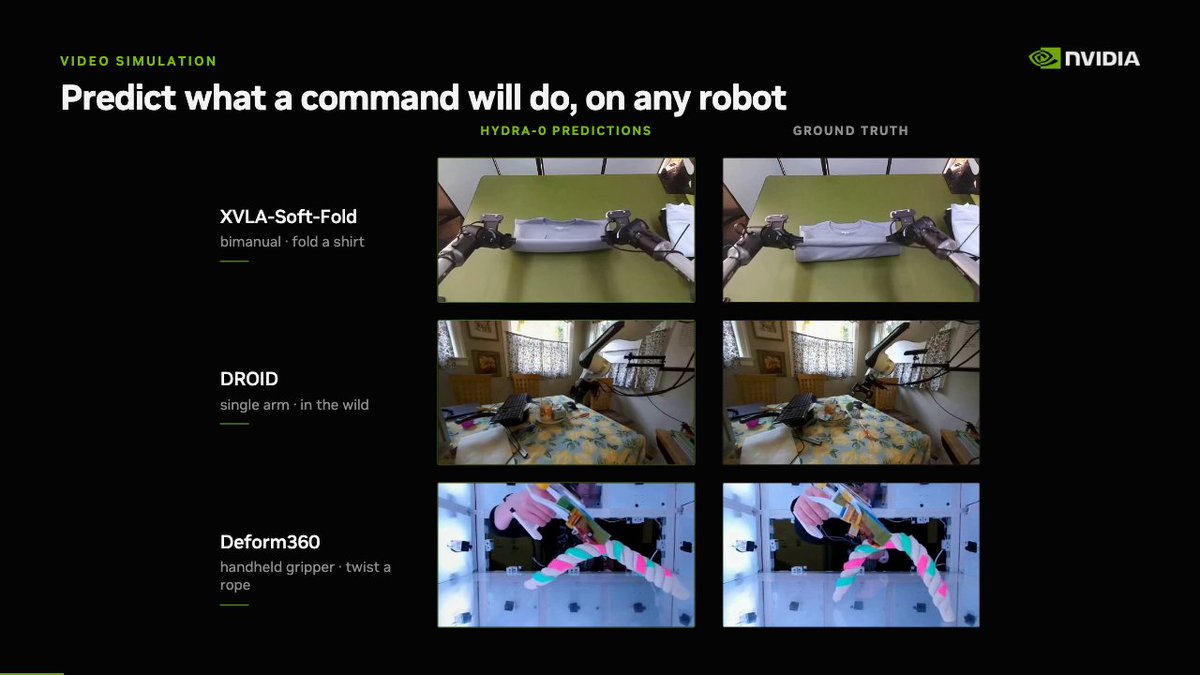
Diffusion has shown great promise for generating robot **actions**, can it act as a **world model** to generate the future conditioned on actions? In our work led by han qi Haocheng Yin and in collaboration with Yilun Du, we show a **controllable** action-conditioned video diffusion model can produce photorealistic...

38,428 Aufrufe • vor 1 Jahr •via X (Twitter)

9 Kommentare

Profilbild von Abhinav Girdhar
Abhinav Girdharvor 1 Jahr

@hanqi359246 @hcy1n @du_yilun This is a huge step forward! Using diffusion models as world models for action-conditioned predictions could revolutionize robotics. Excited to see how this improves policy learning and control.

Profilbild von SecurityPal
SecurityPalvor 2 Jahren

In this episode of the 'In Security' Podcast, coming to you from the Himalayas, @WilHarm3, Operating Partner and CISO at @craft_ventures, and Josh Mullis, Head of Information Security at @productiv_inc, share thoughts on the evolving role of a CISO. 🔗:

Profilbild von LongFang
LongFangvor 1 Jahr

@hanqi359246 @hcy1n @du_yilun 😮

Profilbild von VictorGallagher
VictorGallaghervor 1 Jahr

@hanqi359246 @hcy1n @du_yilun When I see this I think 3D printer control.

Profilbild von T J
T Jvor 1 Jahr

@hanqi359246 @hcy1n @du_yilun Melt the glaciers

Profilbild von Rohan Sundar
Rohan Sundarvor 1 Jahr

@hanqi359246 @hcy1n @du_yilun 😯

Profilbild von Jason Hall
Jason Hallvor 1 Jahr

@hanqi359246 @hcy1n @du_yilun cool work!

Profilbild von Maxime Alvarez
Maxime Alvarezvor 1 Jahr

@hanqi359246 @hcy1n @du_yilun Seems like a bit wasteful (for compute) to plan in image space, could we adapt this with V-JEPA which gives us video prediction in a latent space? Or is there a benefit to images?

Profilbild von Heng Yang
Heng Yangvor 1 Jahr

@hanqi359246 @hcy1n @du_yilun Great comment. Definitely prediction in latent space should be the way forward. Perhaps not just latent space, but more structured representations that are object-centric/semantic. Images may be just a showcase of possibility and first step.

Ähnliche Videos

This is THE moment of Physical AI! We are officially announcing Cosmos 3: Omnimodal World Models for Physical AI 🚀 - Cosmos 3 is an omnimodal world model: within a unified architecture, it can understand and generate language, images, video, audio, and actions. - It is not just a VLM, not just a video generator, not just an audio-visual generative model, and not just a physics simulator / world-action model. It can understand images and videos, generate images, videos, and audio, simulate future worlds, predict actions, and generate robot policies—enabling models to truly begin to “touch the world.” - Cosmos 3 is the #1 open-weight reasoner / T2I / I2V / robot policy across many benchmarks. Huge thanks to every teammate who fought side by side on this journey—from architecture, data, training, infra, serving, and evaluation to post-training. Every part of this project carries an incredible amount of hard work. This was my first time leading a project as Tech Lead, and I feel truly fortunate. The future of Physical AI needs models that can not only “see” and “describe” the world, but also “imagine,” “simulate,” and “act”—and eventually close the loop with the real world. I hope Cosmos 3 can become an important starting point for this direction, and I’m excited to push Physical AI into its next stage together with the open-source community. Welcome to the era of Physical AI. HuggingFace: Project Website: Code:

Max Zhaoshuo Li 李赵硕

1,078,049 Aufrufe • vor 1 Monat

Multi-Track Timeline Control for Text-Driven 3D Human Motion Generation paper page: Recent advances in generative modeling have led to promising progress on synthesizing 3D human motion from text, with methods that can generate character animations from short prompts and specified durations. However, using a single text prompt as input lacks the fine-grained control needed by animators, such as composing multiple actions and defining precise durations for parts of the motion. To address this, we introduce the new problem of timeline control for text-driven motion synthesis, which provides an intuitive, yet fine-grained, input interface for users. Instead of a single prompt, users can specify a multi-track timeline of multiple prompts organized in temporal intervals that may overlap. This enables specifying the exact timings of each action and composing multiple actions in sequence or at overlapping intervals. To generate composite animations from a multi-track timeline, we propose a new test-time denoising method. This method can be integrated with any pre-trained motion diffusion model to synthesize realistic motions that accurately reflect the timeline. At every step of denoising, our method processes each timeline interval (text prompt) individually, subsequently aggregating the predictions with consideration for the specific body parts engaged in each action. Experimental comparisons and ablations validate that our method produces realistic motions that respect the semantics and timing of given text prompts.

AK

126,585 Aufrufe • vor 2 Jahren