Video wird geladen...

Video konnte nicht geladen werden

Zur Startseite

🚨HOLY CRAP: SCOTUS Decision Could WIPE OUT Billions in US Gains, NULLIFY Trump's Deals, Force US To Pay Back TRILLIONS in Tariffs – Economy SHATTERED, Chaos Ensues! 😤 Folks, the lower appeals court ruling on Trump's Tariffs – it's a FULL-BLOWN THREAT to America's sovereignty and economy! If the...

453,576 Aufrufe • vor 1 Jahr •via X (Twitter)

0 Kommentare

Keine Kommentare verfügbar

Kommentare vom Original-Post werden hier angezeigt

Ähnliche Videos

I JUST BROKE DOWN THE REAL NUMBERS ON TRUMP'S TARIFFS Everyone expected tariffs to reduce the current account deficit and restore US jobs. But the numbers tell a different story. China just posted a $1.2 trillion trade surplus in 2025. The biggest in history. Up 20% from 2024. And this happened DURING Trump's "maximum pressure" tariff campaign. Let's dive deeper: Early 2025: Tariffs on China escalated as high as 145%. Late 2025: A deal brought them down to the high-40s/low-50s range. January 2026: Trump threatens 25% tariffs on ANY country doing business with Iran. Iran's biggest trading partner? China. But here's the part nobody's talking about: The Tax Policy Center estimates the average tariff rate on ALL US imports is now 17%. The Budget Lab at Yale estimates these tariffs raised consumer prices by 1.2% - roughly $1,700 per household. In 2025, businesses absorbed most of these costs. But in 2026, they're passing them to consumers. The jobs data is worse: After the April 2025 tariff announcement, factory employment FELL by 68,000 jobs. The Federal Reserve found that tariff exposure in 2018-2019 reduced manufacturing employment by 1.4%. A small +0.3% protection effect was offset by -1.1% from higher input costs and -0.7% from retaliation. Even in optimistic scenarios, tariffs create very few jobs once you account for higher input costs destroying downstream employment and retaliation from trading partners. Trump's theory was that tariffs would force manufacturing back to the US. The reality: Companies just moved production to Vietnam, Mexico, and Malaysia. Supply chains didn't come home. They found cheaper routes around the tariffs. And China? Exports to the US fell 20%, but grew everywhere else. Africa: +26% Southeast Asia: +13% EU: +8% China maintained 14% of global exports. 4x more than India and Vietnam combined. Trump didn't destroy China's export machine. He redirected where it sells. Here's the fiscal reality: Trump claims tariffs will eliminate the deficit and eventually replace income taxes. Even in an optimistic scenario, tariffs will raise about $400 billion. The budget deficit last year? Over $2 trillion. Income tax revenue? Over $2 trillion. The math doesn't work. It's not even close. Now the legal problem: The Supreme Court is weighing whether Trump's tariffs were even legal under the 1977 International Emergency Economic Powers Act. Congressional researchers say importers paid roughly $129 billion in estimated duty deposits for IEEPA tariffs as of December 10, 2025. If the Court rules against Trump, that money potentially gets refunded. The entire tariff structure collapses. And nobody knows what happens next. Costco and major retailers have already filed lawsuits. Meanwhile, the EU is negotiating with China on "minimum price undertakings" to replace tariffs. Canada is considering dropping their 100% tariff on Chinese EVs. So Trump's pressure is pushing allies CLOSER to China, not away. These tariff policies are accelerating the transition to a tripolar world - US, China, and a European bloc increasingly willing to play both sides. Here's the ONE thing you have to understand: Markets can price risk. They cannot price uncertainty. Right now markets are complacent. The VIX is subdued. Credit spreads are tight. But if the Supreme Court rules against the tariffs, uncertainty escalates dramatically. No one knows what happens to the $195 billion already collected. No one knows if companies get refunds. No one knows what Trump's next move is if he loses this authority. Markets do not handle institutional uncertainty well. So are Trump's tariffs working? If working means reducing the deficit and creating US jobs, the answer is no. Tariffs can help a narrow slice of producers and raise revenue. But evidence shows they raise consumer prices and, on net, reduce manufacturing employment once you include input costs and retaliation. The next weeks will be crucial.

George Noble

90,704 Aufrufe • vor 8 Monaten

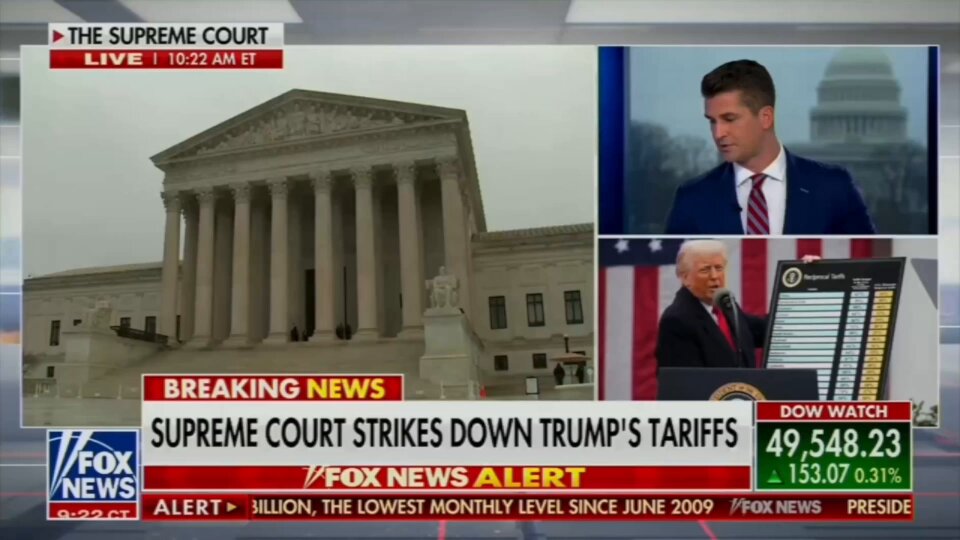
Businesses in America have moved quickly and are now demanding refunds for the tariffs they paid after the pronouncement by the United States Supreme Court that Donald Trump’s tariffs were illegal. So this is how the tariffs worked. If you imported goods from South Africa and there was an illegal 30 percent tariff on them, the company importing the goods from South Africa would have had to pay that 30 percent tariff to the American government and then pass that cost on to the consumer. For instance, if an American company ordered a bottle of wine from South Africa and there was a 30 percent tariff on it, which the Supreme Court has now pronounced illegal, and that bottle cost US$1 to import, once it reached America the importer would have to add the 30 percent tariff, taking the cost to US$1.30. The importing company would then add its own margin, say another US$0.30 as profit. Ordinarily, without the tariff, that bottle might have retailed at around US$1.30, but because of the additional 30 percent tariff, it would end up costing the consumer about US$1.60. In effect, the 30 percent tariff was passed directly on to the consumer through higher retail prices. What American businesses are now saying is that they want that 30 percent tariff refunded. So the company that imported the bottle of wine from South Africa and sold it for US$1.60, comprising 30 percent tariff and 30 percent profit, now wants the tariff component returned to them. How consumers themselves will be reimbursed, if at all, remains unclear, and that is likely to become the next area of legal and commercial contestation. Meanwhile, American media is reporting that Donald Trump has gone into meltdown after the Supreme Court delivered this important ruling, which many had already predicted because it was clear to numerous legal experts that the tariffs were unlawful. Only his most loyal supporters insisted that the court would uphold them. The decision has triggered not only political shockwaves in Washington but also significant financial and legal consequences, as businesses begin positioning themselves to recover the money improperly collected by Trump’s government.

Hopewell Chin’ono

42,592 Aufrufe • vor 7 Monaten