正在加载视频...
视频加载失败
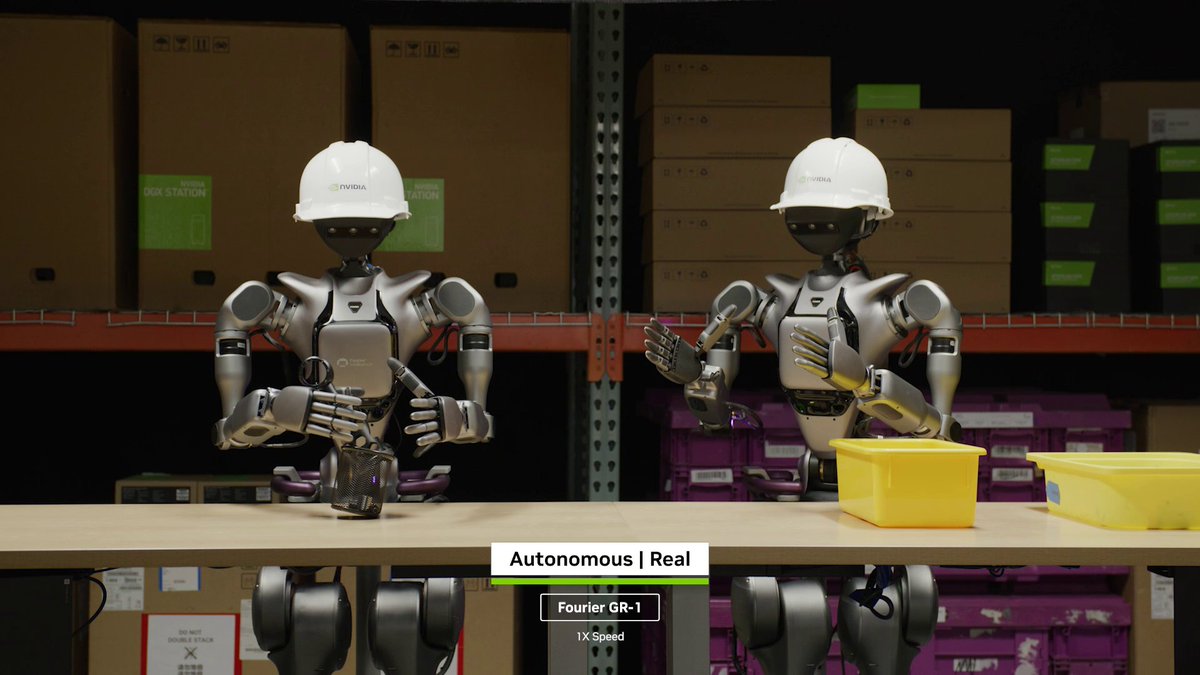
Introducing Ψ₀ ( — an open foundation model for universal humanoid loco-manipulation. 🏆 Outperforms GR00T N1.6 by 40%+ overall success rate 📉 Uses only ~10% of the pre-training data 📦 Fully open-source: model, data, code, and deployment pipeline 1/10

30,472 次观看 • 7 个月前 •via X (Twitter)
10 条评论

Humanoids can dance, do backflips, and even perform martial arts. But when will they actually help with everyday life — pouring water, wiping a table, carrying groceries? That's the problem we have long dreamed of solving: long-horizon loco-manipulation where the robot walks, grasps, manipulates, and places — all in one continous sequence. 2/10
The prevailing approach? Co-train on massive mixed data — internet clips, human videos, robot demos — and hope scale bridges the gap. We found this is fundamentally limited. Humans and humanoid robots have very different kinematics and motion distributions. Mixing them forces the model to learn two conflicting data distributions at once. Ψ₀, instead, decouples the learning to address this issue. 3/10
Our three-stage training paradigm: 1. Pre-train a VLM backbone on ~800hrs of high-quality egocentric human video (EgoDex) → learn rich visual semantics and broad behavior priors. 2. Post-train a flow-based MM-DiT action expert on ~30hrs of real humanoid data (Humanoid Everyday) → learn precise joint-level robot control. 3. Fine-tune end-to-end with only ~80 teleoperation demos per task → rapid adaptation to specific tasks. The key insight: effective scaling isn't about piling on more data — it's about using the right data in the right way. 4/10
Great models need great data. We aim to capture enormous egocentric videos to scale up humanoid pre-training through customized hardware (from WorldEngine) and collaborations with more partners. In addition, we built a custom single-operator teleoperation system for whole-body humanoid control: 🥽 PICO headset + wrist trackers → upper body pose via inverse kinematics 🧤 MANUS data gloves → full dexterous hand control (all finger DOFs) 🦿 Waist & foot trackers → locomotion commands fed to an RL walking policy One person controls the entire robot — walking, reaching, grasping, and fine manipulation. This avoids the multi-operator setups and produces much higher quality demonstrations. 5/10
A 2.5B parameter model with 160ms per forward pass — how do you deploy that on a real robot without jerky, "stop-and-think" motion? We developed Training-time Real-Time Chunking (RTC) for humanoids: → Each prediction is conditioned on the previously committed action chunk → Inference runs asynchronously with execution — no gaps between chunks → During training, we randomly mask early action tokens to simulate real inference latency Result: smooth, 1× speed execution on all tasks. No pauses, no jitter. 6/10
Real-world evaluation across 8 long-horizon dexterous loco-manipulation tasks — from pick-and-place to faucet turning to cart pushing + serving: Ψ₀ outperforms every baseline: ACT, InternM1, EgoVLA, H-RDT, Pi0.5, and GR00T N1.6. 40%+ higher overall success rate than the next best model — while those baselines were trained on 10× more data. 7/10
We're open-sourcing the entire ecosystem: ✅ Teleoperation framework for data collection ✅ Pre-training + post-training pipeline ✅ Foundation model weights ✅ Training data (Humanoid Everyday) ✅ Real-time action inference engine ✅ Simulation benchmark (for fast prototype and evaluation) We believe this is the most complete open-source package for humanoid loco-manipulation to date. 8/10
This took months of the entire team heads-down building every layer of the stack: SonglinWei @hongyi_jin1013 @Boqian_Li_ ZhenyuZhao @PointsCoder ZhenhaoNi SichengHe JieLiu XiaweiLiu, Kaidi Kang, Sheng Zang, WeiduoYuan @drmapavone @HuangDi6. This required expertise across data teleoperation, data collection, VLM pre-training, VLA post-training, simulation, system integration, real-world deployment, model evaluation. No single person covers all of that — we hope you can join our journey in democratizing humanoid learning. 9/10
📄 Paper: 🤗 Model: 📊 Data: 💻 Code: 🌐 Project: This is just the beginning. As dexterous hands improve, as tactile sensing matures, and as model memory grows — humanoids will keep getting better. We hope Ψ₀ provides a foundation for the community to build on. 10/10

Great work! I'm curious why the VLM is labelled as "system 2" and diffusion head as "system 1". Normally system 2 is reserved for something that orchestrates or breaks high level tasks into subtasks which are then passed on to a VLA (system 1) right?