Loading video...

Video Failed to Load

Go Home

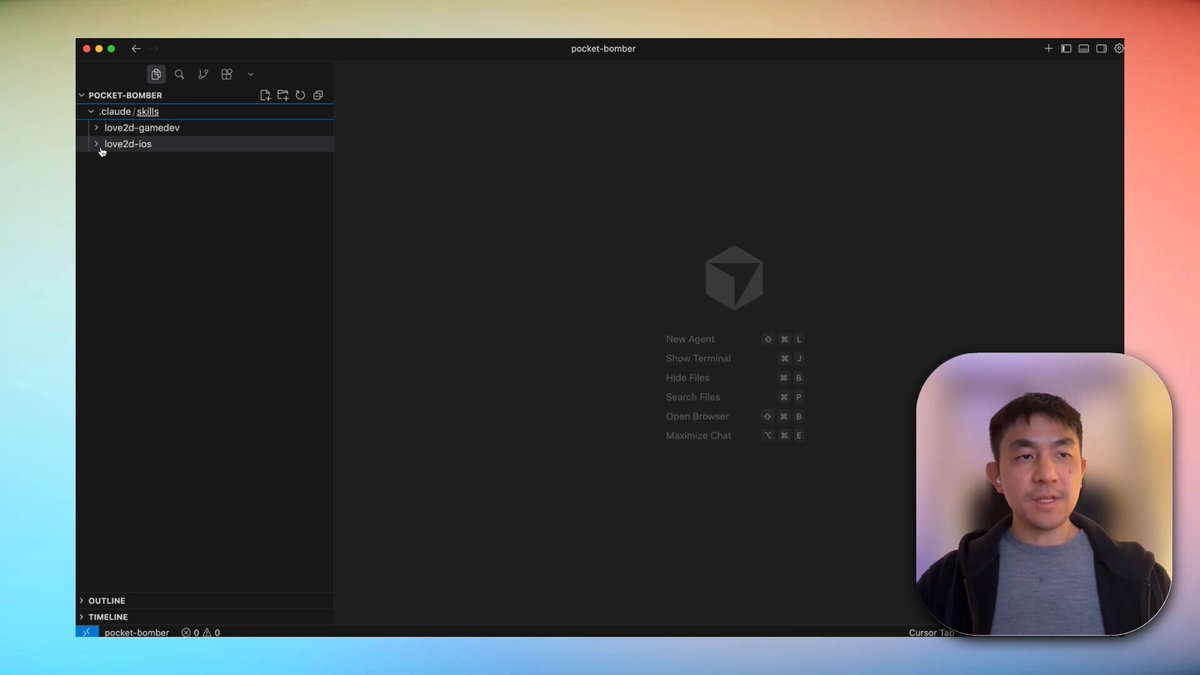
It's been fun, but time to wrap up this project! Learnt so much about vibe coding 2d games: - PhaserJS agent skill - Tiny Swords asset Pixel Frog - TinyPRD for game design - Playwright for testing - Opus 4.5 w/ Claude Code - GPT 5.2 w/ Codex CLI...

30,705 views • 6 months ago •via X (Twitter)

0 Comments

No comments available

Comments from the original post will appear here

Related Videos

BREAKING NEWS: Anthropic just dropped Claude Ops 4.5!! It is by FAR the best coding model I've ever used. We've been testing it internally Every 📧 for the last few days, and it is an absolute paradigm shift for any kind of coding task. It extends the horizon of what you can vibe code The current generation of new models—Anthropic’s Sonnet 4.5, Google’s Gemini 3, or OpenAI’s Codex Max 5.1—can all competently build a minimum viable product in one shot, or fix a highly technical bug autonomously. But eventually, if you kept pushing them to vibe code more, they’d start to trip over their own feet: The code would be convoluted and contradictory, and you’d get stuck in endless bugs. We have not found that limit yet with Opus 4.5—it seems to be able to vibe code forever. Takes working in parallel to a whole new level because it's far better at planning and coding, it can work with more autonomy—meaning you can do more in parallel without breaking anything . Kieran Klaassen worked on 11 different projects in six hours—and had good results on all of them. Great at design iteration Opus 4.5 is incredibly skilled at iterating through a design autonomously using an MCP like Playwright. previous models would lose the thread after a few cycles, or say a design was done when it wasn't. Opus 4.5 is incredible at autonomously iterating until a design is pixel perfect. we have a full 4,000 word vibe check on Every 📧 right now with everything we tested:

Dan Shipper 📧

272,699 views • 8 months ago

BREAKING: GPT-5.5 "Spud" is out and it is a BEAST We've been testing it Every 📧 for the last 3 weeks on everything from coding, to writing, to knowledge work. Here's our day 0 vibe check: - It's a step change in coding AND it's easy to talk to. It's fast and friendly and quickly became my daily driver. But it's also a coding powerhouse—a really rare combination. - It scored 62/100 on our Senior Engineer benchmark. Opus 4.7 scored only a 33/100. (But GPT-5.5 performed best when using an Opus 4.7 plan). Naveen Naidu used over 900 million tokens during testing—and it let him ship production features for Monologue at both high speed and quality. - It has serious conceptual clarity. It can hold a complex plan in its head over hours of work, without getting distracted by existing code. This makes it the first model that we've tested that can perform well on complex refactors requiring deleting and reimagining an substantial existing codebase. - It's a very good writer. This is the first OpenAI model in about a year that got our writers Every 📧 to switch away from Claude. 5.5 has Katie Parrott's seal of approval—not an easy task. Its writing feels more organic and it's better at mimicking a writing style without going overboard. - It's great for agentic knowledge-work. This is the first OpenAI model that manages to be both a stellar senior engineer AND that can be used for everything from spreadsheets to research. It's crazy fast, and it's amazing inside of the Codex desktop app, and got much of our team to switch away from Claude Code and Cowork during the testing period. However, it's not a perfect model. - 5.5 still loses to Opus 4.7 on plan quality. It's plans are extremely readable but Opus has better attention to detail and sharper insight. - 5.5 still loses to Opus 4.7 by a bit on front-end and full-stack product work. Kieran Klaassen found that it wasn't quite as good when full-stack thinking and design are involved. And it's not great writing Ruby. - 5.5 is a great vibe coder but if you're vibe coding without a plan it's worse than Opus. Mike Taylor found that Opus is better at reading in between the lines on underspecified vibe-coding tasks. Overall GPT-5.5 is a massive achievement from OpenAI and it deserves a serious look as your daily driver. Read our full vibe check on Every 📧 here:

Dan Shipper 📧

130,382 views • 3 months ago

I just compared Claude Code vs Codex vs Cursor CLI The task was to build a Next.js app with Tailwind 4 and shadcn components to collect customer feedback and showcase it with a widget. I gave all three the same prompt and let them go for 30 minutes to see what they came up with. Claude Code with Opus 4.1 Even though I told it to set up the app in the existing project folder, it tried to create a directory for it. After I interrupted and told it not to do that, it built a demo form and landing page with no errors. I had to ask it to make the demo interactive so users could submit a testimonial and preview it. The landing page looked like AI and was pretty basic, but it worked and it was done in a fraction of the time of the others. Total tokens used: 33k Codex with GPT-5 At the end of the 30 minutes I just could not get Codex to produce a working app. It got stuck in a loop of not being able to set up Tailwind 4 and despite many, MANY, attempts, I ended up with a "failed to compile" error. Total tokens used: 102k Cursor Agent with GPT-5 This was the slowest agent by far and a couple of times I actually thought it got stuck in a loop and was close to Ctrl+C'ing to cancel it. The TUI is really nice though, especially how it shows diffs and it did eventually build a working app (after one or two slight errors that needed fixing) The demo was interactive and it had a very minimal design that looked bare but also a lot less like an "AI generated" app than the Opus 4.1 design. It also wasn't too chatty and just did what it needed to do! Code quality was on a par with Opus 4.1, but it did use 5.5x as many tokens to get there. Still cheaper than Opus on a direct comparison but not when you factor in a Claude Code Max subscription. Total tokens: 188k I'll be able to do a proper comparison and record some videos when I'm back from holiday but for now, Opus is still the more capable model out of the box and Claude Code is the more complete CLI product. It will be interesting to see how Cursor evolve their CLI though with commands and subagents because I think with GPT-5 they have a real shot at providing competition for Claude Code if they can optimise output to get similar quality with less tokens. Jump to 0:40 in the video to see the two apps. Which do you think is which? ;)

Ian Nuttall

194,949 views • 1 year ago

BREAKING: GPT-5.6 Sol is out—AND Codex has been merged into ChatGPT Desktop as ChatGPT Codex. This combo model and desktop app harness are the gold-standard for knowledge work in AI. 5.6 is powerful, fast, half the price of Fable, and my default for almost everything. We’ve been testing it internally Every 📧 for about a month across coding, writing, design, and knowledge work. Here’s our day-zero vibe check: - An A-tier coder—but it’s not Fable. Sol scored 56/100 on our Senior Engineer benchmark compared to a 91 for Fable. I think the 56/100 undersells it, it's an excellent implementor, and very smart. But Fable just writes conceptually cleaner code and works better at the top end of task complexity. PRO-TIP: Use GPT-5.6 as Fable's subagent for the most goated combo in AI coding. - The best writer of the frontier models. It’s clearer and more concise than Fable or Opus 4.8, without the overexplaining or weird private language. It can one-shot marketing emails, help you workshop taglines, and explain complex concepts clearly. It's also super fast, which makes it easy to collaborate with. - Design is better, but not top-tier. It has noticeably more taste than 5.5, but Fable and Opus 4.8 are still playing at a different level. See examples in the video and vibe check below. - The real leap is knowledge work. Sol is the first model I’ve trusted to run whole loops of knowledge work—not just help with individual tasks. I use it to process email, surface decisions from meetings and Slack, find job candidates, scan Facebook Marketplace for furniture, and log my meals. It has shifted my job from doing the work to tending the system that does it. - The merged app is fine. I was extremely worried about this because I love the Codex app. OpenAI was caught in an interesting position: How to make an agent orchestration app for regular ChatGPT consumers, coders, and businesses all in one app. They now split the interface between ChatGPT Work and ChatGPT Codex. They're basically the same except Work hides code. And "Chat" has been demoted to 2nd tier status for quick questions in either one. It's not a big leap, but it's not a huge setback either. And it remains my favorite of the desktop agent orchestration apps. Verdict: If I really had to put my finger on it, I'd say Fable has way more big model smell. But that means it's a skill in itself to get value out of it—99% of people are still not there yet. GPT-5.6 is almost as powerful, but is easy to use, fast, and relatively cheap. It should give you an early sense of where model work is going. Full Every 📧 Vibe Check:

Dan Shipper 📧

145,238 views • 26 days ago