Video yükleniyor...

Video Yüklenemedi

Ana Sayfaya Dön

Jensen regrets that when Anthropic and OpenAI first needed billions to scale, Nvidia wasn't in a position to invest. So these labs went to hyperscalers like Microsoft, Google, and Amazon instead, and in return committed to using their compute. “I'm not going to make that same mistake again.”

248,303 görüntüleme • 3 ay önce •via X (Twitter)

0 Yorum

Yorum bulunmuyor

Orijinal gönderinin yorumları burada görünecek

Benzer Videolar

Gavin's takes on Microsoft, Google, Meta, & Amazon: Microsoft ($MSFT): "I like Satya, I admire him. He's an exceptional CEO, and I give him a lot of credit for the decisions he's made. But he did go from, "We're going to make Google dance," to being the product manager of Copilot in 3 years. The decision Satya is making now, which the market has punished him for, but I think is the right decision — who knows how fast Azure could be growing if they were willing to just sell GPUs to OpenAI. 'We're going to use our compute internally to make our own products better.' One reason Copilot was so bad, or has been so bad, is that there wasn't enough compute available. They're fixing that. He's making good decisions that are risky decisions, to position Microsoft for this world where frontier models are no longer API-accessible. It's a really courageous decision that I give him a lot of credit for. Microsoft probably would be an $800 stock today if they were using their GPUs to serve solely OpenAI and Anthropic's capacity instead of using them for their own products." Google ($GOOG): "Google was incredible last year because they had that TPU advantage, which is now gone. The reason I think they're still in a great position is they have the most compute of everyone. We talked about the value of installed bases being higher as a result of shortages — they have the biggest installed base of compute. Google I/O is this week. If they don't release something that even slightly leapfrogs OpenAI and/or Claude, that's interesting. It's not a disaster for Google, it's just interesting. Between the amount of data they have, the YouTube data, the amount of compute, the search business — Google's never not going to be in a good position. You see that with GCP going crazy." Meta ($META): "You've got to give Zuckerberg immense credit, for what he's done in terms of making Meta an AI-first company internally. He is the only one of those true internet giants to have done that. I give him a lot of credit for paying up when he did for contracts, that talent. And Muse was a really big upside surprise. It was the first model from MSL, and it's not on the Pareto frontier with xAI, Google's one entrant, OpenAI and Claude, but it's pretty close. That was very impressive to me. So Meta is in a better position — still not as strong of an absolute position as Google, but a better position." Amazon ($AMZN): "Amazon is in a really strong position because of Trainium. You're going to see real P&L efficiencies from robotics over the next 18 months in their retail business. I actually think Nova — their internal models are not where Muse is, but they're better than they get credit for. The two companies who are the most deeply engaged with startups are Amazon and Nvidia by a mile. It's going to end up being a pretty big advantage for Nvidia and Amazon — with Google right behind them — to have this engagement that you just don't see from these other hyperscalers."

Invest Like the Best

52,492 görüntüleme • 1 ay önce

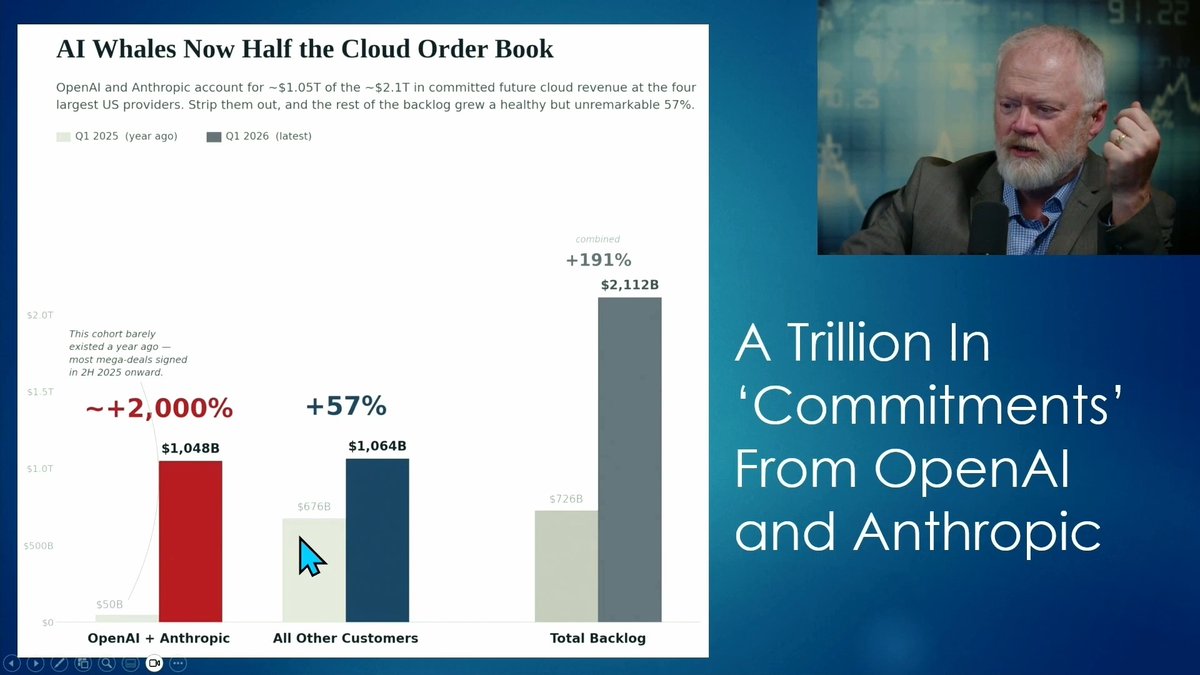
THIS IS ABSOLUTELY RIDICULOUS. OpenAI and Anthropic are losing money on every dollar they make. OpenAI generated $20 billion in revenue in 2025 and is projected to lose $14 billion in the same year. Internal forecasts project cumulative losses hitting $44 billion by 2028. The company's own CFO warned executives in April 2026 that OpenAI might struggle to finance upcoming computing deals if revenue growth slows. Anthropic reached $4.3 billion in annualized revenue in April 2026 against $19 billion in total costs. It spends $3 to make $1, and is not expected to stop burning cash until 2027. Now look at what these two companies have committed to spend. OpenAI and Anthropic together have committed $1.05 trillion in cloud spending to Microsoft, Oracle, Google and Amazon, making up 43 to 54% of each provider's entire future revenue backlog. - Microsoft: $627B total backlog. OpenAI and Anthropic account for 49%. - Oracle: $553B total backlog. OpenAI alone accounts for 54%. - Google: $467.6B total backlog. Anthropic accounts for 43%. - Amazon: $464B total backlog. OpenAI and Anthropic account for 51%. The entire cloud industry's future revenue is a bet on two companies losing billions every quarter. Microsoft, Alphabet, Meta and Amazon are collectively expected to spend $725 billion in capex in 2026, almost entirely on AI infrastructure. Combined hyperscaler capex from 2025 to 2027 is projected at $1.15 trillion, more than double what was spent from 2022 to 2024. What is the return on all of this? McKinsey's 2025 State of AI survey found that only a minority of companies reported AI meaningfully increased revenue or reduced costs. Enterprise generative AI spending grew from $1.7 billion in 2023 to $37 billion in 2025 and most CIOs still describe their initiatives as pilots without clear ROI metrics. Microsoft's AI business is running at a $37 billion annual revenue run rate with 123% year over year growth. That sounds impressive until you realize most of the capex funding is justified by expected future AI revenue rather than current AI profit. The internet burned money for years before it became the most profitable industry in history. But right now $1 trillion in committed cloud spend, $725 billion in annual capex, two loss-making customers making up half of every major cloud provider's revenue backlog, and the enterprises writing the checks cannot tell you if any of it is working.

Crypto Rover

58,862 görüntüleme • 1 ay önce

Anthropic just had to throttle Claude’s thinking depth and cap usage for paying customers. Developers are switching to OpenAI Codex and the market is already sniffing out who wins from all of. Anthropic’s revenue tripled in one quarter to a $30B annual run rate, demand grew so fast that a single developer running an AI agent could drain a full day’s worth of compute in minutes. Anthropic had to reduce Claude’s default thinking mode, introduce peak-hour caps, and test pulling Claude Code off its $20 plan entirely and paying subscribers started hitting limits they’d never seen before. There are literally not enough GPUs to serve every request, even the hyperscalers can’t build fast enough, Microsoft, Google, Amazon, and Meta are committing a combined ~$700 billion in AI capex in 2026, approaching 100% of their combined operating free cash flow. And it’s still not sufficient to meet demand. That gap is where the neocloud trade lives. CoreWeave, Nebius ($NBIS), IREN, and CoreWeave ($CRWV) exist because hyperscalers physically can’t scale fast enough. These companies accumulated $131 billion in enterprise GPU commitments from zero in under three years. CoreWeave alone has a $66.8 billion revenue backlog, Nebius is running at 98% capacity utilization essentially sold out. Synergy Research forecasts the entire neocloud market hits $400 billion by 2031, growing at 58% per year. Google just committed $40 billion and 5 gigawatts to Anthropic. And every AI lab is in the same position: they have the demand, they have the revenue, they are actively looking for anyone who can hand them compute today. If you can bring capacity online fast, you are golden. The AI labs can’t say no, they have no other options.

Milk Road AI

46,800 görüntüleme • 2 ay önce