Video yükleniyor...

Video Yüklenemedi

Ana Sayfaya Dön

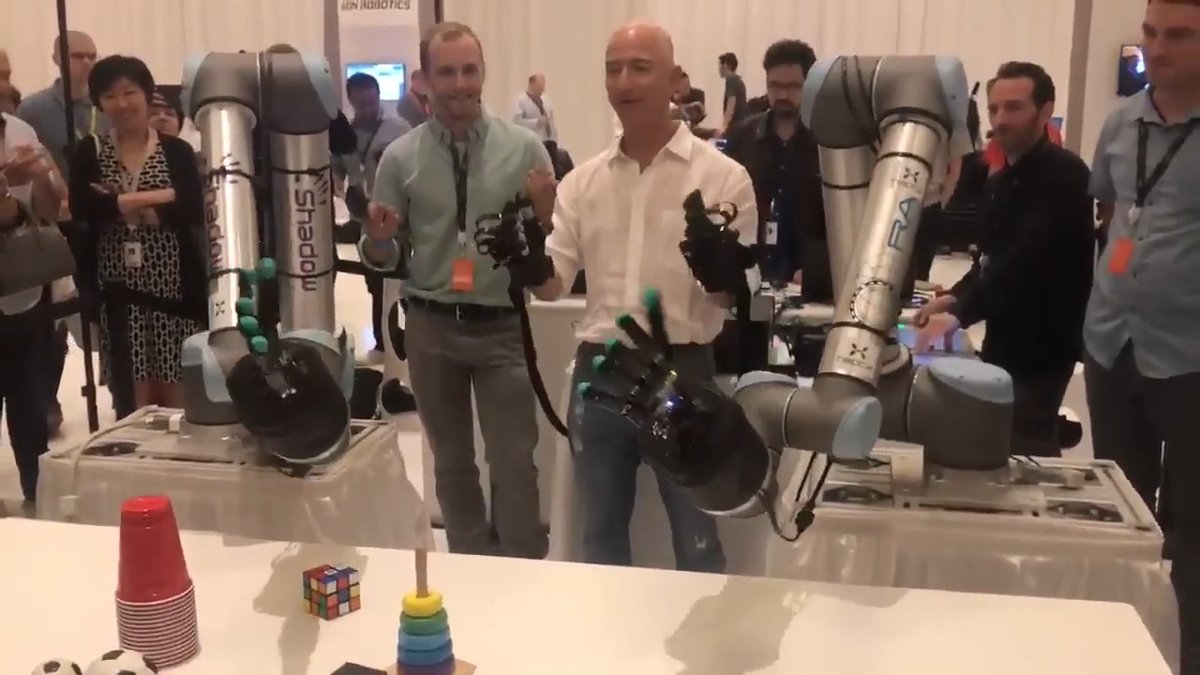
One engineering challenge in dexterous Robot hands is balancing strength and speed. Here a SharpaWave performing rapid hand cycles at over 4x/sec. The Dynamic Tactile Array uses visuo-tactile sensing: fingertip integrates camera & 1,000+ tactile pixels.

27,256 görüntüleme • 6 gün önce •via X (Twitter)

0 Yorum

Yorum bulunmuyor

Orijinal gönderinin yorumları burada görünecek

Benzer Videolar

I was really impressed by the UMI gripper (Cheng Chi et al.), but a key limitation is that **force-related data wasn’t captured**: humans feel haptic feedback through the mechanical springs, but the robot couldn’t leverage that info, limiting the data’s value for fine-grained manipulation tasks. Led by my amazing students Yolanda Zhu and Binghao Huang, we designed a **portable visuo-tactile gripper** by integrating our dense, flexible tactile arrays with the UMI gripper to enable large-scale in-the-wild data collection. 🔗 We demonstrate **cross-modal representation learning** and **downstream policy learning** on tasks requiring in-hand state estimation (e.g., test tube reorientation) and fine-grained force sensing (e.g., pipette fluid transfer). Key takeaways: - Our flexible tactile arrays store the rich haptic information humans perceive as dense tactile signals. - Portability and robustness are key for in-the-wild data collection; our portable gripper is compact, lightweight, and durable. - Touch provides precise, robust measurements of in-hand object pose, invariant to lighting and viewpoint. - Cross-modal pretraining on large-scale in-the-wild data significantly improves policy robustness and sample efficiency (as shown many times before — and verified again here!). Also check out our previous investigations of dense, flexible tactile grids for understanding human-robot-environment interactions: - Dense tactile glove (Nature ’19): - 3D-ViTac (CoRL ’24):

Yunzhu Li

13,188 görüntüleme • 1 yıl önce