Загрузка видео...

Не удалось загрузить видео

На главную

Procedural mesh fracturing in Blender usually means slow calculations, messy topology, or relying on heavy third-party add-ons. Environment and technical artist Jolan Huijskes built a custom Geometry Nodes fracturing solution that splits 3D models into clean, procedural stone blocks and cracked surface tiles in real time—and he's releasing the...

31,869 просмотров • 3 дней назад •via X (Twitter)

Комментарии: 4

Фото профиля Sphaira ⭕️
Sphaira ⭕️3 дней назад

Link?

Фото профиля 🦉🐺¤ ATA YOLUNDA ﺦ🇹🇷͜͡͡✯
🦉🐺¤ ATA YOLUNDA ﺦ🇹🇷͜͡͡✯3 дней назад

That's not bad and slightly not hard but wonder can you make it geometrical fracturing ? i mean let's say you got cube, top view, you wanna fracture but as a shape of square, rectangle, hexagon etc etc ?

Фото профиля Jimmy Lee
Jimmy Lee3 дней назад

Wow so perfect

Фото профиля Nodegrid Games | Dronefall
Nodegrid Games | Dronefall3 дней назад

how can we find this ?

Похожие видео

A really impressive set of Three.js graphics experiments just got open sourced, and these are much more than little visual demos. They are basically reusable procedural systems for oceans, vegetation, fluids and even whole planets. 🔹 Poseidon A real-time FFT ocean running on WebGPU. It simulates large swells, smaller ripples, foam, reflections, choppy displacement and physically inspired wave spectra entirely in the browser. 🔹 Gaia A procedural grass generator where every blade, seed head and field comes from a deterministic genome and environmental parameters. No authored grass models. 🔹 Dryad A procedural flora system that generates trees and other plant forms from physics, environmental conditions and a seed. No authored 3D models or textures are needed for the plants themselves. 🔹 Tiamat A real-time GPU fluid simulation using around 100,000 SPH particles, with the resulting water rendered directly in the browser. 🔹 Demiurge Probably the craziest one. It procedurally builds an entire planet from tectonic plates, then lets uplift drive erosion, erosion and latitude drive climate, and climate drive biomes, wind and weather. You can move seamlessly from orbit down to the surface. What I really like here is that these are not just pretty outputs. They are actual building blocks. Ocean simulation, vegetation generation, fluid dynamics and procedural worlds are exactly the kinds of systems that can be plugged into games, simulations and agent-built 3D environments. Project by: Owen

Token Gremlin

34,448 просмотров • 1 месяц назад

Here is the Geometry Nodes Weighted Normals with Laplacian Blur on a full character (a vroid). It easily improves the shading even on game topology with almost no setup. I built this as part of my quest to improve real time toon shading. 3D anime models are popular, but use of dynamic light is rare even among high quality vtuber models. This is for several reasons, but a big one is simply that it takes a lot of Custom Normals work to make 3D cel shading not look like a jagged mess (other pieces of the puzzle are issues like deformations, multiple lights, etc). And fixing Normals is tedious, especially on existing game topology. I have focused on proxy meshes for priority areas like character faces, but they aren't an efficient solution for the whole body + outfit. I wanted something I could just throw on any model and make it at least not a jagged mess anymore even if it wasn't perfect. As you can see from this clip, this does that very well! And vertex groups can be used to control the style of the effect and power. It still can't smooth beyond what the topology density can support, but the topo itself is no longer a problem (for higher res, could be run on a subdivided version of the model and then baked to a Normal Map.) The only changes I made to this model were adding a weld modifier to merge split edges during interpolation, and a vertex group to select the skirt. I have not yet added full handling and logic for detecting edges with big angles like the skirt, or for handling boundaries like on the hair, so both those areas can get better too. You can also see that while it successfully smooths out the Face, it isn't really stylistically correct there. That is still best done with a proxy mesh to define a new shape. This is part of the tools I am working on for Fondant. We are putting together a Blender Addon to release this + a proxy mesh tool for the face, and are working on resolving other problems in-engine to fully bring dynamic light to real time 3D toon shading. Give us a follow, and send them a DM if you are interested in testing these tools as they develop!

aVersionOfReality

14,904 просмотров • 1 год назад

Will Astra kill us in the future? 😱 Maybe Maybe not. But it absolutely killed this by recreating Barcelona’s Camp Nou in 3D with 86,964 individually selectable seats ❤️‍🔥 You can literally pick any seat and see what your view would look like from that exact position inside the stadium. You can also switch between daylight, golden hour, and floodlit night modes to get a much more realistic feel. I very much loved how it optimized the website’s performance by reducing the overview seat geometry from 2,087,136 triangles to 695,712, which is around a 67% reduction, without reducing the number of seats. The stadium itself is built using procedural geometry and custom BufferGeometry, while Astra used InstancedMesh, spatial batching, and custom distance based LOD to efficiently render and manage nearly 87K selectable seats without creating tens of thousands of separate scene objects. For interaction and realism, it also uses optimized raycasting with broad phase batch rejection, TSL and WebGPU materials, shader driven surface detail, and proper seat level camera transitions. A month ago, I built an imaginary stadium using Claude Fable 5. It was great too, but this feels much more realistic. Astra went further by adding proper doorways, staircases, concourses, tier structures, tunnels, railings, and other architectural details you would expect in an actual stadium. Really classy. We should do this for more stadiums and eventually rethink the ticketing experience altogether. Live:

The Bugged Dev

226,976 просмотров • 14 дней назад

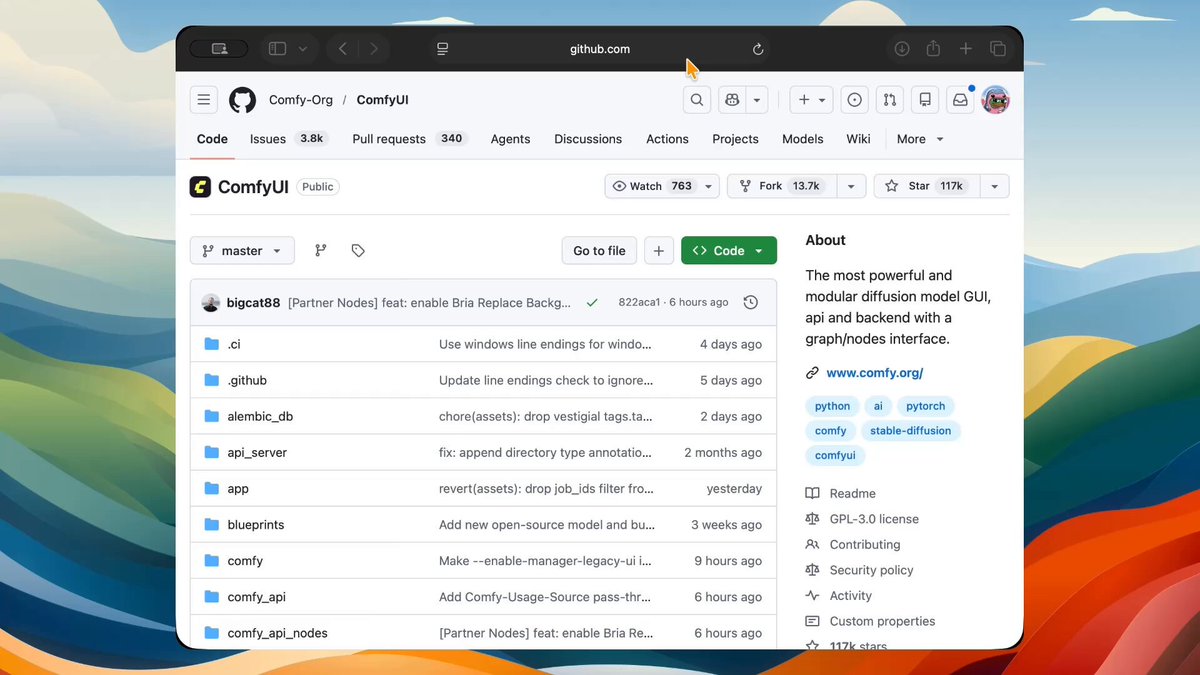
no money for grok or midjourney? this tool is for you. there's a FREE tool created by an anon dev. open-source. runs locally. 117k stars on github. it generates: > images & video > 3d models > audio > 20+ models here's how to set it up in under 5 minutes: 1️⃣download ComfyUI Desktop go to and grab the desktop app for your system. windows 10+, mac (apple silicon), or linux. it installs like any normal app, it sets up python and every dependency for you in the background. no terminal, no config files. 2️⃣open it first launch, it spins up its own environment automatically. you just wait a few seconds and you're in. you'll land on a node canvas, that's the whole interface. 3️⃣load a starter workflow top menu → Workflow → Browse Templates → Image Generation. click it. this drops a ready-made setup onto your canvas so you don't build anything from scratch. 4️⃣grab a model comfyui ships empty on purpose, the model is the brain, and you pick it. in the template, the "Load Checkpoint" node has a Download button when no model is installed. click it. it pulls one in for you (a few GB, this is the only real wait). 5️⃣install ComfyUI Manager this is the one add-on you don't skip. it lets you install models, custom nodes, and updates with a click instead of the command line. grab it from github (link in comments). it's the difference between fighting comfyui and flying in it. one honest note: an NVIDIA gpu makes this fast, apple silicon works great too, and a weak machine still runs it just slower. that's the whole setup. you now own an image, video, and 3D studio that costs you nothing per month. save this. and the next time grok or midjourney asks for your card. you won't need it. disclaimer: comfyui itself is 100% free. so are the local models (sdxl, flux, wan 2.2, ltx-2). some premium models like seedance are pay-per-use api models, only if you want top-tier quality. the free local ones cover most of what you need. (github link in the comments) follow and turn on post notification for daily AI contents.

m0h

14,542 просмотров • 3 месяцев назад

What if you could npm install 3D models? Introducing Vibe3D - the shadcn for threejs Starting with the scifi asset kit, over 180+ models, all free and oss (MIT licensed) and two reference terrain meshes. All models are installed directly into your codebase instead of pre-packaged as code imports or worse yet, FBX files 🤮 Docs: This means, a simple "bunx vibe3d add Artificial Intelligence Papers-kit/pressure-gauge" will install the fully procedural code Want to change something? just tell your ai to do it It uses some shared helper code to produce the topology and at least per kit all items reuse and share the same materials, so technically performance should be better than letting your ai run wild on its own. Also releasing with it two skills: - Vibe model skill to produce your own models and kits, just "bunx vibe-model --global" and tell your ai to vibe model some 3d assets with a reference photo, you'll see it works - Vibe terrain "bunx vibe-terrain" installs the terrain mesh modeler, yea just try it out, best results with opus 5 ngl Everything is MIT licensed, i was just joking, no hate for unreal or unity Threejs still the best tho 🖕🏻 If you just want to see all 3D models up close: Yea, you can also just vampire it and download all modes as .glb files, good luck fixing some of them then though Big thanks to ThreeJS Assets for contributing 50 assets to the scifi kit! Everyone who spends some tokens on it will be added to the contributor list Oh and before i forget fuck you kenney, we roll our own kits now

robot 2.0

58,797 просмотров • 1 месяц назад

Wow. Recreating the Shawshank Redemption prison in 3D from a single video, in real time (!) Just read the MASt3R-SLAM paper and it's pretty neat. These folks basically built a real-time dense SLAM system on top of MASt3R, which is a transformer-based neural network that can do 3d reconstruction and localization from uncalibrated image pairs. The cool part is they don't need a fixed camera model -- it just works with arbitrary cameras -- think different focal lengths, sensor sizes, even handling zooming in video (FMV drone video anyone?!). If you've done photogrammetry or played with NeRFs you know that is a HUGE deal. They've solved some tricky problems like efficient point matching and tracking, plus they've figured out how to fuse point clouds and handle loop closures in real-time. Their system runs at about 15 FPS on a 4090 and produces both camera poses and dense geometry. When they know the camera calibration, they get SOTA results across several benchmarks, but even without calibration, they still perform well. What's interesting is the approach -- most recent SLAM work has built on DROID-SLAM's architecture, but these folks went a different direction by leveraging a strong 3D reconstruction prior. Seems to give them more coherent geometry, which makes sense since that's what MASt3R was designed for. For anyone who cares about monocular SLAM and 3D reconstruction, this feels like a significant step toward plug-and-play dense SLAM without calibration headaches -- perfect for drones, robots, AR/VR -- the works!

Bilawal Sidhu

704,318 просмотров • 1 год назад

✨ I've been using #Unity3D for 12 years. ✨ I'm using Blender's GeoNodes for a procedural mesh that's realtime-animated with a custom shader in Unity. ---(reminiscing, reflection follows)-- At some point, you realize it's 'all' states, relationships, and data/information. What is, isn't, and how they relate, subject to laws, principles. 🌌 Define some latent space -> atomics, data -> simulation/form -> information. Like a grid-texture of pixels that are to mean something, represent something. And they are processed/simulated in some way by some measure. So that you get some transformed, meaningful result. What is possible, here? -- in that space. (by the parameters, and features *defined*). 🧊 Likewise, a 3D field-volume in which things exist, being and not being. It may sound mystical, but I mean it literally: the definition of what things are, and are not, and what that means as a relationship (to something[s]). Take, for example a sphere, or box collider primitive. 🪩 Sphere's and circles are the most simple colliders, involving only a point (where they are) and radius (distance from that point, as a center) to define. 💥 The equations to calculate collisions against and between spheres is also relatively straightforward. Implementation of that is a part of building primitive relationships and definitions for simulations. 🎇 It follows, that for a particle system, the data structure of a single element/particle is (about) some point that simulates in some way. Boids and fluid sims have this in common. It seems this year (so far) has been ~about realizing that (with greater lucidity, at least), and learning it all relates to the nature of the universe. Involving simulations, and data flow-control... Ultimately, all these things are objective to us, in that we learned and were taught about how things work. And all the same, *I'm* still learning, too. 👀 #blender #b3d #geometrynodes #gamedev

Mirza Beig

105,211 просмотров • 10 месяцев назад

Building Data Pipelines has levels to it: - level 0 Understand the basic flow: Extract → Transform → Load (ETL) or ELT This is the foundation. - Extract: Pull data from sources (APIs, DBs, files) - Transform: Clean, filter, join, or enrich the data - Load: Store into a warehouse or lake for analysis You’re not a data engineer until you’ve scheduled a job to pull CSVs off an SFTP server at 3AM! level 1 Master the tools: - Airflow for orchestration - dbt for transformations - Spark or PySpark for big data - Snowflake, BigQuery, Redshift for warehouses - Kafka or Kinesis for streaming Understand when to batch vs stream. Most companies think they need real-time data. They usually don’t. level 2 Handle complexity with modular design: - DAGs should be atomic, idempotent, and parameterized - Use task dependencies and sensors wisely - Break transformations into layers (staging → clean → marts) - Design for failure recovery. If a step fails, how do you re-run it? From scratch or just that part? Learn how to backfill without breaking the world. level 3 Data quality and observability: - Add tests for nulls, duplicates, and business logic - Use tools like Great Expectations, Monte Carlo, or built-in dbt tests - Track lineage so you know what downstream will break if upstream changes Know the difference between: - a late-arriving dimension - a broken SCD2 - and a pipeline silently dropping rows At this level, you understand that reliability > cleverness. level 4 Build for scale and maintainability: - Version control your pipeline configs - Use feature flags to toggle behavior in prod - Push vs pull architecture - Decouple compute and storage (e.g. Iceberg and Delta Lake) - Data mesh, data contracts, streaming joins, and CDC are words you throw around because you know how and when to use them. What else belongs in the journey to mastering data pipelines?

Zach Wilson

16,851 просмотров • 1 год назад

Dear ICP community, the Internet Computer has now been running strong for 5 years 👏👏👏 Here is a celebratory preview of ICP "cloud engines," the sovereign frontier cloud technology the network shall soon provide from Main points: — Cloud engines enable anyone to spin up their own sovereign frontier cloud. The technology involves an extraordinary inventive step, in which cloud is created from a mathematically secure network of nodes. The nodes run as part of the Internet Computer network ( but are selected and configured by the cloud engine's owner. — The frontier cloud provided by engines is strongly focused on enabling AI agents to build and update online applications and services for us. The world is changing fast, and nearly all new online apps and services are already being built with the help of AI, and thus cloud engines target the future of cloud. — Software hosted on cloud engines is tamperproof, which means that it is immune to infrastructure hacks, because it runs inside a mathematically secure network protocol, rather than on computers directly. This means that AI agents, and those building with them, don't need to have a security team in the loop, or to trust someone else's security team. This is crucial, because in the future, non technical people will demand the freedom to build with full automation — where they just need to issue instructions to AI about what to build, and don't need to worry about anything or anyone else. Of course, apps and services running on engines are also vastly safer from the new breed of hacker being enabled by frontier AI. (The cloud engines themselves are also "tamperproof." Even if a hacker gains physical access to some portion of a cloud engine's nodes, and can make arbitrary changes, the computations and data of the hosted apps and services cannot be corrupted or interrupted so long as the network's fault bounds aren't exceeded. The recent hack of Vercel, a major cloud platform, which gave hackers access to the apps it hosted, provides additional perspective on the importance of this advantage.) — Software hosted on cloud engines is guaranteed to run, so long as a sufficient number of the engine's nodes are running. This means that AI can build applications and services without the need to have a human systems admin team constantly tinkering with the underlying platform to keep it running, which is again crucial, because in the future, non technical people will expect the freedom to use AI to build without the support of others. — New frontier programming language technology, in the form of the Motoko language developed by Caffeine Labs, leverages seminal "orthogonal persistence" technology that unifies program logic and data to deliver further unlocks for AI (Motoko is the first computer language being developed that targets agents that are writing software rather than humans engineers per se). Nowadays, AI can build and update production apps at a prodigious rate, even at the speed of conversation. But it can also make mistakes, and there's a risk that an update it creates might be "lossy" in the sense it causes some transformed data to be lost. Again, in this new world, it's both undesirable and impractical for everyone to have to have a systems admin team on-hand to detect lossy updates and roll them back, but Motoko provides a solution: it can detect new software updates are lossy before they are applied, reducing potentially catastrophic errors by AI to harmless coding retries. — Software hosted on cloud engines is "serverless" but unlike traditional serverless software, directly it directly incorporates data through "orthogonal persistence." Another key purpose is simplify backend software logic and fuel the modeling power of AI by increasing abstraction (sorry for the technical language!!!). Put simply, this enables AI to produce more sophisticated backends, faster, and at dramatically lower costs, as measured by the number AI API tokens consumed during coding. (Tip for the technical: orthogonal persistence is a new paradigm where "the program is the database," and data lives inside program variables, which is possible because it's as if hosted software runs forever in persistent memory). — An expanding database of skills at shall make it possible to develop and directly deploy apps and services to your cloud engines directly from Claude Code, Perplexity, Codex and other AI platforms. Further, your account on can be connected, so that new apps and updates created through conversation automatically appear hosted from your cloud engine. In the future, R&D is going to be very seamless. You converse with AI, and your secure and unstoppable apps or services are created or updated. Cloud engines are designed to directly support this "self-writing cloud" future where we can work hands-free. — Tech sovereignty is becoming a huge issue worldwide, with governments and corporations seeking to create sovereign tech stacks owing to geopolitical tensions. Increasingly, people are realizing that tech provided by foreign nations can come with hidden backdoors and kills switches, from the base platform, right up through hosted apps and services. ICP technology is open source, and those building on ICP using AI own their own source code. When you have the source code, you can verify that there are no backdoors, and when you own the source code thanks to AI, you can update it at will, freeing you from vendor lock-in. But cloud engines take sovereignty much further... — You create a cloud engine by selecting the nodes that will be combined. You can choose the class of nodes used, and their number, but more importantly, you can choose who operates the nodes, and where they are located. Almost any configuration is possible, because the Internet Computer scales the security privileges afforded to hosted software within the network according to configuration (software hosted on cloud engines can directly interoperate with software on other engines and traditional subnets, but base restrictions are applied according to security rules). A cloud engine can be created within a region such as Europe, to comply with regs such as GDPR, or completely within a sovereign state like Switzerland or Pakistan. But cloud engines go further still... — Sovereignty is also about freedom from vendor lock-in. Cloud engines are essentially ICP (Internet Computer Protocol) network configurations, and this means the underlying compute nodes they combine can be swapped out without interrupting their hosted apps and services. This is a big deal. In addition, cloud engines now support nodes that are instances running on Big Tech's clouds, in addition to nodes that are dedicated specialized hardware, as per the Gen I and Gen II nodes that dominate the Internet Computer today. For example, it is possible to have an engine running across different AWS data centers, say, and then reconfigure the engine to run across a mixture of AWS, Google, Azure and Hetzner for even more resilience, without the users of hosted apps and services noticing a thing. That's true freedom. — Sovereign AI is becoming increasingly important too, and cloud engines allow special "AI nodes" to be added to them, so that hosted software can perform inference on hardware provisioned by the owner from a location the owner has selected. Even though the AI nodes are only accessible within the cloud engine, they can still benefit from the forthcoming Internet Intelligence Gateway (IG), which will make it possible to validate inference performed on key frontier open weights LLMs, even when the inference is performed on completely independent AI clouds. When the results of inference are received, this technology can verify that neither the prompt+context (input) nor the inference result (output) have been modified, and that the results were produced by the precise LLM expected. This ensures that AI clouds don't cheat by running inference on cheaper models than are being paid for, and bad actors aren't modifying the inputs or outputs to surreptitiously insert advertising into results, say, or change facts, or insert malware when code is being generated. What's super cool about this technology is the cost of the verification is scalable. A very valuable additional security can be achieved with only 1-2% of extra cost. — Scaling apps and services when they hit capacity limits is another thorny problem that cloud engines help the world address. Engines make scaling possible without rewriting or reconfiguring software. The query workload capacity of hosted software can be horizontally scaled simply by adding new nodes to an engine, and nodes can also be added in geographical proximity to demand. Meanwhile, update workload capacity can first be scaled-up by swapping an engine's nodes out for the next class up, and then when no larger class of node is available, horizontally scaled-out by "splitting" the engine into two, which doubles available capacity. (Technical tip: horizontally scaling update capacity by splitting engines requires multi-canister architectures). — For those who have been following how Caffeine builds apps that can efficiently store large numbers of files, I should mention that apps built on cloud engines will also support the new ICP Blob Storage cloud network (since cloud engines currently have up to about 3 TB of memory, which apps storing large amounts of files can easily exceed). We are also working on allowing blob storage nodes to be added to cloud engines, to enable sovereign mass blob storage within an engine, similarly to how AI nodes can be added currently. — Lastly, but certainly not least, I should mention that cloud engines are multi-blockchain capable, and ready for digital assets, thanks to the clever math at their core. For example, an e-commerce service built on a cloud engine can securely accept and custody stablecoin payments, or a multi-chain DEX could be hosted. Further, engines can support software autonomy (software orchestrated and controlled by other autonomous software, in a decentralized way) and can themselves be orchestrated by SNS technology, and thus run autonomously too. Today, though, the focus is on *mainstream* cloud. This year, the cloud industry will generate approximately one trillion dollars in revenue. That number is already huge, but is expected to grow to two trillion dollars by 2030. After years of continuous development, which have seen more than $500m spent on R&D, the Internet Computer network is now tacking directly toward this mainstream cloud market with cloud engine technology. In their first version, cloud engines are not meant to be a cloud panacea. For example, currently they are not ideal for working with big data. You should use something like DataBricks for that. Cloud engines are carefully targeted at enabling AI to produce traditional online applications and services, including SaaS, in a safer and more productive way, which represents a new market segment with tremendous potential. Of course, DFINITY will continue to work relentlessly to push forward ICP's capabilities, so expect further developments. It's worth mentioning that this cloud segment isn't just about creating new apps and services using AI, it's also about replacing legacy systems and apps built on super expensive SaaS services. Caffeine Labs is working to produce technology (Caffeine Snorkel) that can study an enterprise's legacy systems and app built on SaaS, create replacement systems and apps, and migrate the data, while supporting key stakeholders through the process over email and chat, with full automation. Thus the legacy systems and SaaS markets shall also be addressed by cloud engines. Zooming out, and reasoning in a more metaphysical way, we believe, as we always have, that there is room for a new kind of cloud created by mathematical networks, that provides seminal advances in the fields of security and resilience, as well as true sovereignty and freedom from lock-in. That this same technology, with the help of additional technologies like orthogonal persistence and Motoko, enables AI to build for us without the need for so much oversight, and to create more backend sophistication while consuming fewer AI API tokens, enables ICP to bring game-changing advances to the world. Cloud engines will work synergistically with the Intelligence Gateway, which will enable apps and services running on engines to seamlessly leverage AI, wherever that AI is running, while providing verifiability at extremely low cost for open weights frontier models. We believe that cloud engines represent an inflection point in the storied history of the Internet Computer project, and I'm very proud to be sharing the details with you on the network's fifth birthday 💪 I'll be back with more news soon!!

dom | icp

322,292 просмотров • 4 месяцев назад

🚀 We just raised $40 million to build infrastructure for Physical AI! 🦾 AI is rapidly transforming critical industries like manufacturing, logistics, transportation, agriculture, construction, aerospace, and defense. Teams that win in the physical world are those who can create a data flywheel, leveraging infrastructure to capture, ingest, analyze, and evaluate the vast quantities of data generated by real-world systems. Robotics data is multimodal, time-synchronized, and bandwidth‑constrained at the edge. Traditional data and observability platforms were only designed to store and query text and time-series data, not petabyte-scale 3D, video, audio, GNSS, and proprioceptive data. The ability to efficiently capture, ingest, search, visualize, and evaluate multimodal data is critical to Physical AI development. Foxglove is a modern data engine for Physical AI, enabling you to record logs or capture demonstrations at the edge, sync recordings to the cloud or on-premises storage, find critical events across petabytes of data, evaluate robot performance, and watch a 3D frame-by-frame replay using our advanced visualization tool. 👉 Today is still Day 1 for Physical AI, and we're hiring for dozens of roles to assemble the best team in the industry. If you've built ML platforms, data infrastructure, dataset curation, evaluation and validation, or visualization tools at a leading robotics or autonomous vehicle company, let's chat – drop me a note or tag a friend below and I'll follow up personally! Thank you to Alexandra Sukin and Jeremy Levine at Bessemer, Seth Winterroth 🤖 at Eclipse, David Beyer and Sunil Dhaliwal at Amplify Partners, and Icehouse Ventures for joining us on this mission. Also a special shoutout to our angels tobi lutke Alex Kendall Kyle Vogt Milan Kovac Hussein Mehanna Pieter Abbeel Brad Porter Boris Sofman Kevin Peterson Chris Walti Lindon Gao Daniel Kan Adam Draper ⏻ Fred Ehrsam and Karri Saarinen!

Adrian Macneil

46,683 просмотров • 10 месяцев назад

This is probably the most complex workflow I’ve ever built, only with open-source tools. It took my 4 days. It takes four inputs: author, title, and style; and generates a full visual animated story in one click in ComfyUI . I worked on it for four days. There are still some bugs, but here’s the first preview. Here’s a quick breakdown: - The four inputs are sent to LLMs with precise instructions to generate: first, prompts for images and image modifications; second, prompts for animations; third, prompts for generating music. - All voices are generated from the text and timed precisely, as they determine the length of each animation segment. - The first image and video are generated to serve as the title, but also as the guide for all other images created for the video. - Titles and subtitles are also added automatically in Comfy. - I also developed a lot of custom nodes for minor frame calculations, mostly to match audio and video. - The full system is a large loop that, for each line of text, generates an image and then a video from that image. The loop was the hardest part to build in this workflow, so it can process either a 20-second video or a 2-minute video with the same input. - There are multiple combinations of LLMs that try to understand the text in the best way to provide the best prompts for images and video. - The final video is assembled entirely within ComfyUI. - The music is generated based on the LLM output and matches the exact timing of the full animation. - Done! For reference, this workflow uses a lot of models and only works on an RTX 6000 Pro with plenty of RAM. My goal is not to replace humans, as I’ll try to explain later, this workflow is highly controlled and can be adapted or reworked at any point by real artists! My aim was to create a tool that can animate text in one go, allowing the AI some freedom while keeping a strict flow. I don’t know yet how I’ll share this workflow with people, I still need to polish it properly, but maybe through Patreon. Anyway, I hope you enjoy my research, and let’s always keep pushing further! :)

Lovis Odin

58,841 просмотров • 1 год назад

$PI launched three real products. Not another mining gimmick. Stuff outside businesses actually pay for Pi Network announced this on Pi2Day. And it’s worth paying attention to. For the first time, they’re actually shipping products that go beyond their own ecosystem. Three things launched. All three are designed to bring outside businesses and developers into $PI. Not just keep existing users mining on their phones. First, SoloHost. An open framework on Pi Desktop where developers can build and list self-hosted apps for local AI and distributed computing. Users discover them, install them, run them on their own machines. Your data stays on your device. No cloud. They launched a demo called Hermes, an open-source AI agent that runs entirely on your computer. Pi’s got over 420,000 Pioneer-operated nodes. Those can opt in to contribute compute for AI workloads and get paid in Pi. That’s basically a DePIN compute network that’s been building for years. Second, Pi Sign-in. Users can now sign into third-party websites and apps with their Pi account. QR code or browser. No new passwords. Businesses get access to tens of millions of verified users. Users get one less login. That’s Pi letting outside platforms tap the community. Third, PiVerify. Pi’s KYC and real-human check, which they’ve been running internally for years, is now available to external businesses. Need identity verification? Pay in Pi and use their system. That creates token demand from outside the ecosystem. Businesses paying in Pi for a service they actually need. The thread connecting all three is the same. Pi spent years building a massive user base and verification infrastructure. Now they’re packaging it as services outside companies pay for. Compute. Identity. Authentication. All paid in $PI. Pi still has a long road ahead. The token’s market performance hasn’t matched the community hype. There are legitimate questions about centralisation. And “mining” on your phone still makes a lot of crypto people uncomfortable. But 420,000 nodes is real infrastructure. Tens of millions of verified users is real distribution. And shipping three products in one day that create external demand for the token is more than most projects do in a year. Whether you believe in Pi or not, what they just shipped is the most concrete step they’ve taken toward actual utility. And in this market, shipping beats talking every single time

Rypto

66,480 просмотров • 14 дней назад

GeoLibre v2.2 is here! GeoLibre is a free and open-source, lightweight, cloud-native GIS platform for visualizing, exploring, and analyzing geospatial data. It runs everywhere you do, in the web browser, on the desktop, on mobile, and inside Jupyter notebooks, all while keeping your data local and private. What's new in v2.2.0 - Terrain-aware 3D measurement: the Measure tool now follows the terrain surface for true slope distances and volumes. - Timelapse plugin: animate an image or map series and export it as a shareable GIF or video. - Styled offline basemaps: export PMTiles basemaps that keep their styling, with the offline menus consolidated into one place. - Advanced symbology: a rule-based renderer with per-rule symbol properties, scale-dependent visibility, and nested rules, plus a Style Manager that saves reusable symbol, ramp, and label presets to a personal library. - Diagrams and a symbology pack: draw pie, donut, and bar charts on features, and reach for inverted-polygon masks, arrow and marker lines, geometry generators, and data-driven proportional marker sizing. - Expression everywhere: a shared Expression Builder with a function reference, field list, live preview, and variables. - Print Atlas: generate a map series in the Print Layout, one page per feature or a uniform run of pages along a river or trail, with attribute-table and chart blocks on the page. - Browser-native conversions: COG, FlatGeobuf, Shapefile, and GeoPackage conversions now run in the browser, and Vector to PMTiles. - More formats: VRT raster support, and Esri File Geodatabase (.gdb) layers on the desktop app. - Better recordings: Record Video now captures on-map panels (HTML, legend, colorbar) in the output. - Processing History: a panel that lists every tool you have run, with one-click re-run and Copy as Python to turn a session into a reproducible script. - Live GPS tracking: a moving position marker, a recorded track log, and digitizing new features straight from the GPS feed. - Data quality tools: check validity, fix geometries, and check topology rules to catch and repair bad geometries before they bite. Try it out - Launch GeoLibre Web: - GitHub: - Documentation: - Release notes: #GIS #GeospatialData #OpenSource #RemoteSensing #DataVisualization #MapLibre #GeoLibre

Qiusheng Wu

57,489 просмотров • 2 месяцев назад