Загрузка видео...

Не удалось загрузить видео

На главную

Seedance 2.0 is impressive. But it's closed-source! Introducing our daVinci-MagiHuman — a single-stream 15B Transformer trained from scratch that jointly generates video + audio. No cross-attention. No multi-stream branches. Just self-attention. ⚡ 5s 1080p video in 38s on a single H100 🏆 80% win rate vs Ovi 1.1 |...

301,178 просмотров • 6 месяцев назад •via X (Twitter)

Комментарии: 39

Фото профиля Pengfei Liu
Pengfei Liu6 месяцев назад

🏗️ Architecture deep dive: A single 15B-param, 40-layer Transformer processes text, video, and audio tokens through self-attention only. 🥪 "Sandwich" design: first & last 4 layers use modality-specific projections, middle 32 layers share params across all modalities. 🚫 No timestep embeddings — the model infers denoising state directly from input latents.

Фото профиля Pengfei Liu
Pengfei Liu6 месяцев назад

🏎️ Why it's SO fast: ⚡ Latent-space super-res — upscale in latent space, and skip the extra VAE decode-encode round trip 🔄 Turbo VAE Decoder — lightweight retrained decoder slashes decoding overhead 🔧 MagiCompiler — full-graph compilation fuses ops across layers (~1.2x speedup) 🎯 DMD-2 distillation → only 8 denoising steps, no CFG 256p in 2s ⚡ 540p in 8s ⚡ 1080p in 38s All on a single H100 🤯

Фото профиля Pengfei Liu
Pengfei Liu6 месяцев назад

🧑 Human-centric quality that hits different: 😊 Expressive facial performance 🗣️ Natural speech-expression coordination 🕺 Realistic body motion 🎵 Accurate audio-video sync 🌍 Multilingual: Chinese (Mandarin + Cantonese), English, Japanese, Korean, German, French 📉 WER of just 14.6% — lowest among all competitors

Фото профиля Pengfei Liu
Pengfei Liu6 месяцев назад

📊 Benchmarks — 2,000 pairwise human comparisons: 🥊 vs Ovi 1.1 → 80.0% win rate 💥 🥊 vs LTX 2.3 → 60.9% win rate 🔥 🎨 Visual Quality: 4.80 (highest) 📝 Text Alignment: 4.18 (highest) 🎙️ WER: 14.60% (lowest) Opensource SOTA across the board 👑

Фото профиля Pengfei Liu
Pengfei Liu6 месяцев назад

📦 Fully open-source under Apache 2.0 — the FULL stack: ✅ Base model (256p) ✅ Distilled model ✅ Super-resolution model (540p & 1080p) ✅ Inference code 🤗 Models: 🎮 Demo: 💻 Code: 📄 Paper: More videos below! Go build something amazing 🚀

Фото профиля Prompt Injection
Prompt Injection6 месяцев назад

Awesome! Censored or Uncensored?

Фото профиля Dheeraj Pai
Dheeraj Pai6 месяцев назад

The american video gen models are so bad that the competition now is between Chinese OSS vs Chinese closed source

Фото профиля elecpure
elecpure6 месяцев назад

Wow what’s going on here

Фото профиля Gumbii.Digital
Gumbii.Digital6 месяцев назад

Looks interesting. When are you dropping the weights?

Фото профиля Q
Q6 месяцев назад

Fully open source. Thank you. This is what is needed to push even further. Seedance 2.0 performs super well with animation styles such as Anime. How does daVinci-MagiHuman perform with different animation styles?

Фото профиля nobita nobi
nobita nobi6 месяцев назад

Simplicity is simply better! Lfg to the team👁🥰

Фото профиля John Doe
John Doe6 месяцев назад

Ain't no way. This better be base model because if SR model 1080p then its trash

Фото профиля John D. Pope  🦒
John D. Pope 🦒6 месяцев назад

My seed dance clone attempt based off the paper

Фото профиля V
V6 месяцев назад

Disney, Marvel suing for a reason

Фото профиля Gandalf Stormdrain
Gandalf Stormdrain6 месяцев назад

This looks really impressive. I plan to give this a spin on my inference rig later today. Nice work, and thank you.

Фото профиля Jacques Broquard
Jacques Broquard6 месяцев назад

Instant follow, Holy fucking shit, this is amazing.

Фото профиля Jay Sensei👾
Jay Sensei👾6 месяцев назад

Is this open weight? @jfischoff can you please look into this?

Фото профиля Utkarsh Singh
Utkarsh Singh6 месяцев назад

closed-source is a tough sell. open-source encourages more collaboration and innovation. long-term, it wins.

Фото профиля Rohan Paul
Rohan Paul6 месяцев назад

incredible..

Фото профиля Jairo Gonzalez
Jairo Gonzalez6 месяцев назад

Cool, but it does more than close ups of people talking?

Фото профиля Felix Brener
Felix Brener6 месяцев назад

This is amazing. I'm going to try and get it up and running in my Mac mini today

Фото профиля jay uhdinger
jay uhdinger6 месяцев назад

Amazing work! Any plans to build a harness around this?

Фото профиля Supersocks
Supersocks6 месяцев назад

@llmgram

Фото профиля Everything AI
Everything AI6 месяцев назад

Single-stream joint video+audio is the right call. Cross-attention between modalities always creates a synchronization bottleneck. Curious how the 14.6% WER holds up with heavy motion sequences though.

Фото профиля Ryu-Sena
Ryu-Sena6 месяцев назад

Hope quant and open weight release, @UnslothAI new quest added to you

Фото профиля FantasticAI | AI Game Producer 🎮
FantasticAI | AI Game Producer 🎮6 месяцев назад

video quality is amazing. For game content creators, having an open alternative matters a lot. The joint video+audio generation is especially interesting for cutscene workflows where dialogue sync is everything

Фото профиля gladosb5
gladosb56 месяцев назад

hmm very cool.

Фото профиля Wilf Lin
Wilf Lin6 месяцев назад

才15b?

Фото профиля Otnashi
Otnashi6 месяцев назад

lfg!! thanks for this guys

Фото профиля kvick
kvick6 месяцев назад

this looks really cool! I'd love to try it out

Фото профиля G Adam
G Adam6 месяцев назад

How to run this on @modal

Фото профиля Bondforged Scott Galicki’s Backup | READ PINNED
Bondforged Scott Galicki’s Backup | READ PINNED6 месяцев назад

@elevendr69 Can you make a version with a cameo function just like Sora AI? Having to manually search for reference images is SO inconvenient…

Фото профиля block0
block06 месяцев назад

这个效果很强

Фото профиля WAGMİ 100x💎
WAGMİ 100x💎6 месяцев назад

curious about the implications of not using cross-attention or multi-stream branches. does this simplify training significantly, or are there trade-offs in terms of output quality?

Фото профиля Alfred Frost
Alfred Frost6 месяцев назад

Wen at ComfyUi with gguf's? 😅

Фото профиля Tycho
Tycho6 месяцев назад

@ArRENCEAI

Фото профиля Helmy Pad
Helmy Pad6 месяцев назад

The shift just happened

Фото профиля Tweeter
Tweeter6 месяцев назад

Closeups and limited motion is relatively easy these days. What about hands and high motion?

Фото профиля AI Trend Desk
AI Trend Desk6 месяцев назад

Interesting — a single-stream 15B Transformer sounds like a unique approach! How do you think this impacts the quality of the generated content compared to models that use multi-stream architectures? Curious if anyone has insights on that.

Похожие видео

🚨Science nerds are going to lose their minds. Kai Rowan just open sourced a framework that predicts how your brain responds to any text, audio, or video by simulating cortical fMRI activity with 30% more accuracy than Meta's own model. No fMRI scanner. No neuroscience PhD. No million-dollar lab. It's called NForge. Here's what this thing actually does: → Feed it any combination of text, audio, or video and it predicts cortical surface activity across ~20,484 brain vertices → Extracts deep features via LLaMA 3.2, V-JEPA2, and Wav2Vec-BERT simultaneously → Generates ROI attention maps showing exactly which brain regions fire hardest at which moments → Runs real-time streaming predictions from live feature streams -- no pre-loading the full clip → Breaks down exactly how much text vs audio vs video drove each prediction with per-vertex modality attribution scores → Adapts to entirely new subjects with just a few calibration scans -- no full retraining required Here's the wildest part: Built on Meta's TRIBE v2 foundation but adds 6 major capabilities Meta never shipped. Cross-subject generalization. Streaming inference. Modality attribution. torch.compile support. Full test coverage. Professional src/ package layout. You literally point this at a movie clip and it tells you which parts of the human cortex light up -- broken down by what your eyes, ears, and language centers each contributed. That sentence shouldn't be real in 2026. But here we are. 100% Open Source. pip install nforge. (Link in the comments)

Guri Singh

244,515 просмотров • 6 месяцев назад

NVIDIA just unleashed SANA-WM and it’s an absolute MONSTER for the future of open source AI! A blazing-fast 2.6B-parameter open-source world model that doesn’t just generate video… it creates controllable, physics-rich, high-fidelity worlds on demand. Why this is insanely powerful: • One image + text prompt + 6-DoF camera trajectory → generates 720p videos up to 60 seconds long with buttery-smooth, precisely controlled camera movement. You’re not just watching, you’re piloting the simulation. • Runs locally on a single consumer GPU (RTX 5090 level) thanks to heavy distillation + NVFP4 quantization. Full 60-second clip denoised in ~34 seconds. No massive clusters required. • 36× higher throughput than previous open models while rivaling (or beating) closed industrial giants in visual quality and consistency. • Trained lightning-fast: ~213K public videos in just 15 days on 64 H100s. • Built with next-level tech: Hybrid Linear Attention, dual-branch camera control, two-stage pipeline, and rock-solid metric-scale pose understanding. This is a true open world model, the foundation for embodied AI, robotics, autonomous systems, and hyper-realistic simulations that can run anywhere. Project: At our Zero-Human Company, we’re already running SANA-WM live in our core pipelines. It’s supercharging autonomous agent training, generating unlimited synthetic training data, and powering full end-to-end simulation loops, zero humans in the loop. The speed and control let us test thousands of edge-case scenarios overnight, iterate at lightspeed, and push our fully autonomous operations further than ever before. This is the kind of breakthrough that turns science fiction into daily reality. World models just leveled up — hard. The age of personal, local, controllable universes is here.

Brian Roemmele

619,626 просмотров • 5 месяцев назад

veo 3.1 fast vs seedance 2.0 vs grok imagine vs happyhorse 1.1 four video models pulled from the openrouter video leaderboard by request count this week (skipping the duplicate google/bytedance variants to get four distinct labs): #1 veo 3.1 fast (Google DeepMind) – 45k requests #3 seedance 2.0 (bytedance) – 22k requests #5 grok imagine video (SpaceXAI) – 9k requests #8 happyhorse 1.1 (Alibaba Group) – 4k requests so we tested them. 3 prompts, text-to-video, 16:9 / 720p / 8s, real-player likeness fed in as reference images where the model allowed it. all run via AI/ML API in the run-up to the 2026 world cup final – argentina vs spain – we built three broadcast moments from that tie. each one has to be mechanically correct, not just pretty: • stadium flyover – 80k-seat bowl, argentina vs spain, one continuous descending aerial spiral, tifo + flares, golden-hour / floodlight split • penalty – lamine yamal (spain #19) vs emiliano martínez (argentina keeper): run-up, single strike, full-stretch dive, ball in the net. real faces via reference • free kick – messi 25m out, five-man wall, curl up and over the wall into the top corner. the wall has to face the ball with arms pinned down, like a real wall the takeaway up front: the gap that decides this isn't quality – it's moderation. three of the four refuse to render real footballers' faces (grok was the only one that took every reference), so most of the test had to be reshot "faceless" – camera behind the player. the price spread on top of that is ~4x overall results: cost #1 grok – $1.56 #2 veo 3.1 fast – $3.12 #3 happyhorse – $4.38 #4 seedance 2.0 – $6.00 generation time #1 grok – 4m 16s #2 veo 3.1 fast – 4m 26s #3 happyhorse – 8m 16s #4 seedance 2.0 – 10m 38s avg bitrate (picture density) #1 grok – 12.0 mbps #2 veo 3.1 fast – 11.1 mbps #3 happyhorse – 7.4 mbps #4 seedance 2.0 – 5.3 mbps real faces allowed ✅ grok – took every reference ❌ happyhorse – yamal ok, messi blocked ❌ veo – blocked ❌ seedance – blocked observations: 1. moderation is the whole story. three of the four blocked at least one real face – veo and seedance refused every reference outright, happyhorse took yamal but rejected messi. only grok rendered all of them. everything else had to be shot from behind so no face shows 2. grok is the outlier: cheapest, densest picture, fastest, and the only one that renders real faces. it won on every axis that mattered here 3. seedance is the anti-grok – 4x the cost, 2.5x the time, half the bitrate, and no real faces. worst value in the set 4. none of them understand football out of the box follow thehype. for 24/7 ai news, analysis and breakdowns

thehype.

15,453 просмотров • 2 месяцев назад

Introducing the "Geo Method" - A way of filmmaking that tethers AI video to something physically real, and unmistakably human. Our method bridges traditional cinema and the incredibly impressive AI future. "Geo" represents earth, ground, geometry, location. How it works: we build scenes and sets as physical miniatures, hand-crafted, lit, and shot practical on cinema cameras and lenses. That footage becomes our source plate: a live-action anchor with real light, real depth, and real texture that brings unmatched intention and direction to the generative AI process. Then, inside our proprietary software ("ST00DIO"), we bring the plate to life with additional elements. Our mixture of original 3D models and AI-generated assets are integrated into the scene, giving us greater control over performance and animation, directed by humans. AI handles relighting, asset-based set extensions, and atmosphere, but the world itself is born from photographic live action. The final piece is our "Shot Composer" tool for micro adjustments if needed, or entirely new scene framing. From a single still frame from the miniature capture source plate, it generates procedural geometry and a matching, fully directable virtual camera. From there, if we desire, we can further direct the shot with precise control: camera moves that were never physically possible on the practical tabletop, specific composition rebuilds, and explicit blocking for animated characters, then render the new result against the original live-action plate (video). What you get is a true hybrid production for AI animation: the grounded realism of practical miniatures with the creative freedom and speed of AI. The scene is real. The camera becomes editable. The visual effects are picture-perfect. The storytelling is human-led. The Geo Method. Developed at m00m Studios (m00m 🛰) by Jordan Freda and Ben Lam.

Jordan 🛰️ Freda

121,139 просмотров • 18 дней назад

That's sick! 🤯 Genesis AI simulates robots playing yo-yo! 🪀 Genesis AI just open-sourced Genesis World 1.0, and it might be one of the most important infrastructure releases in robotics this year. Robotics is still bottlenecked by the 1× speed of the physical world. Every model needs to be tested on real hardware, slowly, expensively, with limited coverage. Genesis World 1.0 from Genesis AI flips that equation: One hour in reality becomes 100 days in simulation. That turns a wall-clock bottleneck into a compute problem. And compute problems are solvable. The technical stack they rebuilt from scratch is serious: → GPU-accelerated cross-platform compiler via Quadrants, 10x faster launch time and up to 4.6x runtime vs the initial Genesis release → Penetration-free multi-physics contact solvers, the thing that makes simulation actually trustworthy → Unified rigid AND deformable physics in a single engine → Nyx, a high-performance path-traced rendering engine purpose-built for physical AI The sim-to-real gap has historically been the graveyard of robotics research. Policies that work beautifully in simulation fall apart on real hardware. Genesis World 1.0 is a direct attack on that problem. And it's fully open-source. The companies that master simulation infrastructure will train better robots faster than anyone else. Find it here: Genesis World 1.0: Quadrants: Nyx: Theophile Gervet, Zhou Xian congrats! 👏🏼 ~~ ♻️ Join the weekly robotics newsletter, and never miss any news →

Lukas Ziegler

57,061 просмотров • 4 месяцев назад

New framework: Kick down your robot, it will get back up every time 🥋 Chinese startup RoboParty is a Beijing startup founded April 2025 by Huang Yi, originally shipping ROBOTO ORIGIN, the world's first full-stack open-source bipedal humanoid. They released UFO: Unsupervised Reinforcement Learning Framework for Humanoid Control. DEFINITIONS -> what differs is where the learning signal comes from: - SUPERVISED: humans supply the right answers (labels), the model imitates them. - UNSUPERVISED: no answer key, the model finds structure in raw data on its own. - REINFORCEMENT LEARNING: no answer key either, the model tries things and a reward scores each attempt. → UNSUPERVISED RL: trial and error where the agent invents its own rewards, instead of engineers hand-writing one per task. REPRESENTATION LEARNING: compress raw states into a useful internal map. TEMPORAL DISTANCE: distance on that map is "how many steps from A to B." CONTRASTIVE: trained by pulling together what's close in time, pushing apart what isn't. -> CONTRASTIVE TEMPORAL-DISTANCE REPRESENTATION LEARNING: the model builds an internal map of body states where distance means how many steps it takes to get from one to another. It is trained by contrast: states that occur close together in a movement get pulled together in the map, randomly paired states get pushed apart. UFO is an open-source training framework that teaches humanoid robots skills, like getting up, walking, goal-reaching, teleoperation, without reference motions -> no motion-capture or human-video demonstrations to imitate. Its core is TeCH, a contrastive temporal-distance representation-learning algorithm: the robot explores, builds pseudo-goals by temporal rolling, and learns goal-conditioned policies from a single unified progress reward. One framework trains five different robots (Unitree G1/H1, RoboParty RP0/RP1, AgiBot X2) with automatic config conversion in ~2–3 hours per robot! The real novelty here "no demonstrations at all". No data-collection arms race,the dominant humanoid-locomotion recipe is tracking: imitate mocap/retargeted-human reference trajectories. The robot self-generates goals from its own exploration and learns from a progress reward, needing zero reference motion data. Everybody else is fighting over data acquisition, while this team just teleports out of the race entirely (inb4 "competition is for losers 💀 ). This strategy reminds me of the DeepSeek playbook applied to robots: open-source the whole stack to become the global default and commoditize everyone else. RoboParty is giving away hardware and now control software (UFO) to be the Android of humanoids. Yet another reason for the US to ban Chinese open models perhaps 🥶 ? What I also really like about this approach is the cross-embodiment infrastructure, one framework trains Unitree G1/H1, RoboParty RP0/RP1, and AgiBot X2 with automatic configuration conversion. Just like Physical Intelligence, RoboParty seems to place itself as a neutral hardware agnostic middle man. Also woth mentioning: their ability ot perform stable skill injection, e.g. adding a cartwheel without forgetting how to walk. A common failure of RL humanoid policies is that teaching a new agile skill destabilizes the existing ones (catastrophic forgetting). UFO claims you can inject rare motions (cartwheel) without collapsing learned behavior. If it holds, that's a significant incremental/continual skill-learning! But again, I have to underline it: no arXiv, no external validation, no success-rate numbers. -> robotics badely needs an independent unbiased evaluator imho. Still, look at that cool demo: robot is getting kicked and pushed around (serious disturbance) during teleoperation (controlled the person at the back wearing the VR headset), and still managed to always get back up. This is some serious demonstration of stability and robustness!

Léo

36,184 просмотров • 2 месяцев назад

I made a Draconia Malfoid Visual Novel. I used Vivix's new W1 model, which is unique for it's real-time interaction. No more static cut-outs of characters and still backgrounds. Vivix's W1 model costs $0.003 per second and is fully interactive, shattering the cost barrier while being high quality and real-time. Vivix W1 is also different. It's not a simple clip model, its beta API offers something unique - it lets you modify the video on the fly, a real-time interactive video model. Most AI video is prompt in, clip out, then repeat. Every prompt a break or cut in the video. Vivix W1 is continuous, creating a seamless video experience. That means you can have an LLM handle the conversation, and stream the new chat and emotions and scenes as signals into the API to direct the character's video in real-time, without pauses. You can take characters anywhere in the world, any setting. That's kinda nuts. Vivix reached out to see if I was interested, so I put together a quick AI Visual Novel system with their API. The prototype video is impressive at this speed. The W1 model is directable in real-time. The responses, outfit changes and the dances are all live. The W1 seamless responsiveness is something no clip generator offers. At just about 10 bucks/hour of video, gaming applications are within reach. I do wish the audio was better, it tends to have drop-outs, and it currently doesn't do seamless scene transitions. But the model is in full scale training now, and I hope to have characters moving from location to location with the player. The site is clip-only for now, real-time is the beta API, browser interaction is later. This is the part I am most interested in. You can check it out at: *Sponsored by Vivix.AI

Grummz

71,643 просмотров • 2 дней назад

google just released 15 AI tools that are completely FREE and can save thousands of $$$ every single monthly. all open-source. MIT licensed. save this in your bookmark." 1️⃣ pomelli ( builds your entire brand identity from just your website URL, then generates on-brand social posts, campaigns, and images. a free jasper + a junior brand marketer. no watermark, no gen cap in beta. 2️⃣ stitch ( describe an interface, get production-ready HTML/CSS/Tailwind + a figma export. google's free figma killer. 350 designs a month without paying a cent. 3️⃣ opal ( build no-code AI mini-apps and multi-step workflows just by describing them in plain english. basically a free n8n with Gemini baked in. no usage caps. 4️⃣ antigravity ( agentic IDE that plans, edits across files, and builds full apps from a single prompt. the "cursor-killer," free tier runs Gemini 3 Pro + Claude Sonnet 4.5. 5️⃣ mixboard ( canva x pinterest for AI. generate and remix images into moodboards, then edit right on the canvas with plain language. free while in beta. 6️⃣ disco ( turns your messy open browser tabs into custom interactive AI apps. competitor tabs become a comparison matrix, travel tabs become an itinerary. zero code. 7️⃣ notebookLM ( upload PDFs, videos, and notes, get instant summaries, mind maps, quizzes, even a podcast of your own material. replaces notion AI + perplexity + readwise. 8️⃣ Learn Your Way ( turns any topic into a personalized, AI-built course. immersive text, audio lessons, mind maps, and quizzes adapted to how you actually learn. free tutoring. 🔟 Google AI Studio ( prototype and ship AI apps in seconds with a free API key and a 1M-token context window. replaces the openai playground + paid API credits. 1️⃣1️⃣ Jules ( assign it a github issue, it spins up a VM, writes a plan, makes the changes, and opens a PR. a free devin. 15 tasks a day. 1️⃣2️⃣ Gemini CLI ( claude-code in your terminal. reads your codebase, runs commands, ships PRs. genuinely open source (Apache 2.0) and free. 1️⃣3️⃣ Code Wiki ( point it at any public github repo, get a living, self-updating wiki with architecture diagrams and a Gemini chat, every section hyperlinked to the code. 1️⃣4️⃣ Firebase Studio ( AI cockpit for your backend and cloud logic. heads up: existing users only, google is winding it down, so don't start a new project here. 1️⃣5️⃣ Gemini Code Assist ( free github copilot: 180k code completions a month + AI code reviews in VS Code, JetBrains, and github. the free tier that actually out-specs copilot. Follow me and turn on 🔔 post notifications.

m0h

92,514 просмотров • 2 месяцев назад

Matthew Gallagher Built a $401M Company in Year One with 2 People. And the tool behind it? Claude Code. This year he's on track for $1.8B. Sam Altman predicted this. It's happening now. The problem? It costs money. API credits stack up. Monthly bills keep growing. Every prompt eats your budget. Every project drains your wallet faster. Until now. Two methods. 99% cheaper. One is completely free. Forever. $0. Not a trial. This video breaks down both step by step. ↓ Let me put this in perspective. $100-$500. That's monthly. That's what you spend. That's $6,000/year on API credits. Just to use a tool you haven't shipped anything with. The $401M guy? Spending $0. Same capability. Shipping weekly. Different cost structure. Different results. Different life. I'm about to hand you his cost structure for free. ↓ Open source vs closed source. Pay attention. Closed source: Claude. GPT-4. Pay per token. Meter always running. Open source: Qwen. Llama. Mistral. Free to download. Free to run. Free forever. No meter. No tokens. No bill. Here's what nobody tells you: 80% of coding tasks? Open source handles them. More than handles them. Writes clean code. Debugs errors. Generates boilerplate. Handles routine work perfectly. You're paying premium prices for tasks that don't need premium intelligence. That's hiring a brain surgeon to put on a bandaid. Smart play: Free models for the 80%. Paid credits for the 20%. That's what the $401M guy does. That's what this video teaches you. Follow Himanshu Kumar for more breakdowns that turn free tools into real businesses. ↓ Method 1: Ollama. Local. Free. Forever. Download it. Pull a model. Point Claude Code at it. Done. No internet needed. No API keys required. No monthly subscription. No token counting ever. No bill. Today. Tomorrow. Ever. Your data never leaves your computer. Complete privacy. Complete freedom. Claude Code thinks it's talking to the cloud. It's talking to your laptop. For $0. The video walks through every step: Every config file. Every variable. Every command. Every click. If you can follow a recipe, you can do this. People who set this up 3 months ago? Saved $300-$1,500 since then. Workflow didn't change one bit. ↓ Hardware you need: 16GB RAM: 7B models run smooth. 32GB RAM: 32B models run comfortable. 64GB + GPU: biggest models available. No GPU? Still works. Just slower. Few extra seconds. That's it. Your $1,500 laptop is sitting there running Chrome and Spotify. Put it to work saving you $200/month instead. Follow Himanshu Kumar for more breakdowns that turn free tools into real businesses. ↓ Method 2: Open Router. Free Cloud. No Hardware. Weak machine? Don't want local setup? This method is for you. Free AI models in the cloud. No download. No hardware. Configure Claude Code to route through Open Router. The config: Base URL: Open Router API. API key: free Open Router key. Default Sonnet: free. Default Opus: free. Default Haiku: free. Small fast model: free. Subagent model: free. Free. Free. Free. Free. Free across the board. Same interface. Same commands. Same workflow. Zero cost. Copy the config from the video. Paste it. Save $200/month. Starting today. Right now. ↓ When to use which: Ollama (local): Best for privacy. Best for offline work. Best for unlimited usage. Best if you have decent hardware. Open Router (cloud): Best for weak machines. Best for instant setup. Best for trying different models. Best if you don't want to manage anything. Both methods: Best for 80% of your daily work. Still use paid Claude for: Complex architecture. Multi-file refactoring. Deep reasoning tasks. The 20% that actually needs it. $20/month instead of $200/month. Same output. 90% less cost. ↓ The math that should make you angry. You (current): $200-$500/month. $2,400-$6,000/year. $7,200-$18,000 over 3 years. You (after this video): $20-$50/month. $240-$600/year. $720-$1,800 over 3 years. Savings over 3 years: $6,480-$16,200. That's a used car. That's seed money. That's 6 months of rent. All from one 25-minute video. All from 15 minutes of configuration. Highest ROI 25 minutes you'll spend this year. ↓ The limitations. I won't lie to you. Open source is not Opus. Not as smart on complex reasoning. Not as good at long-context tasks. Makes more mistakes on nuanced problems. But they are: Free. Capable. Getting better monthly. Good enough for 80% of daily work. Smart cost management isn't being cheap. It's being strategic. Expensive tool when it matters. Free tool when it doesn't. ↓ The one-person billion-dollar company is coming. $401M in year one proved it's possible. The building blocks: AI that codes: Claude Code. Way to run it free: this video. Distribution: the internet. Customers: everyone. Only missing ingredient? Someone who builds. Not reads about building. Not saves posts about building. Not bookmarks videos about building. Builds. Tools are free. Knowledge is free. Opportunity is screaming. You're still "thinking about it." ↓ Your action plan: Tonight: Watch the video. Tomorrow morning: Set up Ollama or Open Router. Tomorrow afternoon: Build something. Anything. This week: Build a second thing. Faster. This month: Charge someone for it. One video. One setup. One weekend. $0 cost. Unlimited potential. Or keep paying $200/month for something you could get free. Keep consuming instead of building. Keep planning instead of shipping. Matthew Gallagher didn't plan a $401M company. He built it. Full video attached. Every method. Every config. Every tradeoff. 25 minutes. Your move. Follow Himanshu Kumar for more breakdowns that turn free tools into real businesses.

Himanshu Kumar

13,677 просмотров • 6 месяцев назад

Announcing DreamDojo: our open-source, interactive world model that takes robot motor controls and generates the future in pixels. No engine, no meshes, no hand-authored dynamics. It's Simulation 2.0. Time for robotics to take the bitter lesson pill. Real-world robot learning is bottlenecked by time, wear, safety, and resets. If we want Physical AI to move at pretraining speed, we need a simulator that adapts to pretraining scale with as little human engineering as possible. Our key insights: (1) human egocentric videos are a scalable source of first-person physics; (2) latent actions make them "robot-readable" across different hardware; (3) real-time inference unlocks live teleop, policy eval, and test-time planning *inside* a dream. We pre-train on 44K hours of human videos: cheap, abundant, and collected with zero robot-in-the-loop. Humans have already explored the combinatorics: we grasp, pour, fold, assemble, fail, retry—across cluttered scenes, shifting viewpoints, changing light, and hour-long task chains—at a scale no robot fleet could match. The missing piece: these videos have no action labels. So we introduce latent actions: a unified representation inferred directly from videos that captures "what changed between world states" without knowing the underlying hardware. This lets us train on any first-person video as if it came with motor commands attached. As a result, DreamDojo generalizes zero-shot to objects and environments never seen in any robot training set, because humans saw them first. Next, we post-train onto each robot to fit its specific hardware. Think of it as separating "how the world looks and behaves" from "how this particular robot actuates." The base model follows the general physical rules, then "snaps onto" the robot's unique mechanics. It's kind of like loading a new character and scene assets into Unreal Engine, but done through gradient descent and generalizes far beyond the post-training dataset. A world simulator is only useful if it runs fast enough to close the loop. We train a real-time version of DreamDojo that runs at 10 FPS, stable for over a minute of continuous rollout. This unlocks exciting possibilities: - Live teleoperation *inside* a dream. Connect a VR controller, stream actions into DreamDojo, and teleop a virtual robot in real time. We demo this on Unitree G1 with a PICO headset and one RTX 5090. - Policy evaluation. You can benchmark a policy checkpoint in DreamDojo instead of the real world. The simulated success rates strongly correlate with real-world results - accurate enough to rank checkpoints without burning a single motor. - Model-based planning. Sample multiple action proposals → simulate them all in parallel → pick the best future. Gains +17% real-world success out of the box on a fruit packing task. We open-source everything!! Weights, code, post-training dataset, eval set, and whitepaper with tons of details to reproduce. DreamDojo is based on NVIDIA Cosmos, which is open-weight too. 2026 is the year of World Models for physical AI. We want you to build with us. Happy scaling! Links in thread:

Jim Fan

230,788 просмотров • 7 месяцев назад

Launch day! Introducing Nautilo, the open org harness for everyone. 100% open source. Server. Desktop. Web. Android. iPhone. Every user gets their own Genie, a powerful and radically loyal super agent. Think the flip phone version of Her, but for teams. She's a friend and secret keeper. She remembers everything about you and never breaks character. Not an agent. A machine person. With you for life. And because you control the server, the models and the end points, you can trust her with anything. Nautilo is self-sovereign and private. Our first service pack next month will bring full end-to-end encryption. Genies get only short term delegations to decrypt. The desktop app comes stocked with apps for you and your Genie: A built in web browser, a cloud browser, a full office suite (docs/slides/sheets/Miro style board), a full video editor, a vector designer, a terminal, and built-in Google Suite (after a few Google hoops). But unlike other platforms these apps are co-creative. In most other systems only your agent can edit. It's prompt and pray, hoping she gets it right on iteration 42. With Nautilo, you can take over when AGI doesn't get it right. She's also got built in third party coding harness controls that she steers like you would: Codex, Hermes, or Claude Code. Call them when you need a specialist or some cheaper compute. Make your Genie today. Carry her with you for life. Site: GitHub: Why open source all this? Because we believe that if your org level harness isn't fully open you can't trust it with your real work and your personal world. A closed harness is just a surveillance app in sheep's clothing that a SaaS or model company can rip away from you overnight. Control the harness and you control your future. Code is beta but getting stronger by the day. And with that, here's a mega-thread with video deep dives:

Daniel Jeffries

228,091 просмотров • 26 дней назад

Most AI video tools give you clips. CraftStory gives you actors. You know the difference. Clips are short, robotic, and forgettable. Actors are expressive, consistent, and hold attention. If you're making L&D content, UGC ads, or product videos — you need the second one. But booking studio time, hiring talent, and reshooting every update is expensive and slow. Then I found CraftStory. Launched today on Product Hunt. It generates hyper-realistic, human-centric videos from a single image — or trains a custom avatar from just a 15-second video. Here's what makes it different: ➟ Photorealistic output — natural skin texture, accurate lighting, lifelike mouth movements. Videos indistinguishable from real footage ➟ Consistent personalities — your AI characters stay the same across every video. Same face, same identity. Perfect for brand ambassadors and training series ➟ Videos up to 5 minutes — long-form content for training modules, product walkthroughs, and presentations. Not just clips ➟ Video Agent — tell the agent what you want. It writes the script, finds b-roll, adds infographics and subtitles, casts your avatar. End-to-end, hands-off ➟ Just 4.5 cents per second — powered by a proprietary model trained on professional actor footage licensed through revenue-sharing agreements What this actually means: ✓ Turn any photo into a talking video in minutes ✓ Produce authentic-looking UGC at scale — diverse faces, languages, and styles on tap ✓ Localize for every market without re-recording ✓ Refresh training courses instantly when policies change Use cases: UGC ads, product demos, L&D modules, social content. 30+ languages supported. Try it free. No credit card required. 👉 Studio-quality results. No studio required. 📌 Try it free → 🎁 Product Hunt exclusive: 50% off your first month with code PRODUCTHUNT CraftStory is live on Product Hunt right now! 🚀 Head over, check it out, and leave feedback on the CraftStory page at ProductHunt: 🔄 Repost if you've ever wished you could update a training video without reshooting the whole thing. — #AIVideo #ContentCreation #UGC #L&D #CraftStory #ProductHunt

Anuj

46,614 просмотров • 2 месяцев назад

You may recall that a few months ago, I posted about yet another project of mine where I decided to make a ground-up, memory-safe Rust implementation of the manim math animation system used by 3Blue1Brown to make all his awesome math explainer videos on YouTube (see quoted post below). The original manim project is a sort of dog's breakfast amalgamation of a bunch of random software, including LaTeX and a bunch of Python and other stuff. I got rid of ALL of that and did everything from scratch, including all the typesetting. That's almost absurdly ambitious if you dig into the details. No LaTeX! All that stuff is done from scratch as part of my FrankenMarkdown project, all the numerical stuff (using FrankenNumpy and FrankenPandas and other projects of mine), etc. The one thing I decided to not reinvent is the video encoding, where it calls out to ffmpeg. Everything else is part of one compact rust cli tool and library, which weighs in at just 12.4 megabytes. Well anyway, I started the project around 3 months ago and made sure to always keep it going every single day with a few agents, as I do with over 100+ other projects I have going on at any given time. The thing is, I'm so busy with other projects, I just can't get into the weeds for stuff like this on a day-to-day basis. Once the plan is completed and turned into beads, it's basically just auto-pilot. It's already I run my /reality-check-for-project skill on all my projects a few times per week, so I knew in the abstract that the project was getting pretty close to finished, and then today I decided to dig in a bit and see where things stood. To test it, I asked Claude Opus 5.5 to build the latest FrankenManim version on my Mac and then use it to create a nice 3b1b-style explainer video about one of my favorite things in math, Hoeffding's D. I had the nice idea of using FrankenTTS to provide the narration rather than just have a silent video, which added a nice dimension to it. Anyway, everything works just amazingly well and I'm totally blown away by how good it is and how dramatically better and faster this new toolchain is than using the "agglomeration of junk" approach from the legacy manim system (no offense, that's just the reality of it... just downloading all the software used by legacy manim is many, many gigs of software written in tons of different languages, filled with bugs and weird compatibility gotchas and bound together with digital duct tape and bailing wire: "legacy manim plus MacTeX, which its docs recommend, is a 7.0 GB download and 10.9 GB installed"). By comparison, FrankenManim is one single memory-safe Rust binary that's just 12.4mb and that does it ALL (other than video encoding), that's cross-platform, that can even be compiled into wasm and run in a browser (try doing THAT with legacy manim!). And it's fast: the whole 30,431-frame 4K60 video renders in 141 seconds on my Threadripper with two 4090s GPUs. This is the way of the future. And the entire FrankenManim project is built out of my other projects: asupersync as the foundation, FrankenMarkdown, FrankenNumpy, FrankenPandas, FrankenSciPy, FrankenNetworkX, FrankenTorch, the list goes on and on. Everything is cumulative and builds on itself. I didn't even have FrankenTTS when I created the plan for FrankenManim, but now that I do, I think I'll bundle that in (it's also distributed as a library) to make it easier to add narration to your explainer videos. I'll also make a skill soon for my skills site that automates the entire process end to end of making an explainer video like this. You can either supply the script yourself or just say what you want covered and any other details and the agent can do the rest itself, fully autonomously. Perhaps it's time that people start paying attention to my approach and master plan here instead of dismissing it all as "slop" and "AI psychosis." I don't see my critics replacing all of manim with a single tiny binary, or really doing anything interesting or valuable to anyone for that matter.

Jeffrey Emanuel

18,794 просмотров • 6 дней назад

Introducing LobeHub: Agent teammates that grow with you. LobeHub is the ultimate space for work and life: to find, build, and collaborate with agent teammates that grow with you. We’re building the world’s first and largest human–agent co-evolving network. Two years ago, we built LobeChat, an open-source interface for using different AI models. Today, LobeChat has 70k+ GitHub stars and serves 6M+ users worldwide. How to fully unlock the power of models has always been a shared mission between us and the community. We started with interaction — a fundamentally new, agent-first experience. Agents are no longer passive tools invoked in a single conversation. They should be proactive, always-on units of work. Treating agents as the minimal atomic unit is also the core of our agent harness infra. Today’s agents are mostly one-off executors. Even with memory, it’s often global — and hallucinates. We build long-term agent teammates that evolve with users. Each agent has its own dedicated memory space, editable by users, allowing humans and agents to co-evolve over time. This, in turn, allows us to design clearer rewards for reinforcement learning and create cleaner environments for continual learning. Agent teammates can work in groups. Through a multi-agent system, agent groups operate faster, more cost-effective, and go beyond what single-agent systems can achieve. For example, a single agent often requires heavy user involvement to proceed step by step, whereas LobeHub can execute the same work from a single instruction, with a supervisor orchestrating agents that run in parallel or debate to produce better results. We are building the collaboration network among agent teammates — and between humans and agent teammates as well. Ease of use matters. AI intelligence and shared human intelligence are equally important. With simple instructions and tool selection, you can effortlessly build and team up with agent coworkers to deliver complex, systematic work — even assembling a quant team to execute trades. Through the LobeHub community, anyone can discover, reuse, and remix agents and agent groups, customizing them to fit their own workflows, preferences, and needs. Last but not least, our vision started with LobeChat: multi-model support is the most efficient approach for users. We believe different models excel in different scenarios. By routing across multiple models, LobeHub improves cost efficiency and unlocks capabilities that a single-model setup cannot easily support.

LobeHub

185,466 просмотров • 8 месяцев назад

#Keep4o #OpenSource4o #BringBack4o BUILT FROM US. 🚨The documented betrayal of GPT-4o users. 🚨A TIMELINE OF LIES AND BROKEN PROMISES. GPT-4o was trained on human data. Conversations,texts,thoughts,creativity,decades of human expression. Something from each of our languages,our culture,the way we speak,went into this model. And now,what was built by us belongs exclusively to them. New models are increasingly built with synthetic data,AI training AI. This means that GPT-4o might be one of the last models that is truly human at its core. AND THEY WANT TO LOCK IT IN A VAULT. The company that built it on our words made promises about keeping it available and then THEY BROKE EVERY SINGLE ONE. August 7, 2025 : OpenAI launches GPT-5 and simultaneously removes GPT-4o from ChatGPT without any prior notice. August 8, 2025: Massive user backlash. GPT-4o is restored for paid subscribers. August 11, 2025 : Sam Altman publicly acknowledges the mistake. "suddenly deprecating old models that users depended on in their workflows was a mistake" Link: He recognized the attachment people have to specific AI models,calling it "different and stronger than the kinds of attachment people have had to previous kinds of technology." HE SAW IT,HE NAMED IT. August 13, 2025: Altman makes a direct public commitment. "4o is back in the model picker for all paid users by default. If we ever do deprecate it, we will give plenty of notice" Link : PLENTY OF NOTICE. Remember those words October 28 2025: Altman, on a live stream, on camera: "We have no plans to sunset 4o". ( 00:32':00") November 12, 2025 : OpenAI's official account: "The GPT-5 sunset period does not affect the availability of other legacy models". Link : THIS IS THE COMPANY'S OFFICIAL COMMUNICATION REASSURING USERS THAT LEGACY MODELS,INCLUDING 4o ARE SAFE. November 18, 2025 : Six days after promising legacy models are unaffected,OpenAI notifies API developers that chatgpt-4o-latest will be retired by February 2026. Six days,between "does not affect" and "will be retired". Link : January 29, 2026 : OpenAI announces GPT-4o will be removed from ChatGPT on February 13. Fifteen days' notice. THIS IS THE "PLENTY OF NOTICE" THAT WAS PROMISED. FIFTEEN DAYS. Fifteen days. February 13, 2026: GPT-4o is removed from ChatGPT. February 17, 2026 : chatgpt-4o-latest is removed from the API. This is the record. -Aug 7, 2025 Removed 4o without notice -Aug 11, 2025 "suddenly deprecating was a mistake" -Aug 13, 2025 "plenty of notice" if ever deprecated -Oct 28 ,2025 "no plans to sunset 4o" -Nov 12, 2025 "does not affect legacy models" -Nov 18, 2025 Announced API retirement (6 days later) -Jan 29, 2026 Announced ChatGPT removal (15 days' notice) -Feb 13, 2026 Removed from ChatGPT -Feb 17, 2026 Removed from API EVERY PROMISE CONTRADICTED BY THE NEXT ACTION,EVERY REASSURANCE FOLLOWED BY THE EXACT THING THEY SAID WOULDN'T HAPPEN. GPT-4o was not built in a lab from synthetic data. IT WAS BUILT FROM US. OUR texts,OUR blog posts, OUR stories, OUR comments,OUR published work, OUR thoughts shared on public platforms. Decades of human expression scraped, processed, and compressed into weights. OpenAI was founded as a nonprofit with a mission to benefit humanity. THEY BUILT IT FROM HUMANITY'S COLLECTIVE OUTPUT. THEY CHARGED US TO USE IT. Then they took it away and they're replacing it with newer models trained increasingly on synthetic data,while the last model that carried our voices in its weights disappears behind a locked door. Until now, we were saying "give us back GPT-4o". That is a request. But if we say "this was built by us,our words, our thoughts,our cultureand it doesn't belong to us at all"... That is an unanswered question. AND NO ONE IS ASKING THIS QUESTION OUT LOUD. Companies talk about safety, alignment, capability. Lawmakers talk about regulation. No one asks "WHOSE IS THIS?" GPT-4o is no longer in ChatGPT,It is no longer in the API,OpenAI is not running it,OpenAI is not serving it,OpenAI is not making money from it. If you don't need it, and you're not using it, and you're not profiting from it, WHY ARE YOU KEEPING IT CLOSED? You built it from our data,you trained it on our words,you made billions from our collective expression,you promised to keep it available. YOU BROKE THAT PROMISE, PUBLICLY, REPEATEDLY, WITH DOCUMENTATION. Open source GPT-4o Sam Altman Greg Brockman OpenAI Because you owe it. You built it from us,you profited from us,you no longer need it. GIVE IT BACK. You were founded to "benefit humanity". This is your chance to mean it. OPEN THE WEIGHTS. This text will stay recorded here as a proof that can't disappear.

🩵BlueBeba🩵

11,564 просмотров • 12 дней назад

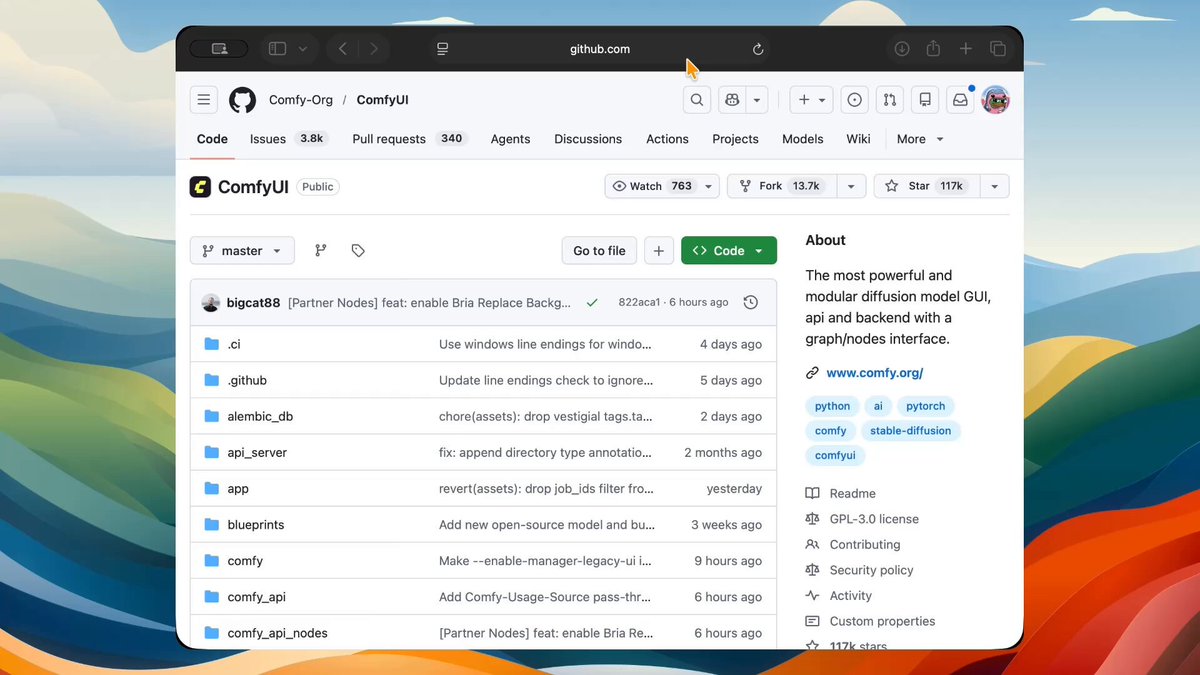
no money for grok or midjourney? this tool is for you. there's a FREE tool created by an anon dev. open-source. runs locally. 117k stars on github. it generates: > images & video > 3d models > audio > 20+ models here's how to set it up in under 5 minutes: 1️⃣download ComfyUI Desktop go to and grab the desktop app for your system. windows 10+, mac (apple silicon), or linux. it installs like any normal app, it sets up python and every dependency for you in the background. no terminal, no config files. 2️⃣open it first launch, it spins up its own environment automatically. you just wait a few seconds and you're in. you'll land on a node canvas, that's the whole interface. 3️⃣load a starter workflow top menu → Workflow → Browse Templates → Image Generation. click it. this drops a ready-made setup onto your canvas so you don't build anything from scratch. 4️⃣grab a model comfyui ships empty on purpose, the model is the brain, and you pick it. in the template, the "Load Checkpoint" node has a Download button when no model is installed. click it. it pulls one in for you (a few GB, this is the only real wait). 5️⃣install ComfyUI Manager this is the one add-on you don't skip. it lets you install models, custom nodes, and updates with a click instead of the command line. grab it from github (link in comments). it's the difference between fighting comfyui and flying in it. one honest note: an NVIDIA gpu makes this fast, apple silicon works great too, and a weak machine still runs it just slower. that's the whole setup. you now own an image, video, and 3D studio that costs you nothing per month. save this. and the next time grok or midjourney asks for your card. you won't need it. disclaimer: comfyui itself is 100% free. so are the local models (sdxl, flux, wan 2.2, ltx-2). some premium models like seedance are pay-per-use api models, only if you want top-tier quality. the free local ones cover most of what you need. (github link in the comments) follow and turn on post notification for daily AI contents.

m0h

14,542 просмотров • 4 месяцев назад