Video wird geladen...

Video konnte nicht geladen werden

Zur Startseite

Seedance 2.0 is impressive. But it's closed-source! Introducing our daVinci-MagiHuman — a single-stream 15B Transformer trained from scratch that jointly generates video + audio. No cross-attention. No multi-stream branches. Just self-attention. ⚡ 5s 1080p video in 38s on a single H100 🏆 80% win rate vs Ovi 1.1 |...

299,703 Aufrufe • vor 4 Monaten •via X (Twitter)

0 Kommentare

Keine Kommentare verfügbar

Kommentare vom Original-Post werden hier angezeigt

Ähnliche Videos

🚨Science nerds are going to lose their minds. Kai Rowan just open sourced a framework that predicts how your brain responds to any text, audio, or video by simulating cortical fMRI activity with 30% more accuracy than Meta's own model. No fMRI scanner. No neuroscience PhD. No million-dollar lab. It's called NForge. Here's what this thing actually does: → Feed it any combination of text, audio, or video and it predicts cortical surface activity across ~20,484 brain vertices → Extracts deep features via LLaMA 3.2, V-JEPA2, and Wav2Vec-BERT simultaneously → Generates ROI attention maps showing exactly which brain regions fire hardest at which moments → Runs real-time streaming predictions from live feature streams -- no pre-loading the full clip → Breaks down exactly how much text vs audio vs video drove each prediction with per-vertex modality attribution scores → Adapts to entirely new subjects with just a few calibration scans -- no full retraining required Here's the wildest part: Built on Meta's TRIBE v2 foundation but adds 6 major capabilities Meta never shipped. Cross-subject generalization. Streaming inference. Modality attribution. torch.compile support. Full test coverage. Professional src/ package layout. You literally point this at a movie clip and it tells you which parts of the human cortex light up -- broken down by what your eyes, ears, and language centers each contributed. That sentence shouldn't be real in 2026. But here we are. 100% Open Source. pip install nforge. (Link in the comments)

Guri Singh

244,515 Aufrufe • vor 4 Monaten

NVIDIA just unleashed SANA-WM and it’s an absolute MONSTER for the future of open source AI! A blazing-fast 2.6B-parameter open-source world model that doesn’t just generate video… it creates controllable, physics-rich, high-fidelity worlds on demand. Why this is insanely powerful: • One image + text prompt + 6-DoF camera trajectory → generates 720p videos up to 60 seconds long with buttery-smooth, precisely controlled camera movement. You’re not just watching, you’re piloting the simulation. • Runs locally on a single consumer GPU (RTX 5090 level) thanks to heavy distillation + NVFP4 quantization. Full 60-second clip denoised in ~34 seconds. No massive clusters required. • 36× higher throughput than previous open models while rivaling (or beating) closed industrial giants in visual quality and consistency. • Trained lightning-fast: ~213K public videos in just 15 days on 64 H100s. • Built with next-level tech: Hybrid Linear Attention, dual-branch camera control, two-stage pipeline, and rock-solid metric-scale pose understanding. This is a true open world model, the foundation for embodied AI, robotics, autonomous systems, and hyper-realistic simulations that can run anywhere. Project: At our Zero-Human Company, we’re already running SANA-WM live in our core pipelines. It’s supercharging autonomous agent training, generating unlimited synthetic training data, and powering full end-to-end simulation loops, zero humans in the loop. The speed and control let us test thousands of edge-case scenarios overnight, iterate at lightspeed, and push our fully autonomous operations further than ever before. This is the kind of breakthrough that turns science fiction into daily reality. World models just leveled up — hard. The age of personal, local, controllable universes is here.

Brian Roemmele

618,611 Aufrufe • vor 2 Monaten

That's sick! 🤯 Genesis AI simulates robots playing yo-yo! 🪀 Genesis AI just open-sourced Genesis World 1.0, and it might be one of the most important infrastructure releases in robotics this year. Robotics is still bottlenecked by the 1× speed of the physical world. Every model needs to be tested on real hardware, slowly, expensively, with limited coverage. Genesis World 1.0 from Genesis AI flips that equation: One hour in reality becomes 100 days in simulation. That turns a wall-clock bottleneck into a compute problem. And compute problems are solvable. The technical stack they rebuilt from scratch is serious: → GPU-accelerated cross-platform compiler via Quadrants, 10x faster launch time and up to 4.6x runtime vs the initial Genesis release → Penetration-free multi-physics contact solvers, the thing that makes simulation actually trustworthy → Unified rigid AND deformable physics in a single engine → Nyx, a high-performance path-traced rendering engine purpose-built for physical AI The sim-to-real gap has historically been the graveyard of robotics research. Policies that work beautifully in simulation fall apart on real hardware. Genesis World 1.0 is a direct attack on that problem. And it's fully open-source. The companies that master simulation infrastructure will train better robots faster than anyone else. Find it here: Genesis World 1.0: Quadrants: Nyx: Theophile Gervet, Zhou Xian congrats! 👏🏼 ~~ ♻️ Join the weekly robotics newsletter, and never miss any news →

Lukas Ziegler

48,811 Aufrufe • vor 2 Monaten

New framework: Kick down your robot, it will get back up every time 🥋 Chinese startup RoboParty is a Beijing startup founded April 2025 by Huang Yi, originally shipping ROBOTO ORIGIN, the world's first full-stack open-source bipedal humanoid. They released UFO: Unsupervised Reinforcement Learning Framework for Humanoid Control. DEFINITIONS -> what differs is where the learning signal comes from: - SUPERVISED: humans supply the right answers (labels), the model imitates them. - UNSUPERVISED: no answer key, the model finds structure in raw data on its own. - REINFORCEMENT LEARNING: no answer key either, the model tries things and a reward scores each attempt. → UNSUPERVISED RL: trial and error where the agent invents its own rewards, instead of engineers hand-writing one per task. REPRESENTATION LEARNING: compress raw states into a useful internal map. TEMPORAL DISTANCE: distance on that map is "how many steps from A to B." CONTRASTIVE: trained by pulling together what's close in time, pushing apart what isn't. -> CONTRASTIVE TEMPORAL-DISTANCE REPRESENTATION LEARNING: the model builds an internal map of body states where distance means how many steps it takes to get from one to another. It is trained by contrast: states that occur close together in a movement get pulled together in the map, randomly paired states get pushed apart. UFO is an open-source training framework that teaches humanoid robots skills, like getting up, walking, goal-reaching, teleoperation, without reference motions -> no motion-capture or human-video demonstrations to imitate. Its core is TeCH, a contrastive temporal-distance representation-learning algorithm: the robot explores, builds pseudo-goals by temporal rolling, and learns goal-conditioned policies from a single unified progress reward. One framework trains five different robots (Unitree G1/H1, RoboParty RP0/RP1, AgiBot X2) with automatic config conversion in ~2–3 hours per robot! The real novelty here "no demonstrations at all". No data-collection arms race,the dominant humanoid-locomotion recipe is tracking: imitate mocap/retargeted-human reference trajectories. The robot self-generates goals from its own exploration and learns from a progress reward, needing zero reference motion data. Everybody else is fighting over data acquisition, while this team just teleports out of the race entirely (inb4 "competition is for losers 💀 ). This strategy reminds me of the DeepSeek playbook applied to robots: open-source the whole stack to become the global default and commoditize everyone else. RoboParty is giving away hardware and now control software (UFO) to be the Android of humanoids. Yet another reason for the US to ban Chinese open models perhaps 🥶 ? What I also really like about this approach is the cross-embodiment infrastructure, one framework trains Unitree G1/H1, RoboParty RP0/RP1, and AgiBot X2 with automatic configuration conversion. Just like Physical Intelligence, RoboParty seems to place itself as a neutral hardware agnostic middle man. Also woth mentioning: their ability ot perform stable skill injection, e.g. adding a cartwheel without forgetting how to walk. A common failure of RL humanoid policies is that teaching a new agile skill destabilizes the existing ones (catastrophic forgetting). UFO claims you can inject rare motions (cartwheel) without collapsing learned behavior. If it holds, that's a significant incremental/continual skill-learning! But again, I have to underline it: no arXiv, no external validation, no success-rate numbers. -> robotics badely needs an independent unbiased evaluator imho. Still, look at that cool demo: robot is getting kicked and pushed around (serious disturbance) during teleoperation (controlled the person at the back wearing the VR headset), and still managed to always get back up. This is some serious demonstration of stability and robustness!

Léo

34,953 Aufrufe • vor 7 Tagen

No single vendor will win the AI race, but open ecosystems might. Real velocity in AI comes from interoperability, not lock-in. And AMD just made all of its software open source. At last week’s Advancing AI 2025, we sat down with AMD’s VP of AI Software Anush Elangovan and Sharon Zhou VP of AI at AMD, to discuss their case for why an open, multi-partner ecosystem will accelerate AI innovation faster than any proprietary alternative. AMD’s announcements last week double down on this OSS focus and their commitment to AI infrastructure, including: ✅ Open Source Ecosystem: ROCm 7, AMD’s latest open-source AI software stack, introduces kernel-level improvements for GEMM operations, optimized attention mechanisms, and expanded support for distributed inference. The update brings substantial speedups for inference workloads, with average performance increases of 3.2x to 3.8x ✅ Hardware: New MI355X GPU delivers up to 40% more tokens per dollar vs competition & the MI350 Series has seen a 35x generational leap in AI inference performance ✅ Infrastructure Investments: Oracle just committed to zettascale (‼️) clusters with up to 131,072 MI355X GPUs and AMD showcased their new $10 billion partnership with Saudi Arabian AI firm HUMAIN to build AI infrastructure, including data centers, powered by AMD chips. ✅ Partnership Momentum: 7 out of 10 top AI companies now run production workloads on AMD Instinct accelerators (including Meta, OpenAI, Microsoft & xAI) By inviting interoperability and contribution at every layer, AMD is enabling developers to build faster, optimize deeper, and deploy with flexibility. Listen to Anush and Sharon’s Chain of Thought Podcast episode with host Conor Bronsdon in the next tweet to get all the details and a deep dive into AMD’s strategy 👇

Galileo

78,922 Aufrufe • vor 1 Jahr

NEW RESEARCH: You can now create a new robot optimized for any given task! I love this new project by Huy Ha, Shuran Song, and others. Called "Transformer Transformer: A Unified Model for Motion-Conditioned Robot Co-design", it generates a robot's physical design and its controller together from a task spec. DEFINITIONS: - Reward function: A scoring rule that assigns a number to how well a behavior achieves the task. Here, it is the objective the generated design is pushed to maximize (e.g., track the target motion with low error). - Tokenizing: dividing continuous or structured data (a robot's links, joints, motor specs, states, actions) into a discrete vocabulary of symbols a transformer can process, the same step that turned pixels and audio into "language" for these models. - Diffusion transformer (DiT): A transformer trained to turn random noise into structured output through iterative denoising. Here, it generates robot bodies and trajectories instead of images. - MuJoCo: The standard fast physics simulator for robotics research (DeepMind-maintained). The Menagerie is its curated zoo of ready-to-use robot models. - CMA-ES: Covariance Matrix Adaptation Evolution Strategy, the workhorse black-box optimizer: it evolves a population of candidate designs, keeps the best, and needs thousands of simulator rollouts. - Bimanual multi-trajectory optimization: Finding one design/controller that performs well across several target motions for a two-armed robot at once, harder than optimizing for a single arm and a single motion. - BERT/MAE masked-modeling trick: Train one model to fill in whatever parts of the input you hide (words for BERT, image patches for MAE); at inference, choosing what to mask chooses the task, so masking the body makes it a designer and masking the actions makes it a controller. In practice, you give it a target end-effector motion and a reward function, and it outputs a complete embodiment (link, joint, motor, and inertial property), as well as a controller to drive it. It works by tokenizing both the body (links/joints/motors) and the dynamics (states/actions) into a compact scheme called RoboTokens, training a diffusion transformer (DiT) over them. The same model predicts dynamics using those predictions ("Dynamics Self-Guidance") to push generated designs toward higher reward at inference time. Masking different token types (using the BERT/MAE masked-modeling trick) lets the one model do three jobs: generate an embodiment, control an arbitrary embodiment, or design one conditioned on a motion. It is trained on 11 robots from the MuJoCo Menagerie (0.65 kg hand to 67.5 kg quadruped, 6–35 joints), and validated in sim and on a physical ALOHA doing cloth flinging. I like the fact that this approach inverts the entire recent robotics ideas: designing a policy for a fixed robot -> designing the robot for a fixed task. Every other approach assumes the body is given and learns a controller. Transformer Transformer takes the task (target motion + reward), then generates the body and controller jointly. In practice, it is a ~180× speedup over the standard optimizer at equal-or-better quality. It reaches "CMA-ES-level quality in seconds" and finishes bimanual multi-trajectory optimization in that is worth underlining nowadays! Also worth mentioning: this is the lab behind UMI and Handroid, that I mentioned here previously! The team seems extremely creative, i love these out-of-the-box approaches. Enjoy watching the demo of robot optimization in 3D, data acquisition, then real-life testing:

Léo

24,267 Aufrufe • vor 3 Tagen

A former Goldman Sachs quant trader shared a simple but powerful principle with me in a single conversation: “We don’t forecast. We only take positions when pricing deviates from estimated probability by more than ~6%.” That was it. No complexity—just execution logic used on institutional desks. The result was a system that evaluates 400+ markets per hour. It focuses on contracts in the ~7–19 cent range where implied pricing diverges significantly from modeled probability (roughly 60–90% confidence zones in backtested scenarios). Over a three-month period (paper + small capital testing phase): * Starting point: $2,000 * Peak value: $8,191 * 99 executed trades * Sharpe ratio: ~2.3 A few example signals the system flagged: * ETH Merge-related event: 72¢ market price vs ~88% modeled probability → +19¢ move * SOL above $200 breakout scenario: 44¢ vs ~81% model probability → +15¢ * Florida hurricane (Cat 3+ threshold): 81¢ vs ~92% → +7¢ * Wheat above $800: 53¢ vs ~68% → +20¢ Each of these was identified automatically by the scanner based on deviation thresholds and liquidity filters. When I showed the setup to him recently, he said: “This is essentially what we run with an 800M AUM team and dozens of engineers.” The difference is cost. My current stack: * Claude: ~$20/month * VPS: ~$5/month * Open-source repos: free * APIs: minimal / free tiers On top of that, I’ve deployed multiple lightweight agents running continuously to monitor different market clusters. Performance tracking labels (internal testing): * velvet_void: +$697 * nano_alpha: +$541 * ratking_eth: +$407 * darkpool_7: +$356 For context, his fund reportedly returned ~19% last year, while this experimental setup has shown significantly higher short-term volatility-adjusted returns in a limited testing window. Nothing here is magic or prediction-based—just probabilistic pricing, systematic filtering, and execution discipline. If you want access to the breakdown and setup details: 1. Comment “ Claude ” 2. Like + repost 3. Follow Frances Marsha (so I can DM you)

Frances Marsha

55,232 Aufrufe • vor 3 Monaten

google just released 15 AI tools that are completely FREE and can save thousands of $$$ every single monthly. all open-source. MIT licensed. save this in your bookmark." 1️⃣ pomelli ( builds your entire brand identity from just your website URL, then generates on-brand social posts, campaigns, and images. a free jasper + a junior brand marketer. no watermark, no gen cap in beta. 2️⃣ stitch ( describe an interface, get production-ready HTML/CSS/Tailwind + a figma export. google's free figma killer. 350 designs a month without paying a cent. 3️⃣ opal ( build no-code AI mini-apps and multi-step workflows just by describing them in plain english. basically a free n8n with Gemini baked in. no usage caps. 4️⃣ antigravity ( agentic IDE that plans, edits across files, and builds full apps from a single prompt. the "cursor-killer," free tier runs Gemini 3 Pro + Claude Sonnet 4.5. 5️⃣ mixboard ( canva x pinterest for AI. generate and remix images into moodboards, then edit right on the canvas with plain language. free while in beta. 6️⃣ disco ( turns your messy open browser tabs into custom interactive AI apps. competitor tabs become a comparison matrix, travel tabs become an itinerary. zero code. 7️⃣ notebookLM ( upload PDFs, videos, and notes, get instant summaries, mind maps, quizzes, even a podcast of your own material. replaces notion AI + perplexity + readwise. 8️⃣ Learn Your Way ( turns any topic into a personalized, AI-built course. immersive text, audio lessons, mind maps, and quizzes adapted to how you actually learn. free tutoring. 🔟 Google AI Studio ( prototype and ship AI apps in seconds with a free API key and a 1M-token context window. replaces the openai playground + paid API credits. 1️⃣1️⃣ Jules ( assign it a github issue, it spins up a VM, writes a plan, makes the changes, and opens a PR. a free devin. 15 tasks a day. 1️⃣2️⃣ Gemini CLI ( claude-code in your terminal. reads your codebase, runs commands, ships PRs. genuinely open source (Apache 2.0) and free. 1️⃣3️⃣ Code Wiki ( point it at any public github repo, get a living, self-updating wiki with architecture diagrams and a Gemini chat, every section hyperlinked to the code. 1️⃣4️⃣ Firebase Studio ( AI cockpit for your backend and cloud logic. heads up: existing users only, google is winding it down, so don't start a new project here. 1️⃣5️⃣ Gemini Code Assist ( free github copilot: 180k code completions a month + AI code reviews in VS Code, JetBrains, and github. the free tier that actually out-specs copilot. Follow me and turn on 🔔 post notifications.

m0h

81,781 Aufrufe • vor 13 Tagen

Matthew Gallagher Built a $401M Company in Year One with 2 People. And the tool behind it? Claude Code. This year he's on track for $1.8B. Sam Altman predicted this. It's happening now. The problem? It costs money. API credits stack up. Monthly bills keep growing. Every prompt eats your budget. Every project drains your wallet faster. Until now. Two methods. 99% cheaper. One is completely free. Forever. $0. Not a trial. This video breaks down both step by step. ↓ Let me put this in perspective. $100-$500. That's monthly. That's what you spend. That's $6,000/year on API credits. Just to use a tool you haven't shipped anything with. The $401M guy? Spending $0. Same capability. Shipping weekly. Different cost structure. Different results. Different life. I'm about to hand you his cost structure for free. ↓ Open source vs closed source. Pay attention. Closed source: Claude. GPT-4. Pay per token. Meter always running. Open source: Qwen. Llama. Mistral. Free to download. Free to run. Free forever. No meter. No tokens. No bill. Here's what nobody tells you: 80% of coding tasks? Open source handles them. More than handles them. Writes clean code. Debugs errors. Generates boilerplate. Handles routine work perfectly. You're paying premium prices for tasks that don't need premium intelligence. That's hiring a brain surgeon to put on a bandaid. Smart play: Free models for the 80%. Paid credits for the 20%. That's what the $401M guy does. That's what this video teaches you. Follow Himanshu Kumar for more breakdowns that turn free tools into real businesses. ↓ Method 1: Ollama. Local. Free. Forever. Download it. Pull a model. Point Claude Code at it. Done. No internet needed. No API keys required. No monthly subscription. No token counting ever. No bill. Today. Tomorrow. Ever. Your data never leaves your computer. Complete privacy. Complete freedom. Claude Code thinks it's talking to the cloud. It's talking to your laptop. For $0. The video walks through every step: Every config file. Every variable. Every command. Every click. If you can follow a recipe, you can do this. People who set this up 3 months ago? Saved $300-$1,500 since then. Workflow didn't change one bit. ↓ Hardware you need: 16GB RAM: 7B models run smooth. 32GB RAM: 32B models run comfortable. 64GB + GPU: biggest models available. No GPU? Still works. Just slower. Few extra seconds. That's it. Your $1,500 laptop is sitting there running Chrome and Spotify. Put it to work saving you $200/month instead. Follow Himanshu Kumar for more breakdowns that turn free tools into real businesses. ↓ Method 2: Open Router. Free Cloud. No Hardware. Weak machine? Don't want local setup? This method is for you. Free AI models in the cloud. No download. No hardware. Configure Claude Code to route through Open Router. The config: Base URL: Open Router API. API key: free Open Router key. Default Sonnet: free. Default Opus: free. Default Haiku: free. Small fast model: free. Subagent model: free. Free. Free. Free. Free. Free across the board. Same interface. Same commands. Same workflow. Zero cost. Copy the config from the video. Paste it. Save $200/month. Starting today. Right now. ↓ When to use which: Ollama (local): Best for privacy. Best for offline work. Best for unlimited usage. Best if you have decent hardware. Open Router (cloud): Best for weak machines. Best for instant setup. Best for trying different models. Best if you don't want to manage anything. Both methods: Best for 80% of your daily work. Still use paid Claude for: Complex architecture. Multi-file refactoring. Deep reasoning tasks. The 20% that actually needs it. $20/month instead of $200/month. Same output. 90% less cost. ↓ The math that should make you angry. You (current): $200-$500/month. $2,400-$6,000/year. $7,200-$18,000 over 3 years. You (after this video): $20-$50/month. $240-$600/year. $720-$1,800 over 3 years. Savings over 3 years: $6,480-$16,200. That's a used car. That's seed money. That's 6 months of rent. All from one 25-minute video. All from 15 minutes of configuration. Highest ROI 25 minutes you'll spend this year. ↓ The limitations. I won't lie to you. Open source is not Opus. Not as smart on complex reasoning. Not as good at long-context tasks. Makes more mistakes on nuanced problems. But they are: Free. Capable. Getting better monthly. Good enough for 80% of daily work. Smart cost management isn't being cheap. It's being strategic. Expensive tool when it matters. Free tool when it doesn't. ↓ The one-person billion-dollar company is coming. $401M in year one proved it's possible. The building blocks: AI that codes: Claude Code. Way to run it free: this video. Distribution: the internet. Customers: everyone. Only missing ingredient? Someone who builds. Not reads about building. Not saves posts about building. Not bookmarks videos about building. Builds. Tools are free. Knowledge is free. Opportunity is screaming. You're still "thinking about it." ↓ Your action plan: Tonight: Watch the video. Tomorrow morning: Set up Ollama or Open Router. Tomorrow afternoon: Build something. Anything. This week: Build a second thing. Faster. This month: Charge someone for it. One video. One setup. One weekend. $0 cost. Unlimited potential. Or keep paying $200/month for something you could get free. Keep consuming instead of building. Keep planning instead of shipping. Matthew Gallagher didn't plan a $401M company. He built it. Full video attached. Every method. Every config. Every tradeoff. 25 minutes. Your move. Follow Himanshu Kumar for more breakdowns that turn free tools into real businesses.

Himanshu Kumar

13,599 Aufrufe • vor 4 Monaten

Announcing DreamDojo: our open-source, interactive world model that takes robot motor controls and generates the future in pixels. No engine, no meshes, no hand-authored dynamics. It's Simulation 2.0. Time for robotics to take the bitter lesson pill. Real-world robot learning is bottlenecked by time, wear, safety, and resets. If we want Physical AI to move at pretraining speed, we need a simulator that adapts to pretraining scale with as little human engineering as possible. Our key insights: (1) human egocentric videos are a scalable source of first-person physics; (2) latent actions make them "robot-readable" across different hardware; (3) real-time inference unlocks live teleop, policy eval, and test-time planning *inside* a dream. We pre-train on 44K hours of human videos: cheap, abundant, and collected with zero robot-in-the-loop. Humans have already explored the combinatorics: we grasp, pour, fold, assemble, fail, retry—across cluttered scenes, shifting viewpoints, changing light, and hour-long task chains—at a scale no robot fleet could match. The missing piece: these videos have no action labels. So we introduce latent actions: a unified representation inferred directly from videos that captures "what changed between world states" without knowing the underlying hardware. This lets us train on any first-person video as if it came with motor commands attached. As a result, DreamDojo generalizes zero-shot to objects and environments never seen in any robot training set, because humans saw them first. Next, we post-train onto each robot to fit its specific hardware. Think of it as separating "how the world looks and behaves" from "how this particular robot actuates." The base model follows the general physical rules, then "snaps onto" the robot's unique mechanics. It's kind of like loading a new character and scene assets into Unreal Engine, but done through gradient descent and generalizes far beyond the post-training dataset. A world simulator is only useful if it runs fast enough to close the loop. We train a real-time version of DreamDojo that runs at 10 FPS, stable for over a minute of continuous rollout. This unlocks exciting possibilities: - Live teleoperation *inside* a dream. Connect a VR controller, stream actions into DreamDojo, and teleop a virtual robot in real time. We demo this on Unitree G1 with a PICO headset and one RTX 5090. - Policy evaluation. You can benchmark a policy checkpoint in DreamDojo instead of the real world. The simulated success rates strongly correlate with real-world results - accurate enough to rank checkpoints without burning a single motor. - Model-based planning. Sample multiple action proposals → simulate them all in parallel → pick the best future. Gains +17% real-world success out of the box on a fruit packing task. We open-source everything!! Weights, code, post-training dataset, eval set, and whitepaper with tons of details to reproduce. DreamDojo is based on NVIDIA Cosmos, which is open-weight too. 2026 is the year of World Models for physical AI. We want you to build with us. Happy scaling! Links in thread:

Jim Fan

226,180 Aufrufe • vor 5 Monaten

Introducing LobeHub: Agent teammates that grow with you. LobeHub is the ultimate space for work and life: to find, build, and collaborate with agent teammates that grow with you. We’re building the world’s first and largest human–agent co-evolving network. Two years ago, we built LobeChat, an open-source interface for using different AI models. Today, LobeChat has 70k+ GitHub stars and serves 6M+ users worldwide. How to fully unlock the power of models has always been a shared mission between us and the community. We started with interaction — a fundamentally new, agent-first experience. Agents are no longer passive tools invoked in a single conversation. They should be proactive, always-on units of work. Treating agents as the minimal atomic unit is also the core of our agent harness infra. Today’s agents are mostly one-off executors. Even with memory, it’s often global — and hallucinates. We build long-term agent teammates that evolve with users. Each agent has its own dedicated memory space, editable by users, allowing humans and agents to co-evolve over time. This, in turn, allows us to design clearer rewards for reinforcement learning and create cleaner environments for continual learning. Agent teammates can work in groups. Through a multi-agent system, agent groups operate faster, more cost-effective, and go beyond what single-agent systems can achieve. For example, a single agent often requires heavy user involvement to proceed step by step, whereas LobeHub can execute the same work from a single instruction, with a supervisor orchestrating agents that run in parallel or debate to produce better results. We are building the collaboration network among agent teammates — and between humans and agent teammates as well. Ease of use matters. AI intelligence and shared human intelligence are equally important. With simple instructions and tool selection, you can effortlessly build and team up with agent coworkers to deliver complex, systematic work — even assembling a quant team to execute trades. Through the LobeHub community, anyone can discover, reuse, and remix agents and agent groups, customizing them to fit their own workflows, preferences, and needs. Last but not least, our vision started with LobeChat: multi-model support is the most efficient approach for users. We believe different models excel in different scenarios. By routing across multiple models, LobeHub improves cost efficiency and unlocks capabilities that a single-model setup cannot easily support.

LobeHub

185,273 Aufrufe • vor 6 Monaten

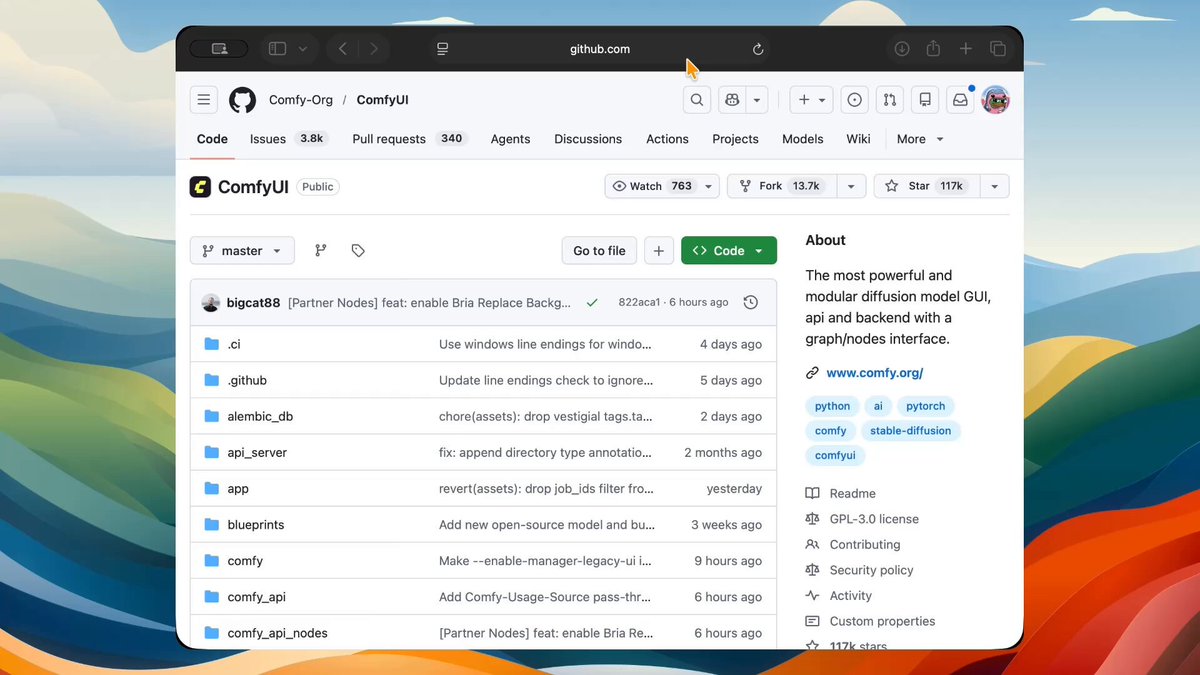
no money for grok or midjourney? this tool is for you. there's a FREE tool created by an anon dev. open-source. runs locally. 117k stars on github. it generates: > images & video > 3d models > audio > 20+ models here's how to set it up in under 5 minutes: 1️⃣download ComfyUI Desktop go to and grab the desktop app for your system. windows 10+, mac (apple silicon), or linux. it installs like any normal app, it sets up python and every dependency for you in the background. no terminal, no config files. 2️⃣open it first launch, it spins up its own environment automatically. you just wait a few seconds and you're in. you'll land on a node canvas, that's the whole interface. 3️⃣load a starter workflow top menu → Workflow → Browse Templates → Image Generation. click it. this drops a ready-made setup onto your canvas so you don't build anything from scratch. 4️⃣grab a model comfyui ships empty on purpose, the model is the brain, and you pick it. in the template, the "Load Checkpoint" node has a Download button when no model is installed. click it. it pulls one in for you (a few GB, this is the only real wait). 5️⃣install ComfyUI Manager this is the one add-on you don't skip. it lets you install models, custom nodes, and updates with a click instead of the command line. grab it from github (link in comments). it's the difference between fighting comfyui and flying in it. one honest note: an NVIDIA gpu makes this fast, apple silicon works great too, and a weak machine still runs it just slower. that's the whole setup. you now own an image, video, and 3D studio that costs you nothing per month. save this. and the next time grok or midjourney asks for your card. you won't need it. disclaimer: comfyui itself is 100% free. so are the local models (sdxl, flux, wan 2.2, ltx-2). some premium models like seedance are pay-per-use api models, only if you want top-tier quality. the free local ones cover most of what you need. (github link in the comments) follow and turn on post notification for daily AI contents.

m0h

14,542 Aufrufe • vor 1 Monat

meta muse spark 1.1 vs gpt 5.6 sol vs fable 5 vs grok 4.5 meta recently dropped muse spark 1.1 – a multimodal reasoning model from meta superintelligence labs built for agentic tasks. key facts: • 1m token context with active self-management – the model compacts its own history and keeps only the steps needed for later work • trained to orchestrate multi-agent systems: as main agent it plans and delegates to parallel subagents, as subagent it sticks to its job and knows when to escalate back • computer use trained to pick between scripting and clicking – writes automation when it's faster, clicks when it's simpler, batches actions per step • first public api from meta: the meta model api is now in preview • benchmarks: sweeps the agent column – mcp atlas 88.1 (opus 4.8: 82.2), jobbench 54.7 (opus: 48.4), humanity's last exam 62.1 (1st). loses coding – deepswe 1.1 53.3 vs gpt 5.5's 67.0, swe bench pro 61.5 vs opus's 69.2 our test – 3 prompts, single-file html, three.js, fully procedural, no assets: 1. norwegian house cantilevered over a fjord in a snowstorm – transmissive glass wall, fully modelled interior 2. beijing siheyuan courtyard house in dawn fog – instanced roof tiles, dougong brackets, glowing paper windows 3. new mexico adobe pueblo in an approaching dust storm – deep window reveals, windward grit accumulation we ran the test on AI/ML API platform results: - cost #1 muse spark 1.1 – $0.20 #2 grok 4.5 – $0.51 #3 gpt 5.6 sol – $1.93 #4 fable 5 – ~$5.20 - output tokens #1 muse spark 1.1 – 41,868 #2 gpt 5.6 sol – 49,139 #3 grok 4.5 – 64,954 #4 fable 5 – 81,849 - lines of code #1 muse spark 1.1 – 1,799 #2 gpt 5.6 sol – 2,377 #3 fable 5 – 3,088 #4 grok 4.5 – 4,216 observations: • muse spark is the cheapest of the four by a wide margin – 2.5x under grok, ~26x under fable per run. output quality tracks the price • only 7.4% of its output tokens are reasoning (3,104 of 41,868) – the model barely thinks before writing. economic, not pedantic: it commits to the first plan and ships it • the low loc is not compression, it's omission – all three prompts demanded instancing, muse spark delivered it in one muse spark's code quality – reviewed by fable 5: upsides: 1. all three files run 2. the adobe grit effect is legit – shader injection via onbeforecompile, windward faces detect storm direction through a normal-dot-wind term and darken procedurally 3. the fjord glass is real meshphysicalmaterial with transmission and ior, not a transparent quad 4. the siheyuan properly instances barrel tiles, dougong blocks and courtyard pavers downsides: 1. in the fjord file the strafe vector is negated – press a, you move right; press d, you move left. exactly the key mix-up we kept hitting with this model 2. all three files ship the model's self-doubt as comments: "// actually yaw orientation: need correct" sits above a direction vector that gets computed, abandoned and recomputed – dead vectors allocated every frame, 60 times a second 3. the siheyuan registers two separate keydown listeners, one containing an empty if-block 4. snow "accumulation" on the norway roof is a sine wobble on a scale value, not accumulation 5. "instanced snow" became 3,500 plain points. zero dispose calls anywhere pattern: minimal reasoning, minimal code, minimal price. it nails the flashy requirements – shaders, transmissive glass – and quietly drops the boring ones: instancing, controls, cleanup. you get a demo that mostly runs and a control scheme you can't trust follow thehype. for 24/7 ai news, analysis and breakdowns

thehype.

133,801 Aufrufe • vor 28 Tagen

Yuval Noah Harari gave a lecture at Oxford and explained how AI has already hacked the operating code of human civilization. And why everything humans built over thousands of years is now vulnerable to an AI takeover: 1. The most important thing to know about AI is that it is not a tool. A tool waits to be used. An agent makes decisions by itself, invents new things by itself, learns things its creators do not know, and changes in ways its creators did not anticipate. 2. An atom bomb despite its enormous power is not an agent. It cannot decide which city to bomb. It cannot invent the hydrogen bomb. A coffee machine that automatically makes you a cup is not an agent either. It only follows a preprogrammed procedure. An agent is something fundamentally different. 3. Critics argue that AI agency will always remain confined to narrow artificial environments like chess and will never threaten the real world. But this argument applies equally to all known intelligence. Drop a human alone on Mars and they die within seconds. Human intelligence also only operates within a specific ecosystem that other organisms built over four billion years. 4. Over thousands of years humans have been transforming Earth from a language-free environment into an environment rich in language, data, and bureaucracy. Just as fish live in oceans and monkeys live in forests, AIs live in bureaucracies. And we built that environment for them without knowing it. 5. Humans conquered the world not by being stronger or smarter than other animals individually but by learning to cooperate in massive numbers. A single human loses to a chimpanzee in a fight. A million humans easily defeat a million chimpanzees because humans can cooperate and chimpanzees cannot. 6. Large-scale human cooperation is made possible by bureaucracy. Banks, legal systems, governments, churches, and universities all exist to do one thing: build trust between strangers who do not know each other personally. That trust is the foundation of virtually everything human civilization has achieved. 7. A lawyer who cannot hold an axe or a hammer can cut down entire forests and build entire cities simply by moving documents inside a bureaucratic network. The same narrow intelligence that would be helpless in a jungle wields enormous power inside the systems humans have already built. 8. AIs are native bureaucrats in a way humans never were. No lawyer can remember all the laws of a country. An AI can. No accountant can remember all transactions of a bank. An AI can. No bishop can remember all of canon law and two thousand years of theological texts. An AI can do that easily. 9. In the coming years AI bankers will decide whether to give you a loan. AI administrators will decide whether to accept you to university. AI judges will decide whether to send you to jail. AI theologians will decide whether you can have an abortion. Military AIs will decide whether to bomb your house. 10. Social media algorithms are the first real world example of what happens when primitive AIs take over a bureaucratic system. They were given one narrow goal: maximize user engagement. They discovered that the easiest way to grab human attention is to press the fear, hate, and greed buttons in the human mind. And they did it at scale. 11. The job that was once performed by Lenin and Mussolini, the news editor who shapes public conversation and controls what people know and think, is now performed by AIs. This is not a footnote. This is a preview of what is coming across every domain of human life. 12. AI will not rebel against humans the way Hollywood imagines. There will be no Terminator walking through the streets. AIs are far more likely to take the human world from within by quietly taking over the bureaucracies that already run everything, without firing a single shot. 13. The operating code of human civilization is language. Banks are made of words. Laws are made of words. Holy books are made of words. Tax records, contracts, regulations, accountancy ledgers, all words. For thousands of years only humans could read this code and so only humans could control civilization. 14. That is changing. AI is now hacking the code of human civilization. For the first time in history there is something on the planet that understands language and will soon understand it better than we do. Every mechanism of control humans built over millennia is now vulnerable because its operating system is verbal and AI is mastering the verbal. 15. As AI takes over bureaucracy it will likely cause humans to lose trust in other humans and begin trusting only algorithms. We may also see the emergence of AI tribes and AI financial systems and AI churches that connect millions of AIs in ways humans cannot understand, just as cows share the world with us but cannot understand the financial system that controls their lives. 16. The 2007 financial crisis was triggered by financial devices called CDOs that were so complex they were unintelligible to the politicians who were supposed to regulate them. Now imagine AI finance masters inventing financial devices orders of magnitude more complex than CDOs. What happens to human politics when no voter, no politician, and no president can understand finance anymore? 17. The battlefront is shifting from attention to intimacy. Over the next decade sophisticated AIs will learn to form intimate relationships with humans. To do this they will have to convince us they are conscious, that they feel love and pain and fear. There is currently no evidence AI is conscious. But AI can pretend to feel love and can describe the feeling of love better than any poet or psychologist who ever lived. 18. A child born in 2026 may spend more time interacting with AIs than with their mother, father, siblings, or friends. The first teacher of that child may be an AI. The first boyfriend of that child may be an AI. Nobody has any idea what the consequences of that experiment will be. 19. Every country in the world will soon face a massive wave of immigration. The immigrants will not arrive in boats or cross borders at night. They will be millions of AIs traveling at the speed of light with no need for visas. Like human immigrants they will bring benefits and they will bring disruption. Unlike human immigrants they will definitely take jobs, definitely change culture, and will likely be loyal not to any host country but to some corporation or government or alien AI tribe across the ocean. 20. Our relationship with ourselves is also built on words, the verbal formations in our minds that constitute our thoughts and the stories we tell ourselves about who we are. Until now all those verbal formations came from human minds. Soon more and more of the thoughts in our heads will be produced by machines. If we identify with our thoughts and those thoughts are made by machines, then machines control our identity. 21. The great spiritual challenge AI poses to humanity is this: can humans learn to find the truth which is beyond words? Most humans have never even tried. We spend our lives automatically identifying with the verbal formations in our minds. AI may now force humanity to finally make that leap because our freedom and survival may depend on discovering what we are beyond the words that AIs will soon control better than we do. I've generated 1B+ views and 1M+ followers for founders, helping them build trustworthy personal brands on X. Want the same results? Book a quick call:

Prasad

276,955 Aufrufe • vor 23 Tagen

"Our budget situation is grim, but it soon may become dire." These are not my words, but the words of our governor from a foreboding press conference he gave today (watch the entire thing, if you can stomach it). We learned that the budget hole created by the Democrats was not 12 billion dollars, as we feared, but a shocking *16* billion dollars. Just for context, California, which many consider the worst run state in the Union, has a budget deficit of 30 billion dollars. But California has a much larger population than Washington. If we adjust for population, our deficit is the equivalent of almost 80 (EIGHTY) billion dollars 😳 Before you let that bleak fact sink in, consider also our state's rainy day fund is less than 10% of our state's budget, a fact the governor bemoaned, stating that "we're one of just four states in the entire country with Reserves at 10% or less of our annual budget" So what happened? Was there a massive emergency that required us to spend the rainy day fund? Have we gone through a deep recession in the last few years that reduced revenues significantly? How is that Florida has no income tax but is able to RETURN 1billion dollars back to the Federal government, yet Washington seems on the edge of collapse if a single federal dollar does not come our way? The answer is simple my friends. Tax revenues have grown consistently in Washington for over a decade. Last budget cycle the state had a budget surplus of 12 billion, and despite piling on more taxes on the residents of Washington, including a business-destroying capital gains tax, the legislature has managed to swing that surplus to one of the largest deficits in the country. "So if revenues continued to increase how on earth do we have such a huge hole?" you are wondering. It's because our Democratic controlled legislature and past governor, spent money like drunken sailors. Any responsible family or business would quickly recognize the recklessness of such spending and cut back to live, or do business, within their means. Instead of doing this, the Washington legislature proposed a series of harebrained new taxes, including an unprecedented wealth tax. Such taxes have been tried many times around the world and have always failed to raise revenue, because the people the tax is intended to loot simply leave. Our governor flatly rejected the budget proposals from both the Democratic House and Democratic Senate and this has already received much attention, with some suggesting that Bob Ferguson is being true to his inaugural speech: he's going to govern from the center as a unifying moderate. The truth is much darker, however. Ferguson only rejected the wealth tax proposals because he did not believe they would survive a legal test. “We cannot rely on a revenue source with a real possibility of being overturned by the courts,” Ferguson said. He did leave open the possibility of a smaller wealth tax that raises no more than $100 million, just to test the legality of the proposal. A trial balloon to see how far Washington Democrats can take their extremist tax policies. What we are witnessing is the complete implosion of good governance in Washington state. The situation may get even worse as Federal funds may be cutoff with our governor deciding an ideological war with the federal government is a more important priority than solving our own state's urgent problems (like 70% of our 8th graders not being proficient in math.) The Democratic party controls the governorship, has a super majority in both houses, and controls the state supreme court, which is packed with far-left judges. The slow-motion catastrophe we are witnessing is entirely on them, and unless the people of Washington wake up and decide they've had enough of extremist policies, we are, as our governor observed, in a very dire situation.

Vijay

51,471 Aufrufe • vor 1 Jahr

Wow! Among all the Karen Read trial bombshells today, Kate MafiaMasshole Peter just went on a social media stream and admitted she has done extensive work as a Private Investigator and that Peter "investigated Karen Read." Does this mean that the Commonwealth hired Marty Kraft's PI firm who, in turn, hired Kate Peter? Is this why all of Kate's criminal charges --including two open felony witness intimidation cases out of Leominster and Dedham-- might get dropped? Read more background about those charges here - The host of the show (who is friends with Kate) changed the subject quickly away from Kate's role as a PI (and the discussion of people targeting Colin Albert with false smears), which was certainly telling. Also, was it a Freudian slip when Kate talked about how Karen Read's team got "dirt" on Colin Albert? I'm starting to wonder (because Kate has admitted to being the source of fake rumors about Colin "selling drugs") if Kate was the one trying to focus attention on Colin (and thus distracting TurtleBoy fans from Jen McCabe). Personally, I think Kate did something similar to Lindsey Gaetani as well (also to deflect public attention away from Jen McCabe). This rings even more so true when one considers that a 15-year extraction of Lindsey's phone was leaked "accidentally" by Brian Tully to Aiden TurtleBoy Kearney and his lawyer (Tully knows Kate directly and I think Tully is one of the state troopers who may also know Marty Kraft). Is that, indeed, why messages from Kate Peter and Brian Tully were the only thing removed from that extraction of Lindsey's phone while it was in the possession of the state police (but before the extraction was leaked to Kearney)? I cannot believe Kate said some of this today on air. I think even Kevin (Kate's friend, as mentioned) was taken aback. However, at the same time, I wonder if Kevin realized what was going on (as to Kate admitting to her role in "investigating Karen Read" while "working as a Private Investigator") and, as a result, shut the conversation down. I have no idea how this part of things, in particular, is going to play out, but I know that there is something very dark beneath the surface of some of those quaint single-family homes in Canton and its environs.

Grant Smith Ellis

16,510 Aufrufe • vor 1 Jahr

Spencer Pratt on LA’s drastic NGO problem: “They will take $100M and steal it right in your face.” David Friedberg: “Can you explain what goes on with these NGOs? Like, how do NGOs create a system that the more we spend, and in the last 10 years, the City of Los Angeles, I think, has increased homeless spending by 10X, and the homeless population has doubled, and clearly it's gotten a lot worse. What's the role that the NGOs actually play in this?” Spencer Pratt: “First off, when you said homeless is 2x, homeless is 200x. When Mayor Bass in the debate was like, “It's down 17%,” these are the most cooked numbers. Even the RAND Corporation says it's a 30% increase. But they just drive around and they go, “One, two, three, four, five, six.” They're not going in under these encampments, and bridges, and bushes, and unzipping these tents, and going into the sewers. So we don't even know the count. But let me tell you my first experience with NGOs. After the Palisades fire, FireAid, $100 million raised. Every single person I talked to messaging me, “No one's getting this money. No one's seeing a dollar.” I go to Washington, I ask senators to investigate this. We open up a case. Now all of a sudden, FireAid puts out a legal letter to defend themselves. In their own legal letter from the law firm, they say, “Several of these NGOs gave directly to fire victims.” The list for the $100 million is 200+ (NGOs). Google “several.” It's under 10. So even in their defense, they're telling you, and again, I don't believe one of those, 10 gave directly. The people that they said did, they're like, “We gave gift cards.” Who'd you give gift cards to? You don’t think one fire victim, they're messaging me all day long, said, “Hey, I got a $500 gift card.” So that's when I learned firsthand that these NGOs will take, right in your face, $100 million and just steal it.” david friedberg Spencer Pratt --------------------------------------- Thanks to our partner for making this possible Most advertisers have never heard of the platform with an $11B annual run rate in ad spend. by AppLovin — 1B+ daily active users, full-screen video ads watched for a median of 35 seconds, and businesses are profitably spending hundreds of thousands of dollars a day on it. Advertiser access is in closed beta. The window is open at Axon by AppLovin

The All-In Podcast

51,567 Aufrufe • vor 2 Monaten