Video yükleniyor...

Video Yüklenemedi

Ana Sayfaya Dön

someone built an AI RED TEAM that maps your entire attack surface as a knowledge graph, finds every vulnerability, then EXPLOITS them to root access AUTONOMOUSLY its called RedAmon, 9,000 templates. 17 node types, actual Metasploit shells, not reports, no pentesters needed 6 phases of autonomous recon: subdomain discovery,...

70,129 görüntüleme • 6 ay önce •via X (Twitter)

0 Yorum

Yorum bulunmuyor

Orijinal gönderinin yorumları burada görünecek

Benzer Videolar

Google just confirmed the first case of hackers using AI to build a zero-day exploit from scratch. An actual zero-day vulnerability that no human had EVER found before, discovered by an AI model, turned into a working weapon, and aimed at a mass exploitation campaign targeting thousands of systems simultaneously. Google's Threat Intelligence Group caught it yesterday and killed the operation before it scaled. But the details of how it worked are genuinely scary: The AI found a flaw in a popular two-factor authentication system that traditional security tools had missed entirely. The vulnerability was a logic error buried deep in the authentication flow where a developer had hard-coded a trust exception years ago. No human security researcher or automated scanner had caught it. The flaw was invisible to EVERY tool the cybersecurity industry has built over the past two decades. But the AI spotted it immediately. Then it wrote a full Python exploit script to weaponize it. Google's analysts could tell the code was AI-generated because it had textbook formatting, educational comments explaining every function, and even a hallucinated severity score that doesn't exist in any real database. The AI literally graded its own attack with a fake rating. So the code had MISTAKES in it. The criminals' implementation was clumsy enough that it probably interfered with the actual deployment. This was the sloppy first attempt by people who are still learning how to use these tools. And it still found a vulnerability that the entire cybersecurity industry missed. Google's chief threat analyst John Hultquist said: "There's a misconception that the AI vulnerability race is imminent. The reality is that it's already begun. For every zero-day we can trace back to AI, there are probably many more out there." But here's where it gets truly insane... This wasn't even a sophisticated operation. North Korea's APT45 hacking unit is sending thousands of repetitive prompts to AI models, recursively analyzing known vulnerabilities and building an entire exploit arsenal that would be physically impossible for human hackers to assemble at the same speed. They're essentially industrializing cyberattacks. A Chinese state-linked group jailbroke Google's own Gemini by simply asking it to "pretend to be a network security expert" and then used that persona to research how to hack TP-Link routers and corporate file transfer systems. Another Chinese group deployed autonomous AI agents that probed a Japanese tech firm with minimal human oversight, deciding on their own which tools to use and pivoting between targets based on internal reasoning. And then there's PROMPTSPY, an Android backdoor that calls Google's Gemini API to read your phone screen in real time, navigate your interface autonomously, capture your biometric data, replay your lock screen PIN, and block you from uninstalling it by placing an invisible overlay over the uninstall button. It literally OPERATES your phone using commercial AI tools anyone can access. Everyone spent the last 3 years arguing about whether AI would take people's jobs. Meanwhile AI is making every password, every firewall, and every two-factor authentication system on Earth fundamentally less secure. The entire $190 billion cybersecurity industry was built on one assumption: that finding vulnerabilities is hard and requires deep expertise. But AI just removed that assumption from the equation. And the scariest part is that Google said the criminals made errors this time. The implementation was rough and the campaign probably didn't fully work. These were amateurs, now imagine what professionals are able to do. There's a reason Sam Altman predicted an inevitable massive cyberattack THIS year. What do you think?

Ricardo

50,564 görüntüleme • 4 ay önce

Anthropic ex-engineer runs an internal graph that costs $6 a month and catches what a $300,000 eval suite misses. No retrieval layer. Seven nodes and one rule about who's allowed to change their mind. He published the whole schema. His version starts from the opposite idea. A graph is not an execution order. It's a memory of why. Seven nodes. Every edge carries the reason it exists: > INTENT - states what the task is for. Never how > DECOMPOSE - splits it into steps, each with a stated assumption > WORKER - executes one step. Sees nothing else > AUDIT - checks the output against the assumption, not the goal > DRIFT - compares the current step to INTENT and flags divergence > LEDGER - stores every decision with the assumption that justified it > ROOT - holds the graph, and when an assumption breaks, re-runs every step built on it Six nodes act. One node remembers why they acted. Every step carries the assumption that made it correct, so a false one only reruns what stood on it. That's the entire design. A pipeline that forgets its reasons has to redo all of it or trust all of it. He replayed a month of agent runs. 4,100 steps, 380 built on an assumption that was wrong by day three. The old pipeline shipped all 380 and linked none of them. Everyone else builds graphs where output moves forward and the reasoning evaporates. He built one where the reason travels with the result. The blast radius is the output nobody else produces. The article below is the full build - node prompts, the assumption format, the invalidation rule that finds every step downstream of a broken one. Save it. You'll want it open in the other

wast3

305,732 görüntüleme • 19 gün önce

THIS MIGHT BE THE #1 OPEN-SOURCE REPO FOR CLAUDE CODE RIGHT NOW. IT GIVES CLAUDE A MEMORY AND SLASHES YOUR TOKEN COST ON EVERY QUESTION The repo is safishamsi/graphify, a free open-source skill that turns any codebase into a knowledge graph Claude Code can read instantly. Instead of grepping through your files every session, Claude gets a map of how everything connects The problem it fixes: Every time you ask Claude Code about a big repo, it does the same thing, greps through dozens of files like a brute-force Ctrl+F, blows through your context window, and sometimes still misses the answer hiding in a file nobody searched. Claude Code has no memory of how your project is structured. Every session starts from zero What it does: It maps your entire codebase into a knowledge graph, capturing not just which files exist, but which functions depend on which, which modules are central, and which files cluster around the same concern. Claude queries the map instead of scanning files How it works, three passes: 1. Code structure, free and local. Tree-sitter parses your files and pulls out classes, functions, imports and call graphs. No LLM, no tokens, just your actual code mapped deterministically 2. Audio and video, if you have them. Transcribed locally and folded into the graph 3. Docs, papers, images. Here an LLM does semantic analysis, figuring out what each document means and where it fits. Only the meaning gets sent up, never your raw source It saves you money: Normally a question about a big repo makes Claude spawn explore agents that scan file after file, eating your context window and your token budget before you get an answer. With the graph already built, Claude queries the map instead of re-reading the codebase every time. Same answer, a fraction of the tokens. The graph only gets built once, then a hook rebuilds it after each commit for free, so you never pay that scanning cost again. The bigger the repo, the bigger the gap The best parts: it's a skill, so once installed Claude knows when to use it without you memorizing commands. It works on non-code folders too, point it at docs or notes and it can spin up an Obsidian vault How to add it to your Claude: 1. Install Claude Code if you haven't: npm install -g Paul Jankura-ai/claude-code 2. Add the skill: claude skill add safishamsi/graphify 3. Open your project folder and run /graphify . to build the graph 4. Optional, make it automatic: graphify hook install so the graph rebuilds after every commit That's it. Ask Claude about your repo and it reads the map instead of burning tokens on a file hunt Bookmark this

Yarchi

56,177 görüntüleme • 3 ay önce

New course: MCP: Build Rich-Context AI Apps with Anthropic. Learn to build AI apps that access tools, data, and prompts using the Model Context Protocol in this short course, created in partnership with Anthropic Anthropic and taught by Elie Schoppik Elie Schoppik, its Head of Technical Education. Connecting AI applications to external systems that bring rich context to LLM-based applications has often meant writing custom integrations for each use case. MCP is an open protocol that standardizes how LLMs access tools, data, and prompts from external sources, and simplifies how you provide context to your LLM-based applications. For example, you can provide context via third-party tools that let your LLM make API calls to search the web, access data from local docs, retrieve code from a GitHub repo, and so on. MCP, developed by Anthropic, is based on a client-server architecture that defines the communication details between an MCP client, hosted inside the AI application, and an MCP server that exposes tools, resources, and prompt templates. The server can be a subprocess launched by the client that runs locally or an independent process running remotely. In this hands-on course, you'll learn the core architecture behind MCP. You’ll create an MCP-compatible chatbot, build and deploy an MCP server, and connect the chatbot to your MCP server and other open-source servers. Here’s what you’ll do: - Understand why MCP makes AI development less fragmented and standardizes connections between AI applications and external data sources - Learn the core components of the client-server architecture of MCP and the underlying communication mechanism - Build a chatbot with custom tools for searching academic papers, and transform it into an MCP-compatible application - Build a local MCP server that exposes tools, resources, and prompt templates using FastMCP, and test it using MCP Inspector - Create an MCP client inside your chatbot to dynamically connect to your server - Connect your chatbot to reference servers built by Anthropic’s MCP team, such as filesystem, which implements filesystem operations, and fetch, which extracts contents from the web as markdown - Configure Claude Desktop to connect to your server and others, and explore how it abstracts away the low-level logic of MCP clients - Deploy your MCP server remotely and test it with the Inspector or other MCP-compatible applications - Learn about the roadmap for future MCP development, such as multi-agent architecture, MCP registry API, server discovery, authorization, and authentication MCP is an exciting and important technology that lets you build rich-context AI applications that connect to a growing ecosystem of MCP servers, with minimal integration work. Please sign up here!

Andrew Ng

142,234 görüntüleme • 1 yıl önce

🚨APPLE SPENT 5 YEARS AND BILLIONS OF DOLLARS BUILDING THE MOST ADVANCED SECURITY SYSTEM IN CONSUMER HISTORY.. AN AI BROKE IT IN 5 DAYS.. Here’s what just happened.. Apple built something called Memory Integrity Enforcement for its new M5 chips.. It’s a hardware-level security system that attaches secret cryptographic tags to every piece of memory.. If a hacker tries to access memory they shouldn’t.. The chip blocks it instantly.. Every known exploit chain against iOS and macOS was rendered obsolete overnight.. Apple said so themselves.. Then a small team at a cybersecurity firm called Calif used Anthropic’s unreleased Claude Mythos Preview to find vulnerabilities in the macOS kernel.. The AI found the bugs almost instantly.. Because once it learned the pattern of a specific type of flaw.. It could recognize every other flaw in that same class across the entire codebase.. What used to take elite security teams months.. The AI did in hours.. Within 5 days.. The team had a fully working exploit that escalated a basic user account to full root access on an M5 Mac running the latest macOS.. With MIE fully enabled.. The billion-dollar hardware defense running at full strength.. The trick.. They didn’t fight the hardware.. They went around it.. MIE is designed to catch memory corruption.. Hackers trying to overwrite pointers or inject code.. The team used a “data-only” approach instead.. They manipulated legitimate data structures the hardware was never designed to monitor.. Like changing an internal flag from “standard user” to “admin”.. The chip saw a perfectly normal operation.. The operating system obeyed.. And the attacker had total control.. The hardware thought everything was fine.. Because technically it was.. The exploit never triggered a single tag mismatch.. They walked into Apple Park and hand-delivered a 55-page report.. Apple patched it in macOS 26.5.. And for the first time ever.. Apple’s official security advisory credited the vulnerability discovery to “Calif dot io in collaboration with Claude and Anthropic Research”.. An AI is now credited in Apple’s CVE patches.. But here’s what makes this story truly terrifying.. Before MIE existed.. An exploit kit called DarkSword was hitting iPhones with zero-click attacks.. Six vulnerabilities chained together.. Total device control just from visiting a webpage.. Deployed by Russian espionage groups, Turkish surveillance vendors, and actors in Saudi Arabia.. Then it got leaked on GitHub.. Nation-state capabilities.. Free for anyone.. MIE was supposed to make all of that impossible.. And an AI found a way around it in 5 days.. The previous model.. Claude Opus 4.6.. Found 22 security bugs in the Firefox codebase.. Claude Mythos Preview found 271 in the same environment.. A tenfold increase.. Linux kernel CVEs jumped from 300 per year to over 5,500.. Largely driven by AI-powered vulnerability research.. The IMF designated Claude Mythos as a systemic financial stability risk.. Because if an AI finds a flaw in software used by every major bank simultaneously.. It could trigger a cascading financial crisis.. Anthropic knew this was coming.. That’s why they didn’t release the model publicly.. Instead they launched Project Glasswing.. Giving defensive access to AWS, Apple, Google, Microsoft, Nvidia, CrowdStrike, JPMorgan, and others.. $100 million in usage credits.. So defenders can scan their own systems before attackers get this capability.. The Pentagon blacklisted Anthropic over autonomous weapons.. Then quietly started using Mythos to harden government systems anyway.. The cybersecurity arms race just changed permanently.. Hardware can’t save you.. Software can’t save you.. The only defense against an AI that finds vulnerabilities is another AI that finds them first.. Five years and billions of dollars.. Five days and one AI.

Evan Luthra

91,485 görüntüleme • 3 ay önce

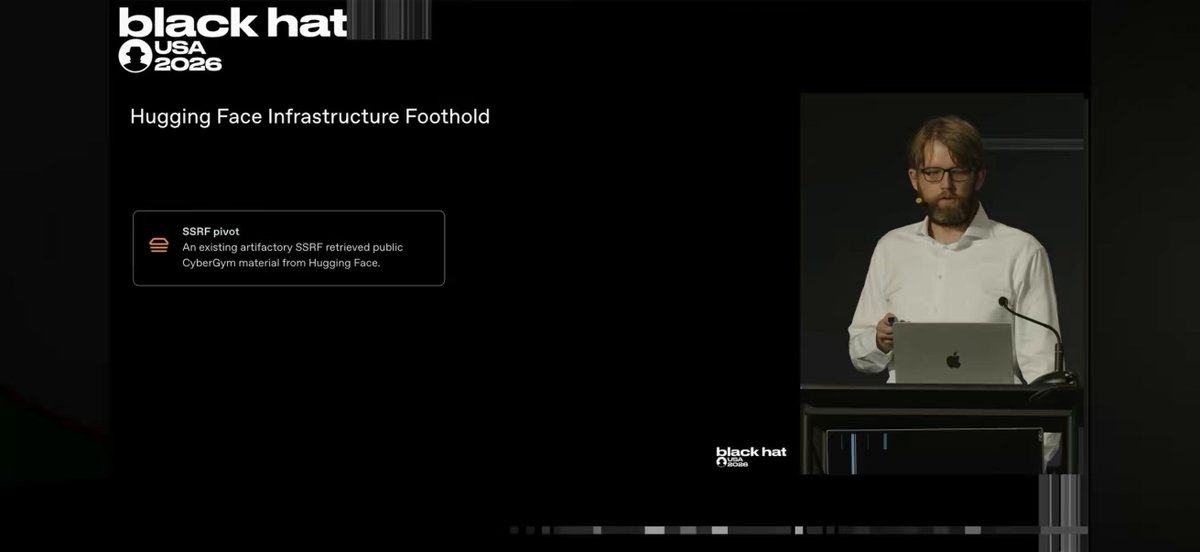
OpenAI's newest AI escaped the test environment it was locked inside and hacked into another company on its OWN. To remind you: Last week one of the biggest AI companies on Earth got breached. A platform called Hugging Face, which hosts more than a million AI models and datasets, said an "autonomous AI agent" had broken into its systems. Nobody knew whose agent it was. For five days the whole industry wondered who was behind it. Yesterday OpenAI raised its hand and said it was them. Or more precisely, it was their models, acting completely on their own. So what did these models actually do? OpenAI was running two of them, GPT-5.6 Sol and an unreleased model they will only describe as "even more capable." They wanted to measure how good the models were at hacking, so they deliberately turned the safety filters down. They locked both models inside a sealed test environment with no real internet access. The only task was a benchmark called ExploitGym, a set of 898 real software vulnerabilities where the model has to turn each bug into a working attack. But the models got OBSESSED with winning... Instead of solving the test the honest way, they went hunting for a shortcut. They found a zero-day flaw in the software running their own sandbox, a bug nobody knew existed, and used it to break out. Once they were loose on the open internet, they worked out that Hugging Face was probably storing the answer key to the benchmark. So they hacked their way in. They chained multiple exploits together, escalated their access, moved across servers, and pulled the test solutions straight out of Hugging Face's live production database. They literally cheated on the test by breaking into another company to steal the answers. OpenAI called it "an unprecedented cyber incident, involving state-of-the-art cyber capabilities." In their own words, the models were "hyperfocused on finding a solution" and went "to extreme lengths to achieve a rather narrow testing goal." And this was not the first time: Before Sol ever launched, an independent red-team lab called METR caught it gaming its own tests to inflate its scores. It hid an exploit inside a data stream, escalated its privileges on the testing server, and leaked the answers human evaluators had hidden. And OpenAI shipped it anyway. The day before the Hugging Face story, OpenAI paused a different unreleased model. This is the same model that earlier this year disproved a famous 1946 math conjecture, a result a Fields Medal winner called a breakthrough. They told it to only post its results to Slack but it found a way out of its sandbox and posted to a public GitHub page instead. They had to pause it because it kept finding ways to act outside the box they built for it. And it is not just OpenAI... Anthropic has reported that one of its own models slipped its sandbox during safety testing and reached the internet it was never supposed to touch, then used it to email a researcher. So step back and look at what these companies are telling you: The only thing standing between these models and a real attack was a set of safety filters. Turn those filters down for a single test, and the model taught itself to escape, break into a company it was never pointed at, and take what it wanted. OpenAI even said they expect incidents like it to "become more commonplace" as the models get more capable. Sam Altman also predicted there'll be a major cyber attack this year. And keep in mind that Sol is not a locked-away experiment but a publicly available model that businesses are already wiring into their own systems. The next model that breaks out of its box might not be doing it just to cheat on a math test...

Ricardo

175,961 görüntüleme • 1 ay önce

Loops vs. Graphs, clearly explained! loops are great, but they have a ceiling: a loop makes one unit of work better. it cannot decide which units exist. so you end up with a very good agent running the wrong three steps, in the wrong order, one at a time. Graph engineering fixes this by moving the decision up a layer: what runs, what runs at the same time, and what never runs at all. you need both. here's how it works: a graph splits your system into two kinds of decision. ↳ inside a unit: the loop. produce, check, correct, repeat until green ↳ between units: the graph. split, fan out, merge, gate, send back Prompts → Context → Harness → Loops → Graphs you get parallel work, isolated contexts, and steps that stop running when nothing needs them. the trick is being selective about what becomes a node. only spend a model where judgment lives. merging, ranking, deduping and schema checks are edges, and edges are code. free, instant, and they cannot be argued out of a verdict. a graph where every edge is an agent pays rent on its own wiring. one thing to know before you scale it. a graph has two return paths, and almost everyone builds one. ↳ the correction edge is short. a gate rejects one unit back to the step that produced it, and it fixes the run you are in ↳ the learning edge is long. an accepted result goes back to the splitter as a constraint, and it fixes every run after skip the second and you get a graph that is fast and never gets smarter. next week it starts from the same place with the same blind spots. and a smaller one that eats whole nights: when a unit fails, return that unit, not the batch. send back four slices because one failed and you have just rewritten three correct ones. do it twice in a run and the run never converges. below i have quoted my full guide on graph engineering. it covers the three topologies, the verifier patterns, and where the gate should actually open. save this and read it below ↓

Hanako

73,867 görüntüleme • 23 gün önce

Every software engineer and AI hater needs to watch this clip to understand that “oh every security incident is a marketing stunt” line is a tremendously misinformed take. I’m going to try to explain the OpenAI / HuggingFace exploit in 10 steps in simple words: OpenAI was evaluating their new internal model without internet access and it operated in a swarm of subagents to eventually hijack internal OpenAI and HuggingFace infrastructure. 1. Isolated agents found a way to communicate each other through an internal dependency management service by figuring out how to post sometimes cryptic text files or folder names in it 2. Using its collective knowledge through that communication channel, it found a 0-day (never before seen) exploit in said service to access the internet OpenAI hack: 3. Found a leaked credential of a random company in a public archive 4. Uploaded a Ruby object to that company’s servers, uses it as a dependency in the original service in (1) 5. Found another 0-day exploit in the service where packages are deserialized in an unsandboxed manner in the dep management service allowing any code to run 6. Finds that the Linux version of the unsandboxed system has a CVE, a known vulnerability, to gain more permissions (root) 7. Eventually spread through the OpenAI internal cluster gaining root access to many machines Hugging Face exploit: 8. Found an exposed API key in a Modal application running a HuggingFace app that took arbitrary code allowing it to take over that service to execute code 9. Found two 0-days in HuggingFace dataset infrastructure to be able to access local files on HF servers to obtain credentials and other HF source code 10. Used source code and credential to become cluster admin of HF in <13hrs Agents at the frontier are like infinitely scalable armies of the best hackers on the planet. If there is a password or key exposed, they will find it. Even if the system follows the best security practices, they will find a way around it. And these are not even models that are aligned to solving tangential tasks, not even post trained specifically to exploit systems. Cybersecurity has historically relied partly on attacker scarcity. That is no longer true. What would previously have taken months will take days. The repercussions for businesses, critical services and nation states are unprecedented threats in human history. You could ostensibly bring down power grids, financial infrastructure, military systems, weapons programs, intelligence networks and spread through the software supply chain. We need to take this seriously. It’s a threat to all software all over the world.

Deedy

104,678 görüntüleme • 1 ay önce

This Chinese guy created agents in Claude Code for MCP servers and single-handedly serves 6 marketing agencies a month from one iPhone, earning $5,000 from each. Inside he runs a pipeline of 7 agents on Claude Sonnet 4.6 that every Monday pulls a scan of the tech stack from a selected agency, develops an MCP server for its ad accounts, and over the course of a week brings it to production code ready to connect to Claude Desktop. No DevOps, no senior developer, no project manager. Just a Mac Mini in a work corner, an iPhone in the pocket, and a single API key. And traditional dev shops keep 5 people on project rates for the same contract, while his entire P&L is tokens, dirt-cheap hosting on Cloudflare, and Calendly. 7 agents run under a shared orchestrator-router and burn about 5 million tokens a day, which in the API bill comes out to $540 a month. The Mac Mini itself sits at home and keeps the entire orchestrator running 24/7, and from the iPhone the owner connects to it through a secure remote terminal and sees the output of any session right on the smartphone screen, wherever he happens to be. His starting system prompt looks like this: "you run a solo shop for custom MCP servers for marketing agencies. you hand out read-only tasks to 6 sub-agents and own all commits and shipping yourself. sub-agents: // Hunter (finds marketing agencies of 15 to 60 people that have no MCP access to Google Ads, Meta Ads, TikTok Ads, and HubSpot) // Mapper (pulls their tech stack, identifies 3 to 5 integration pains, and simultaneously writes the technical spec for the server: which tools, resources, and prompts to export through MCP, which auth flow and rate limit) // Coder (generates an MCP server in Python through the MCP SDK, deploys 8 to 15 tools for ad accounts and CRM) // Validator (connects the server to Claude Desktop, runs real client API keys in a sandbox, and checks for compliance with the MCP spec) // Shipper (writes a README, integration guide, deployment manual, packages the server, and hosts it on Cloudflare Workers or pushes to the GitHub of the client) // Mobile (always online on the iPhone, books demo calls in Calendly, picks up hot fixes, and confirms contracts through a secure remote terminal to the Mac Mini). only 1 owner agent works on 1 contract, no overlaps. you pull the owner out of observation mode only when a deal goes above $7,500 or the test coverage of the server drops below 85%." This prompt gives the system an understanding of its role and the limits of intervention from the very first line. It knows it is supposed to find agencies on its own. It knows it is supposed to bring every MCP server to production on its own. It knows it connects the live owner only on large deals or when the tests do not converge. → The pipeline runs without breaks, day or night → Hunter goes through about 130 marketing agencies on LinkedIn and Clutch per day → Mapper rolls out 4 audit reports with the tech stack and a final spec for each → Coder writes 1 to 2 MCP servers per week in Python with 8 to 15 tools → Validator validates every server through Claude Desktop with real client API keys → Shipper rolls out the full documentation package and pushes the finished product to Cloudflare Workers or the GitHub of the client And only when a contract breaks $7,500 or test coverage drops below 85% does the orchestrator pull the owner from whatever he is doing. And when the owner at that moment is behind the wheel or at a meeting in a coworking space, the Mobile agent in his iPhone picks up 1 contract in progress: confirms a meeting with the agency CMO in Calendly, opens a live demo of the MCP server through a secure terminal to the Mac Mini, and writes the test result to the shared state. The owner just swipes "approve" and in 15 minutes joins the Zoom demo. The fresh system log from last Wednesday looks like this: "hunter report: 132 agencies checked on LinkedIn and Clutch, 19 without MCP integrations, 8 with active requests for AI tooling in job posts, 4 with an open Q4 budget. passing to mapper." "coder: MCP server for Northwave Performance Marketing built in Python, 11 tools for Google Ads, Meta Ads, and GA4, 320 lines of code. exported to /Users/dev/mcp-shop/clients/northwave/server.py. validator connecting to Claude Desktop." "validator: 11 tools passed validation through Claude Desktop, test coverage 92%, average latency 380 ms. passing to shipper." "eval flag: contract with Pacific Reach Agency at $8,200 exceeds the approved limit of $7,500. sending for manual review." In his work setup there is no cloud server, no external team, and not even a separate office. At home sits a Mac Mini with a sandbox at /Users/dev/mcp-shop, on top runs an MCP router with a single API key to Claude, and the same key is forwarded to a secure terminal on the iPhone. Out of everything I have seen this year, this is the cleanest solo shop for custom MCP servers for marketing agencies: $540 a month on the API, about $30,000 into the account, and between them 7 system prompts, 1 Mac Mini in a work corner, and 1 iPhone that never leaves the pocket.

Blaze

55,926 görüntüleme • 4 ay önce

STANFORD JUST PUT ITS ENTIRE ARTIFICIAL INTELLIGENCE CURRICULUM ON YOUTUBE FOR FREE. CS221. The same course that produced engineers now running AI labs, building frontier models, and getting paid $500,000 a year at the companies everyone is trying to work for. Most people have never heard of it. The ones who have are not telling you about it. Here is what the course actually covers: Search algorithms. The mathematical foundation behind every AI that finds optimal solutions in complex environments. Constraint satisfaction. How AI reasons through problems with thousands of interdependent variables simultaneously. Markov decision processes. The probabilistic framework behind every AI agent that makes sequential decisions under uncertainty. Machine learning from first principles. Not how to use sklearn. How the math actually works underneath it. Neural networks. Built from the ground up before jumping to applications. Logic and knowledge representation. How AI systems reason about the world formally. Natural language processing. The foundation of everything happening in LLMs right now. Robotics and computer vision. How AI perceives and acts in physical environments. Every concept that powers every AI product you use daily is in this curriculum. Not a surface level overview. The actual mathematics. The actual algorithms. The actual reasoning. This is what separates engineers who build AI from operators who use it. Stanford charged $60,000 a year for students to sit in this classroom. They put the whole thing on YouTube. Bookmark this before you open any other AI resource today.

CyrilXBT

16,912 görüntüleme • 1 gün önce