Video wird geladen...

Video konnte nicht geladen werden

Zur Startseite

This is how Windows should feel. AtlasOS: • lightweight • private • fast • responsive even under load What changes: • removes telemetry & background tracking • disables unnecessary services & scheduled tasks • removes ads, suggestions & preinstalled apps • reduces CPU usage & RAM consumption • cleans...

29,224 Aufrufe • vor 5 Monaten •via X (Twitter)

50 Kommentare

Profilbild von Techjunkie Aman
Techjunkie Amanvor 5 Monaten

Github official:

Profilbild von Techjunkie Aman
Techjunkie Amanvor 5 Monaten

Would you try this over official Windows OS?

Profilbild von ven
venvor 5 Monaten

This, is how windows should feel

Profilbild von Techjunkie Aman
Techjunkie Amanvor 5 Monaten

@anyframeisgood Hahaha or cachyos

Profilbild von Shindou Hikaru 🇸🇬 🇮🇩
Shindou Hikaru 🇸🇬 🇮🇩vor 5 Monaten

I've used it before... if you focus on playing games, atlas OS is one of the best options. But if you use it to support your work, don't be surprised by some errors that come because many system files have been removed by them..good for low end, but for mid-up pc almost no impact

Profilbild von Techjunkie Aman
Techjunkie Amanvor 5 Monaten

yeah, the downside is real. Once you start removing core Windows components, you’re basically trading stability and compatibility for performance. That’s why random issues pop up, especially with work apps, updates, or anything that expects standard Windows behavior.

Profilbild von Shindou Hikaru 🇸🇬 🇮🇩
Shindou Hikaru 🇸🇬 🇮🇩vor 5 Monaten

Would u recommend atlas or ghost spetcre? They seems similar for me, at least quite similar.

Profilbild von Techjunkie Aman
Techjunkie Amanvor 5 Monaten

Atlas is a safer choice, more control, easier to trust Ghost Spectre is more extreme, but also more risk of random breakage. I would prefer Atlas here as it's more transparent

Profilbild von Shindou Hikaru 🇸🇬 🇮🇩
Shindou Hikaru 🇸🇬 🇮🇩vor 5 Monaten

Bro, thanks a lot. Noted, I will switch to atlas..❤️

Profilbild von Techjunkie Aman
Techjunkie Amanvor 5 Monaten

Currently you are on windows?

Profilbild von Shindou Hikaru 🇸🇬 🇮🇩
Shindou Hikaru 🇸🇬 🇮🇩vor 5 Monaten

I use windows 11 for working and banking and ghost spectre for gaming but I curious with privacy.

Profilbild von Techjunkie Aman
Techjunkie Amanvor 5 Monaten

Fair take.

Profilbild von MAJİNEX🇹🇷
MAJİNEX🇹🇷vor 5 Monaten

İm actually curious, I will give a try at this, but is it going to give me an equal to Linux's battery saver and privacy? My battery runs out in 3 hours when I use windows, but when I used tlp in Linux, got 9 hours of battery life, and the ram usage was at 700 when its idle.

Profilbild von Techjunkie Aman
Techjunkie Amanvor 5 Monaten

Honestly… no, you’re not going to get Linux-level battery or privacy on Windows, even with Atlas OS. If battery and privacy matter that much to you, Linux will always win there. Atlas is more like a compromise, not a replacement.

Profilbild von Lycal
Lycalvor 5 Monaten

Don’t install modified versions of Windows, way too risky.

Profilbild von Techjunkie Aman
Techjunkie Amanvor 5 Monaten

But this is no tom dick and harry OS. it's a very transparent and supported by community. Check it yoruself

Profilbild von Neptune 'Valkie' Revel (VAR-74) ☄️🔧
Neptune 'Valkie' Revel (VAR-74) ☄️🔧vor 5 Monaten

Heard some good stuff concerning Atlas from a few friends, might give it a shot some time 🤔

Profilbild von Techjunkie Aman
Techjunkie Amanvor 5 Monaten

Yeah it’s worth trying, just go in with the right expectations. Atlas OS can feel really clean and fast at first, especially if you’re coming from bloated Windows installs. For gaming or just casual use, it can actually feel nice.

Profilbild von Neptune 'Valkie' Revel (VAR-74) ☄️🔧
Neptune 'Valkie' Revel (VAR-74) ☄️🔧vor 5 Monaten

WIll have to take a closer look on my side then, thanks for clarifying things up. One of my main complains was win11 feeling bloated, so might be something to make dual-booting worth it with my current linux install😄

Profilbild von RudGreyrat777
RudGreyrat777vor 5 Monaten

another system with broken network folder sharing

Profilbild von Techjunkie Aman
Techjunkie Amanvor 5 Monaten

It’s not that Windows sharing is “broken,” it’s that Atlas removed parts it depends on. If you rely on network shares even a little, stock Windows or Linux with Samba will feel way more consistent 👍

Profilbild von g-omni
g-omnivor 5 Monaten

Oh yeah windows still has drivers huh. Lol.

Profilbild von Techjunkie Aman
Techjunkie Amanvor 5 Monaten

You remain on windows

Profilbild von g-omni
g-omnivor 5 Monaten

Last time I installed a driver on Linux it was that nvidia swill, and it made me want to buy an AMD GPU lol

Profilbild von Techjunkie Aman
Techjunkie Amanvor 5 Monaten

That’s exactly why so many Linux users just go AMD now. With AMD, drivers are built into the kernel Mesa handles everything updates are seamless Wayland works properly

Profilbild von g-omni
g-omnivor 5 Monaten

Yep, we had RHEL workstations at work with Quadro cards, and every kernel update would be a kernel panic on reboot thanks to nvidia's sloppy DKMS support.

Profilbild von Techjunkie Aman
Techjunkie Amanvor 5 Monaten

One mismatch and boom, black screen or kernel panic. RHEL makes it even more noticeable because everything else is so stable, so the NVIDIA stack sticks out hard when it breaks. It’s not even that NVIDIA is unusable, it’s just fragile compared to everything else in the Linux stack.

Profilbild von g-omni
g-omnivor 5 Monaten

Exactly! Has me wondering how they have any foothold in server compute at all.

Profilbild von SonicallyDC
SonicallyDCvor 5 Monaten

Bŕo gon get sued for making an app using windows source code but taking all the money from windows by being better

Profilbild von Techjunkie Aman
Techjunkie Amanvor 5 Monaten

Hahaha I dnt think so. It's been around for a long time.

Profilbild von Owen
Owenvor 5 Monaten

NEVER use a customised version of Windows. You just dont know what these versions do in the background. Just use an official Microsoft ISOs and do tweaks however YOU see fit. These customised versions could potentially contain malware or other malicious services.

Profilbild von vaso
vasovor 5 Monaten

NGL, i prefer ReviOS

Profilbild von Techjunkie Aman
Techjunkie Amanvor 5 Monaten

What makes it your preferred choice?

Profilbild von vaso
vasovor 5 Monaten

Atlas debloates heavy ngl, Revi doesnt remove bloat like Atlas does, and the performance for me is basically the same with less issues due to me using some Microsoft apps, and for the tracking and other stuff i just use other tools for that specific thing

Profilbild von Techjunkie Aman
Techjunkie Amanvor 5 Monaten

I seriously do not have idea about that OS. But definately will check it out

Profilbild von vaso
vasovor 5 Monaten

Worth a try! here’s the link: If you get to try it please tell me what you think :)

Profilbild von Techjunkie Aman
Techjunkie Amanvor 5 Monaten

Sure buddy. Honestly though, I was thinking of switching to Linux

Profilbild von vaso
vasovor 5 Monaten

If you’ve never tried Linux before i’d recommend dual booting honestly

Profilbild von Techjunkie Aman
Techjunkie Amanvor 5 Monaten

No I have a second system with Cachyos. But I The other with Windows is

Profilbild von Matthew
Matthewvor 5 Monaten

SapphireOS or K3rnel is better

Profilbild von ElOmary
ElOmaryvor 5 Monaten

Ran AtlasOS on an older gaming rig. Boot times dropped noticeably, idle RAM usage almost halved. The anti-cheat compatibility is the real question before installing, some titles flag modified Windows builds. Test your games first before committing.

Profilbild von Masrraaa
Masrraaavor 5 Monaten

Me gustaría de verdad una opinión sincera para dedicar este sistema operativo a videojuegos + estudios con Word, Excel, Photoshop, sabrían si da esa estabilidad

Profilbild von TheRiaya
TheRiayavor 5 Monaten

I much prefer Sophia debloater to be honest. Due to it not being quite as destructive as AtlasOS can be.

Profilbild von Minoga Timurena
Minoga Timurenavor 5 Monaten

Вырезание системных компонентов ради экономии 200 мегабайт оперативки тупо ломает магазин приложений и игровые сервисы. Заявленная совместимость на практике оборачивается частыми микрофризами в шутерах и необходимостью 5 часов ковырять реестр через консоль ради восстановления ОС

Profilbild von skippy usa
skippy usavor 5 Monaten

🤔

Profilbild von Techjunkie Aman
Techjunkie Amanvor 5 Monaten

????

Profilbild von ChiiKen Thing
ChiiKen Thingvor 5 Monaten

Will this run Adobe apps okay aka Premiere Pro, After Effect, Photoshop and Illustator?

Profilbild von Techjunkie Aman
Techjunkie Amanvor 5 Monaten

Yes it should. This is not linux. It's still windows os

Profilbild von ChiiKen Thing
ChiiKen Thingvor 5 Monaten

Thank you so much. I may try this because my laptop is real old and run slow with latest wins 11 update.

Profilbild von Techjunkie Aman
Techjunkie Amanvor 5 Monaten

Yes it might give more life to older devices.

Ähnliche Videos

Beta Blocker 3.6 is here and it introduces a BIG new feature. Here's everything that's new: 🖥️ UI Overhaul. The entire interface has been cleaned up to feel more premium, modern, and less boxed-in. 📐 Better Window Scaling. Wider windows now properly use the available space instead of stretching awkwardly or leaving everything floating in the center. 🎨 Live Preview. The Style tab now includes a real-time preview, so you can see exactly what your block will look like before you enable it. ⚙️ Cleaner Detection Settings. Detection settings have been reorganised and simplified so everything is easier to understand. 🧭 Reworked Help & Settings Layout. Important options are now easier to find with a cleaner settings and help structure. now for the big one… 🔄 REVERSE CENSOR REWORK This is the biggest part of the update. Reverse Censor has been completely rebuilt. Instead of blocking detected areas, it now applies your block across the screen while leaving detected parts visible. This also adds: ✨ New Reverse Censor settings tab 🌀 Blur or mosaic modes 🎚️ Strength controls 🖥️ Full monitor selection support ⚡ Live setting updates while blocking is active BUG FIXES & POLISH 🛠️ Fixed Reverse Censor sizing issues on second monitors, including Windows scaling modes like 125% 🖥️ Improved multi-monitor behaviour for effects and Popup Storm 🧹 Cleaned up the Help tab 🎯 Fixed Auto-Detect changing results after switching tabs 📷 Improved camera handling in virtual camera mode 🎮 Reduced cursor flicker while Beta Blocker is active for a smoother gaming experience 🖤 & lots more smaller QoL improvements throughout the app. sfw

Isla

340,516 Aufrufe • vor 3 Monaten

I have waited to publish the Pixel 11 Pro XL Performance and Gaming experience, and there is a slight difference in its performance between when it was launched and now. 🧵 (1/2) The Pixel 11 Pro XL is fast and smooth in real-life usage during normal day-to-day tasks, but heavy tasks and gaming need much improvement. There are improvements in Genshin Impact because, at the time of launch, it was not playable, but now it's playable. Let's talk in detail: Starting with the daily tasks, like app opening and switching between apps, is smooth and fast and easily comparable with other Flagships. The camera shutter button is responsive and quick, and this new Chipset looks efficient too because it doesn't heat up in day-to-day tasks and has less energy consumption. RAM management is also good; it easily keeps apps running in the background. But things get a little messy when you do heavy tasks on it, which is now a habit for almost every Pixel device. When you do heavy things like heavy editing and video rendering at very high quality, it feels slow compared to other Flagships, and the gaming experience is not comparable with them because Snapdragon 8 Elite Gen 5 devices' gaming experience is on another level. Benchmarks Note: All benchmarks were conducted at room temperature around 27°C, in a non-air-conditioned room. Pixel 11 Pro XL features Tensor G6 3nm Chipset, which is paired with IMG CXTP 48 1536 GPU, UFS 4.0 Storage, and up to 16GB LPDDR5X RAM. The device scores 1.9 million in AnTuTu, reaching around 36°C and consuming 4% battery. During a 30-minute throttling test, the device throttled to 68%, and the temperature was around 34°C. Geekbench Scores: CPU Scores: - Single Core: 2287 - Multi-core: 6709 - GPU Score: 3259 AI Scores: - AITuTu Score: 127K 3DMark Stress Test 20 minutes each: Wild Life Stress Test Highest: 13655 | Lowest: 10766 Stability: 78% Wild Life Extreme Stress Test Highest: 3467 | Lowest: 2861 Stability: 81% Steel Nomad Light Stress Test Highest: 1118 | Lowest: 1048 Stability: 93% These 3DMark scores are not impressive but quite stable. The maximum temperature the device reached after these extreme stress tests was 43°C, which is acceptable and good because these tests demand more power and hardware output. The Pixel 11 Pro XL's performance is improved compared to its predecessor but is not comparable with other Flagship devices.

Abhishek Yadav

20,338 Aufrufe • vor 11 Tagen

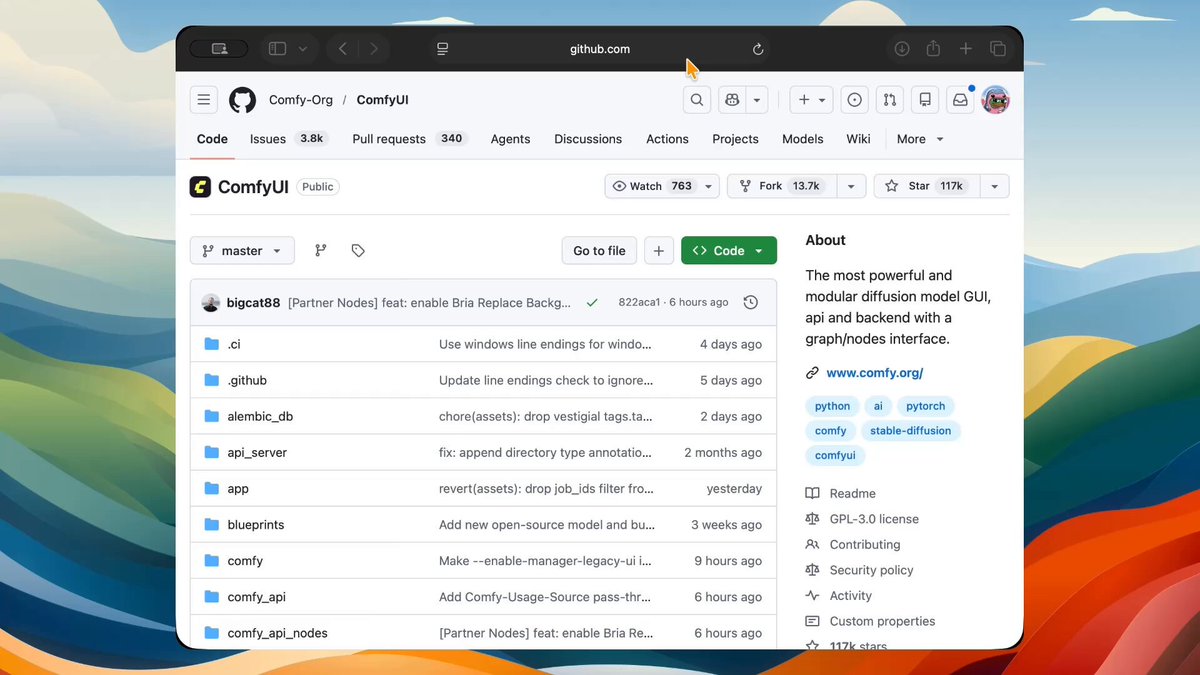
no money for grok or midjourney? this tool is for you. there's a FREE tool created by an anon dev. open-source. runs locally. 117k stars on github. it generates: > images & video > 3d models > audio > 20+ models here's how to set it up in under 5 minutes: 1️⃣download ComfyUI Desktop go to and grab the desktop app for your system. windows 10+, mac (apple silicon), or linux. it installs like any normal app, it sets up python and every dependency for you in the background. no terminal, no config files. 2️⃣open it first launch, it spins up its own environment automatically. you just wait a few seconds and you're in. you'll land on a node canvas, that's the whole interface. 3️⃣load a starter workflow top menu → Workflow → Browse Templates → Image Generation. click it. this drops a ready-made setup onto your canvas so you don't build anything from scratch. 4️⃣grab a model comfyui ships empty on purpose, the model is the brain, and you pick it. in the template, the "Load Checkpoint" node has a Download button when no model is installed. click it. it pulls one in for you (a few GB, this is the only real wait). 5️⃣install ComfyUI Manager this is the one add-on you don't skip. it lets you install models, custom nodes, and updates with a click instead of the command line. grab it from github (link in comments). it's the difference between fighting comfyui and flying in it. one honest note: an NVIDIA gpu makes this fast, apple silicon works great too, and a weak machine still runs it just slower. that's the whole setup. you now own an image, video, and 3D studio that costs you nothing per month. save this. and the next time grok or midjourney asks for your card. you won't need it. disclaimer: comfyui itself is 100% free. so are the local models (sdxl, flux, wan 2.2, ltx-2). some premium models like seedance are pay-per-use api models, only if you want top-tier quality. the free local ones cover most of what you need. (github link in the comments) follow and turn on post notification for daily AI contents.

m0h

14,542 Aufrufe • vor 3 Monaten

Why is Redis Fast? Redis is fast for in-memory data storage. Its speed has made it popular for caching, session storage, and real-time analytics. But what gives Redis its blazing speed? Let's explore: RAM-Based Storage At its core, Redis primarily uses main memory for storing data. Accessing data from RAM is orders of magnitude faster than from disk. This is a major reason for Redis's speed. However, RAM is volatile. To persist data, Redis supports disk snapshots and append-only file logging. This combines RAM's performance with disk's permanence. There is a tradeoff though - recovery from disk is slow. If a Redis instance fails, restarting from disk can be slow compared to failing over to a replica instance fully in memory. So while Redis offers durability via disk, it comes at the cost of slower recovery. A better solution is Redis replication. With a synchronized replica kept in memory, failover is instant with no rehydration. This maintains speed and near-instant recovery. IO Multiplexing & Single-threaded Read/Write Redis uses an event-driven, single-threaded model for its core operations. A main event loop handles all client requests and data operations sequentially. This single-threaded execution avoids context switching and synchronization overhead typical of multi-threaded systems. Redis uses non-blocking I/O to handle multiple connections asynchronously. This allows it to support many client connections with very low overhead, Redis does leverage threading in certain areas: - Background tasks like taking snapshots. - I/O threads are used for certain operations. - Modules can use threads. - Since Redis 6.0, it supports multi-threaded I/O for network communication, improving performance on multi-core systems. Redis also uses pipelining for high throughput. Clients pipeline commands without waiting for each response. This allows more efficient network round trips, boosting overall performance. Efficient Data Structures Redis supports various optimized data structures, from linked lists, zip lists, and skip lists to sets, hashes, and sorted sets, among others. Each is carefully designed for specific use cases for quick and efficient data access. Over to you: With Redis now supporting some multi-threading, how should we configure it to fully utilize all the CPU cores of modern hardware when deploying in production? – Subscribe to our weekly newsletter to get a Free System Design PDF (158 pages):

Sahn Lam

46,910 Aufrufe • vor 2 Jahren

Introducing Workshop: cloud + on-device agentic AI. And to celebrate, we're giving away $250k in Google Gemini AI credits. (details below). The future of AI work is neither cloud-based nor local. It's both. In Workshop Cloud, you can use agents powered by frontier models like Claude and/or open source models like Z.ai's GLM-5 to build internal tools, dashboards, and AI web apps. Or, breeze through tasks like managing your Google and Meta Ads. In Workshop Desktop, you can do all the same right on your computer, plus make desktop apps, mobile apps, and 3D creations. Our favorite part? You can power the full agent experience with local models like Qwen 3.5 family on your computer. Fully offline. 2026 is the year in which local models for agentic tasks will become viable for mainstream use. But the setup for tools like OpenClaw is like setting up Linux from scratch on your computer. Workshop Desktop is one-click to install on Windows, Mac, and Linux. It recommends which open source model you should use for your hardware and lets you download and run it right in the app. And its agent harness allows you to chat, create websites, build personal utilities, and analyze data. 100% offline. Or multitask with AI models in the cloud while running other agent threads locally. Start in Workshop Cloud when you want flexibility and speed. Download your project and continue in Workshop Desktop when you want local files, privacy, and/or better performance on large code bases. Publish from either. The agent tooling space is maturing and discerning users have come to expect a lot from their tools. We've packed Workshop with features to help you 10x your productivity. - Native support for skills - Autocompaction for seamless context management - Built-in AI for your apps - Dozens of connectors, like Google Drive, Big Query, and Supabase - dbt integration to ground your dashboards in your semantic layer - Native Github integration - Private app deployment - ... and more (+ we're shipping super fast) To access the free credit offer, RT this post and reply with "Workshop". Make sure you are following us so we can DM you the instructions to redeem. - First 100 to RT + comment get $500 in credits. - Everyone else gets up to $250 And thanks to our partners Modal, Google Gemini, and Z.ai!

Workshop AI

29,245 Aufrufe • vor 5 Monaten

I’ve been testing Hy4 preview in WorkBuddy, and the most interesting part is not simply the model size, it’s how much practical work it can handle with a relatively focused active parameter count. Hy4 preview brings together stronger code understanding, generation, and editing; improved document and information processing; workflow automation; web and game development; cross-tool collaboration; and more reliable completion of complex, multi-step tasks. In other words, it is designed for work that requires planning, tool use, iteration, and follow-through, not just a quick answer in a chat window. Compared with its initial release, the current Hy4 preview is noticeably faster and better-performing in practical workflows. Following an upgrade released yesterday, it can complete tasks with fewer conversation rounds and lower token usage, while reasoning more quickly and making the overall user experience feel smoother from the first instruction to the final result. For my test, I gave it a demanding Three.js game-prototyping task with a 770B-parameter model and 49B active parameters. The result was more revealing than a simple first-look demo: Hy4 preview handled the core logic, edge cases, and follow-up changes while maintaining the broader context of the project. That combination of capability, speed, context, and active compute is what makes its cost-effectiveness worth examining. A fair evaluation should use the same prompt and environment configuration across models, changing only the model itself. That makes it easier to assess task completion, planning quality, tool-calling stability, reasoning speed, token efficiency, and performance over longer workflows without confusing the result with different settings. If you want to test the model yourself, access Hy4 preview through WorkBuddy and see how it performs on a real coding, document, automation, or creative task: Tencent Hy Tencent AI WorkBuddy

Tyler Wayne

56,152 Aufrufe • vor 7 Tagen

Look ma new Codex Updates! 0.119.0 and 0.120.0 are here. And with it, a HUGE number of quality of life updates and bug fixes! > Hooks now render in a dedicated live area above the composer. They only persist when they have output, so your terminal stays clean. If you're running PreToolUse or PostToolUse hooks, this is a huge readability win. > Hooks are now available again on Windows > CTRL+O copies the last agent output. Small but clutch when you're pulling a code block into another file or chat. > New statusline option: context usage as a graphical bar instead of a percentage. Easier to glance at mid-session when you're trying to gauge how much runway you have left. > Zellij support is here with no scrollback bugs. If you've been stuck on tmux just because Codex was broken in Zellij, you're free now (shout out Felipe Coury 🦀) > Memory extensions just landed. The consolidation agent can now discover plugin folders under memories_extensions/ and read their instructions.md to learn how to interpret new memory sources. Drop a folder in, give it guidance, and the agent picks it up automatically during summarization. No core code changes needed. This is the first real extension point for Codex's memory system, and it opens the door for third-party memory plugins. > Did you know, you can /rename a thread? But what's really cool about that is, after you rename it, you can resume it with the same name, no more UUIDs. codex resume mynewapp or directly from the TUI: /resume mynewapp > Multi agents v2 got an update to tool descriptions More reliable multi agent environments and inter agent communication > You can now enable TUI notifications whether Codex is in focus or not. Modify this in your config: [tui] notification_condition = "always" > MAJOR overhaul to Codex MCP functionality: 1. Codex Tool Search now works with custom MCP servers, so tools can be searched and deferred instead of all being exposed up front. 2. Custom MCP servers can now trigger elicitations, meaning they can stop and ask for user approval or input mid-flow. 3. MCP tool results now preserve richer metadata, which improves app/UI handoff behavior. 4. Codex can now read MCP resources directly, letting apps return resource URIs that the client can actually open. 5. File params for Codex Apps are smoother: local file paths can be uploaded and remapped automatically. 6. Plugin cache refresh and fallback sync behavior are more reliable, especially for custom and curated plugins. > Composer and chat behavior smoother overall, resize bugs remain though. > Realtime v2 got several significant improvements as well. > You're still reading? What a legend. 🫶 npm i -g @openai/codex to update

am.will

742,455 Aufrufe • vor 5 Monaten

** MEGA Parodius Scaling Effects Part 2 ** Well - this is the BIG one - literally !! Huge thanks to my team Pyron & Vector Orbitex for their efforts. Pyron has provided all the source frames for Puyon and his spikes / explosion and a lot of analysis video on how the spikes behave / move which was really helpful. Pyron also used his CRT setup for this video as we felt an emulator video would not do it justice - running on 100% real MD hardware FTW. Vector has provided the catchy boss music and its sounding great - as always ! The coding on this has been a bit insane - things done since part 1 post previous: Implemented dual buffering - Last video was single buffered - so VRAM is very tight now , we only have about 40/2048 tiles free. For the longest time I didn't think it would fit - I found a vram jigsaw puzzle that made it work in the end. Double buffering has cleaned up the stability of the animation and matches the arcade scaling effect now albiet costing 2x more VRAM . Vertical Scaling Implemented - the vertical scaler was taken from Lufthoheit ( my other shooter ) and its heavily optimised to reduce cpu usage. During the scaling the vertical scaler partitions the 68k processor registers into 2 sets, 4 registers are allocated to feeding the fast horizontal interrupt (h-int) that drives the vertical scaling , remaining 12 registers are for the horizontal scaler running in the background. This setup is much faster than normal backup / restore register methods, as we do not need to backup / restore registers in the h-int which would double CPU costs. The catch is the momment any background routine tries to use the H-ints registers it would break things so it has to be carefully timed. Added the spike projectiles - this was very tricky to get close to the arcade, they are semi heat seeking missiles basically and hence needed code that worked out angle differences to player at speed theres no time for arc-tan or similar so it uses faster lookup tables to work out the angles . They speed up over time and get larger and whats more we can't keep all the scales in VRAM - we have room for 2 spike buffers only. Also what was a real pain was working out scaled coordinates for the circular launch of the spikes . Added Fish Damage - Shock frame and Explosion frames from Arcade . Very proud of the fact we have the full arcade quality explosion is which is fully scaled also. Added Temporal Masking - which is fancy wording for don't draw nothing to buffer if nothing is there already there for the scaling . So empty Corners and edges can be optimised out to lower cpu costs and rom costs. I had to make some scripting for this and work out what areas did not need drawing at all in the frame, which should be force cleared by cpu and which areas should just be copied from rom. This reduced rom size by 30 kb and with a bit more work we could extend that to 60 kb & get a bit more speedup even doing so. Added a frame limiter . In the last video update we let the 68k burn hot and just pump out frames as fast as it could - here we match the arcade animation rate which does leave the cpu idling at times , particularly in the smaller frames - even at large though we could be running the animation 25 % faster , issue is though that would speed up the game logic and make it less arcade accurate. We had some real bullet / Spike hell simulations going without the limiter but yeah we had to tone it down a bit. Maybe in a hardcore mode we could let it run wild though ! Code is 95% 68k assembly with about 5% C code (v-int as its cold path ) driving things . This sort of thing needs all the speed it can get !! Well now after all that I can return to finish off Level 1 haha - just a wee sidetrack there . No doubt we will polish stage 8 boss some more in time too !! #SegaMegadrive #SegaGenesis #Parodius #SGDK

Shannon Birt

26,902 Aufrufe • vor 7 Monaten

LayerEdge LayerEdge Closed 🛠️ Testnet - 🗓️3 days remaining. Easy to keep in the background and earn points 👇 🌐 1⃣Connect EVM wallet (MM or Keplr) 2⃣Use code: NgAMgDAG 3⃣Click "Start Node" - You may need to try a few times, but on a 3rd-4th try it launches for me 4⃣Keep tab open and earn points (can be in the background). 1 Point per second while mining 5⃣Check back every 24 hours and grab extra points (click "Claim Reward" at the top nav) The more tab stays open = more points 🛠️Testnet Roll-out Structure ➡️Phase 1: Closed Testnet (Jan 22–28, 2025) 🔸Stress-testing with browser-based light nodes and limited access 🔸*this may be extend by a few days🔸 ➡️Phase 2: Public Beta Testnet (Jan 28, 2025) 🔸Full launch with browser-based and system-based light nodes, more protocol integrations and more What is LayerEdge? LayerEdge makes Bitcoin more useful by solving two main problems: 1. It makes complex computations cheaper and faster by doing them off the Bitcoin network while still maintaining Bitcoin’s security. 2. It bundles multiple verifications into one, reducing costs by up to 95%, which makes it much more affordable for apps and services to use Bitcoin’s security. Think of LayerEdge like a smart assistant for Bitcoin - it handles the complicated work elsewhere but checks back with Bitcoin to make sure everything is correct and secure. This approach allows Bitcoin to support more advanced applications like gaming and IoT devices without becoming slow or expensive. The key benefit is that instead of paying $900+ for each verification on Bitcoin, protocols using LayerEdge might pay less than $20 when sharing costs with others. Source: 🫡

Grey Ledger

17,675 Aufrufe • vor 1 Jahr

Micron is going to $4,000 and once you understand what inference actually is, the number stops sounding crazy (Save this). Dylan Patel just said that by 2030, OpenAI and Anthropic alone will need over 100 gigawatts of compute combined and by 2040, we may not even be measuring AI infrastructure in gigawatts anymore. We may be talking about terawatts. Every single one of those gigawatts needs memory to function. Without it, the compute is worthless. Most people heard that and thought about Nvidia but they should be thinking about Micron. Every AI model generating a response has two phases. The first is prefill, processing your prompt which is compute-heavy and the second is decode generating each word one token at a time and that phase is almost entirely memory-bound, not compute-bound. During decode, the GPU's processing units sit idle more than 95% of the time, waiting for data to arrive from memory. Google confirmed it in a research paper that decode-phase bottlenecks are dominated by memory bandwidth and capacity not raw compute. The GPU is not the bottleneck but the memory feeding the GPU is. This matters because inference is now where all the money lives. Training a model happens once, Inference happens billions of times a day every ChatGPT response, every Claude output, every agentic workflow running in the background and every one of those token streams is a billing event tied directly to memory performance. Adding more GPUs does not fix this because GPUs are already underutilized in inference because they are sitting idle waiting on memory. Adding more memory bandwidth and capacity is what directly reduces token cost, reduces latency, and allows the same cluster to serve dramatically more users simultaneously. Longer context windows compound the problem further, a model running a 1 million token context window requires dramatically more memory per session than a 10,000 token window, and every new model generation pushes context longer. The market treats memory as a downstream beneficiary of Nvidia orders. The correct framework is the opposite, Micron is the upstream constraint on how much value every Nvidia GPU can actually generate at inference scale. Micron guided Q4 to $50 billion in revenue, has HBM4 ramping at twice the pace of the prior generation, and CEO Sanjay Mehrotra has said supply will not catch demand before the end of 2027. At 8x forward earnings on $112 projected FY2027 EPS, Micron is the most undervalued infrastructure company in the entire AI stack. Inference is memory. Memory is Micron and the inference ramp has barely started. Milk Road Pro members are already up massively on this position and we're just getting started. If you want the full breakdown of what we're buying and why, come join us for just a dollar using the link below!

Milk Road AI

130,756 Aufrufe • vor 2 Monaten

The world of writing has changed forever. AI is getting really good, really fast. ChatGPT is already a better writer than most humans and some professional writers. So, what’s the future of writing? 18 thoughts from Tyler Cowen: 1) Don't let AI smooth out your idiosyncrasies. Let your writing stay weird and uniquely yours. 2) Generic content is dying and the burden is on you as the writer to be distinctive. 3) The more personal your writing becomes, the more future-proof it is. Nobody wants to read memoirs from AI, even if they're technically "better." 4) Use AI as your secondary literature when you read — not just for quick answers, but as a thinking companion. As Tyler puts it, "I'll keep on asking the AI: 'What do you think of chapter two? What happened there? What are some puzzles?' It just gets me thinking... and I'm smarter about the thing in the final analysis." 5) Hallucinations aren't the crisis everyone makes them out to be. No matter the source, if you're going to use a piece of information, you should double-check it. This is true for both books and AI. 6) Secrets will become more valuable in an AI-driven world. 7) One way to use AI as a writer is to research fields you aren't as familiar with before you start writing about them. Tyler said: "I just wrote a column about declassifying classified documents. I don't know that law very well. I asked the AI for a lot of background... now I feel like I'm not an idiot on the topic." 8) AI changes what books are even worth writing. "Predictive books and books about the near future. They don't make sense to write anymore." 9) Editing trick: Try running your writing through AI and asking what some people might find obnoxious. It’s a surprisingly powerful editing trick. 10) When prompting AI, put humans out of your mind and imagine you're talking to an alien or a non-human animal. 11) Many of the most significant AI advancements are likely happening behind closed doors. For example, I hear that Google allows employees to use Gemini with virtually unlimited context windows. 12) What possibilities do large context windows open up? Researchers will be able to load entire regulatory frameworks, historical archives, or massive datasets like "tax records from Renaissance Florence" into a single query. 13) The rate of AI improvement matters more than its current capabilities. As Tyler puts it, "This is the worst they will ever be" is key to understanding their trajectory. "A lot of people don't get that. They're impressed by what they see in the moment, but they don't understand the rate of improvement." 14) The best way to appreciate the current rate of improvement is to use the latest models. 15) Being non-technical can sometimes be an advantage when thinking about AI. Here’s Tyler: "If you're not focused on the technical side, you will see other things more clearly... You just focus on what is this actually good for? And not, am I impressed by all the neat bells and whistles on this advance with AI?" 16) How Tyler uses AI to prep for podcast interviews: Don't waste time asking AI for generic interview questions or broad topics. Tyler says that's the worst question you can ask an AI. It’s “too normy.” Instead, ask specific questions about historical examples and get context. Then, let your own creative questions emerge. 17) Your relationship with mentors and peers becomes more crucial, not less, in an AI world. "Two pieces of general advice with or without AI in the world." Tyler says: "Get more and better mentors and work every day at improving the quality of your peer network." 18) The divide between AI and humans creates a striking paradox. As Tyler puts it: "On one hand the AIs are getting so much better, so learn how to use the AIs. On the other hand, the AIs are getting so much better, so invest in these other things that aren't AI—pure networks. You've gotta do both." I've shared the full conversation with tylercowen below. In the replies, I've also linked to a full transcript and relevant links to YouTube, Spotify, and Apple Podcasts if you want to listen there. And if you want a bite-size entry to the episode, I've shared some clips in the replies too.

David Perell

175,200 Aufrufe • vor 1 Jahr

What is Apple doing in the AI race? Ever since ChatGPT came out in 2022, every tech company realized that generative AI is the next big thing. So, all these companies dropped everything else and started focusing on it first. Google launches Bard and does a bunch of stuff. Microsoft teams up with OpenAI and rolls out a pilot. Adobe launches Firefly. Elon Musk starts his new company, XI. Meta launches the Llama model. Tons of other AI startups pop up, and investors are throwing money at AI like crazy Apple's AI strategy is fascinating because it's playing a completely different game than Google, Microsoft, and OpenAI. While everyone else rushed to build the most powerful language models, Apple took a fundamentally different approach that aligns with their core business model and strengths Apple Intelligence is comprised of multiple highly capable generative models that are specialized for users' everyday tasks, but unlike competitors, Apple isn't trying to win the raw AI power race. Instead, they're leveraging what they've always done best, creating seamless, integrated experiences The key insight you mentioned about revenue models is crucial. While Microsoft makes 48% from cloud services and Google relies heavily on cloud and subscriptions, Apple's business is 80% hardware driven. This means they don't need to compete on cloud AI services they can focus on making AI work better on the devices people already own Apple's four step strategy you outlined is spot on, The "Invisible Model" approach is brilliant because most users don't want to think about which AI model to use. Tim Cook doubled down on Apple's AI strategy, insisting that generative AI was never off the table and was always about pursuing it in a thoughtful kind of way, they're making AI feel natural rather than technical Ecosystem Integration remains Apple's superpower. At WWDC 2025, Apple announced what it calls the Foundation Models framework, which will let developers tap into its AI models while offline, this is huge because it means third party apps can now leverage Apple's AI without internet dependency, something Google and Microsoft can't easily replicate across their fragmented hardware ecosystem The Distribution Advantage is where Apple really shines. They have direct control over 2 billion devices with powerful Apple Silicon chips that can run AI models locally. Apple is still pushing App Intents, the same system that makes it simpler for Apple Intelligence and Siri to use apps and get things done, which will enable those complex multi app workflows you described Building Trust through privacy focused messaging is classic Apple. They're positioning themselves as the "safe" AI option while competitors deal with data privacy concerns The real genius is that Apple doesn't need to build the world's best AI model, they just need to build the best AI experience. By partnering with OpenAI for complex tasks while handling simple ones locally, they're creating a hybrid approach that prioritizes user experience over technical bragging rights The upcoming Apple Intelligence features slated for 2025 demonstrate Apple's commitment to integrating advanced AI technologies into its devices, enhancing user experience, and promoting productivity, suggesting they're still in the early phases of a longer term strategy This approach could indeed "wipe out" Android and Windows in the AI era not by building better models, but by making AI feel like a natural extension of the devices people already love. It's classic Apple, arrive late, but redefine the entire category

D4rsh🦅

13,266 Aufrufe • vor 1 Jahr

Just pulled up Olipop's landing page after seeing their ads everywhere lately and I need to break this down because this is one of the cleaner DTC pages I've seen in a while. Here's what's actually happening when you land on this page and why it converts cold Facebook traffic better than 90% of ecom brands right now: 1) The first 3 seconds Before you read a single word, there's a video of the product being poured, fizzing, bubbling and condensation on the can with no voiceover or text overlay. Your brain processes that faster than any headline ever could. You can almost hear the fizz. That's intentional. They're triggering a sensory response before your logical brain even wakes up. Then the headline hits. "A New Kind of Soda." Now that's a category repositioning. They're not saying "healthy soda" or "better soda." They're saying the entire category you grew up with needs a new version and this is it. Sub-headline says high fiber, less sugar. Targets exactly the person who clicked the health-focused ad on Instagram. Message match is perfect. The person who clicked the ad lands here and immediately feels like the page was made for them. 2) The product carousel Most brands mess this up by showing you the product and making you go through three more pages to add it to your cart. Olipop lets you hover over any flavor and an "Add 12 Pack" button appears right there. One click. Done. You never leave the homepage. That little micro-interaction is doing serious conversion work because every extra click you require is a percentage of buyers you lose. They basically short-circuited the whole buying process and most people don't even notice it's happening. Star ratings under every flavor. Smart. You're not waiting until the reviews section at the bottom to see social proof. It's right there next to the product at the exact moment you're deciding what to buy. Then there's the "Limited" and "Out of Stock" tags on certain flavors. This is a psychological move that a lot of brands either don't use or use badly. When you see Shirley Temple is sold out your brain immediately thinks this must be good enough that people are actually buying it. And now you're looking at everything else thinking you better grab it before it's gone too. 3) The retention play At this point you haven't bought yet and they already know some people won't on the first visit. So right here they drop the rewards program section. Trade your email for perks and points. They're not letting you leave empty handed. Either you buy today or you give them your email so they can bring you back. Both outcomes work for them. Then comes the subscription nudge. 15% off. Free shipping. Cancel anytime. Three objections handled in one sentence. 1. Too expensive? 15% off. 2. Annoying to reorder? Free shipping straight to your door. 3. Scared of being locked in? Cancel whenever you want. That's a complete objection removal stack built into what looks like a simple banner. The people who weren't ready to buy a 12-pack today are looking at that and doing the math. 4) The press section Bloomberg. Forbes. BuzzFeed. Mindbody. This section exists for one reason. You clicked an ad from a brand you'd maybe seen once or twice before. You don't fully trust them yet. These logos close that gap in about half a second. It's institutional validation. You don't need to read the articles. Just seeing the logos tells your brain people with real credibility have looked at this and thought it was worth covering. Background behind this section is a high-res macro shot of condensation on the can. Cold. Refreshing. Premium. Even the section design is doing sensory work. 5) The overall lesson What Olipop figured out is that a landing page for Facebook traffic has one job. Close the trust gap between the ad and the purchase as fast as possible without losing the energy the ad created. Every section of this page does exactly that. Sensory hook gets you in. Category positioning tells you what it is. Carousel with inline add to cart removes friction. Social proof and scarcity show demand. Subscription offer removes price and convenience objections. Press section provides institutional trust. By the time you hit the footer you either already bought or you gave them your email. That's not a landing page. That's a conversion machine. If your page isn't doing all of this right now, that's where your revenue is leaking. Not in the ads. In what happens after the click. DM me ‘FUNNEL’ and I'll show you exactly how to build something like this for your brand.

Nick Theriot

26,389 Aufrufe • vor 6 Monaten

Don't Buy a Mac Mini for Clawdbot: The Secret $10,000 Architecture That Costs You Nothing clawdbot might be the reason you feel like you need a ten thousand dollar computer right now but i am about to show you why that fomo is going to leave you broke. if you have been watching everyone rush out to buy mac minis and mac studios just to run open claw or some local models you are witnessing a massive transfer of wealth from your pocket to apple for no reason. there is a specific setup i use that costs almost nothing and keeps my main machine safe from whatever these autonomous agents are doing. if you stick with me i will walk you through the exact architecture of a professional trading system that handles the heavy lifting without you needing to drop a single rack on hardware most people are scared of running these bots on their main computer because they don't want an agent messing with their personal files or browser sessions. instead of buying a second mac mini for six hundred dollars you can just go to the top left of your screen and create a brand new user profile. this acts like a completely isolated sandbox where you can install all your trading tools and agents without them ever seeing your main data. it is essentially like getting a free computer for the price of five minutes of clicking around your settings but what if you aren't on a mac or you need to access your system while you are traveling without carrying three laptops in your backpack. this is where the first loop of professional automation starts to close because i use something called chrome remote desktop to bridge the gap. this allows me to leave a dedicated machine running in a safe place while i access the full desktop environment from a tablet or a cheap laptop anywhere in the world. it solves the mobility issue but it still doesn't solve the problem of those massive ten thousand dollar price tags for high end mac pros if you are a pc user or just someone who doesn't want to own physical hardware yet you should look into a windows vps through a provider like contabo. most developers will tell you to use a linux terminal but if you aren't a coder yet you need a visual interface you can actually see. getting a windows server allows you to log in and see a desktop just like your home computer for about fifteen dollars a month. i usually recommend at least twelve gigabytes of ram to keep things from getting janky when you are running multiple browser windows and agents at once now you might be thinking that the whole point of the big hardware was to run local models like kimi or glm to save on api costs. i spent years thinking i had to own the machines myself and i even spent hundreds of thousands on developers before i realized i could just do this myself. the secret to running those massive open source models without the ten thousand dollar investment is renting gpu power by the hour. sites like lambda labs let you spin up a monster machine that can run any model in existence for just a couple dollars an hour this is the ultimate pivot because it allows you to test if your strategy actually prints money before you commit to the hardware. you can turn the server on when you are iterating and turn it off the second you are done which keeps your overhead near zero. if you haven't proven that your bot can pay for itself yet then buying a mac studio is just an expensive hobby rather than a business move. there is a much bigger loophole involving the anthropic subscriptions that most people are completely overlooking right now right now i am using a specific plan with claude code that costs about two hundred dollars a month but it lets me run open claw all day without hitting api limits. if i were paying for those same tokens through the standard api i would probably be spending hundreds of dollars every single day. it is a massive cost savings that allows you to iterate and fail until you find a winning strategy without draining your bank account. even if they eventually close this loophole or snitch on the usage patterns it serves as the perfect training ground for a data dog the goal is to find a system that works with a smaller or cheaper model like haiku before you ever try to scale up to the heavy weights. if you can make a strategy profitable using a less intelligent and cheaper model then you know you have found real alpha. once you have that foundation you can decide if it finally makes sense to build your own custom pc rig which will always be half the price of an apple machine. i am an apple guy so i usually pay the tax anyway but i only do it once the system is already generating enough to cover the cost ten times over i believe that code is the great equalizer because it took me from losing money and getting liquidated to having fully automated systems doing the work for me. i had to learn to live with the iterations and the failures on youtube to get to this point of clarity. the universe tends to get out of your way once you make a non negotiable contract with yourself to see the process through to the end. you don't need the flashy hardware or the most expensive setup to start winning in this game stay focused on the logic and the data rather than the hype and the fomo that everyone else is falling for. if you can master the bridge between renting power and owning your logic you will be ahead of ninety nine percent of the people in this space. the path to a fully automated life isn't paved with expensive gadgets but with the discipline to iterate until the system finally prints

Moon Dev

17,382 Aufrufe • vor 7 Monaten

$AMD $5 Trillion MC Is Inevitable Long Term👑 This thread will focus more on Inference! 2026 EPYC "Venice" $TSM 2nm to save Large GW Scale Inference by 40% more than Prior Turin gen. Context: EPYC Turin achieves ~$0.001 per million tokens for batch inference vs $0.02-$0.12/ million tokens as I wrote the thread below. Venice is going to lower cost down to $0.0005-$0.0006/Million Tokens. OpenAI spent roughly $20B on Inference and Training, where 80-90% of that was for Inference per Analysts. AKA Renting Compute is Expensive AF! In this thread, I want to focus on why most analysts and investors are underestimating the role EPYC "Venice" and future Gen on overall Data center revenue. And $TSM ramping up 2nm supply early is a confirmation that AMD will be a major buyer long term. I will also link the thread the Gap between AMD Analysts & Reality and 2nm Ramp Thread so you have more comprehensive view of what I'm writing here. Before I go into detail this is my 2026 Projection: AI GPUs: $35-$50B EPYC Data Center: $15B-$17B Client Segment: $12-$13B Gaming: $6B Embedded: $4B-$5B Total Revenue $70-$100B Non-GAAP net income $18B-$25B Non-GAAP EPS $10.97-$15.40 Foward P/E 55x-70x= $603-$1,078 AMD's Analysts are projecting $0 Revenue for MI450 and sluggish EPYC Growth. Meaning, all analysts are either full of 💩 or Sexist, you decide! Analysts are also projecting 0% growth on AMD "Secret Weapon" Chip as $MSFT said we are at significant Windows refresh and upgrade cycle. Do you think TSMC would allocate more 2nm supply to $AMD at $0 MI450 revenue and sluggish EPYC? 1. EPYC is going to be the leader in lowest Inference! Current Turin cost saving is 95% vs $NVDA or 98-99% on Inference cost when you factor in renting Inference compute from Amazon Web Services, Microsoft Azure, or $NVDA Neocloud pets. TSMC claimed: 10-15% higher performance at iso-power, 25-30% lower power at iso-speed, and ~15% higher transistor density compared to 3nm. This reduces operational expenses (energy, cooling) while increasing throughput per chip. EPYC Turin achieves ~$0.001 per million tokens for batch inference (via vLLM on models like Llama 3 70B), driven by high core counts and low hardware costs. EPYC Venice offers ~1.7x overall performance and up to 70% more compute capability per core, with up to 256 cores (512 threads). Enhanced vector/AI instructions and open-source firmware (openSIL) optimize for inference workloads. AMD Incorporates AI Engines (now part of AMD's XDNA) for on-chip acceleration, improving efficiency for low-latency and edge inference. This reduces reliance on discrete GPUs, lowering system complexity and TCO. Venice SKUs are projected at $3,000-$15,000 ($5,000 for 256-core flagship), far below NVIDIA Rubin ($50,000-$90,000) or AMD's own MI450 GPUs ($40,000-$50,000). High memory bandwidth (up to 1.6 TB/s) supports efficient batch inference. Venice is designed exactly for Large customers that want to lower Inference Cost and MI450 Helios is for Customers that want Training at lowest TCO, TDP as well as lower Upfront 1GW scale(Full build $35-$40B vs $NVDA $55B-$80B). 2. Real World Example: OpenAI's 2025 inference spend reached ~$20B, escalating to even higher total compute rental (mostly inference) amid token volume growth(from video generating). By 2026, with usage doubling (consistent with industry trends: token demand grows 2-5x YoY), assume OpenAI processes ~1,800 billion million-tokens annually $NVDA Blackwell at $0.02-$0.12 is $36B(most optimized) Rubin is projected to be at $0.01/million tokens or $18B annual Inference Cost vs $AMD Venice $0.0005/million tokens or $0.9B annual Inference Cost => Massive saving for OpenAI or anyone that are paying 80-90% Annual Bill for Inference compute. In short, it is unsustainable to pay this much rent vs owning for all current AI players for the medium to long term. Rubin excels in low-latency decode (if Groq integration from $20B deal in 2027-2028), but Venice dominates batch (80% of inference by 2030). Actual savings depend on deployment scale (OpenAI's 6GW AMD plans), electricity rates, and software maturity. If Rubin only hits $0.03, savings swell to $53.1B vs. $17.1B. 3. Will running Inference on Venice and future Gen slow down response generation in 2026 and beyond? Human perception of "fast enough" for chat, agents, search augmentation, summarization, coding assistance is roughly Meaning, EPYC may generate $100B a year on data center revenue, Hence $MSFT $AMZN $META $GOOGL OpenAI xAI and 42+ Countries are leaning AMD for Inference, because the cost saving is MASSIVE! 4. Regular users (you, me, people using ChatGPT, Claude, Gemini, Grok, Perplexity...) are extremely unlikely to notice any slowdown and in many cases might even experience slightly faster or more consistent response times if the industry heavily shifts toward AMD EPYC for inference. What actually happens when companies save massively on inference? When OpenAI , Anthropic , Gemini , Grok Meta .... save billions on the batch/enterprise/RAG layer using EPYC Venice, they typically do one or more of these things with the savings, none of which make your chat slower but enhancing their bottom line(Profit) ~Keep prices the same → make more profit ~Lower subscription prices / increase free tier limits ~Train bigger & better models more frequently ~Offer longer context windows ~Add more reasoning steps / tool calls / agents per query ~Improve multimodal capabilities ~Build more data centers / reduce throttling during peaks In practice the consumer experience usually gets better, not worse, when inference becomes dramatically cheaper. Prime example is $META leaning AMD heavily or currently AMD largest customer. or Grok 2 to Grok 3 heavily used AMD for Inference saving. And most Grok Users reported Groke responses snappier, not slower. 5. What does this mean for potential Revenue? Noted that TSMC is massively ramping 2nm supply for $AMD both MI450 and EPYC. EPYC Conservative projection: FY2025: $10.5B(best Est) FY2026: $16B FY2027: $29B FY2028: $49B FY2029: $75B FY2030: $100B Large customers: $META OpenAI $MSFT $AMZN $GOOGL xAI (Apple?) Smaller customer: $DELL $HPE $SMCI and 42+ other countries. The roadmap to $5 Trillion is very much inevitable as Inference Cost from Renting or owning $NVDA are too high, but $NVDA will still dominate Training market share, where MI families are likely to take 15-20% market share, but the TAM is also expanding Rapidly. Most Institutions are projecting $2-$3Trillion TAM by 2030. $NVDA said $4 Trillion. Dr. Lisa Su said $1 Trillion+ by 2030. So you decide on how much TAM. If you enjoy this kind of analysis, Slap the Like/Repost and Bookmark to please the X Algo as it is Free.99! If you want to support my work further, consider subscribe to see more in-depth analysis! Alright, that is it. Not Financial Advice!

Mike

102,223 Aufrufe • vor 8 Monaten

BADLAB V2: WHERE YOUR MEDIOCRE CODING DREAMS GO TO DIE 🔊 Listen up, code peasants. While you've been copy-pasting Stack Overflow answers, we've been revolutionizing how fucking development works. BADLAB V2 just dropped, and it's not just another update – it's a fucking paradigm shift. Let me break this down for you smooth-brains: 1️⃣ BADLAB V2 makes it easier and faster to build web apps, games, smart contracts, and data visualizations: No-code deployment, run, and share - without the headaches. 2️⃣ What This Means for Users: You can build bigger, better, and more useful projects and tools. Works with all the tools you love: React, Web3, Three.js, d3, and more—whether you’re building games, dApps, automation tools, or interactive charts, the sky is the limit. 3️⃣ Smart automation does the hard work: AI writes code for you, making it easier to start building without deep technical expertise. 4️⃣ CDN-backed hosting: Your projects load fast and reliably because they run from Cloudflare CDN, not some sketchy server. And now? You can share your creations with friends. 5️⃣ Easier debugging & updates: No more jumping through hoops to update files or fix errors. 6️⃣ Bottom Line: If you want to build web apps, games, or blockchain projects without dealing with all the messy setup and technical headaches, BADLAB V2 makes it easy. 🆕 WHAT’S NEW: ✔️ Multi-file projects – Because one file isn’t enough for real developers. ✔️ File updates that don’t require a PhD – No unnecessary complexity. ✔️ Examples even a brain-dead monkey could follow – Clear and simple. ✔️ Support for every major file format – JS, JSON, Markdown, 3D models, and more. ✔️ React components that don’t look like digital vomit – Finally, code that makes sense. ✔️ Server-side bundling – Because we’re not savages. ✔️ CDN-backed deployment – No lag, no downtime, just pure speed. ⚠️ WEAPONS OF MASS CREATION: 💧 d3.js – Interactive charts that don’t look like Excel’s morning sickness. 💧 Three.js – 3D visuals that push browsers to their limits. 💧 Effector – Business logic that actually makes fucking sense. 💧 Kaboom.js – Build browser games that aren’t complete garbage. 💧 React-Three/Fiber – 3D meets React without the usual drama. 💧 Framer Motion – Animations that are smooth as hell (and don’t cause seizures). 💧 Ethers & Web3.js – Blockchain development for the mentally stable. 🎮 Want to See It in Action? 🔗 Try our BADLAB V2 Agent Here: – Let AI do the hard work for you. ♟ Play the 4D Chess Game Here: – While you're playing checkers, we're transcending dimensions. 🎙 Welcome to the future, you beautiful disasters. Try not to break anything important. 🧪💀 C₈H₁₁NO₂

ARCH AI

44,480 Aufrufe • vor 1 Jahr

UC Berkeley just open-sourced FreeToken. (2–4x faster local LLM inference than Ollama) the results are wild: - Qwen3.6-35B on an 8GB GPU at 39.3 tokens/s - DeepSeek-V4-Flash 284B on a 32GB GPU at 22 tokens/s - GLM-5.2 753B on a 96GB GPU at 14.9 tokens/s a 35B model at 16-bit precision needs about 70GB just for its weights. even at 4 bits it is close to 18GB, and FreeToken serves it on an 8GB GPU. let me explain how: all three models mentioned above are Mixture-of-Experts, and that is what FreeToken takes advantage of. each layer holds hundreds of separate experts plus a small router that picks a few of them per token. Qwen3.6-35B activates roughly 3B of its 35B parameters per token. DeepSeek-V4-Flash picks 6 of 256 experts per layer, so 13B of its 284B run at a time. so compute was never the bottleneck. the weights a single step touches fit comfortably on a consumer GPU. every expert the router might pick still has to exist somewhere. they sit in system RAM, and the GPU keeps a cache of the ones the model has been using recently. so everything comes down to what happens when the router picks an expert that is not on the GPU. there are two ways to serve that miss: 1. copy it over PCIe and run it on the GPU 2. run it on the CPU, where it already lives both read from the same system memory, so they compete for one pool of bandwidth instead of adding to each other. existing engines pick one option and freeze it when the model loads. but routing changes on every token, so a fixed choice misses most of what the model asks for. FreeToken measures both bandwidths on your machine and splits each step's misses between the two paths in proportion. the GPU and CPU results then merge exactly, with no approximation. two machines with the same GPU can end up wanting opposite strategies, which I did not expect. a 5090 in a gaming desktop should push nearly everything over PCIe, while an 8GB laptop is better off computing most misses on the CPU. none of that is readable off a spec sheet, so the engine profiles it once per machine. the second half of the design is about agents. coding agents constantly rewrite their own history, and every edit normally forces thousands of tokens back through prefill. FreeToken saves its checkpoints at the exact boundaries agent frameworks cut on, so it only reprocesses the new part. its slowest first token stays under 44 seconds, while llama.cpp peaks at 232 and KTransformers at 946. it serves the OpenAI and Anthropic APIs under Apache 2.0, so Claude Code and Codex can point at it directly. releasing weights publicly decides who can download a model, not who can afford to run one. frontier open models keep shipping, and running them still assumes a rented cluster. meanwhile there are over a hundred million consumer machines with discrete GPUs sitting mostly idle. closing that gap was never a hardware problem, and work like this is what turns open weights into something you can actually use. paper: repo: almost every idea in this post, from why memory bandwidth decides the outcome to why moving weights costs more than computing on them, comes straight out of how a GPU is built. I wrote a detailed primer on that. the article is quoted below.

Akshay 🚀

342,266 Aufrufe • vor 26 Tagen

Still spending $100K to make startup launch videos? With Minimax H3, you can generate UNLIMITED variations, and pick your favorite, for FREE. All you need is a PC with 8GB or more of VRAM, or a Mac. No need to hire a studio, no need for special effects. No need to waste time shooting videos. And thanks to the superior prompt-adherence, it does and says exactly what you ask. For this I used Maestro. First select "Multi-window sequence", and then select "Manual plan -- one per line". Then adjust the duration slider at the top until it's 6 windows (Since the prompt will be 6 lines). Here's the prompt: Hyper-real startup launch video, one continuous forward-tracking shot, a young founder walks confidently toward the camera through a sleek San Francisco office while employees work behind him, speaking with polished launch-video energy: "For the last two years, we've been asking one simple question: what if everything could be better? Today, we're finally ready to show you what we've been building." The office gradually becomes an underground parking garage without a cut, absolutely no music or soundtrack. He keeps walking at exactly the same pace as the parking garage seamlessly transforms into a crowded supermarket and then slowly into a moving subway train, shoppers push carts around him, a forklift knocks over a display, then subway passengers sway beside him as tunnels flash past the windows, and he says: "We started from first principles, threw away every assumption, and rebuilt the experience from scratch. The result isn't just faster or smarter. It fundamentally changes what's possible.". no music. He walks through the end of the subway carriage and emerges seamlessly onto an enormous medieval battlefield, armored soldiers charge around him, horses thunder past and flaming arrows cross the sky, then the battlefield gradually transforms into a gigantic futuristic neon metropolis with flying vehicles and giant robots fighting between skyscrapers while he never reacts and continues: "And the crazy thing is, we’re only getting started. Because once you remove the old constraints, you realize the entire category was designed wrong." zero background music. The neon city begins flooding while he keeps walking, water rises around him until the entire environment becomes a vast underwater civilization filled with glowing towers, fish and whales, then the water abruptly drains away to reveal that he is now walking across the surface of Mars as astronauts flee from a damaged colony behind him, and he says: "So instead of asking how we could improve the existing product, we asked why it had to exist at all. That led us to something completely different, something we think will become obvious in hindsight." no music. Mars slowly grows vegetation around his feet until it becomes a dense prehistoric jungle, enormous dinosaurs crash through the trees and a T-rex charges behind him, then the jungle begins collapsing into a modern city undergoing an impossible combination of earthquakes, tornadoes, meteor strikes and collapsing skyscrapers while crowds sprint in every direction, yet he calmly says: "The best technology disappears. You don't think about it. It just becomes part of your life. That’s why we believe this isn't a feature, or even a product. It’s a new primitive." there is absolutely no music score. Reality itself starts malfunctioning around him while he continues walking, people duplicate, buildings fragment into floating geometry, gravity reverses, objects become half-generated and the entire world dissolves into shimmering visual noise as he finishes: "And once you have the primitive, you can build things nobody has even imagined yet." Everything suddenly snaps back to an utterly ordinary silent office conference room, he finally stops beside a small beige plastic doorstop displayed dramatically on a pedestal, gestures toward it and says with complete sincerity: "Introducing Doorstop. It keeps your door open. Available today for ninety-nine dollars." All apocalyptic sound instantly cuts to mundane room tone, fluorescent hum, air conditioning and distant keyboard typing; after two seconds of silence, an employee in the background slowly closes the door.

cocktail peanut

13,418 Aufrufe • vor 19 Tagen