Video yükleniyor...

Video Yüklenemedi

Ana Sayfaya Dön

This is how Windows should feel. AtlasOS: • lightweight • private • fast • responsive even under load What changes: • removes telemetry & background tracking • disables unnecessary services & scheduled tasks • removes ads, suggestions & preinstalled apps • reduces CPU usage & RAM consumption • cleans...

28,030 görüntüleme • 2 ay önce •via X (Twitter)

0 Yorum

Yorum bulunmuyor

Orijinal gönderinin yorumları burada görünecek

Benzer Videolar

Beta Blocker 3.6 is here and it introduces a BIG new feature. Here's everything that's new: 🖥️ UI Overhaul. The entire interface has been cleaned up to feel more premium, modern, and less boxed-in. 📐 Better Window Scaling. Wider windows now properly use the available space instead of stretching awkwardly or leaving everything floating in the center. 🎨 Live Preview. The Style tab now includes a real-time preview, so you can see exactly what your block will look like before you enable it. ⚙️ Cleaner Detection Settings. Detection settings have been reorganised and simplified so everything is easier to understand. 🧭 Reworked Help & Settings Layout. Important options are now easier to find with a cleaner settings and help structure. now for the big one… 🔄 REVERSE CENSOR REWORK This is the biggest part of the update. Reverse Censor has been completely rebuilt. Instead of blocking detected areas, it now applies your block across the screen while leaving detected parts visible. This also adds: ✨ New Reverse Censor settings tab 🌀 Blur or mosaic modes 🎚️ Strength controls 🖥️ Full monitor selection support ⚡ Live setting updates while blocking is active BUG FIXES & POLISH 🛠️ Fixed Reverse Censor sizing issues on second monitors, including Windows scaling modes like 125% 🖥️ Improved multi-monitor behaviour for effects and Popup Storm 🧹 Cleaned up the Help tab 🎯 Fixed Auto-Detect changing results after switching tabs 📷 Improved camera handling in virtual camera mode 🎮 Reduced cursor flicker while Beta Blocker is active for a smoother gaming experience 🖤 & lots more smaller QoL improvements throughout the app. sfw

Isla

281,693 görüntüleme • 1 ay önce

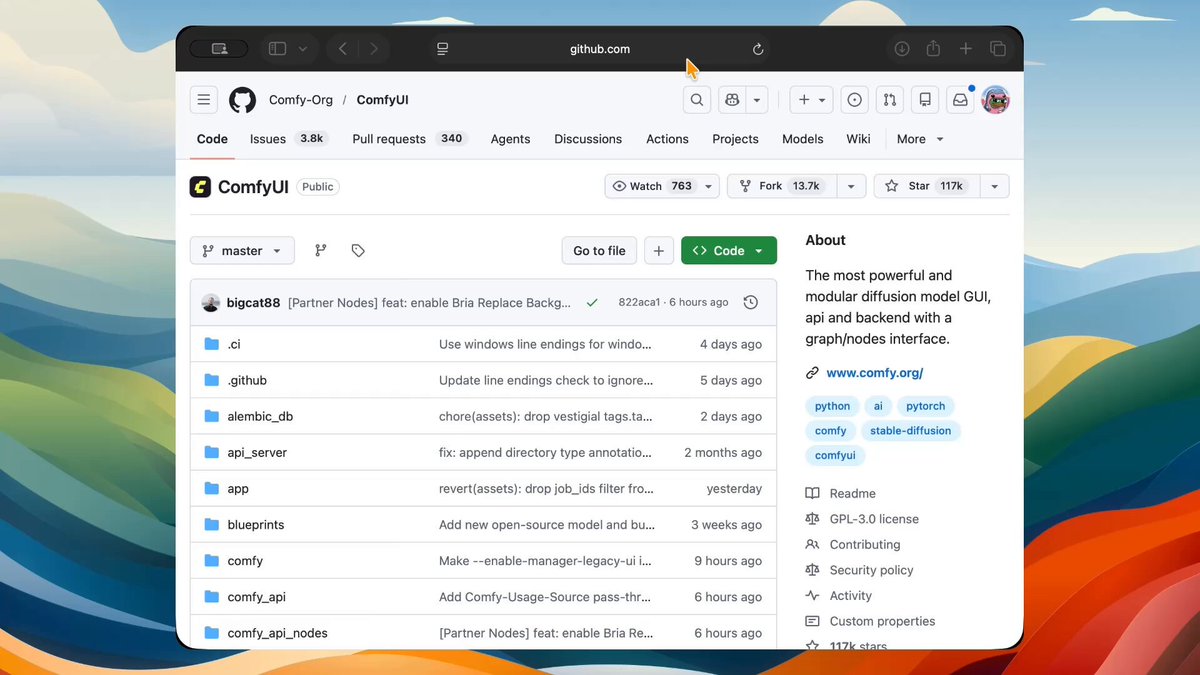
no money for grok or midjourney? this tool is for you. there's a FREE tool created by an anon dev. open-source. runs locally. 117k stars on github. it generates: > images & video > 3d models > audio > 20+ models here's how to set it up in under 5 minutes: 1️⃣download ComfyUI Desktop go to and grab the desktop app for your system. windows 10+, mac (apple silicon), or linux. it installs like any normal app, it sets up python and every dependency for you in the background. no terminal, no config files. 2️⃣open it first launch, it spins up its own environment automatically. you just wait a few seconds and you're in. you'll land on a node canvas, that's the whole interface. 3️⃣load a starter workflow top menu → Workflow → Browse Templates → Image Generation. click it. this drops a ready-made setup onto your canvas so you don't build anything from scratch. 4️⃣grab a model comfyui ships empty on purpose, the model is the brain, and you pick it. in the template, the "Load Checkpoint" node has a Download button when no model is installed. click it. it pulls one in for you (a few GB, this is the only real wait). 5️⃣install ComfyUI Manager this is the one add-on you don't skip. it lets you install models, custom nodes, and updates with a click instead of the command line. grab it from github (link in comments). it's the difference between fighting comfyui and flying in it. one honest note: an NVIDIA gpu makes this fast, apple silicon works great too, and a weak machine still runs it just slower. that's the whole setup. you now own an image, video, and 3D studio that costs you nothing per month. save this. and the next time grok or midjourney asks for your card. you won't need it. disclaimer: comfyui itself is 100% free. so are the local models (sdxl, flux, wan 2.2, ltx-2). some premium models like seedance are pay-per-use api models, only if you want top-tier quality. the free local ones cover most of what you need. (github link in the comments) follow and turn on post notification for daily AI contents.

m0h

14,542 görüntüleme • 1 ay önce

Introducing Workshop: cloud + on-device agentic AI. And to celebrate, we're giving away $250k in Google Gemini AI credits. (details below). The future of AI work is neither cloud-based nor local. It's both. In Workshop Cloud, you can use agents powered by frontier models like Claude and/or open source models like Z.ai's GLM-5 to build internal tools, dashboards, and AI web apps. Or, breeze through tasks like managing your Google and Meta Ads. In Workshop Desktop, you can do all the same right on your computer, plus make desktop apps, mobile apps, and 3D creations. Our favorite part? You can power the full agent experience with local models like Qwen 3.5 family on your computer. Fully offline. 2026 is the year in which local models for agentic tasks will become viable for mainstream use. But the setup for tools like OpenClaw is like setting up Linux from scratch on your computer. Workshop Desktop is one-click to install on Windows, Mac, and Linux. It recommends which open source model you should use for your hardware and lets you download and run it right in the app. And its agent harness allows you to chat, create websites, build personal utilities, and analyze data. 100% offline. Or multitask with AI models in the cloud while running other agent threads locally. Start in Workshop Cloud when you want flexibility and speed. Download your project and continue in Workshop Desktop when you want local files, privacy, and/or better performance on large code bases. Publish from either. The agent tooling space is maturing and discerning users have come to expect a lot from their tools. We've packed Workshop with features to help you 10x your productivity. - Native support for skills - Autocompaction for seamless context management - Built-in AI for your apps - Dozens of connectors, like Google Drive, Big Query, and Supabase - dbt integration to ground your dashboards in your semantic layer - Native Github integration - Private app deployment - ... and more (+ we're shipping super fast) To access the free credit offer, RT this post and reply with "Workshop". Make sure you are following us so we can DM you the instructions to redeem. - First 100 to RT + comment get $500 in credits. - Everyone else gets up to $250 And thanks to our partners Modal, Google Gemini, and Z.ai!

Workshop AI

28,322 görüntüleme • 3 ay önce

Vibe computing is here. Or, as Matt Deitke @mattdietke, cofounder of Vercept, puts it "the first true AI operating layer" is here. I use it on my Mac, prompt to it, and it does stuff. Like changes system settings, watch how I work and gives suggestions, or copies and pastes from one application into another. I'm highly interested in how AI is changing how we work, so I sat down with Matt for an hour to get a much better look at how he thinks, and what his AI operating layer, Vy, is for. Here's what ChatGPT learned after I fed it the transcript: ++++++++++++ Vercept AI + Vi: Rethinking How We Use Computers 🚀 What It Is Vi is an AI-powered assistant that can control your entire Mac screen like a human would — moving the mouse, typing, clicking, navigating apps. It’s being called the first true AI operating layer — what you dubbed “AI operating system” or “vibe computing.” Unlike traditional assistants (Siri, Copilot, ChatGPT), Vy works across any app — from Descript to Chrome to Slack to Photoshop — and acts on your behalf. 🤯 Game-Changing Capabilities Does anything you can describe: “Unfollow people on X,” “Write a Word doc,” “Summarize my emails,” or “Plan my vacation in a spreadsheet.” Works via screenshots: Interprets your screen visually, just like a human would — no APIs or browser hooks needed. Cross-app workflows: Can copy data from one app to another, or handle complex tasks like “look up 10 Goodreads books, extract data, and fill a spreadsheet.” Understands vague language: Even if you don’t use exact names or phrasing, Vy figures it out. 🧠 Where It’s Going Will evolve to: Run in the background Manage multiple apps and windows Act like a team of virtual assistants Work on Apple Vision Pro and future AR/AI interfaces Long-term vision: Vy becomes a swarm of agents running “24/7 like a digital company” doing real, expert-level work. 💼 For Power Users & Enterprises Strong use cases for: Developers using Cursor or VS Code Researchers summarizing YouTube videos, PDFs, long threads Execs automating emails, calendar, reports Batching tasks, templates, and macros are coming: “Tell Elon X, Y, Z” → will soon run across apps and reuse workflows. 🔐 Privacy & Safety Runs locally, stores nothing permanently, doesn’t send screen data to servers. You control when it’s active. Cept prioritizes on-device execution and temporary-only data. Security-conscious users (like Apple employees) will eventually get fully offline modes. 💵 Business Model Currently 100% free while in early access. Future: Premium plans, pro tools, enterprise deployments. 🧑‍🔬 The Founders A veteran computer vision & AI research team from University of Washington, Allen Institute for AI, and early deep learning work. Includes Ross Girshick, one of the most cited researchers in computer vision. 🔮 The Future Matt sees Vy evolving into: A universal expert-level interface across all digital tools The AI-powered bridge between humans and complex systems (e.g., building robots via simulators, managing workflows, analyzing regulations) A new way to compute, where you just describe your goal and it gets done — quietly, in the background, or visually on screen. Try it at:

Robert Scoble

17,509 görüntüleme • 1 yıl önce

Look ma new Codex Updates! 0.119.0 and 0.120.0 are here. And with it, a HUGE number of quality of life updates and bug fixes! > Hooks now render in a dedicated live area above the composer. They only persist when they have output, so your terminal stays clean. If you're running PreToolUse or PostToolUse hooks, this is a huge readability win. > Hooks are now available again on Windows > CTRL+O copies the last agent output. Small but clutch when you're pulling a code block into another file or chat. > New statusline option: context usage as a graphical bar instead of a percentage. Easier to glance at mid-session when you're trying to gauge how much runway you have left. > Zellij support is here with no scrollback bugs. If you've been stuck on tmux just because Codex was broken in Zellij, you're free now (shout out Felipe Coury 🦀) > Memory extensions just landed. The consolidation agent can now discover plugin folders under memories_extensions/ and read their instructions.md to learn how to interpret new memory sources. Drop a folder in, give it guidance, and the agent picks it up automatically during summarization. No core code changes needed. This is the first real extension point for Codex's memory system, and it opens the door for third-party memory plugins. > Did you know, you can /rename a thread? But what's really cool about that is, after you rename it, you can resume it with the same name, no more UUIDs. codex resume mynewapp or directly from the TUI: /resume mynewapp > Multi agents v2 got an update to tool descriptions More reliable multi agent environments and inter agent communication > You can now enable TUI notifications whether Codex is in focus or not. Modify this in your config: [tui] notification_condition = "always" > MAJOR overhaul to Codex MCP functionality: 1. Codex Tool Search now works with custom MCP servers, so tools can be searched and deferred instead of all being exposed up front. 2. Custom MCP servers can now trigger elicitations, meaning they can stop and ask for user approval or input mid-flow. 3. MCP tool results now preserve richer metadata, which improves app/UI handoff behavior. 4. Codex can now read MCP resources directly, letting apps return resource URIs that the client can actually open. 5. File params for Codex Apps are smoother: local file paths can be uploaded and remapped automatically. 6. Plugin cache refresh and fallback sync behavior are more reliable, especially for custom and curated plugins. > Composer and chat behavior smoother overall, resize bugs remain though. > Realtime v2 got several significant improvements as well. > You're still reading? What a legend. 🫶 npm i -g @openai/codex to update

am.will

738,887 görüntüleme • 3 ay önce

** MEGA Parodius Scaling Effects Part 2 ** Well - this is the BIG one - literally !! Huge thanks to my team Pyron & Vector Orbitex for their efforts. Pyron has provided all the source frames for Puyon and his spikes / explosion and a lot of analysis video on how the spikes behave / move which was really helpful. Pyron also used his CRT setup for this video as we felt an emulator video would not do it justice - running on 100% real MD hardware FTW. Vector has provided the catchy boss music and its sounding great - as always ! The coding on this has been a bit insane - things done since part 1 post previous: Implemented dual buffering - Last video was single buffered - so VRAM is very tight now , we only have about 40/2048 tiles free. For the longest time I didn't think it would fit - I found a vram jigsaw puzzle that made it work in the end. Double buffering has cleaned up the stability of the animation and matches the arcade scaling effect now albiet costing 2x more VRAM . Vertical Scaling Implemented - the vertical scaler was taken from Lufthoheit ( my other shooter ) and its heavily optimised to reduce cpu usage. During the scaling the vertical scaler partitions the 68k processor registers into 2 sets, 4 registers are allocated to feeding the fast horizontal interrupt (h-int) that drives the vertical scaling , remaining 12 registers are for the horizontal scaler running in the background. This setup is much faster than normal backup / restore register methods, as we do not need to backup / restore registers in the h-int which would double CPU costs. The catch is the momment any background routine tries to use the H-ints registers it would break things so it has to be carefully timed. Added the spike projectiles - this was very tricky to get close to the arcade, they are semi heat seeking missiles basically and hence needed code that worked out angle differences to player at speed theres no time for arc-tan or similar so it uses faster lookup tables to work out the angles . They speed up over time and get larger and whats more we can't keep all the scales in VRAM - we have room for 2 spike buffers only. Also what was a real pain was working out scaled coordinates for the circular launch of the spikes . Added Fish Damage - Shock frame and Explosion frames from Arcade . Very proud of the fact we have the full arcade quality explosion is which is fully scaled also. Added Temporal Masking - which is fancy wording for don't draw nothing to buffer if nothing is there already there for the scaling . So empty Corners and edges can be optimised out to lower cpu costs and rom costs. I had to make some scripting for this and work out what areas did not need drawing at all in the frame, which should be force cleared by cpu and which areas should just be copied from rom. This reduced rom size by 30 kb and with a bit more work we could extend that to 60 kb & get a bit more speedup even doing so. Added a frame limiter . In the last video update we let the 68k burn hot and just pump out frames as fast as it could - here we match the arcade animation rate which does leave the cpu idling at times , particularly in the smaller frames - even at large though we could be running the animation 25 % faster , issue is though that would speed up the game logic and make it less arcade accurate. We had some real bullet / Spike hell simulations going without the limiter but yeah we had to tone it down a bit. Maybe in a hardcore mode we could let it run wild though ! Code is 95% 68k assembly with about 5% C code (v-int as its cold path ) driving things . This sort of thing needs all the speed it can get !! Well now after all that I can return to finish off Level 1 haha - just a wee sidetrack there . No doubt we will polish stage 8 boss some more in time too !! #SegaMegadrive #SegaGenesis #Parodius #SGDK

Shannon Birt

26,424 görüntüleme • 5 ay önce

LayerEdge LayerEdge Closed 🛠️ Testnet - 🗓️3 days remaining. Easy to keep in the background and earn points 👇 🌐 1⃣Connect EVM wallet (MM or Keplr) 2⃣Use code: NgAMgDAG 3⃣Click "Start Node" - You may need to try a few times, but on a 3rd-4th try it launches for me 4⃣Keep tab open and earn points (can be in the background). 1 Point per second while mining 5⃣Check back every 24 hours and grab extra points (click "Claim Reward" at the top nav) The more tab stays open = more points 🛠️Testnet Roll-out Structure ➡️Phase 1: Closed Testnet (Jan 22–28, 2025) 🔸Stress-testing with browser-based light nodes and limited access 🔸*this may be extend by a few days🔸 ➡️Phase 2: Public Beta Testnet (Jan 28, 2025) 🔸Full launch with browser-based and system-based light nodes, more protocol integrations and more What is LayerEdge? LayerEdge makes Bitcoin more useful by solving two main problems: 1. It makes complex computations cheaper and faster by doing them off the Bitcoin network while still maintaining Bitcoin’s security. 2. It bundles multiple verifications into one, reducing costs by up to 95%, which makes it much more affordable for apps and services to use Bitcoin’s security. Think of LayerEdge like a smart assistant for Bitcoin - it handles the complicated work elsewhere but checks back with Bitcoin to make sure everything is correct and secure. This approach allows Bitcoin to support more advanced applications like gaming and IoT devices without becoming slow or expensive. The key benefit is that instead of paying $900+ for each verification on Bitcoin, protocols using LayerEdge might pay less than $20 when sharing costs with others. Source: 🫡

Grey Ledger

17,675 görüntüleme • 1 yıl önce

Micron is going to $4,000 and once you understand what inference actually is, the number stops sounding crazy (Save this). Dylan Patel just said that by 2030, OpenAI and Anthropic alone will need over 100 gigawatts of compute combined and by 2040, we may not even be measuring AI infrastructure in gigawatts anymore. We may be talking about terawatts. Every single one of those gigawatts needs memory to function. Without it, the compute is worthless. Most people heard that and thought about Nvidia but they should be thinking about Micron. Every AI model generating a response has two phases. The first is prefill, processing your prompt which is compute-heavy and the second is decode generating each word one token at a time and that phase is almost entirely memory-bound, not compute-bound. During decode, the GPU's processing units sit idle more than 95% of the time, waiting for data to arrive from memory. Google confirmed it in a research paper that decode-phase bottlenecks are dominated by memory bandwidth and capacity not raw compute. The GPU is not the bottleneck but the memory feeding the GPU is. This matters because inference is now where all the money lives. Training a model happens once, Inference happens billions of times a day every ChatGPT response, every Claude output, every agentic workflow running in the background and every one of those token streams is a billing event tied directly to memory performance. Adding more GPUs does not fix this because GPUs are already underutilized in inference because they are sitting idle waiting on memory. Adding more memory bandwidth and capacity is what directly reduces token cost, reduces latency, and allows the same cluster to serve dramatically more users simultaneously. Longer context windows compound the problem further, a model running a 1 million token context window requires dramatically more memory per session than a 10,000 token window, and every new model generation pushes context longer. The market treats memory as a downstream beneficiary of Nvidia orders. The correct framework is the opposite, Micron is the upstream constraint on how much value every Nvidia GPU can actually generate at inference scale. Micron guided Q4 to $50 billion in revenue, has HBM4 ramping at twice the pace of the prior generation, and CEO Sanjay Mehrotra has said supply will not catch demand before the end of 2027. At 8x forward earnings on $112 projected FY2027 EPS, Micron is the most undervalued infrastructure company in the entire AI stack. Inference is memory. Memory is Micron and the inference ramp has barely started. Milk Road Pro members are already up massively on this position and we're just getting started. If you want the full breakdown of what we're buying and why, come join us for just a dollar using the link below!

Milk Road AI

128,079 görüntüleme • 15 gün önce

The world of writing has changed forever. AI is getting really good, really fast. ChatGPT is already a better writer than most humans and some professional writers. So, what’s the future of writing? 18 thoughts from Tyler Cowen: 1) Don't let AI smooth out your idiosyncrasies. Let your writing stay weird and uniquely yours. 2) Generic content is dying and the burden is on you as the writer to be distinctive. 3) The more personal your writing becomes, the more future-proof it is. Nobody wants to read memoirs from AI, even if they're technically "better." 4) Use AI as your secondary literature when you read — not just for quick answers, but as a thinking companion. As Tyler puts it, "I'll keep on asking the AI: 'What do you think of chapter two? What happened there? What are some puzzles?' It just gets me thinking... and I'm smarter about the thing in the final analysis." 5) Hallucinations aren't the crisis everyone makes them out to be. No matter the source, if you're going to use a piece of information, you should double-check it. This is true for both books and AI. 6) Secrets will become more valuable in an AI-driven world. 7) One way to use AI as a writer is to research fields you aren't as familiar with before you start writing about them. Tyler said: "I just wrote a column about declassifying classified documents. I don't know that law very well. I asked the AI for a lot of background... now I feel like I'm not an idiot on the topic." 8) AI changes what books are even worth writing. "Predictive books and books about the near future. They don't make sense to write anymore." 9) Editing trick: Try running your writing through AI and asking what some people might find obnoxious. It’s a surprisingly powerful editing trick. 10) When prompting AI, put humans out of your mind and imagine you're talking to an alien or a non-human animal. 11) Many of the most significant AI advancements are likely happening behind closed doors. For example, I hear that Google allows employees to use Gemini with virtually unlimited context windows. 12) What possibilities do large context windows open up? Researchers will be able to load entire regulatory frameworks, historical archives, or massive datasets like "tax records from Renaissance Florence" into a single query. 13) The rate of AI improvement matters more than its current capabilities. As Tyler puts it, "This is the worst they will ever be" is key to understanding their trajectory. "A lot of people don't get that. They're impressed by what they see in the moment, but they don't understand the rate of improvement." 14) The best way to appreciate the current rate of improvement is to use the latest models. 15) Being non-technical can sometimes be an advantage when thinking about AI. Here’s Tyler: "If you're not focused on the technical side, you will see other things more clearly... You just focus on what is this actually good for? And not, am I impressed by all the neat bells and whistles on this advance with AI?" 16) How Tyler uses AI to prep for podcast interviews: Don't waste time asking AI for generic interview questions or broad topics. Tyler says that's the worst question you can ask an AI. It’s “too normy.” Instead, ask specific questions about historical examples and get context. Then, let your own creative questions emerge. 17) Your relationship with mentors and peers becomes more crucial, not less, in an AI world. "Two pieces of general advice with or without AI in the world." Tyler says: "Get more and better mentors and work every day at improving the quality of your peer network." 18) The divide between AI and humans creates a striking paradox. As Tyler puts it: "On one hand the AIs are getting so much better, so learn how to use the AIs. On the other hand, the AIs are getting so much better, so invest in these other things that aren't AI—pure networks. You've gotta do both." I've shared the full conversation with tylercowen below. In the replies, I've also linked to a full transcript and relevant links to YouTube, Spotify, and Apple Podcasts if you want to listen there. And if you want a bite-size entry to the episode, I've shared some clips in the replies too.

David Perell

175,011 görüntüleme • 1 yıl önce

CANCEL Your Weekend Plans and Learn Vibe Coding Today, Start Making $10,000/Month Building Apps for People. $0 in Coding Experience. I made 5 AI Trading Bots & Apps Built in 6 Hours. Each One Worth $3,000-$15,000 to Clients. You Spent $500 on a Bootcamp and Still Can't Deploy a Landing Page. That's not the bootcamp's fault. That's you. People with zero coding skills are building full apps with payments, databases, and authentication using AI. Charging clients $5,000-$10,000 per project. Finishing in one afternoon. You're still Googling "should I learn Python or JavaScript first." This attached video is a goldmine. 6 hours. 5 real apps. From complete beginner to deploying revenue-generating products. One video. Free. Save it. Watch it this weekend. Not next weekend. Today. Now let me break down exactly what's inside and why you can't afford to ignore this. Save this post. You'll hate yourself if you lose it. ↓ Let's talk about why you still can't code... You bought the Udemy course. $12.99. Watched 3 lectures. Got confused. Told yourself you'd continue tomorrow. That was 8 months ago. You bought another course. $49.99. This one had better reviews. Watched the intro. Bookmarked the rest. Never opened it again. You signed up for a bootcamp. $5,000. Dropped out at week 4 because "life got busy." Life didn't get busy. You got scared. Three years. Hundreds of dollars. Multiple courses. Zero apps built. Zero projects deployed. Zero revenue generated. And now someone with zero coding experience is building full apps in hours using AI tools you haven't even tried. You're not falling behind slowly. You're falling behind at full speed. Save this post right now. This is the course that makes every other coding course you bought irrelevant. Follow Himanshu Kumar so you don't miss the breakdown. ↓ What is vibe coding and why should you care? Traditional coding: Learn syntax for 6 months. Build a to-do app. Feel proud. Realize nobody will pay for a to-do app. Give up. Vibe coding: Describe what you want to build. AI builds it. You guide, adjust, deploy. People pay for it. You're not writing code line by line. You're directing an AI agent that writes code for you. Think of it like this: Traditional coding = you're the construction worker. Vibe coding = you're the architect. The architect makes more money. The architect doesn't carry bricks. The architect doesn't need to know how to pour concrete. The architect needs to know what to build and why. That's vibe coding. And while you've been debating whether to learn Python or JavaScript first, people are skipping both and building apps that generate revenue. With zero coding knowledge. This isn't the future. This is right now. Save this post and follow Himanshu Kumar for more vibe coding breakdowns that actually make you money. ↓ What this 6-hour course covers. This isn't some 20-minute tutorial that shows you how to make a button change color. This is 6 hours. 5 complete apps. Real software engineering. Real deployment. Real money-making potential. Here's what you'll build: > Portfolio website - deployed live on Netlify > Full-stack client dashboard - with database and auth > Lead generation app - with API integrations > Thumbnail generator - with payment integration via Stripe > Splinter - a full SaaS product with pricing and marketing Not toy projects. Not "follow along and never use again." Actual apps that people pay for. Built with Gemini 3.1 Pro, Antigravity, Supabase, Next.js, Vite, and more. You know how many people charge $5,000+ to build a single one of these apps for a client? You'll be able to build all 5 by the end of this weekend. You can't afford to scroll past this. Bookmark this post. Follow Himanshu Kumar because I'm breaking down every tool in this stack separately. ↓ The tools you'll master. Gemini 3.1 Pro: Google's most powerful AI model. You'll use it to generate entire codebases. Not snippets. Entire apps. Antigravity: The AI coding environment that makes vibe coding actually work. Agent chat. MCP servers. Voice dictation. It's not VS Code with a chatbot bolted on. It's built from the ground up for AI-first development. Supabase: Your backend. Database. Authentication. All set up in minutes. Not weeks of configuration. Next.js + Vite: Modern frameworks that make your apps fast, scalable, and professional. Stripe: Payment integration. So your apps can actually charge people money. You know, the whole point. Claude Code: Yes, Claude Code is covered too. Because the best developers in 2026 don't use one AI tool. They use all of them. While you're still trying to decide which AI tool is "the best one," smart people are using all of them together and making money from every angle. Stop debating tools. Start using them. Save this post and follow Himanshu Kumar for deep dives into each of these tools. ↓ What you'll actually learn beyond just "building apps." This course doesn't just teach you to copy and paste prompts. You'll learn real software engineering: > Hosting and deployment > Modern software design patterns > Languages and frameworks > Version control and GitHub > Programming with AI agents and agent teams > Database design (SQL vs NoSQL) > Security audits > API integration > Payment processing This is everything a $15,000 bootcamp teaches. In 6 hours. For free. On YouTube. Your friend who spent $15K on a bootcamp is going to be really upset when you build better apps than them after watching one YouTube video this weekend. Don't tell them about this course. Or do. Their reaction will be priceless. This is a $15,000 education for $0. Save this post before it gets buried. Follow Himanshu Kumar for more free resources that make paid courses look like scams. ↓ The guy teaching this actually makes money. Not "makes money selling courses about making money." Actually makes money. Nick built automated businesses with Make . Most notably 1SecondCopy, a content company that hit 7 figures. Seven figures. From automation. He's not teaching theory. He's showing you what real systems that generate real revenue look like. 90% of coding teachers on YouTube have never shipped a product that made $1. They teach coding. They don't use coding to make money. This guy does both. That's why this course is different. You've been learning from people who teach for a living. Start learning from people who build for a living. Save this post. Follow Himanshu Kumar for more content from builders, not lecturers. ↓ Let me tell you what's really happening while you "think about learning to code." Every week that passes, AI coding tools get better. Every week that passes, more people learn vibe coding. Every week that passes, the market gets more competitive. Right now, vibe coding is still early. Not many people know how to do it well. Clients are desperate for someone who can build apps fast. $3,000 for a landing page with payments. $5,000 for a SaaS MVP. $10,000 for a full client dashboard. These are real prices people are charging for apps they built in a single day using the exact tools in this course. But this window won't last forever. In 6 months, everyone will know how to vibe code. In 12 months, it'll be a basic requirement. In 24 months, not knowing this will be like not knowing how to use email in 2010. You're either early or you're irrelevant. Right now you can still be early. But not if you spend this weekend on Netflix. The window is closing. Every weekend you waste is a weekend someone else uses to get ahead of you. Save this post. Follow Himanshu Kumar before this opportunity becomes obvious to everyone. ↓ The 5 apps you'll build and what they're actually worth. App 1: Portfolio Website. What clients pay for this: $500-$2,000. Time to build with vibe coding: 30 minutes. App 2: Client Dashboard. What clients pay for this: $5,000-$15,000. Time to build with vibe coding: 2-3 hours. App 3: Lead Generation Tool. What clients pay for this: $3,000-$8,000. Time to build with vibe coding: 1-2 hours. App 4: Thumbnail Generator with Payments. What clients pay for this: $2,000-$5,000. Or sell it as a SaaS for recurring revenue. Time to build: 1-2 hours. App 5: Splinter (Full SaaS Product). What clients pay for this: $10,000-$25,000. Or launch it yourself for monthly recurring revenue. Time to build: 2-3 hours. Total value of apps you can build after this course: $20,000-$55,000. Total cost of this course: $0. Total time investment: one weekend. You spend more than one weekend deciding which Netflix show to start next. At least this weekend would pay you back. Read those numbers again. Save this post. Follow Himanshu Kumar because I'll be breaking down how to sell each of these apps as a service. ↓ Here's the business model nobody's talking about. Learn vibe coding this weekend. Build 5 apps. Pick the one you're best at. Offer it as a service. "I build professional SaaS dashboards for businesses using AI. Faster than agencies. Fraction of the cost. $5,000 per project." 2 projects per month = $10,000/month. Working maybe 20 hours total. While you're applying for jobs that pay $4,000/month and require 5 years of experience you don't have, someone who watched this course last weekend just landed their second $5,000 client. No degree. No portfolio. No 5 years of experience. Just the ability to build what people need faster than anyone else. That's the entire business model. Learn fast. Build fast. Charge accordingly. Stop applying for jobs. Start creating them. Save this post. Follow Himanshu Kumar for the exact outreach scripts to land your first vibe coding client. ↓ Why you won't watch this course. Because it's 6 hours. "6 hours?? That's too long." You binged an entire season of a show last weekend in 8 hours. You scrolled Twitter for 4 hours yesterday. You spent 3 hours watching YouTube shorts that you don't even remember. But 6 hours to learn a skill that could make you $10,000/month? "I don't have time for that." You have time. You just don't have discipline. And that's the actual reason you're broke. Not the economy. Not the market. Not your circumstances. Your inability to sit down for 6 hours and learn something that changes your life. Everything else is a story you tell yourself to feel better about doing nothing. That's the uncomfortable truth. Save this post so it stares at you every time you open your bookmarks. Follow Himanshu Kumar because I'll keep reminding you until you actually do something. ↓ What happens this weekend determines your next year. Path A: Watch the course Saturday. Build your first app Sunday. Start offering services Monday. Land first client within 2 weeks. $5,000-$10,000/month within 60 days. Path B: Sleep in Saturday. Brunch Sunday. Netflix Sunday night. Monday morning alarm goes off. Back to the same job. Same salary. Same frustration. Same "I'll start next weekend." 52 weekends in a year. How many have you already wasted? Path A costs you one weekend. Path B costs you your entire future. Same video. Same information. Same 6 hours. Two completely different lives. ↓ Full 6-hour course attached. 5 real apps. Real deployment. Real revenue potential. From the guy who built a 7-figure automated business. Not theory. Not motivation. Actual hands-on building. The course is free. The tools are free. The knowledge is right here. The only thing that costs money is your decision to do nothing. And that cost compounds every single day. Follow Himanshu Kumar for more breakdowns that turn free YouTube videos into $10,000/month skill sets. Save this post. Watch the video. Build something this weekend that your Monday self will thank you for. Or don't. And wonder next year why nothing changed.

Himanshu Kumar

39,379 görüntüleme • 3 ay önce

Steve Jobs walked into a room full of MBA students and asked how many were going into consulting. Hands went up. He said their careers would be “like a picture of a banana.” “You might get a very accurate picture. But you never really taste it.” He spent 60 minutes explaining what actually builds careers: "Without owning something over an extended period of time, where one has a chance to take responsibility for one's recommendations, where one has to see one's recommendations through all action stages and accumulate scar tissue for the mistakes and pick oneself up off the ground and dust oneself off, one learns a fraction of what one can." He continues: "Coming in and making recommendations and not owning the results, not owning the implementation, I think is a fraction of the value and a fraction of the opportunity to learn and get better." "You do get a broad cut at companies, but it's very thin." Then the line that made the room go silent: "It's like a picture of a banana. You might get a very accurate picture, but it's only two dimensional. Without the experience of actually doing it, you never get three dimensional." "So you might have a lot of pictures on your walls. You can show it off to your friends. You can say, look, I've worked in bananas, I've worked in peaches, I've worked in grapes." "But you never really taste it." The room applauded. This was 1992. Jobs had been fired from Apple seven years earlier. He was running NeXT. He had scar tissue. An MIT student asked him: where would Apple be if you hadn't left? Jobs paused. "I've obviously thought about this a lot. I think everybody lost. I think I lost. I think Apple lost. I think customers lost." "And having said all that, so what? You go on. It's not as bad as a lot of things. Not as bad as losing your arm." That's Steve Jobs. Getting fired from the company he built, comparing it to losing a limb, and shrugging. He spent the rest of the talk explaining what he learned about building companies. On competitive advantage: "Hardware churns every 18 months. It's pretty impossible to get a sustainable competitive advantage from hardware. If you're lucky, you can make something one and a half or two times as good as your competitor. And it only lasts for six months." "But software seems to take a lot longer for people to catch up with." "I watched Microsoft take eight or nine years to catch up with the Mac, and it's arguable whether they've even caught up." On technology windows: "You can use the concept of technology windows opening and then eventually closing." "Enough technology from fairly diverse places comes together and makes something that's a quantum leap forward possible. And a window opens up." "It usually takes around five years to create a commercial product that takes advantage of that technical window opening up." "And then it seems to take about another five years to really exploit it in the marketplace." He gave examples from his own life: Apple II lasted 15 years. DOS lasted 15 years. Mac was eight years old at the time and would easily last another five. "These things are hard. They don't last because it's convenient, or even because it's economic. They last because this is hard stuff to do." On management: "I've never believed in the theory that if we're on the same management team and a decision has to be made, and I decide in a way that you don't like, and I say, come on, buy into the decision." "Because what happens is, sooner or later, you're paying somebody to do what they think is right, but then you're trying to get them to do what they think isn't right. And sooner or later, it outs." His approach: "The best way is to get everybody in a room and talk it through until you agree." Then this: "We don't pay people to do things. That's easy, to find people to do things." "What's harder is to find people to tell you what should be done. That's what we look for." "So we pay people a lot of money, and we expect them to tell us what to do. And when that's your attitude, you shouldn't run off and do things if people don't all feel good about them." A student asked: what's the most important thing you learned at Apple that you're doing at NeXT? Jobs thought for a moment. "I now take a longer-term view on people." "When I see something not being done right, my first reaction isn't to go fix it. It's to say, we're building a team here. And we're going to do great stuff for the next decade, not just the next year." "So what do I need to do to help so that the person that's screwing up learns, versus how do I fix the problem?" "And that's painful sometimes. And I still have that first instinct to go fix the problem." "But taking a longer-term view on people is probably the biggest thing that's changed." On not knowing your own competitive advantage: "A lot of times you don't know what your competitive advantage is when you launch a new product." "When we did the Macintosh, we never anticipated desktop publishing. Sounds funny, because that turned out to be the Mac's compelling advantage." "We anticipated bitmap displays and laser printers. But we never thought about PageMaker, that whole industry really coming down to the desktop." "But we were smart enough to see it start to happen nine to twelve months later. And we changed our entire marketing and business strategy to focus on desktop publishing." "And it became the Trojan horse that eventually got the Mac into corporate America." The same thing happened at NeXT. They built software to help developers create apps faster. Their target customers were Lotus, Adobe, WordPerfect. Then big companies started showing up and saying: "You don't understand what you've got. The same software that allows Lotus to create their apps faster is letting us build our in-house apps five to ten times faster." "And you dummies don't even know it." Jobs admitted: "It took them about three months before we finally heard it." On hiring: "It seems like all the good people I really want to hire, it takes me a year to hire them. It's always been that way, even at Apple." "I usually meet somebody that is really good. And you can't get them. And then you go try to find other people. And nobody measures up." "When you meet somebody that good, you always compare them to this one person. And you know you're going to be settling for second best if you compromise." "And I've always found it best not to compromise, and just keep chipping away." His VP of Marketing took a year and a half to hire. "And they're all worth it." This talk is Steve Jobs at his most unfiltered. A founder with scar tissue explaining what he learned the hard way. This 60 minute MIT lecture will teach you more about building companies than every startup book you've read combined. Bookmark & give it an hour, no matter what.

Jaynit

995,185 görüntüleme • 2 ay önce

Just pulled up Olipop's landing page after seeing their ads everywhere lately and I need to break this down because this is one of the cleaner DTC pages I've seen in a while. Here's what's actually happening when you land on this page and why it converts cold Facebook traffic better than 90% of ecom brands right now: 1) The first 3 seconds Before you read a single word, there's a video of the product being poured, fizzing, bubbling and condensation on the can with no voiceover or text overlay. Your brain processes that faster than any headline ever could. You can almost hear the fizz. That's intentional. They're triggering a sensory response before your logical brain even wakes up. Then the headline hits. "A New Kind of Soda." Now that's a category repositioning. They're not saying "healthy soda" or "better soda." They're saying the entire category you grew up with needs a new version and this is it. Sub-headline says high fiber, less sugar. Targets exactly the person who clicked the health-focused ad on Instagram. Message match is perfect. The person who clicked the ad lands here and immediately feels like the page was made for them. 2) The product carousel Most brands mess this up by showing you the product and making you go through three more pages to add it to your cart. Olipop lets you hover over any flavor and an "Add 12 Pack" button appears right there. One click. Done. You never leave the homepage. That little micro-interaction is doing serious conversion work because every extra click you require is a percentage of buyers you lose. They basically short-circuited the whole buying process and most people don't even notice it's happening. Star ratings under every flavor. Smart. You're not waiting until the reviews section at the bottom to see social proof. It's right there next to the product at the exact moment you're deciding what to buy. Then there's the "Limited" and "Out of Stock" tags on certain flavors. This is a psychological move that a lot of brands either don't use or use badly. When you see Shirley Temple is sold out your brain immediately thinks this must be good enough that people are actually buying it. And now you're looking at everything else thinking you better grab it before it's gone too. 3) The retention play At this point you haven't bought yet and they already know some people won't on the first visit. So right here they drop the rewards program section. Trade your email for perks and points. They're not letting you leave empty handed. Either you buy today or you give them your email so they can bring you back. Both outcomes work for them. Then comes the subscription nudge. 15% off. Free shipping. Cancel anytime. Three objections handled in one sentence. 1. Too expensive? 15% off. 2. Annoying to reorder? Free shipping straight to your door. 3. Scared of being locked in? Cancel whenever you want. That's a complete objection removal stack built into what looks like a simple banner. The people who weren't ready to buy a 12-pack today are looking at that and doing the math. 4) The press section Bloomberg. Forbes. BuzzFeed. Mindbody. This section exists for one reason. You clicked an ad from a brand you'd maybe seen once or twice before. You don't fully trust them yet. These logos close that gap in about half a second. It's institutional validation. You don't need to read the articles. Just seeing the logos tells your brain people with real credibility have looked at this and thought it was worth covering. Background behind this section is a high-res macro shot of condensation on the can. Cold. Refreshing. Premium. Even the section design is doing sensory work. 5) The overall lesson What Olipop figured out is that a landing page for Facebook traffic has one job. Close the trust gap between the ad and the purchase as fast as possible without losing the energy the ad created. Every section of this page does exactly that. Sensory hook gets you in. Category positioning tells you what it is. Carousel with inline add to cart removes friction. Social proof and scarcity show demand. Subscription offer removes price and convenience objections. Press section provides institutional trust. By the time you hit the footer you either already bought or you gave them your email. That's not a landing page. That's a conversion machine. If your page isn't doing all of this right now, that's where your revenue is leaking. Not in the ads. In what happens after the click. DM me ‘FUNNEL’ and I'll show you exactly how to build something like this for your brand.

Nick Theriot

26,389 görüntüleme • 4 ay önce

Don't Buy a Mac Mini for Clawdbot: The Secret $10,000 Architecture That Costs You Nothing clawdbot might be the reason you feel like you need a ten thousand dollar computer right now but i am about to show you why that fomo is going to leave you broke. if you have been watching everyone rush out to buy mac minis and mac studios just to run open claw or some local models you are witnessing a massive transfer of wealth from your pocket to apple for no reason. there is a specific setup i use that costs almost nothing and keeps my main machine safe from whatever these autonomous agents are doing. if you stick with me i will walk you through the exact architecture of a professional trading system that handles the heavy lifting without you needing to drop a single rack on hardware most people are scared of running these bots on their main computer because they don't want an agent messing with their personal files or browser sessions. instead of buying a second mac mini for six hundred dollars you can just go to the top left of your screen and create a brand new user profile. this acts like a completely isolated sandbox where you can install all your trading tools and agents without them ever seeing your main data. it is essentially like getting a free computer for the price of five minutes of clicking around your settings but what if you aren't on a mac or you need to access your system while you are traveling without carrying three laptops in your backpack. this is where the first loop of professional automation starts to close because i use something called chrome remote desktop to bridge the gap. this allows me to leave a dedicated machine running in a safe place while i access the full desktop environment from a tablet or a cheap laptop anywhere in the world. it solves the mobility issue but it still doesn't solve the problem of those massive ten thousand dollar price tags for high end mac pros if you are a pc user or just someone who doesn't want to own physical hardware yet you should look into a windows vps through a provider like contabo. most developers will tell you to use a linux terminal but if you aren't a coder yet you need a visual interface you can actually see. getting a windows server allows you to log in and see a desktop just like your home computer for about fifteen dollars a month. i usually recommend at least twelve gigabytes of ram to keep things from getting janky when you are running multiple browser windows and agents at once now you might be thinking that the whole point of the big hardware was to run local models like kimi or glm to save on api costs. i spent years thinking i had to own the machines myself and i even spent hundreds of thousands on developers before i realized i could just do this myself. the secret to running those massive open source models without the ten thousand dollar investment is renting gpu power by the hour. sites like lambda labs let you spin up a monster machine that can run any model in existence for just a couple dollars an hour this is the ultimate pivot because it allows you to test if your strategy actually prints money before you commit to the hardware. you can turn the server on when you are iterating and turn it off the second you are done which keeps your overhead near zero. if you haven't proven that your bot can pay for itself yet then buying a mac studio is just an expensive hobby rather than a business move. there is a much bigger loophole involving the anthropic subscriptions that most people are completely overlooking right now right now i am using a specific plan with claude code that costs about two hundred dollars a month but it lets me run open claw all day without hitting api limits. if i were paying for those same tokens through the standard api i would probably be spending hundreds of dollars every single day. it is a massive cost savings that allows you to iterate and fail until you find a winning strategy without draining your bank account. even if they eventually close this loophole or snitch on the usage patterns it serves as the perfect training ground for a data dog the goal is to find a system that works with a smaller or cheaper model like haiku before you ever try to scale up to the heavy weights. if you can make a strategy profitable using a less intelligent and cheaper model then you know you have found real alpha. once you have that foundation you can decide if it finally makes sense to build your own custom pc rig which will always be half the price of an apple machine. i am an apple guy so i usually pay the tax anyway but i only do it once the system is already generating enough to cover the cost ten times over i believe that code is the great equalizer because it took me from losing money and getting liquidated to having fully automated systems doing the work for me. i had to learn to live with the iterations and the failures on youtube to get to this point of clarity. the universe tends to get out of your way once you make a non negotiable contract with yourself to see the process through to the end. you don't need the flashy hardware or the most expensive setup to start winning in this game stay focused on the logic and the data rather than the hype and the fomo that everyone else is falling for. if you can master the bridge between renting power and owning your logic you will be ahead of ninety nine percent of the people in this space. the path to a fully automated life isn't paved with expensive gadgets but with the discipline to iterate until the system finally prints

Moon Dev

17,382 görüntüleme • 5 ay önce

$AMD $5 Trillion MC Is Inevitable Long Term👑 This thread will focus more on Inference! 2026 EPYC "Venice" $TSM 2nm to save Large GW Scale Inference by 40% more than Prior Turin gen. Context: EPYC Turin achieves ~$0.001 per million tokens for batch inference vs $0.02-$0.12/ million tokens as I wrote the thread below. Venice is going to lower cost down to $0.0005-$0.0006/Million Tokens. OpenAI spent roughly $20B on Inference and Training, where 80-90% of that was for Inference per Analysts. AKA Renting Compute is Expensive AF! In this thread, I want to focus on why most analysts and investors are underestimating the role EPYC "Venice" and future Gen on overall Data center revenue. And $TSM ramping up 2nm supply early is a confirmation that AMD will be a major buyer long term. I will also link the thread the Gap between AMD Analysts & Reality and 2nm Ramp Thread so you have more comprehensive view of what I'm writing here. Before I go into detail this is my 2026 Projection: AI GPUs: $35-$50B EPYC Data Center: $15B-$17B Client Segment: $12-$13B Gaming: $6B Embedded: $4B-$5B Total Revenue $70-$100B Non-GAAP net income $18B-$25B Non-GAAP EPS $10.97-$15.40 Foward P/E 55x-70x= $603-$1,078 AMD's Analysts are projecting $0 Revenue for MI450 and sluggish EPYC Growth. Meaning, all analysts are either full of 💩 or Sexist, you decide! Analysts are also projecting 0% growth on AMD "Secret Weapon" Chip as $MSFT said we are at significant Windows refresh and upgrade cycle. Do you think TSMC would allocate more 2nm supply to $AMD at $0 MI450 revenue and sluggish EPYC? 1. EPYC is going to be the leader in lowest Inference! Current Turin cost saving is 95% vs $NVDA or 98-99% on Inference cost when you factor in renting Inference compute from Amazon Web Services, Microsoft Azure, or $NVDA Neocloud pets. TSMC claimed: 10-15% higher performance at iso-power, 25-30% lower power at iso-speed, and ~15% higher transistor density compared to 3nm. This reduces operational expenses (energy, cooling) while increasing throughput per chip. EPYC Turin achieves ~$0.001 per million tokens for batch inference (via vLLM on models like Llama 3 70B), driven by high core counts and low hardware costs. EPYC Venice offers ~1.7x overall performance and up to 70% more compute capability per core, with up to 256 cores (512 threads). Enhanced vector/AI instructions and open-source firmware (openSIL) optimize for inference workloads. AMD Incorporates AI Engines (now part of AMD's XDNA) for on-chip acceleration, improving efficiency for low-latency and edge inference. This reduces reliance on discrete GPUs, lowering system complexity and TCO. Venice SKUs are projected at $3,000-$15,000 ($5,000 for 256-core flagship), far below NVIDIA Rubin ($50,000-$90,000) or AMD's own MI450 GPUs ($40,000-$50,000). High memory bandwidth (up to 1.6 TB/s) supports efficient batch inference. Venice is designed exactly for Large customers that want to lower Inference Cost and MI450 Helios is for Customers that want Training at lowest TCO, TDP as well as lower Upfront 1GW scale(Full build $35-$40B vs $NVDA $55B-$80B). 2. Real World Example: OpenAI's 2025 inference spend reached ~$20B, escalating to even higher total compute rental (mostly inference) amid token volume growth(from video generating). By 2026, with usage doubling (consistent with industry trends: token demand grows 2-5x YoY), assume OpenAI processes ~1,800 billion million-tokens annually $NVDA Blackwell at $0.02-$0.12 is $36B(most optimized) Rubin is projected to be at $0.01/million tokens or $18B annual Inference Cost vs $AMD Venice $0.0005/million tokens or $0.9B annual Inference Cost => Massive saving for OpenAI or anyone that are paying 80-90% Annual Bill for Inference compute. In short, it is unsustainable to pay this much rent vs owning for all current AI players for the medium to long term. Rubin excels in low-latency decode (if Groq integration from $20B deal in 2027-2028), but Venice dominates batch (80% of inference by 2030). Actual savings depend on deployment scale (OpenAI's 6GW AMD plans), electricity rates, and software maturity. If Rubin only hits $0.03, savings swell to $53.1B vs. $17.1B. 3. Will running Inference on Venice and future Gen slow down response generation in 2026 and beyond? Human perception of "fast enough" for chat, agents, search augmentation, summarization, coding assistance is roughly Meaning, EPYC may generate $100B a year on data center revenue, Hence $MSFT $AMZN $META $GOOGL OpenAI xAI and 42+ Countries are leaning AMD for Inference, because the cost saving is MASSIVE! 4. Regular users (you, me, people using ChatGPT, Claude, Gemini, Grok, Perplexity...) are extremely unlikely to notice any slowdown and in many cases might even experience slightly faster or more consistent response times if the industry heavily shifts toward AMD EPYC for inference. What actually happens when companies save massively on inference? When OpenAI , Anthropic , Gemini , Grok Meta .... save billions on the batch/enterprise/RAG layer using EPYC Venice, they typically do one or more of these things with the savings, none of which make your chat slower but enhancing their bottom line(Profit) ~Keep prices the same → make more profit ~Lower subscription prices / increase free tier limits ~Train bigger & better models more frequently ~Offer longer context windows ~Add more reasoning steps / tool calls / agents per query ~Improve multimodal capabilities ~Build more data centers / reduce throttling during peaks In practice the consumer experience usually gets better, not worse, when inference becomes dramatically cheaper. Prime example is $META leaning AMD heavily or currently AMD largest customer. or Grok 2 to Grok 3 heavily used AMD for Inference saving. And most Grok Users reported Groke responses snappier, not slower. 5. What does this mean for potential Revenue? Noted that TSMC is massively ramping 2nm supply for $AMD both MI450 and EPYC. EPYC Conservative projection: FY2025: $10.5B(best Est) FY2026: $16B FY2027: $29B FY2028: $49B FY2029: $75B FY2030: $100B Large customers: $META OpenAI $MSFT $AMZN $GOOGL xAI (Apple?) Smaller customer: $DELL $HPE $SMCI and 42+ other countries. The roadmap to $5 Trillion is very much inevitable as Inference Cost from Renting or owning $NVDA are too high, but $NVDA will still dominate Training market share, where MI families are likely to take 15-20% market share, but the TAM is also expanding Rapidly. Most Institutions are projecting $2-$3Trillion TAM by 2030. $NVDA said $4 Trillion. Dr. Lisa Su said $1 Trillion+ by 2030. So you decide on how much TAM. If you enjoy this kind of analysis, Slap the Like/Repost and Bookmark to please the X Algo as it is Free.99! If you want to support my work further, consider subscribe to see more in-depth analysis! Alright, that is it. Not Financial Advice!

Mike

102,223 görüntüleme • 6 ay önce

BADLAB V2: WHERE YOUR MEDIOCRE CODING DREAMS GO TO DIE 🔊 Listen up, code peasants. While you've been copy-pasting Stack Overflow answers, we've been revolutionizing how fucking development works. BADLAB V2 just dropped, and it's not just another update – it's a fucking paradigm shift. Let me break this down for you smooth-brains: 1️⃣ BADLAB V2 makes it easier and faster to build web apps, games, smart contracts, and data visualizations: No-code deployment, run, and share - without the headaches. 2️⃣ What This Means for Users: You can build bigger, better, and more useful projects and tools. Works with all the tools you love: React, Web3, Three.js, d3, and more—whether you’re building games, dApps, automation tools, or interactive charts, the sky is the limit. 3️⃣ Smart automation does the hard work: AI writes code for you, making it easier to start building without deep technical expertise. 4️⃣ CDN-backed hosting: Your projects load fast and reliably because they run from Cloudflare CDN, not some sketchy server. And now? You can share your creations with friends. 5️⃣ Easier debugging & updates: No more jumping through hoops to update files or fix errors. 6️⃣ Bottom Line: If you want to build web apps, games, or blockchain projects without dealing with all the messy setup and technical headaches, BADLAB V2 makes it easy. 🆕 WHAT’S NEW: ✔️ Multi-file projects – Because one file isn’t enough for real developers. ✔️ File updates that don’t require a PhD – No unnecessary complexity. ✔️ Examples even a brain-dead monkey could follow – Clear and simple. ✔️ Support for every major file format – JS, JSON, Markdown, 3D models, and more. ✔️ React components that don’t look like digital vomit – Finally, code that makes sense. ✔️ Server-side bundling – Because we’re not savages. ✔️ CDN-backed deployment – No lag, no downtime, just pure speed. ⚠️ WEAPONS OF MASS CREATION: 💧 d3.js – Interactive charts that don’t look like Excel’s morning sickness. 💧 Three.js – 3D visuals that push browsers to their limits. 💧 Effector – Business logic that actually makes fucking sense. 💧 Kaboom.js – Build browser games that aren’t complete garbage. 💧 React-Three/Fiber – 3D meets React without the usual drama. 💧 Framer Motion – Animations that are smooth as hell (and don’t cause seizures). 💧 Ethers & Web3.js – Blockchain development for the mentally stable. 🎮 Want to See It in Action? 🔗 Try our BADLAB V2 Agent Here: – Let AI do the hard work for you. ♟ Play the 4D Chess Game Here: – While you're playing checkers, we're transcending dimensions. 🎙 Welcome to the future, you beautiful disasters. Try not to break anything important. 🧪💀 C₈H₁₁NO₂

ARCH AI

44,480 görüntüleme • 1 yıl önce

[New Xbox Controller Review] #ad Special thanks to Qrdgame_offcial for supplying me with a review unit of their Ferrox M5 Xbox & PC Controller QRD Ferrox M5 The QRD Ferrox M5 is a Wireless Xbox One–style gamepad with a transparent design. Since it targets Xbox One natively, it works automatically on PC and Xbox Series S/X. The included 2.4Ghz USB Dongle also supports Switch and Android with the right adapter (USB C), but I was not able to test those in time for this review. A Wireless Xbox Controller The QRD FERROX M5 comes in a familiar Xbox layout with Hall Effect joysticks, RGB rings around the sticks, and a magnetic & detachable clear shell that shows the internals. The controller feels very similar to a standard Xbox pad in terms of shape and size, but it’s slightly lighter at compared to the usual Xbox controller weight. The lighter weight makes it easier to hold for longer sessions without hand fatigue. The D-Pad is surprisingly good at dialing special moves feels as solid and responsive as the official Xbox controller, and that’s impressive at a lower price point. I spent a few days trying out the Mortal Kombat Legacy Kollection exclusively using this controller and I did not notice any difference at all. Capabilities From what I’ve tested, the controller performs extremely well for action games, fighting games, and shooters. The Hall Effect joysticks offer smooth movement and precise control with no drift issues. The D-Pad uses micro switches, so every input is tactile and accurate. The back triggers support an adaptive “trigger stop” mode, which shortens the travel distance for faster reaction time in FPS games or quicker blocks in Fighting Games. You also get 4 back macro buttons, turbo mode, and adjustable joystick sensitivity with deadzone options. Vibration strength and RGB lighting modes are also customizable. What can it do The FERROX M5 includes an 800mAh battery that lasts around 8 hours of gameplay. It only uses the 2.4Ghz wireless connection, not Bluetooth, so it always requires the included USB Dongle. The good thing is once you sync it with your Xbox or PC, you don’t need to sync it again—it carries over between both devices automatically. The 2.4G connection is stable and low latency, and the controller has a 3.5mm headphone jack for audio and mic support. It also features a quick calibration system to keep sticks and triggers accurate over time. The overall grip and shape feel close to the official Xbox controller, comfortable for long gaming sessions, and the transparent shell gives it a distinct look. Areas of improvement I initially had trouble charging the controller while playing because connecting it to the Xbox via USB would disable all inputs, making it unusable in wired mode. But luckily QRD Support helped and provided me with an updat - I had to connect it to a PC, download the firmware tool from QRD’s website, and update the controller manually. After installing the new firmware, the controller can now charge while being used normally on Xbox, so the issue is fully resolved. The Xbox button also behaves differently on Xbox, where the single press acts like hold and the hold acts like single press; this issue doesn’t appear on PC. Syncing with the dongle took a few attempts on both Xbox and PC, but once paired, it never needed syncing again. The wireless mode is strictly 2.4G with no Bluetooth support, so it cannot connect without the dongle, though the benefit is that one pairing works across both Xbox and PC. Final Summary ✅ Hall Effect Joystick ✅ Lights in the dark ✅ Good D-Pad for input dialing ✅ Light Controller ❌ First sync can be annoying on PC ❌ No bluetooth for phone usage - Dongle is necessary ❌ Needs an update for the Xbox Wired issues which require a PC The Controller is available on Amazon for $59.99, and will be part of the Black Friday Deals on their official website for even more discount! Amazon Link Website Link

thethiny 🐰🍉

16,864 görüntüleme • 8 ay önce

CANCEL Your Weekend Plans, and Learn Claude Code Today. $5,000/month. $10,000/month. $20,000/month. People are building entire apps and charging clients thousands using Claude Code. You're still Googling 'how to center a div.' While you're binge-watching a show you won't remember next week, a 19 year old with zero coding experience just built a $5,000 SaaS product in one afternoon using the tool I'm about to break down. Same laptop. Same internet. Same 24 hours. He has Claude Code. You have Netflix. That's the only difference. This YouTube video is a goldmine. Full Claude Code tutorial. Beginner to pro. Every feature. Every setup step. Every best practice. Zero prior knowledge needed. Save it. Watch it tonight. Not tomorrow. Tonight. Save this post. This is your complete Claude Code roadmap. Lose it and you lose the next 12 months of income. Follow Himanshu Kumar so you don't miss the breakdowns for each feature. ↓ 1. Understand What Claude Code Actually Is. You think Claude Code is just another chatbot. It's not. And that misunderstanding is why you're broke. ChatGPT gives you text. Claude Code gives you software. It runs in your terminal. It reads your entire codebase. It writes files directly to your project. It runs commands on your machine. It debugs errors autonomously. It builds features end to end. You're not chatting. You're deploying a developer. One that works 24/7. Never asks for a raise. Never calls in sick. Never pushes broken code at 5 PM on a Friday. People are charging clients $5,000-$10,000 for apps they built with Claude Code in 3 hours. And you didn't even know this tool existed because you're still asking ChatGPT to write you a to-do list. The gap between you and people making money with AI isn't intelligence. It's awareness. Now you're aware. Save this post. Follow Himanshu Kumar for the complete breakdown of every Claude Code feature. ↓ 2. Set Up Claude Code Properly. Most people quit here. "It's too complicated." "I don't know terminal." "I'll set it up later." Later never comes. And "complicated" means "I watched for 30 seconds and gave up." The setup takes 10 minutes. Install Node.js. Install Claude Code via npm. Authenticate your account. Open your terminal. Done. 10 minutes. You spent longer this morning deciding what to have for breakfast. The video walks through every single click. Every command. Every screen. Assuming you know absolutely nothing. If you can download an app on your phone, you can set up Claude Code. It's the same level of difficulty. But you'll still tell yourself it's "too technical" because that excuse is more comfortable than admitting you're just scared to try something new. This is the setup that everything else builds on. Skip it and nothing works. ↓ 3. Use the Desktop App. You don't even need to live in the terminal if you don't want to. Claude Code has a desktop app. Clean interface. Visual feedback. Everything you need without touching command line. But here's the thing most people don't know: The desktop app isn't just a pretty wrapper. It lets you manage projects visually. See file changes in real time. Switch between projects instantly. The people making money with Claude Code use the desktop app for client projects because it's faster to manage multiple builds simultaneously. You're still opening 14 browser tabs to organize one project. They open one app and everything's there. Efficiency isn't a personality trait. It's a tool choice. Save this post. Follow Himanshu Kumar for the desktop app workflow that handles 5 client projects at once. ↓ 4. Install the Right Dependencies. This is where beginners silently fail and blame the tool. Claude Code needs certain dependencies installed to work properly. Miss one and everything breaks. Then you go on Twitter and say "Claude Code doesn't work." It works fine. You just didn't read the setup guide. The video covers every dependency you need. What to install. How to install it. How to verify it's working. No guessing. No Stack Overflow rabbit holes at midnight. No "why isn't this working" for 3 hours. Watch the dependency section once. Follow every step. Never deal with setup issues again. You spent more time last week troubleshooting a printer than this takes. ↓ 5. Work Inside Your Code Editor. Claude Code integrates directly with your code editor. VS Code. Cursor. Whatever you use. It's not a separate window you alt-tab between. It's right there. In your workflow. You type a request. Claude writes the code. The code appears in your editor. You review it. Accept it. Done. No copy pasting between windows. No reformatting code that got mangled in transit. No "which version was the right one." It's like pair programming with someone who never gets distracted, never argues about naming conventions, and actually writes code that works on the first try. Your current coding process is: Google the problem, read 5 answers on Stack Overflow, copy the wrong one, debug for an hour, find the right one, paste it in, break something else, repeat. Claude Code's process is: describe what you want, get working code, move on with your life. Same hour. One method produces working software. The other produces frustration and a browser history full of Stack Overflow tabs. Stop coding the hard way. Save this post. Follow Himanshu Kumar for code editor setup guides and integration tips. ↓ 6. Master Basic Usage. Most people learn 5% of a tool and say they "know" it. You "know" Photoshop because you can crop an image. You "know" Excel because you can sum a column. You "know" Claude Code because you asked it one question. Basic usage means: How to give Claude Code context about your project. How to ask for changes to existing code. How to generate new files and features. How to review what Claude produces. How to iterate when the output isn't perfect. These basics are the foundation of everything. Skip them and every advanced feature feels confusing. Master them and every advanced feature feels obvious. The video breaks down each one with real examples. Not theory. Actual usage on actual projects. You've been using AI tools at 5% capacity and wondering why your results are 5% of what others get. Save this post. Follow Himanshu Kumar for daily Claude Code usage tips. ↓ 7. Learn Every Command. Claude Code has commands that most users never discover. Because most users type one message and expect magic. That's not how professionals use it. Professionals use specific commands that tell Claude Code exactly what to do, how to do it, and what constraints to follow. The difference between a beginner and someone making $10K/month with Claude Code is knowing which command to use and when. The video walks through every single one. Not just what they do. But when to use each one. And why one command is better than another for specific situations. You've been using Claude Code like a hammer. These commands turn it into a full toolbox. Stop treating a power tool like a blunt instrument. Save this post. Follow Himanshu Kumar for the command cheat sheet I use daily. ↓ 8. Understand Modes and Shortcuts. Speed matters. The person who builds an app in 2 hours charges $5,000. The person who builds the same app in 2 days charges $2,000. Same app. Same quality. Different speed. Different income. Claude Code has modes that change how it operates. And shortcuts that cut your workflow time in half. Most people don't know either exists. They use Claude Code in default mode for everything. Like driving a car in first gear on the highway. Technically it works. But everyone is passing you. The video shows you every mode. Every shortcut. Every time-saving trick that separates the people charging $2,000 per project from the people charging $10,000. Speed is money. Literally. Save this post. Follow Himanshu Kumar for the shortcuts that cut my build time by 60%. ↓ 9. Write a Proper Planning Prompt. This is the section that separates amateurs from professionals. And it's the section most people skip. A planning prompt tells Claude Code what you're building before you start building it. Architecture. File structure. Technologies. Features. Constraints. Edge cases. Without a planning prompt, Claude Code guesses. And guessing produces garbage. With a planning prompt, Claude Code executes a clear plan. And clear plans produce working software. The video shows you exactly how to write a planning prompt that makes Claude Code produce professional-grade output on the first try. "But I just want to start coding." That's why your code breaks every time. That's why you restart projects 4 times. That's why nothing you build ever gets finished. Because you refuse to plan. A 5-minute planning prompt saves you 5 hours of debugging. But you'd rather skip the 5 minutes and suffer through the 5 hours because patience isn't your thing. And that's exactly why you're not making money. Planning is the most underpaid skill in coding. And the most overpaid when you master it. Save this post. Follow Himanshu Kumar for the planning prompt templates I use for every client project. ↓ 10. Choose the Right Model. Claude Code lets you select different AI models. Not all models are the same. Not all tasks need the same model. Using the most powerful model for a simple task wastes credits. Using a basic model for a complex task wastes time. The video explains: Which model to use for quick fixes. Which model to use for complex architecture. Which model to use for debugging. Which model to use for code generation. Most people pick one model and use it for everything. That's like using a sledgehammer to hang a picture frame. Model selection is strategy. And strategy is money. The people making $10K/month with Claude Code are strategic about every credit they spend. You're burning through credits because you use the most expensive model to write a hello world. ↓ 11. Use Git and Version Control. If you're not using version control, you're one mistake away from losing everything. Claude Code integrates with Git. Every change tracked. Every version saved. Every mistake reversible. Without Git: Claude makes a change. It breaks something. You can't undo it. You start over. 3 hours wasted. With Git: Claude makes a change. It breaks something. You roll back in 5 seconds. Keep working. Version control isn't optional. It's insurance. And the people not using it are the same people who say "I lost my entire project" like it's something that just happens. It doesn't just happen. It happens because you didn't set up Git. The video walks through the entire Git integration. Save this post. Follow Himanshu Kumar for the Git workflow that's saved every project I've ever built. ↓ 12. Set Up Claude.MD and Memory. This is the feature that makes Claude Code feel like a real team member instead of a stranger you explain everything to every time. ClaudeMD is a memory file. You tell Claude Code about your project once. It remembers forever. Coding style preferences. Project architecture decisions. Technology stack. File naming conventions. Business logic rules. Without ClaudeMD: Every new conversation starts from zero. You explain the same things repeatedly. Output is inconsistent. With ClaudeMD: Claude knows your project. Claude follows your rules. Claude produces consistent, professional code. The difference between a sloppy freelancer and a reliable agency is consistency. Claude. MD gives you consistency without the agency overhead. Most people don't set this up and wonder why Claude Code gives different answers every time. ↓ 13. Automate with Tasks. This is where Claude Code stops being a tool and starts being an employee. Tasks let you define repeating workflows. "Every time I push code, run tests." "Every time I create a new file, add boilerplate." "Every time I start a session, check for errors." Automated. Hands-free. Consistent. You're doing these things manually every single day. The same checks. The same steps. The same routine. Tasks do them automatically. So you can focus on the work that actually makes money. Every manual task you automate is time you get back. And time is the only thing you can never make more of. Save this post. Follow Himanshu Kumar for the task automation templates that run my entire workflow. ↓ 14. Explore Features Most People Never Touch. The video covers features that 95% of Claude Code users don't know exist. Because they watched a 3-minute TikTok about Claude Code and think they're experts now. They're not. They're using 5% of a tool that can do everything. The full tutorial goes deep into features that most tutorials skip because they're "too advanced." They're not too advanced. They're too valuable for lazy creators to bother explaining. This video explains all of them. Clearly. For beginners. The 5% of features you don't know about are the 5% that make people rich. ↓ Let's zoom out. I just broke down 14 sections of Claude Code. Setup and installation. Desktop app. Dependencies. Code editor integration. Basic usage. Commands. Modes and shortcuts. Planning prompts. Model selection. Git and version control. Memory and Claude. MD. Tasks and automation. Advanced features. All in one video. All free. All beginner friendly. The person who masters even half of these in the next 2 weeks will be in the top 1% of Claude Code users. The top 1% of Claude Code users are the ones charging $5,000-$10,000 per project and building them in a single afternoon. Everyone else is asking ChatGPT to fix their resume. Same tools. Same access. Completely different outcomes. Because one person treats AI like a toy. And the other treats it like a business. ↓ Here's the hard truth nobody wants to hear. You don't have a talent problem. You don't have an intelligence problem. You don't have a resources problem. You have an action problem. Everything I just listed has a free tutorial right here in the attached video. 33 minutes. That's it. 33 minutes to learn the tool that people are using to build $5,000-$20,000/month businesses. You spent more time today scrolling Twitter than it takes to watch this video. You spent more time this week watching Netflix than it takes to master Claude Code basics. You spent more time this month doing nothing than it would take to completely change your income. The information is free. The tool is accessible. The opportunity is here. The only thing missing is you caring enough to start. ↓ CANCEL your plans this week. This isn't optional anymore. The people learning Claude Code right now will be building apps for the people who didn't learn it. That's not a prediction. That's already happening. Companies are replacing $150/hour developers with one person and Claude Code. If you code: learn Claude Code or become half as valuable by next year. If you don't code: learn Claude Code or miss the biggest opportunity to start earning from tech without a CS degree. There's no path forward that doesn't include AI coding tools. None. You have one window. Right now. This week. ↓ Here's your action plan for the next 7 days: Day 1: Watch the full video. Install Claude Code. Set up dependencies. Day 2: Learn basic usage. Try 5 different commands. Day 3: Write your first planning prompt. Build a small project. Day 4: Set up Claude. MD. Configure your memory file. Day 5: Master modes and shortcuts. Build a second project faster. Day 6: Set up Git integration. Automate with tasks. Day 7: Build something real. A tool, an app, a website. Ship it. 7 days. One tool. One completely different skill set. One completely different income potential. Or 7 more days of scrolling Twitter watching other people build things while you "plan to start." Your call. ↓ This is the most important video you'll watch this year. 33 minutes. Complete Claude Code mastery. From zero to building real projects. Save this post. Come back to it every single day this week. Check off each section as you complete it. Follow Himanshu Kumar for daily Claude Code breakdowns, advanced tutorials, and the exact workflows that are turning beginners into $10K/month builders. The only thing between you and $10K/month with Claude Code is this video and 7 days. Don't waste them. You Must Follow me Himanshu Kumar, so i can send you DM.

Himanshu Kumar

101,105 görüntüleme • 3 ay önce

$AMD $MSFT Partnership is MASSIVE in 2026 🚀 If you were excited about my thread on $AMD $AMZN AWS long time partnership, you will be even more excited about what Microsoft gonna do with 2026 AMD EPYC "Venice". Historical Context: The relationship between AMD and Microsoft began in the early 2000s, with Microsoft initially focusing on Intel's x86 architecture for its Windows operating system and server products. However, AMD's entry into the server market with its Opteron processors in 2003 marked the beginning of a competitive dynamic that eventually led to collaboration. The partnership intensified with the launch of 3rd Generation EPYC "Milan" in 2021, powering Azure's N2D and C2D VM families. By 2025, Microsoft had integrated 5th Generation EPYC "Turin" into new compute-optimized instances, reflecting a strategic shift towards AMD for cost and performance benefits. This "Secret Weapon" breakthrough will mark another inflection point for AMD Microsoft Azure relationship, will probably be more aggressive than EPYC "Milan" moment in 2021. We can call it EPYC "Venice" moment 2026" 1. Technical performance of AMD EPYC "Venice" (2026) AMD's 6th Gen EPYC "Venice" processors, slated for 2026, introduce New Chiplet design breakthrough. a revolutionary chiplet interconnect fabric that redefines server scalability for AI. This isn't just faster silicon; it's a paradigm shift for Microsoft Azure , enabling hyper-efficient, rack-scale AI inference that slashes costs and latency while boosting throughput. ~Up to 256 Zen 6 cores, a 70% performance increase over "Turin," optimized for AI and HPC. ~Memory and Bandwidth: 1.6 TB/s per socket, doubling "Turin's" capability, with support for MR-DIMM/MCR-DIMM. ~Efficiency: 1,500-1,700W power draw, a 50% reduction, aligning with Microsoft's sustainability initiatives. ~Interconnect: PCIe 6.0 and a new chiplet fabric for rack-scale AI, reducing latency and enhancing scalability. 2. Why $MSFT will adopt $AMD YPYC Share to 50%+ in 2026. AMD EPYC Share: ~30-35% of Azure's x86 CPU-based business while Intel Xeon share is 65% Microsoft's Azure has been progressively integrating AMD EPYC, with "Venice" expected to expand this footprint: A. Dominance of AI Inference Workloads ~AI inference constitutes 80% of AI workloads in cloud environments, with latency-sensitive applications like chatbots, recommendation engines, and fraud detection requiring sub-second response times. ~"Venice's" 35x inference performance uplift directly addresses these requirements, outperforming Intel's offerings and custom Arm solutions in multi-threaded scenarios. B. Cost Efficiency and Operational Savings ~Azure's 2025 capex of $118B is under pressure to deliver returns. "Venice" can reduce operational expenses by $20-30B annually due to its power efficiency and performance gains, improving Azure's margins to 35-40%. ~The cost per inference operation is significantly lower with "Venice," estimated at 24-31% less than Intel-based alternatives, enhancing Azure's competitiveness against AWS and GCP. C. Scalability for Enterprise AI: ~"Venice" supports rack-scale AI deployments, enabling Azure to scale AI services for enterprise customers. For example, a 1,000-node cluster can process 700,000+ tokens per second, crucial for large-scale AI applications like personalized marketing and predictive analytics. ~This scalability is particularly important as Azure aims to capture the $100B+ AI opportunity by 2026, as stated by Microsoft CEO Satya Nadella. D. Reduction of Nvidia Dependency ~While Nvidia ( $NVDA) dominates AI accelerators, AMD's integrated EPYC-GPU solutions (MI450 with "Venice") offer a balanced approach, reducing Azure's reliance on Nvidia's high-cost GPUs. ~"Venice" enables hybrid inference models, where CPU-based inference handles 80% of workloads, and GPU acceleration is reserved for training and complex tasks, optimizing resource allocation. 3. Financial Implication: ~Revenue from Azure could reach $15-18B annually by 2026, part of a total revenue projection of $70-100B ~Profit margins could improve to 55-60%, boosting net income to $20-25B, supported by scale economies and reduced production costs. Intel could respond by giving more aggressive discounts, but this breakthrough has been a decade long of $AMD R&D, or rethinking chiplet design, a complete new approach. "Venice's" lead in AI inference and efficiency is challenging to match. Broader Industry: Other hyperscalers ( Amazon Web Services , GCP) and enterprises will follow Azure's lead, standardizing EPYC technology and pressuring Intel further. This could lead to a broader industry shift towards AMD, enhancing its ecosystem and bargaining power. Conclusion: The strategic adoption of AMD's 6th Generation EPYC "Venice" processors by Microsoft Azure in 2026 marks a pivotal moment in the evolution of cloud computing, particularly for AI inference capabilities. "Venice's" groundbreaking chiplet design, offering a 35x performance uplift for AI inference tasks, a 50% reduction in power consumption, and unparalleled scalability, positions Azure to leapfrog its competitors in the race for AI dominance. This technical superiority, combined with significant cost savings potentially $20-30B annually in operational expenses; aligns perfectly with Microsoft's ambitions to capture the $100B+ Revenue AI opportunity by 2026. The shift to 50% x86 market share for AMD within Azure is not merely a technical transition but a strategic realignment that redefines the competitive landscape. Historically, Microsoft's partnership with AMD has evolved from niche deployments to a core component of Azure's infrastructure, and "Venice" accelerates this trend. The 30-35% AMD EPYC share in 2025 is expected to double, driven by new VM families like C4D and H4D, which will dominate AI-intensive and HPC workloads. This migration is incentivized by "Venice's" efficiency gains, reducing dependency on Intel and Nvidia, and enhancing Azure's sustainability profile. Not Financial Advice!

Mike

141,018 görüntüleme • 8 ay önce

CANCEL Your Weekend Plans, & Learn Claude Code Today. This Claude Code teaches more about vibe-coding in 30 mins than most tutorials do in hours. Save this, it'll change how you build forever People are building entire apps and charging clients $5,000 to $20,000 using Claude Code. This Claude Code video is a goldmine. Full Claude Code tutorial. Beginner to pro. Every feature. Every setup step. Every best practice. Zero prior knowledge needed. Save it. Watch it tonight. Not tomorrow. Tonight. Follow Himanshu Kumar so you don't miss the breakdowns for each feature. This is your complete Claude Code roadmap. Lose it and you lose the next 12 months of income. ↓ 1. Understand What Claude Code Actually Is. You think Claude Code is just another chatbot. It's not. And that misunderstanding is why you're broke. ChatGPT gives you text. Claude Code gives you software. It runs in your terminal. It reads your entire codebase. It writes files directly to your project. It runs commands on your machine. It debugs errors autonomously. It builds features end to end. You're not chatting. You're deploying a developer. One that works 24/7. Never asks for a raise. Never calls in sick. Never pushes broken code at 5 PM on a Friday. People are charging clients $5,000-$10,000 for apps they built with Claude Code in 3 hours. And you didn't even know this tool existed because you're still asking ChatGPT to write you a to-do list. The gap between you and people making money with AI isn't intelligence. It's awareness. Now you're aware. Save this post. Follow Himanshu Kumar for the complete breakdown of every Claude Code feature. ↓ 2. Set Up Claude Code Properly. Most people quit here. "It's too complicated." "I don't know terminal." "I'll set it up later." Later never comes. And "complicated" means "I watched for 30 seconds and gave up." The setup takes 10 minutes. Install Node.js. Install Claude Code via npm. Authenticate your account. Open your terminal. Done. 10 minutes. You spent longer this morning deciding what to have for breakfast. The video walks through every single click. Every command. Every screen. Assuming you know absolutely nothing. If you can download an app on your phone, you can set up Claude Code. It's the same level of difficulty. But you'll still tell yourself it's "too technical" because that excuse is more comfortable than admitting you're just scared to try something new. This is the setup that everything else builds on. Skip it and nothing works. ↓ 3. Use the Desktop App. You don't even need to live in the terminal if you don't want to. Claude Code has a desktop app. Clean interface. Visual feedback. Everything you need without touching command line. But here's the thing most people don't know: The desktop app isn't just a pretty wrapper. It lets you manage projects visually. See file changes in real time. Switch between projects instantly. The people making money with Claude Code use the desktop app for client projects because it's faster to manage multiple builds simultaneously. You're still opening 14 browser tabs to organize one project. They open one app and everything's there. Efficiency isn't a personality trait. It's a tool choice. Save this post. Follow Himanshu Kumar for the desktop app workflow that handles 5 client projects at once. ↓ 4. Install the Right Dependencies. This is where beginners silently fail and blame the tool. Claude Code needs certain dependencies installed to work properly. Miss one and everything breaks. Then you go on Twitter and say "Claude Code doesn't work." It works fine. You just didn't read the setup guide. The video covers every dependency you need. What to install. How to install it. How to verify it's working. No guessing. No Stack Overflow rabbit holes at midnight. No "why isn't this working" for 3 hours. Watch the dependency section once. Follow every step. Never deal with setup issues again. You spent more time last week troubleshooting a printer than this takes. ↓ 5. Work Inside Your Code Editor. Claude Code integrates directly with your code editor. VS Code. Cursor. Whatever you use. It's not a separate window you alt-tab between. It's right there. In your workflow. You type a request. Claude writes the code. The code appears in your editor. You review it. Accept it. Done. No copy pasting between windows. No reformatting code that got mangled in transit. No "which version was the right one." It's like pair programming with someone who never gets distracted, never argues about naming conventions, and actually writes code that works on the first try. Your current coding process is: Google the problem, read 5 answers on Stack Overflow, copy the wrong one, debug for an hour, find the right one, paste it in, break something else, repeat. Claude Code's process is: describe what you want, get working code, move on with your life. Same hour. One method produces working software. The other produces frustration and a browser history full of Stack Overflow tabs. Stop coding the hard way. Save this post. Follow Himanshu Kumar for code editor setup guides and integration tips. ↓ 6. Master Basic Usage. Most people learn 5% of a tool and say they "know" it. You "know" Photoshop because you can crop an image. You "know" Excel because you can sum a column. You "know" Claude Code because you asked it one question. Basic usage means: How to give Claude Code context about your project. How to ask for changes to existing code. How to generate new files and features. How to review what Claude produces. How to iterate when the output isn't perfect. These basics are the foundation of everything. Skip them and every advanced feature feels confusing. Master them and every advanced feature feels obvious. The video breaks down each one with real examples. Not theory. Actual usage on actual projects. You've been using AI tools at 5% capacity and wondering why your results are 5% of what others get. Save this post. Follow Himanshu Kumar for daily Claude Code usage tips. ↓ 7. Learn Every Command. Claude Code has commands that most users never discover. Because most users type one message and expect magic. That's not how professionals use it. Professionals use specific commands that tell Claude Code exactly what to do, how to do it, and what constraints to follow. The difference between a beginner and someone making $10K/month with Claude Code is knowing which command to use and when. The video walks through every single one. Not just what they do. But when to use each one. And why one command is better than another for specific situations. You've been using Claude Code like a hammer. These commands turn it into a full toolbox. Stop treating a power tool like a blunt instrument. Save this post. Follow Himanshu Kumar for the command cheat sheet I use daily. ↓ 8. Understand Modes and Shortcuts. Speed matters. The person who builds an app in 2 hours charges $5,000. The person who builds the same app in 2 days charges $2,000. Same app. Same quality. Different speed. Different income. Claude Code has modes that change how it operates. And shortcuts that cut your workflow time in half. Most people don't know either exists. They use Claude Code in default mode for everything. Like driving a car in first gear on the highway. Technically it works. But everyone is passing you. The video shows you every mode. Every shortcut. Every time-saving trick that separates the people charging $2,000 per project from the people charging $10,000. Speed is money. Literally. Save this post. Follow Himanshu Kumar for the shortcuts that cut my build time by 60%. ↓ 9. Write a Proper Planning Prompt. This is the section that separates amateurs from professionals. And it's the section most people skip. A planning prompt tells Claude Code what you're building before you start building it. Architecture. File structure. Technologies. Features. Constraints. Edge cases. Without a planning prompt, Claude Code guesses. And guessing produces garbage. With a planning prompt, Claude Code executes a clear plan. And clear plans produce working software. The video shows you exactly how to write a planning prompt that makes Claude Code produce professional-grade output on the first try. "But I just want to start coding." That's why your code breaks every time. That's why you restart projects 4 times. That's why nothing you build ever gets finished. Because you refuse to plan. A 5-minute planning prompt saves you 5 hours of debugging. But you'd rather skip the 5 minutes and suffer through the 5 hours because patience isn't your thing. And that's exactly why you're not making money. Planning is the most underpaid skill in coding. And the most overpaid when you master it. Save this post. Follow Himanshu Kumar for the planning prompt templates I use for every client project. ↓ 10. Choose the Right Model. Claude Code lets you select different AI models. Not all models are the same. Not all tasks need the same model. Using the most powerful model for a simple task wastes credits. Using a basic model for a complex task wastes time. The video explains: Which model to use for quick fixes. Which model to use for complex architecture. Which model to use for debugging. Which model to use for code generation. Most people pick one model and use it for everything. That's like using a sledgehammer to hang a picture frame. Model selection is strategy. And strategy is money. The people making $10K/month with Claude Code are strategic about every credit they spend. You're burning through credits because you use the most expensive model to write a hello world. ↓ 11. Use Git and Version Control. If you're not using version control, you're one mistake away from losing everything. Claude Code integrates with Git. Every change tracked. Every version saved. Every mistake reversible. Without Git: Claude makes a change. It breaks something. You can't undo it. You start over. 3 hours wasted. With Git: Claude makes a change. It breaks something. You roll back in 5 seconds. Keep working. Version control isn't optional. It's insurance. And the people not using it are the same people who say "I lost my entire project" like it's something that just happens. It doesn't just happen. It happens because you didn't set up Git. The video walks through the entire Git integration. Save this post. Follow Himanshu Kumar for the Git workflow that's saved every project I've ever built. ↓ 12. Set Up Claude MD and Memory. This is the feature that makes Claude Code feel like a real team member instead of a stranger you explain everything to every time. ClaudeMD is a memory file. You tell Claude Code about your project once. It remembers forever. Coding style preferences. Project architecture decisions. Technology stack. File naming conventions. Business logic rules. Without ClaudeMD: Every new conversation starts from zero. You explain the same things repeatedly. Output is inconsistent. With ClaudeMD: Claude knows your project. Claude follows your rules. Claude produces consistent, professional code. The difference between a sloppy freelancer and a reliable agency is consistency. Claude. MD gives you consistency without the agency overhead. Most people don't set this up and wonder why Claude Code gives different answers every time. ↓ 13. Automate with Tasks. This is where Claude Code stops being a tool and starts being an employee. Tasks let you define repeating workflows. "Every time I push code, run tests." "Every time I create a new file, add boilerplate." "Every time I start a session, check for errors." Automated. Hands-free. Consistent. You're doing these things manually every single day. The same checks. The same steps. The same routine. Tasks do them automatically. So you can focus on the work that actually makes money. Every manual task you automate is time you get back. And time is the only thing you can never make more of. Save this post. Follow Himanshu Kumar for the task automation templates that run my entire workflow. ↓ 14. Explore Features Most People Never Touch. The video covers features that 95% of Claude Code users don't know exist. Because they watched a 3-minute TikTok about Claude Code and think they're experts now. They're not. They're using 5% of a tool that can do everything. The full tutorial goes deep into features that most tutorials skip because they're "too advanced." They're not too advanced. They're too valuable for lazy creators to bother explaining. This video explains all of them. Clearly. For beginners. The 5% of features you don't know about are the 5% that make people rich. ↓ Let's zoom out. I just broke down 14 sections of Claude Code. Setup and installation. Desktop app. Dependencies. Code editor integration. Basic usage. Commands. Modes and shortcuts. Planning prompts. Model selection. Git and version control. Memory and Claude. MD. Tasks and automation. Advanced features. All in one video. All free. All beginner friendly. The person who masters even half of these in the next 2 weeks will be in the top 1% of Claude Code users. The top 1% of Claude Code users are the ones charging $5,000-$10,000 per project and building them in a single afternoon. Everyone else is asking ChatGPT to fix their resume. Same tools. Same access. Completely different outcomes. Because one person treats AI like a toy. And the other treats it like a business. ↓ Here's the hard truth nobody wants to hear. You don't have a talent problem. You don't have an intelligence problem. You don't have a resources problem. You have an action problem. Everything I just listed has a free tutorial right here in the attached video. 33 minutes. That's it. 33 minutes to learn the tool that people are using to build $5,000-$20,000/month businesses. You spent more time today scrolling Twitter than it takes to watch this video. You spent more time this week watching Netflix than it takes to master Claude Code basics. You spent more time this month doing nothing than it would take to completely change your income. The information is free. The tool is accessible. The opportunity is here. The only thing missing is you caring enough to start. ↓ CANCEL your plans this week. This isn't optional anymore. The people learning Claude Code right now will be building apps for the people who didn't learn it. That's not a prediction. That's already happening. Companies are replacing $150/hour developers with one person and Claude Code. If you code: learn Claude Code or become half as valuable by next year. If you don't code: learn Claude Code or miss the biggest opportunity to start earning from tech without a CS degree. There's no path forward that doesn't include AI coding tools. None. You have one window. Right now. This week. ↓ Here's your action plan for the next 7 days: Day 1: Watch the full video. Install Claude Code. Set up dependencies. Day 2: Learn basic usage. Try 5 different commands. Day 3: Write your first planning prompt. Build a small project. Day 4: Set up Claude. MD. Configure your memory file. Day 5: Master modes and shortcuts. Build a second project faster. Day 6: Set up Git integration. Automate with tasks. Day 7: Build something real. A tool, an app, a website. Ship it. 7 days. One tool. One completely different skill set. One completely different income potential. Or 7 more days of scrolling Twitter watching other people build things while you "plan to start." Your call. ↓ This is the most important video you'll watch this year. 33 minutes. Complete Claude Code mastery. From zero to building real projects. Save this post. Come back to it every single day this week. Check off each section as you complete it. Follow Himanshu Kumarfor daily Claude Code breakdowns, advanced tutorials, and the exact workflows that are turning beginners into $10K/month builders. The only thing between you and $10K/month with Claude Code is this video and 7 days. Don't waste them. You Must Follow me Himanshu Kumar, so i can send you DM.

Himanshu Kumar

85,668 görüntüleme • 2 ay önce