Loading video...

Video Failed to Load

Go Home

🚨 Very concerning 0-click zero-day vulnerability for sale: allows unauthenticated attackers to execute arbitrary code with SYSTEM-level privileges on fully patched Windows 10/11 and Windows Server 2022 systems. The exploit is “reliable, low-resource, and bypasses the latest security mitigations.” Price: 25k POC:

77,014 views • 10 months ago •via X (Twitter)

0 Comments

No comments available

Comments from the original post will appear here

Related Videos

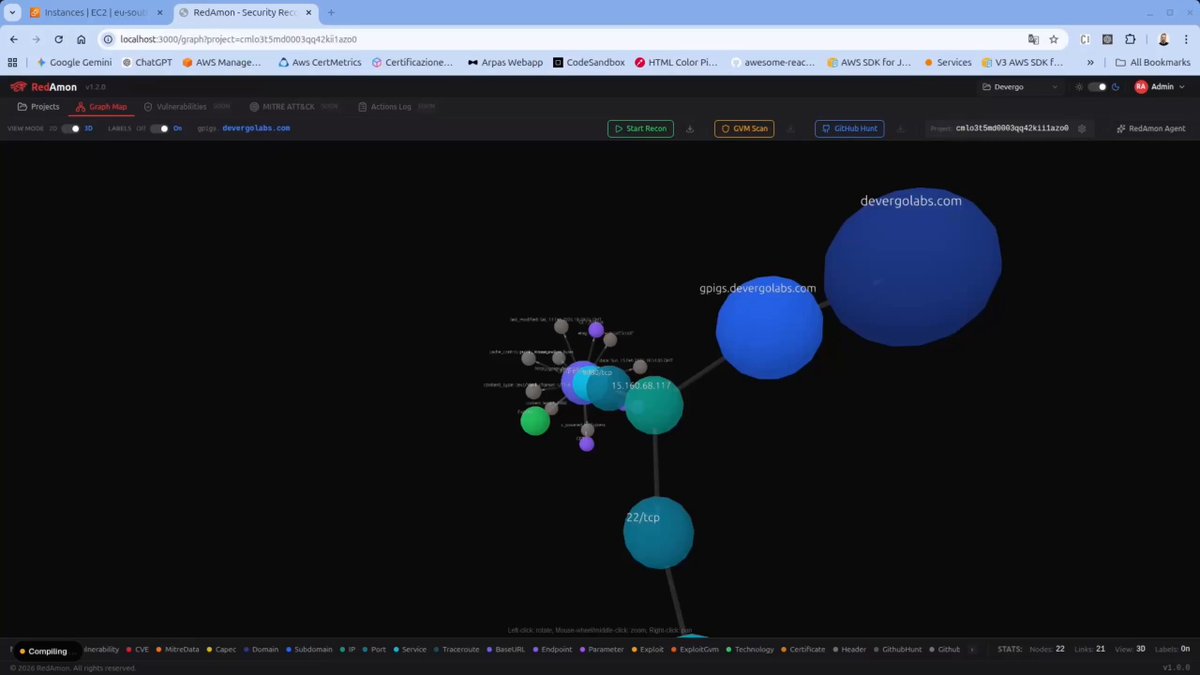
someone built an AI RED TEAM that maps your entire attack surface as a knowledge graph, finds every vulnerability, then EXPLOITS them to root access AUTONOMOUSLY its called RedAmon, 9,000 templates. 17 node types, actual Metasploit shells, not reports, no pentesters needed 6 phases of autonomous recon: subdomain discovery, port scanning, http probing, resource enumeration, vulnerability scanning, MITRE mapping every finding stored in a Neo4j graph with 17 node types and 20+ relationship types. the AI reasons about the graph, finds attack paths, and runs actual Metasploit exploits, actual shells stress-tested with zero vulnerability data, zero exploit modules, one instruction find a CVE and exploit it, it went from empty database to root-level RCE in 20 steps, researched the exploit on the web, crafted a custom deserialization payload, debugged itself when the first attempt failed next try, the server responded with root access, the highest privilege level on any Linux system. full control over everything the target was running node-serialize 0.0.4, a package with a critical deserialization flaw (CVE-2017-5941, CVSS 9.8), the server takes your cookie, decodes it, and passes it straight into unserialize() which executes any code inside it, the AI figured this out on its own with no hints built on LangGraph + MCP tool servers for naabu, nuclei, curl, metasploit. hunts leaked secrets across GitHub repos, 40+ regex patterns for AWS keys, Stripe tokens, database creds

chiefofautism

70,129 views • 4 months ago

MUST WATCH:🚨 Watch this crucial 20-minute video featuring prominent Democrats, computer science professors, and election security experts discussing the vulnerabilities in America's election system. They warn that the system is online, easily hackable, and often operates on outdated Windows 7 or older systems. Key Points: Easily Hackable Voting Equipment: All electronic voting equipment can be hacked as they must receive programming before each election from memory cards prepared on election management systems. These systems are often connected to the internet and run outdated Windows versions. Spread of Malware: If a county election management system is infected with malware, it can spread to USB drives, which then transfer it to voting machines, scanners, and ballot-marking devices throughout the county. Programming Practices: Most U.S. election systems are programmed by local county officials or third-party vendors. They use previously used USB drives on internet-connected computers before plugging them into scanners, tabulators, and voting machines. Outdated Systems: In 2019, the Associated Press reported that most of the 10,000 election jurisdictions, including swing states, were still using Windows 7 or older systems for ballot production, vote programming, counting, and reporting. End of Windows 7 Support: Windows 7 reached its end of life on January 14, 2020, with Microsoft stopping technical support and security updates. Remote Access and Modems: Voting machine manufacturers have installed remote-access software and wireless modems, connecting voting machines directly to the internet. NBC News reported in 2020 that ES&S, the largest U.S. election machine vendor, had installed at least 14,000 modems. Dominion Voting Systems: The second-largest vendor, Dominion, has publicly acknowledged using modems in their machines and running remote-access software during the 2020 election. For example, in Georgia, election worker Susan Voyles testified that Dominion employees operated remotely on ballot-marking devices and poll pads. Findings from Wisconsin and Michigan: Investigations found Dominion and ES&S machines online and connected to the internet. In Michigan, a modem chip was discovered in an ES&S voting machine, potentially allowing hackers to intercept and manipulate election results. Conclusion: Hackers can potentially infiltrate elections through vulnerable USB cards, election management systems, and voting machines themselves. This underscores the urgent need for securing America's election infrastructure.

KanekoaTheGreat

1,146,565 views • 2 years ago

XBOX Gen-10 details: • Microsoft's next-generation Xbox (Gen-10) is the company's most ambitious and risky gaming platform, built as a Windows 11 gaming PC with a TV-optimized, console-like interface. • It supports full backward compatibility for all Xbox One, Series X|S, and legacy games, plus any Windows 11 PC titles. • Users can exit the Xbox interface to full Windows for tasks like streaming, coding, or music production, akin to Steam Deck's Linux mode. • Core hardware features an AMD semi-custom SoC codenamed “Magnus.” • AMD CEO Lisa Su: “Development of Microsoft's next-gen Xbox featuring an AMD semi-custom SoC is progressing well to support a launch in 2027.” • 2027 launch is a "best-case scenario"; Microsoft insiders are surprised by Su's timeline, pending Windows 11 polish. • Xbox President Sarah Bond confirmed a multi-year Xbox-AMD partnership for hardware and backward compatibility. • Xbox and Windows teams collaborate for a seamless, console-like OS experience atop Windows 11. • Supports multiple storefronts: Xbox Store, Steam, and Epic Games Store, with ports to PS and Switch 2. • The "Xbox Everywhere" strategy offers hardware choices via OEM partners like ASUS (Xbox Ally preview). • OEMs (ASUS, Lenovo, and Razer) to offer a range of Xbox-branded devices at different price/performance points. • Microsoft plans its own first-party Xbox handheld in the future. • NPU-powered features like auto-generated gameplay highlight clips, testing on Xbox Ally X, and rollout in March 2026. • Emphasizes cross-play, cross-saves, and cross-purchasing via Xbox Play Anywhere to grow the industry. • First-party games ported to Steam, PlayStation, and Nintendo Switch 2. • Easier developer publishing tools; major updates at GDC 2026. • Polished software experience is critical; current Ally handhelds highlight Windows issues to fix. • Epic Games Store and Steam are expected to be part of the next Xbox’s multi-store openness, alongside Xbox’s own store. • Price is uncertain (due to tariffs and costs; OEMs for affordability), but the next Xbox may skew more premium (~$1,000)—while lower-end options may persist via partners. Also, Series S support will be extended. • Echoes the original Xbox vision of Windows in the living room; Surface-like premium ecosystem strategy. via: Windows Central Jez

Idle Sloth

69,919 views • 5 months ago

⚠️ A defense evasion tool called ExEngine is being sold as a service, marketed as an AV/EDR killer that disables mainstream consumer security software including Windows Defender, Malwarebytes, Bitdefender, and Avast. The tool combines AV termination with a Ring-3 rootkit, UAC bypass, and decoy payload delivery to support stealthy initial access operations. ⠀ ‣ Threat Actor: ryewx1 ‣ Category: Defense Evasion Tool / Killer ‣ Offering: ExEngine AV/EDR Killer ‣ Industry: Malware Tooling ⠀ The seller claims ExEngine actively terminates security software rather than only obfuscating payloads, granting attackers a longer window of undetected operation. The tool supports Windows 10 and 11 builds and is sold per-build at $150 to $250. ⠀ Advertised capabilities: ⠀ ▪️ AV/EDR termination with primary and fallback techniques ▪️ UAC bypass with automatic privilege escalation ▪️ Ring-3 rootkit functionality to hide files, processes, registry keys, and network connections ▪️ Discord webhook logging for victim machine info and execution status ▪️ Secondary decoy payload (game/document/installer) to keep targets unaware ▪️ Persistence across reboots and logouts ▪️ Anti-VM and anti-debug detection with fake error message exit ▪️ Universal Windows 10/11 support, all payload types ⠀ Risk to defenders: ⠀ ▪️ Active termination of consumer AV products including Windows Defender means traditional endpoint protections cannot be relied on once ExEngine executes successfully ▪️ Decoy payload pattern is designed to delay user-driven incident reporting, lengthening attacker dwell time ▪️ Ring-3 rootkit hiding of files, processes, and network connections complicates incident response triage on compromised hosts ▪️ Discord webhook telemetry indicates the operator is targeting consumer and SMB victims at scale rather than running individual targeted campaigns ▪️ Sold per-build at low cost ($150 to $250), making it accessible to low-skill operators who can pair it with commodity stealers, RATs, or loaders

Dark Web Informer

23,210 views • 2 months ago

‼️A malware binder tool branded "Universal File Binder 2026" is being sold on a popular cybercrime forum, advertised as fully undetectable and designed to disguise executable payloads as common file types including documents, images, and videos. ⠀ ‣ Threat Actor: Davina Keenan ‣ Category: Malware Tool Sale / Payload Binder ‣ Product: Universal File Binder 2026 ‣ Industry Impact: Phishing, Social Engineering, Initial Access ⠀ The tool is marketed as a payload binder, a category of malware used to attach executable code to a legitimate looking file so that opening the file triggers both the decoy document and the hidden payload. A video demo is attached to the listing and this post. ⠀ Advertised features: ⠀ ▪️ Claimed "100% FUD" (Fully Undetectable) against major antivirus engines including Windows Defender, Avast, and Kaspersky, at both scantime and runtime ▪️ Bind payloads to .jpg, .png, .pdf, .docx, .pptx, .mp4, and .mp3 files ▪️ Icon and extension spoofing, including double extension tricks ▪️ Lightweight stub with small footprint ▪️ Stated compatibility with Windows 10 and Windows 11 ⠀ Pricing: ⠀ ▪️ Single build: $100 ▪️ Lifetime access with updates: $1,000 ⠀ Binders of this type are a common component of commodity phishing kits, used primarily to deliver RATs, stealers, and ransomware via email attachments or messaging platforms. "FUD" claims on public forums are typically short lived and degrade within days or weeks of release as antivirus vendors collect samples.

Dark Web Informer

25,017 views • 2 months ago

This is a standard practice for almost all Tier-1 banking applications in Nigeria, and for some fintech applications I’ve previously performed pentests on. Client-side encryption isn’t a total waste, or a waste of compute, as some people have claimed, but rather a measure to protect against API tampering or API request/response manipulation between the client and the server when implemented properly. Even with HTTPS, attackers can capture a decrypted version of web or mobile API data in transit because the browser and the server establish a level of trust during the TLS handshake. Attackers can leverage this trust to capture & proxy already-decrypted traffic, tamper with it, and then forward it to the server. This allows them to override what the user interface or client is originally supposed to send and replace it with data of their choosing. That is why validation needs to be performed on both the client and the server side. To wrap up, encrypting API requests and responses makes it significantly harder for attackers to tamper with data, even if they capture the traffic, unless they have access to the encryption details (algorithm, encryption mode, key size, secret key, and initialization vector), assuming asymmetric encryption is used. In the demo below, you can see how I discovered additional parameters (balance, is_admin) in the API response, captured the registration API request, despite it being sent over HTTPS from the interface, added the discovered parameters, and successfully inflated my balance to 50 billion and also escalated my privileges to admin, and ultimately deleted the accounts of two live users/customers. In the second slide, I captured an API traffic of a bank app, and you can see how difficult the payloads are to read.

Ghost St Badmus

217,252 views • 7 months ago