

Danny Limanseta
@DannyLimanseta • 34,355 subscribers
I make games with AI. Product Designer, Co-founder at Nurture and Reroll.
Shorts


Videos

Yesterday, my boys and I vibe coded a game together. They tell me what they want in their game and I prompt it into Opus 5.5 to build it. And of course they picked "Zelda Breath of the Wild" inspired game, where they can explore an open world, do dungeon puzzles, fight mini bosses and a final boss. The twist is that the hero holds a giant paintbrush as a weapon, each color had a different attack and effect (red = fire, blue = ice, yellow = bounce, green = vines). And oh they also wanted to fly on the paintbrush. We spent our whole saturday playing and iterating on the game. It was great fun. I told them, the future is all about Imagination, whatever they can imagine, it will be manifested in a digital experience. At the end of the day, the game had: - 2 biomes (1 island and a bunch of floating islands) - Paintbrush-based combat (4 colors representing different effects and mechanics) - 3 dungeons with puzzles - An undeground cave - Unlockable flying paintbrush when you activate 4 crystals around the island - 30+ enemies and elites - 1 giant boss As you can see in the gameplaye video below, its not the most polished video game but it's so satisfying to see my boys getting bewildered when whatever they asked for, the game is built before their eyes. Of all the games I have vibe coded so far, this was the most satisfying because my boys were actively co-creating it and playing it. This is definitely not the last game we're making together, they have already started brainstorming their next game, hint: "Peak with grappling hooks and TNTs." You can play the game here, works only on desktop:
Danny Limanseta1,234,858 views • 21 days ago

I took Grok 4 for a spin this weekend to build this game prototype. I used SuperGrok Chat to generate the initial game prototype and then brought it over to Cursor to continue coding with Grok 4 MAX. Grok 4 in Cursor is like a no-nonsense agent. Doesn't speak much, but delivers the goods. There were moments where I was rate-limited or stuck on a bug or two that I had to get other models to help, but otherwise it's a fast, reliable model to work with. This makes me incredibly excited for Grok Code to launch in August!
Danny Limanseta20,490,794 views • 1 year ago

I got to try Grok 4.5 in early access in Cursor for the past few days and I absolutely enjoyed it. It feels like Opus 4.8 at 2x the speed at a much cheaper price point. I tasked it to brainstorm > plan > implement a big feature for my game (this act 1 boss fight) and it did not disappoint. - It is much smarter than Composer 2.5, during planning mode, it is able to think through my request more robustly, ensuring that edge cases are covered and makes sure to ask the right questions to confirm with me first. - It is much better at brainstorming ideas/suggestions, similar to Opus 4.8, though I think Fable still edges out a little when it comes to brainstorming ideas and suggestions - It is FAST. probably the fastest of all frontier models (Opus 4.8, GPT 5.5 etc), which makes it a joy to build with, because I can stay in the flow - It has much improved visual/animation capabilities than Composer 2.5, it can code up animations (i wanted an explosion animation with particle effects) with much, much better visuals, animation movement and timing. This is a big leap and I was so happy to see this improvement. - The best part for me is that I can just use the same model from planning down to execution without switching to a lower cost model because the price point is cheaper than other frontier models. I'll be testing this model with more challenging tasks in the next few days but I think this is going to be my main driver for vibe coding for a while. Also, its nice to see Grok back in the race. 🙌
Danny Limanseta1,431,098 views • 3 months ago

I’ve been using Grok Bot in early access for a little over a week now, and it has been a massive boost to my game dev workflow and my productivity in general. One of the first things I asked it to do was to visit my custom art generation tool webpage and generate art assets to replace all the image placeholders in my game. It looked through my codebase to understand what each asset was, wrote a custom art generation prompt for every single one, generated the images, cropped and cleaned them up into transparent PNGs, and then wired them back into the game. In about 2 hours, it generated 74 (cleaned and cropped) art assets for the cards and integrated all of them into my game. Now, ALL my art assets workflows go through Grok bot. This blew my mind because, before this, I was doing everything manually, one asset at a time. It basically solved my entire art asset workflow and allowed me to put it on autopilot, which is amazing. I’ve also been using Grok Bot for: Playtesting my game: The bot was a little slow initially, so I asked it to build a skill specifically designed to playtest my game, with intimate knowledge of its rules and mechanics. It’s much faster now, though I’m still looking for ways to optimise its speed. Setting up my itchio page for my game: It also automated a workflow that uploads a new build to itch whenever I push one to GitHub. Going to the itch website and uploading builds manually every single time was always a pain. Flowcharts and UX design: I’m a UX designer by day, so I decided to give it a much bigger task. I fed the agent a PRD and asked it to design the UX flows and wireframes. With the help of the Figma MCP, it actually delivered. Auditing all my paid subscriptions: I had it go through my emails and hunt down subscriptions that I might have forgotten about. Unsubscribing me from marketing newsletters: It did this beautifully, though it did miss a few newsletters. What I’ve learned is that it takes time to discover all the possible use cases for Grok bot. I’ve had to reevaluate my day-to-day workflows and figure out which parts I can delegate to it. So far, it has been a huge productivity unlock for me and I am discovering more uses for my Grok bots every other day.
Danny Limanseta806,616 views • 2 months ago

Little Habitats is launched! You can play it on this link below: It's a cosy island builder, inspired by games like Townscaper and Tiny Glade. - Design & create your own island habitat - Attract up to 17 small animals - Discover up to 23 landmarks through interesting tile placements - Uncover 6 wonders and festivities (these are hard to find!) - Invite majestic animal spirits to your island - Share your island with your friends with your own island URLs! Do give it a try! it should work decently on mobile and do share your islands too!
Danny Limanseta238,805 views • 22 days ago


I have just launched Treetop Tales on Wavedash! If you're like me and have always wanted to own a treehouse, you'll probably like this cosy sandbox game where you can build the treehouse of your dreams. Play now (works on mobile, recommended on desktop) This game has: - Only one thing to do: place a block. Rope bridges, slides and rocket ships appear on their own - 119 secrets to find, from pirate ships to paddling pools with rubber ducks - Watch the sun go down over your treehouse, with lanterns, fireflies and an aurora - Free in your browser, on desktop and phone. No timers, no goals If you've built a treehouse, pls share them in the comments! would love to see it.
Danny Limanseta55,201 views • 19 days ago

We may have reached the singularity with digital experiences. Opus 5.5 has proven that it's capable of producing tasteful, well-designed experiences, like this example here. Any digital experience will likely be commoditised, personalised and available to anyone who seeks it. In the near future, any digital experience you can think of will probably be generated in minutes, or even seconds. I'm still not sure what to think of this. On one side, it's amazing, we'll enter an era of digital content abundance. Whatever you seek to experience, learn or play, you'll be able to generate it in seconds. On the flip side, the joy of creation will be largely diminished, because any experience you could think of will probably have been generated by someone else already. I think premium gaming experiences and amazing movies by human directors will still exist, but that high bar is slowly getting eaten up by generative AI, and I can foresee a future where it surpasses even that. What a time to be alive to experience this. Play Little Habitats here (works well on mobile too) This mini-game is built by Opus 5.5 in 2+ hours.
Danny Limanseta62,402 views • 23 days ago

I'm truly impressed with Opus 5.5. I asked it to visualise Atlantis in ThreeJS for me, and it created a tour around Poseidia, the last surviving island of Atlantis. Sound on 🔊 for full trailer experience. Even this trailer is made by Opus 5.5 as well. I think we’re on the verge of a new type of media: Generative Experiences. The idea is that you can describe a world you have in mind and step into it is pretty incredible. You could explore its cities, meet its inhabitants, discover its stories, and shape what happens next through your own choices. This took Opus 5.5 about two hours to make. But if we extrapolate a year into the future, I can imagine being able to conjure up these kinds of fantastical, immersive experiences within seconds. The possibilities go well beyond gaming. Writers could walk through the worlds they’re building. Children could explore an ancient civilisation and ask questions along the way. Learning could become an experience you actively participate in, with the world responding to what you’re curious about. This is incredibly exciting and I am here for it. You can tour around Poseidia here:
Danny Limanseta57,342 views • 24 days ago

Very impressed with Composer 2.5 after about a day of usage. I've almost moved over to it exclusively from GPT 5.5, even using it for planning now. It's like Opus 4.7 on steroids, crazy fast. Fast models really get me into the flow of building, which is exhilarating. Also, a sneak peek of a weekend mini-project I'm building: a racing game where you race your mouse cursor.
Danny Limanseta299,550 views • 5 months ago


I gave Sonnet 5.5 full artistic control for this game and told it to create an atmospheric action/puzzle RPG across 5 biomes, 5 guardian boss fights and it delivered, with some handholding from me. Understory is entirely drawn with code and made in a couple days. I am still constantly blown away at how much "taste" the new Sonnet and Opus 5.5 has. The ending is really poignant. Highly recommend spending the 20-30mins to get to the ending if you have the time. The game is built on ThreeJS with procedural 2D art made by code. You can play Understory here (Desktop Browsers for best experience):
Danny Limanseta26,131 views • 12 days ago

Having a lot of fun making this retro Japanese-style survivor-like game where you grow from a tiny kaiju into a massive monster, destroying buildings and fighting the military robots and other creatures along the way. I vibe coded this in just over 2 weeks, and it comes with 4 different kaiju to unlock, 3 different biomes, and hundreds of upgrade options. I'm currently playtesting the game. Once it's ready, I'll post it on Wavedash!
Danny Limanseta47,308 views • 26 days ago

I've been making a chill parcel delivery game where you drive through a rainy Hong kong-inspired city with different districts, highways and alleys. Each parcel has a small, funny or poignant story tied to it and ocassionally you get to play mini-games like mahjong match-3, claw machines, karaoke and use a chopstick to catch flies. Made mainly with Sonnet 5.5 on ThreeJS. I think it turned out pretty ok!
Danny Limanseta29,328 views • 16 days ago

Happy to announce that the game I've been building for the past 2+ months now has a playable demo! If you're at your computer and would like to give the game a try, you can play it at I'd love to hear your feedback and suggestions in the itchio comments or in this thread. Thank you!
Danny Limanseta96,679 views • 2 months ago

Gunfrog is a bullet-time shooter mini-game where you play as a gunslinging frog with a grappling tongue! This project is mostly an experiment for me to try out Gabriel Dechichi's new Kaigen3D engine, and so far I'm pretty impressed! Here's my thoughts after playing around with it: - It's really fast to preview and compile. - Performance has been great in my tests so far. - The default character and environment presets look great out of the box! This means a lot IMO. - I noticed that all the frontier models seem to be really good at working with it, maybe because the engine runs on C and AI frontier models are great at C. - I bought some assets for this game and was pleasantly surprised by how easy it was to wire everything up. - The game isn't optimised for mobile yet, so it's best played on desktop for now with mouse and keyboard - The enemies actually try to take cover and wait for opportunities to attack you. It's not the smartest enemy AI, but pretty decent! Overall, I've had a lot of fun experimenting with the engine and making this little game. You can play Gunfrog on Wavedash here (PC desktop only for now): See you on the leaderboard!
Danny Limanseta12,921 views • 6 days ago
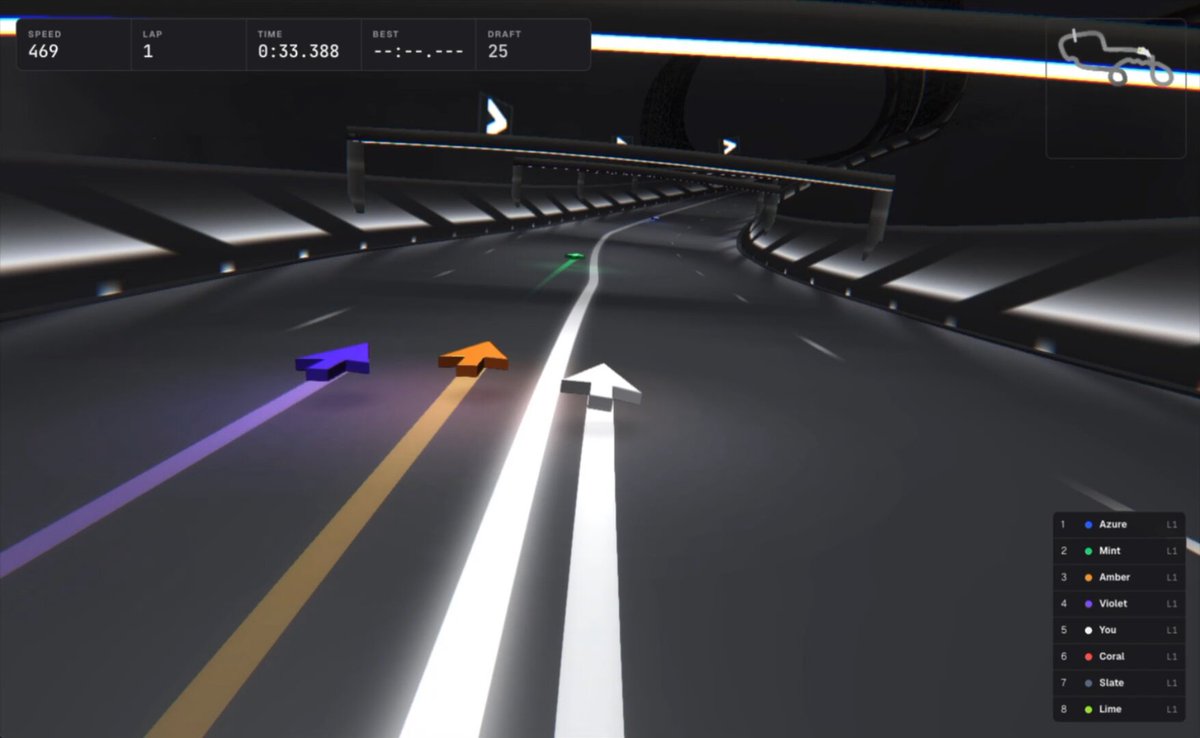
After a couple more days with Composer 2.5, I've got a pretty good sense of what it can do for game dev, specifically this mouse cursor racing game I'm building. It nailed ~80% of the features I threw at it, from planning to execution. Pretty amazing. I did have to switch to Opus 4.7 MAX a few times for features that need stronger visual understanding, like adding a 360 loop to the track or nailing a specific visual effect I had in mind. But man, Opus 4.7 MAX is expensive. Composer 2.5's visual understanding is weaker than Opus 4.7, but for most other things it's pretty damn close, and 10x cheaper. So it's now my default. The beauty of Cursor is I can switch models whenever I want, so I'm never stuck on one. Really excited for the larger incoming model. I have a feeling it's going to shine at planning. Can't wait!
Danny Limanseta172,578 views • 4 months ago
