
Dr. PM Dhakate
@paragenetics • 12,085 subscribers
Special Secretary, Hon’ble Chief Minister & Minority Welfare, Govt of Uttarakhand | MS-UKPCB | UIIDB |
Shorts


Videos

Tigers are obligate opportunists, but hunting megaherbivores carries risk. While tigers occasionally target vulnerable rhino calves, adult females pose fatal retaliation risks. Rhinos have poor eyesight, so this mother uses scent to detect the stalk and charges straight into the open, her aggressive grunts and snorts driving the cat away while keeping her calf glued close. A tiger cannot risk a injury; once ambush is lost, the hunt is called off immediately. VC: Manish Raj #Tiger #Wildlife #wildlifephotography #PredatorPrey #BigCats
Dr. PM Dhakate180,114 views • 8 days ago

A large Blue Bull (Nilgai) drinks at a waterhole while a leopard lies crouched inches away. Why does the predator hold back? Survival in the wild relies on strict risk management. Weighing nearly three hundred kilograms, a male Nilgai poses a lethal threat to a smaller cat. Attacking makes no sense. Instead, the leopard uses crypsis, freezing completely to avoid a fight. The bull, aware of its size, drinks calmly. Only when the heavy ungulate shifts and breaches the leopard’s critical flight distance does the cat break cover and retreat. It is a example of wild pragmatic coexistence. VC: CP Saini ( @ cp_saini ) #Leopard #Nilgai #Wildlife #BigCats #AnimalBehavior #Nature
Dr. PM Dhakate489,485 views • 1 month ago

Look at this Bengal tiger using cryptic posturing. By tucking its limbs and lowering its head, the cat eliminates its silhouette on the track. Its disruptive coloration dissolves into the leaf litter, mimicking a forest mound. When a smooth-coated otter approaches, an interspecies dynamic unfolds. Tigers often hold a tactical freeze to manage encounters or remain undetected. Meanwhile, smaller mammals use close-range inspection to evaluate landscape anomalies. This interaction is a prime example of predator behavior and survival strategies within shared ecosystems. VC: Manveer Singh (manveer_singh8786) #Tiger #Predator #Wildlife #WildlifeConservation
Dr. PM Dhakate141,109 views • 2 months ago


The footage shows dominance as a tiger extracts a Mugger crocodile from the waterline. In this rare predator-versus-predator encounter, the tiger demonstrates its status as the ultimate hunter. By securing a precise grip on the back of the neck, the tiger targets the base of the skull, instantly neutralizing the crocodile's armored defenses and powerful jaws. Dragging such dense weight through the mud requires immense physical power. This hunt proves that even a formidable reptile is viewed as prey when a tiger exerts its capabilities. VC: anirudh_lakshmipathy #nature #wildlife #tiger #predator #tigerconservation #predatorvspredator
Dr. PM Dhakate393,935 views • 8 months ago

What an incredible moment of quiet understanding between two worlds sharing the same stretch of earth. But don't let the mesmerizing calm fool you into a sense of safety, because in that beautiful stillness lies a universe of raw power. A tiger moves like lightning, and the gap between admiration and tragedy can be closed before you even draw a breath. This is the pact of the wild: admire its beauty, but never forget the razor-thin line you walk. Distance isn't just a suggestion; it's everything when coexisting. VC: maddie_jungle_diary #tiger #predator #nature #wildlife #wildlifeconservation #coexistence
Dr. PM Dhakate302,166 views • 11 months ago

Even for an apex predator like the Royal Bengal tiger, wild boars are formidable opponents. Consequently, tigers often try to hunt them in the early morning, as this is when the boars are typically drowsy. This timing provides the tiger with a much-needed advantage, yet despite this edge, the hunts frequently fail. VC: Durgesh_Sonwane_Pench #tiger #bigcat #predator #royalbengaltiger #wildlife #nature
Dr. PM Dhakate257,541 views • 10 months ago

A tiger sees you several times before you see it once. This footage captures a high Flight Initiation Distance (FID) response. The engine’s vibration and noise, triggered this tiger’s nervous system, resulting in a defensive mock charge. Recent field data confirms that traditional Gypsys force predators into "fight or flight" states prematurely. High FID leads to cumulative stress and unnecessary caloric expenditure. Transitioning to silent Electric Vehicles reduces this acoustic friction and vehicular pollution allowing for natural behaviors and shorter, stress-free approach distances. VC: Sonurawat #Tiger #Predator #FlightInitiationDistance #TigerBehavior #WildlifeConservation #FlightInitiationDistance
Dr. PM Dhakate199,155 views • 8 months ago
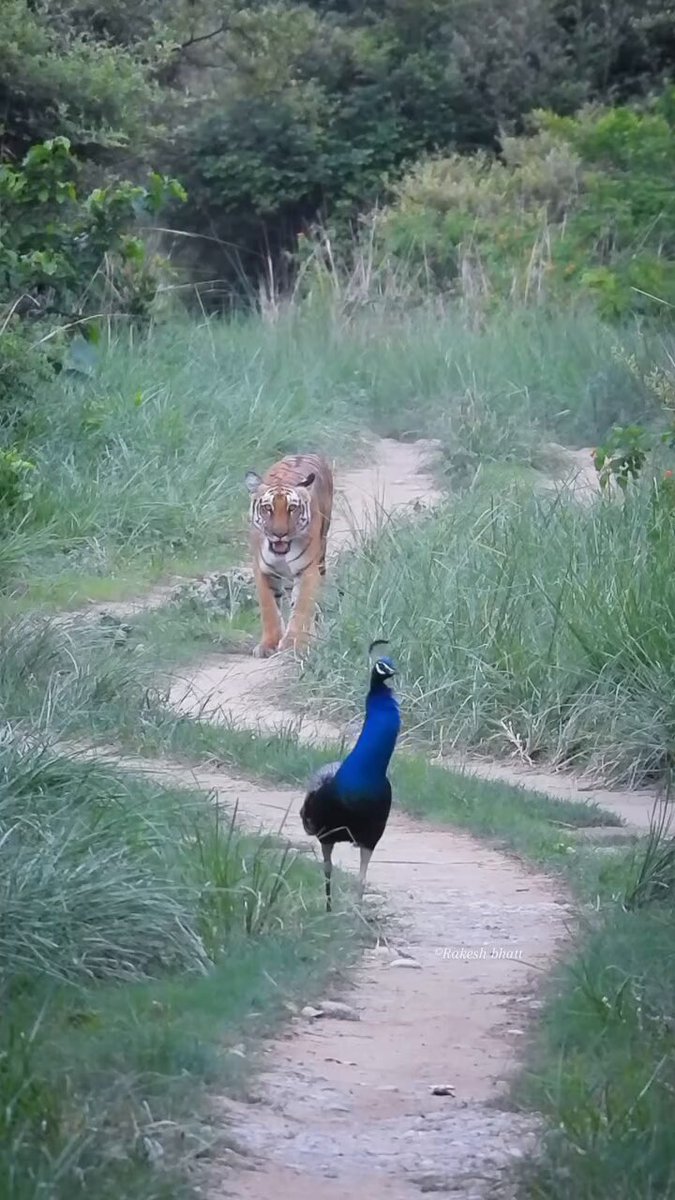
An amazing video, our national animal and bird, together in one frame! A perfect symbol of India's vibrant spirit. Wishing everyone a Happy Independence Day. आप सभी को स्वतंत्रता दिवस की हार्दिक बधाई एवं शुभकामनाएं, जय हिंद। 🇮🇳 VC: Rakesh Bhatt #IndependenceDay #JaiHind #स्वतंत्रता_दिवस #India #tiger #peacock
Dr. PM Dhakate215,261 views • 1 year ago

Rearing four wild tiger cubs reflects peak ecosystem health. A litter this size requires high prey density and a secure core territory to support the metabolic demands of lactation, which increases a mother’s daily caloric requirement by roughly 50%. To nurse all four cubs simultaneously, the tigress relies on a functional postural shift. Lying on her side, Elevating her leg opens direct access to the higher-yielding rear inguinal teats, allowing every cub a dedicated spot to feed without overcrowding while the mother conserves critical energy. VC: Durgesh Sonawane ( @ durgesh_sonwane_pench ) #Tigers #BigCats #Wildlife #Conservation #Nature
Dr. PM Dhakate30,733 views • 1 month ago

When tiger cubs freeze on asphalt, it is a sensory disruption. Bare tarmac provides none of the familiar tactile feedback of forest soil and leaf litter. Because their neuromuscular motor pathways are still developing, they lack the smooth, low-slung stride of adults, defaulting to cautious pauses and explosive, uncoordinated bounds. To neutralize this vulnerability, the tigress relies on spatial buffering. She plants her body broadside in the lane creating a physical barrier against oncoming traffic and offering a visual anchor until every cub crosses safely. VC: rawtadoba #Tigers #Wildlife #Nature #TigerCubs #AnimalBehavior #BigCats
Dr. PM Dhakate13,234 views • 18 days ago

This "safari jam" shows a critical point in wildlife tourism. When vehicles crowd a tiger’s path, the animal’s natural movement is disrupted, forcing it into a "fight or flight" state. The tiger’s vocalization is a clear territorial stress signal. Crowding creates a physical barrier, increasing cortisol levels (stress hormone) and potentially leading to defensive aggression. Responsible tourism requires maintaining distance and absolute silence. Respecting the tiger's corridor ensures both visitor safety and the animal's ecological well-being. VC: ratanbhayal #TigerConservation #ResponsibleTourism #WildlifeEtiquette #Tiger #wildlife #SafariEthics
Dr. PM Dhakate90,148 views • 6 months ago

Nursing a litter of five cubs places a substantial physiological demand on a tigress. To sustain lactation for six months, she must increase her caloric intake by nearly 50%, often hunting daily to provide. During this period, her own physical condition may decline as nutrients are prioritized for the cubs’ growth. This biological investment shows whether in the jungle or a home, motherhood requires intense sacrifice. It is a selfless redirection of energy that ensures the survival of the next generation across all species. VC: PlanetTiger #Tiger #WildIndia #Wildlife #BigCatConservation #MotherNature #WildlifePhotography
Dr. PM Dhakate90,307 views • 7 months ago

What looks like play is actually acute distress. In fringe habitats, Encounters between domestic dogs and wild elephants often lead to conflict. Elephants possess a highly sensitive neurobiology, reacting intensely to unpredictable stimuli. This deep reactivity triggers the severe physiological stress response seen here. These rapid movements are escalated threat displays designed to displace perceived predators. We consistently misread these vital cues. Ignoring defensive postures and distress vocalizations directly fuels conflict. Coexistence demands behavioral sensitization. By learning to accurately read animal body language, communities can recognize escalating danger, secure their dogs, and prevent these encounters. VC: Modhu Bhai #HumanWildlifeConflict #AsianElephant #AnimalBehavior #WildlifeConservation #Coexistence
Dr. PM Dhakate17,914 views • 1 month ago

A good documentation. This video shows practical skill development. The sub-adult cubs' interaction with the Gaur kill is "object-play," a behavioral mechanism for developing complex motor skills. It's a hands-on training, allowing them to study the prey's structure and practice survival techniques. Each interaction builds muscle memory and refines the instincts needed to become independent hunters. This is experiential learning, building raw competence through direct, practical application. VC: wanderinginthewilderness_ #Tiger #Predator #TigerCubs #Wildlife #AnimalBehaviour #Gaur #WildIndia #wildlifeconservation #wildlifeeducation
Dr. PM Dhakate111,961 views • 10 months ago

When a tiger stalks a gaur through tall grass, every movement reduces sound. The cat lowers its center of mass, pressing its chest close to the earth to break its silhouette. As it steps forward, it relies on direct registration, placing each hind paw into the exact footprint left by its front paw. This precise footfall reduces noise and prevents vegetation from snapping underfoot. Soft pads absorb impact while retractable claws remain sheathed. Eyes lock forward, measuring distance before explosive acceleration. Silent locomotion in dense cover relies entirely on stealth. VC: Ashutosh ( @ rover.ashie ) #Tiger #Wildlife #Nature #BigCats #WildlifeConservation #WildIndia
Dr. PM Dhakate20,364 views • 1 month ago

From an emerald bush to the dusty red track Shy, striped little monks step out and glance... Though alarm calls ring out from the jungle... Their mother keeps watch with a vigilant love. Four curious cubs gather close on the trail, Where fear and sweet wonder together prevail. Soon time will disperse them to wander alone, And each shy young prince will claim his own throne. VC: Vasu Kiran Ranga ( @ kiranranga_ ) #Tiger #WildlifePhotography #BigCats #Wildlife #Nature #WildIndia
Dr. PM Dhakate19,138 views • 1 month ago

This amazing video captured by Bertie Gregory features a rare top angle drone shot of a cheetah in full sprint. From this perspective, you can see how its spine works like a massive spring, stretching and contracting to cover over seven meters in a single stride. Unlike other cats, cheetahs have "semi-retractable" claws that act like track spikes, providing permanent grip on the ground. Their long, heavy tail serves as a biological rudder, swinging sharply to balance the body during high-speed turns. It’s perfect natural engineering designed for one thing-pure, explosive speed. VC: Bertie Gregory #Cheetah #nature #wildlife #WildlifePhotography #NatureIsAmazing #DroneShot #Speed
Dr. PM Dhakate74,041 views • 6 months ago

This is an amazing video showing how Tigers communicate through a sophisticated chemical language. In this footage, a Bengal tiger performs the Flehmen response after sniffing a scent-marked tree. By curling its upper lip, the tiger directs pheromones to the Jacobson’s organ located in the roof of its mouth. This "taste-smelling" process identifies the age, gender, and reproductive status of the individual that marked the territory. It is a vital survival mechanism for managing social hierarchies and mating without direct physical confrontation. Video Credits: Ratish Nair (ratishnairphotography) #Tiger #WildlifeConservation #IndianWildlife #AnimalBehavior #TigerReserve
Dr. PM Dhakate86,277 views • 8 months ago

A cheetah hitting a sharp turn at high speed should logically skid out, but it doesn't. The secret is the tail. This muscular rudder acts as a high-speed stabilizer. By whipping it in the opposite direction of a turn, the cheetah creates counter-torque to balance its center of mass. This allows for rapid pivots while semi-retractable claws provide permanent, spike boots-like traction. It’s pure biomechanics using physics to manage angular momentum. While we build supercars with active spoilers, nature perfected this steering millions of years ago. VC: Lemurt Wildlife #wildlife #nature #predator #cheetah #biomechanics
Dr. PM Dhakate58,609 views • 5 months ago