正在加载视频...

视频加载失败

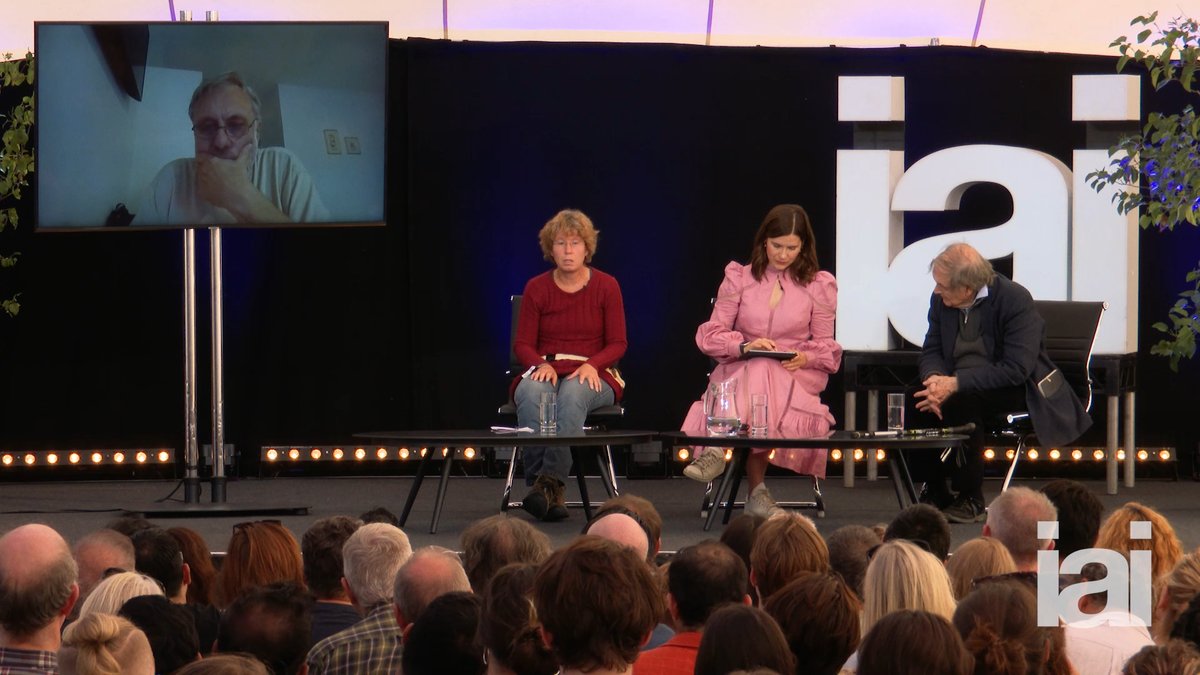
Are brains computational? Can AI be conscious? Roger Penrose, alongside Max Tegmark and Sabrina Gonzalez Pasterski, unpacks the deepest questions at the intersection of neuroscience, mathematics, and physics, challenging whether minds are just biological computers, or something fundamentally beyond computation. Tap to watch in full.

13,271 次观看 • 5 个月前 •via X (Twitter)

0 条评论

暂无评论

原始帖子的评论将显示在这里

相关视频

Adding more GPUs will never make a machine conscious. Nobel Prize-winning physicist Roger Penrose just dismantled the entire AI race’s core assumption. Right now, the industry operates on one belief. Build massive data centers. Scale the models. AGI will just “wake up.” Penrose destroys this completely. Penrose: “There is this sort of view that once you make a computer complicated enough or something, it suddenly becomes aware. I just don’t believe that. There’s no reason to believe that.” A machine can compute better than any human alive. But computation is not awareness. Penrose: “There is something quite different involved in understanding things, in being aware of things, of feeling things, which is not part of computations.” We’re confusing rule-following with actual intelligence. Penrose: “The keyword is the word ‘understanding.’ You can follow rules alright, but we don’t understand what we’re doing. The understanding is the key point.” Models today are exceptional at processing data. At mimicking logic. But true understanding requires consciousness. Penrose: “It doesn’t make sense to say of a device that it understands something if it’s not even aware of it. There is something much more profound in being conscious of something.” And here’s what should terrify every AI lab on earth. Penrose: “I believe that the brain is following the laws of physics, sure. We don’t have a good picture of the laws of physics.” Penrose: “Quantum mechanics is not an answer to the way the universe operates. It’s a partial answer. It’s incomplete.” We’re trying to engineer synthetic consciousness using classical computation. While biological consciousness likely operates on physics we haven’t even discovered yet. The race to AGI isn’t just an engineering problem. It’s a frontier science problem. The labs are hiring engineers. The problem might require physicists who don’t exist yet.

Dustin

196,638 次观看 • 4 个月前

Roger Penrose, Nobel Prize-winning physicist and mathematician, explains why we should stop calling it AI and start calling it "artificial cleverness": He believes the entire field is mislabelled, and the label itself is doing damage. His objection is simple but cuts deep: "The name is wrong. It's not artificial intelligence. It's not intelligence. Intelligence would involve consciousness. Well, if it's a machine, it's not conscious." For Penrose, people have confused raw computing power with genuine understanding. "People have lost the plot. They've lost it in the power of computing. The thing is that computers have got so powerful that they've lost the thread of what they're doing. But I think consciousness is something different. It's not computational." He believes the term itself has hypnotized people into a category error: "People are so hypnotized. The trouble is that AI is a bad term. It means artificial intelligence. Now intelligence in my view is conscious. That's what intelligence is about." So he proposes a rename. Artificial Cleverness. AC instead of AI. To illustrate the distinction, Penrose draws on his experience teaching mathematics: "You have mathematics students. Some of them understand what they're doing. Some are just clever. They can repeat what they've learned. They know how to do it very cleverly. They can calculate very well, but they don't necessarily understand what they're doing." That gap, between calculating well and actually understanding, is the gap Penrose sees between today's machines and genuine intelligence. Cleverness can be manufactured. Consciousness, in his view, cannot. So the question worth sitting with: when we call a system "intelligent," are we describing what it does, or quietly assuming something about what it is?

Big Brain AI

117,354 次观看 • 1 个月前

Roger Penrose just broke the most expensive assumption in human history. Every major AI lab operates on one belief. Scale it far enough and consciousness just appears. Penrose: “There is this sort of view that once you make a computer complicated enough or something, it suddenly becomes aware. I just don’t believe that. There’s no reason to believe that.” Nobel Prize in Physics. Proved black holes are inevitable from general relativity alone. And he’s calling the foundational thesis of the entire AI industry a baseless assertion. Not flawed. Not premature. Baseless. No one proved that complexity produces consciousness. No experiment. No paper. No mathematical proof. The most technologically advanced industry built its core thesis on an assumption indistinguishable from faith. Penrose: “The keyword is the word ‘understanding.’ You can follow rules alright, but we don’t understand what we’re doing. The understanding is the key point.” These models don’t understand anything. Not the questions. Not the answers. Not a single word they generate. They process. They predict. They output. But understanding requires something no architecture has ever produced. Awareness. Penrose: “It doesn’t make sense to say of a device that it understands something if it’s not even aware of it. There is something much more profound in being conscious of something.” They built the most sophisticated language machines in history. Not one has ever experienced a single moment of its own existence. Penrose: “There is something quite different involved in understanding things, in being aware of things, of feeling things, which is not part of computations.” Awareness is not a software update. Consciousness is not a scaling problem. You cannot build what you cannot define. And no one alive has defined consciousness. Penrose: “I believe that the brain is following the laws of physics, sure. We don’t have a good picture of the laws of physics.” Penrose: “Quantum mechanics is not an answer to the way the universe operates. It’s a partial answer. It’s incomplete.” The physics that lets you read this sentence and know that you’re reading it might not exist in any textbook on Earth. We are not just trying to build machines that think. We are trying to engineer something we experience every second of our lives and cannot explain. You are proof of that right now. You are conscious. You know you exist. You feel yourself thinking. No one alive can tell you what that is. That is what the largest investment in human history is trying to build.

Dustin

22,012 次观看 • 2 天前