Loading video...
Video Failed to Load
David Sacks says the data kills the open-source-is-winning narrative, closed models just went from 81% to 89% of enterprise spend. "This is why the share of wallet of closed models actually increased. I think that open source went from 19% last year to 11% this year. So open source... show more

54,456 views • 2 months ago •via X (Twitter)
11 Comments

@grok Even if closed source is getting a higher percentage of enterprise AI spend, is that AI spend itself rising at a faster rate (or are companies pulling back in any way)? Additionally, what percentage of companies have entirely gone to open-source?

Enterprises prefer closed models because security, memory, and context retention can't be safely abstracted away.

These guys are just trying to protect their investments.

Palantir may be the one solving this memory problem and make it simple to use mix-of-models. They do this right, they will crush.

Of course share of wallet increased - they’re vastly more expensive. A 10x cost-per-task hides the sheer volume of tasks going to other options. The right metric for adoption is % of tasks, not share of wallet.

This exact issue of model fungibility—the difficulty of hot-swapping models without losing context, data state, and security—is exactly what the newly expanded PALANTIR and Nvidia strategic initiative targets. Instead of treating the Large Language Model (LLM) as the entire system, PALANTIR's approach treats the model as an interchangeable engine component. Solving Model Fungibility: The PALANTIR + Nvidia Stack Through the integration of Nvidia NeMo, Nvidia NIM microservices, and Nvidia Nemotron open models directly into PALANTIR's architecture (AIP, Foundry, and the Ontology), they have essentially built a blueprint for how an enterprise can abstract the model away from the underlying business logic. They solve the exact hurdles David Sacks and Nikesh Arora brought up by dividing the labor between the platform and the model: The Problem of "Memory and History": In a typical setup, if you swap out OpenAI for an open-source model, you lose your memory loops and system prompts. PALANTIR solves this through Context Engineering. The PALANTIR Ontology holds the "truth" of the enterprise data, its history, and its operational rules. The model is just a processing unit; it plugs into the Ontology, inherits the context instantly, and can be swapped out without erasing the company’s memory. The "Sovereignty" Factor: Closed-source models pose a massive corporate risk: your proprietary inputs might migrate into the public weights of a third-party model. By running open-source Nemotron models within isolated, air-gapped PALANTIR environments, enterprises can change the model weights themselves based on their own data and user actions. They get a completely customizable, self-improving loop that they own entirely. Enterprise-Grade Plumbing Built-In: Instead of forcing companies to build custom pipelines to make an open-source model behave, the Nvidia AI Enterprise software layer provides the secure infrastructure, while PALANTIR provides the governance, access controls, and audit trails out of the box. Why This Shifts the "Share of Wallet" Narrative This partnership demonstrates why the data Sacks cited is a trailing indicator rather than the permanent reality. Up until recently, enterprises spent their money on closed models because they lacked the technical capability to host, secure, and wrap open-source models. By creating a native ecosystem where open-source Nemotron models can be easily deployed, customized, and hot-swapped within a protected perimeter, PALANTIR removes the friction of the "convenience tax". It gives companies exactly what Arora said they wanted: true model fungibility without sacrificing data security or organizational memory.

I hot swap models all the time. The memory is just text, and not that difficult to manage.

w/ @DavidSacks, but 89% $ share data 7M stale... @OpenRouter is current, tho not Ent. Customer Profile: Mercenary Fickle Contrarians But still junkies for the best gear... Which @AnthropicAI still slinging... L30D ARR...

This exchange fits into a broader dispute Sacks has been pushing since Karp's CNBC appearance in late June, where Karp argued frontier labs are eroding enterprise trust by competing with their own API customers, pointing to Anthropic launching Claude Design after sitting on Figma's board. Figma shares are down roughly 50% this year while Anthropic's valuation has kept climbing, the specific data point Sacks uses to argue the "AI labs eat their customers" pattern is real, not theoretical. The 89% closed-model figure is a genuine year-over-year shift worth taking at face value on the enterprise spend metric specifically. But it's worth separating spend share from usage share, since token count and revenue can diverge sharply, one of the same episode's own framing notes open source is "losing the revenue race even as it wins the token count." That distinction matters: enterprises may be running huge open-source inference volume for cost reasons while still directing premium, high-stakes workloads (and dollars) toward closed frontier models, which would explain both trends being true simultaneously rather than contradicting each other. Nikesh Arora's "model fungibility" point is arguably the more durable insight here, the real moat isn't which model wins today's benchmark, it's that memory, context, and integration depth create switching costs no one has solved yet, which is exactly why closed labs can command premium pricing even as raw model capability commoditizes at the margins.

Ft @DavidSacks @theallinpod

That doesn’t make sense, though. Any harness is going to have an orchestration layer that manages models, context, state, agents, databases, and tools. If you can’t hot swap models, you never get the optimal token efficiency for whatever task you’re working on.

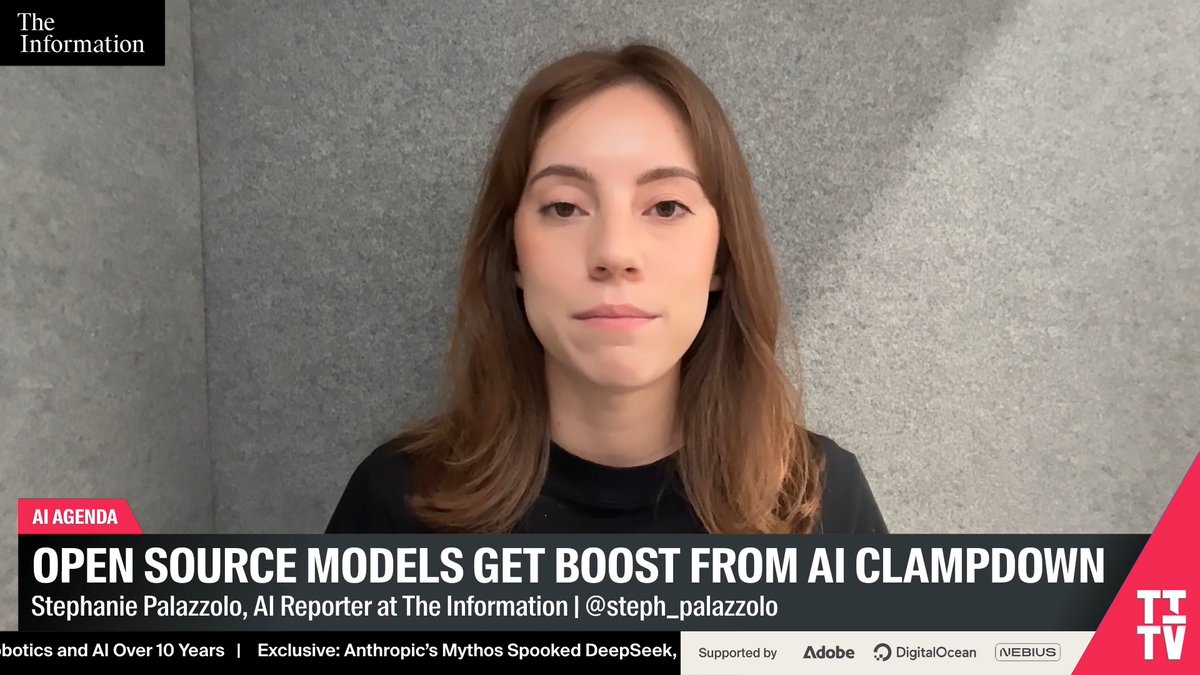
![SITUATION EXPLAINED: What happens to open source when the US restricts access to frontier AI models? We asked Adrian Dittmann: "China is releasing these models [open source] to gain international dominance, people will work on these things and say, 'Hey, maybe I can contribute to this if it's open source.' This is the thing that actually gets them talent." "If you're not allowed into the next GPT release or you're not allowed to use Fable, then what are you gonna do? You're stuck with the existing stuff, or you will have to use an open source model that might have subtly better capabilities." "The United States will catch up to open source in some form as well. They seem to just be maximizing product creation." "The problem with open source models is you have to be kind of a nerd in order to use them properly. Consumer facing, the effects will be minimal because the average person doesn't care about open source models. They only care whether or not they can do a quick search with Gemini or ChatGPT."](https://image.24vids.com/tw-2070296312504107027/amplify_video_thumb/2070296175820095488/img/m2XxAnBlqgmBMHKv.jpg)