正在加载视频...

视频加载失败

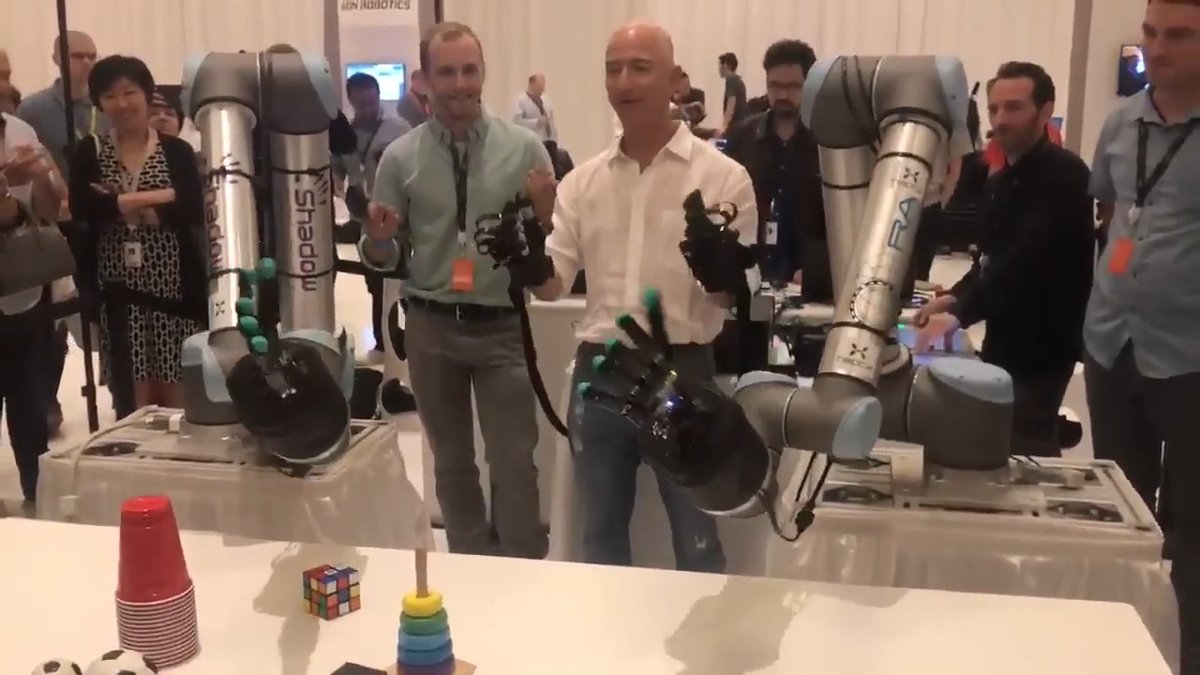
🚀Exciting News! We’re thrilled to introduce OpenWBT — the open-source, whole-body VR teleoperation system designed for humanoid across various robot types & virtual/physical worlds! 🤖✨ 💡Developed through collaboration between Galbot and Tsinghua University researchers! 🔥 Why it’s cool? ✅ Multi-robot support – Control different types of bots with one...

38,510 次观看 • 1 年前 •via X (Twitter)

0 条评论

暂无评论

原始帖子的评论将显示在这里

相关视频

🔥 JUST IN: Open-source robotics dataset from 100% real-world scenarios! 🤯 Chinese robotics company AGIBOT just released AGIBOT WORLD 2026, an open-source dataset systematically covering key embodied AI research directions. Built entirely from real-world environments: commercial spaces, and homes. Collected using AGIBOT G2 robots in free-form collection mode, providing structured, accurately annotated, high-quality data. Digital twin technology creates 1:1 scale replicas in simulation matching the real environments. Both real-world and simulation data are open-sourced. The AGIBOT G2 platform collects multiple data types simultaneously: RGB(D) cameras, tactile sensors, force sensors, LiDAR, IMU, and full-body joint states. Whole-body control coordinates arms, waist, and hands for complex tasks. First-person teleoperation lets operators control the robot from its perspective. The tasks covered are fine-grained manipulation, ultra-long-horizon tasks, spatial navigation, dual-arm coordination, and multi-agent/human-robot collaboration. The dataset includes error-recovery trajectories with annotations. Most datasets only show successful demonstrations. AGIBOT includes failures and how the robot recovers, teaching models how to handle mistakes. After collection, data is tested through policy training and real-robot deployment to ensure quality. Then processed through industrial quality control with multiple screening and cleaning rounds. Making it open-source accelerates embodied AI research by giving researchers access to high-quality real-world robot data at scale. 🇨🇳 Learn more here: ~~ ♻️ Join the weekly robotics newsletter, and never miss any news →

Lukas Ziegler

40,583 次观看 • 4 个月前

Everything you love about generative models — now powered by real physics! Announcing the Genesis project — after a 24-month large-scale research collaboration involving over 20 research labs — a generative physics engine able to generate 4D dynamical worlds powered by a physics simulation platform designed for general-purpose robotics and physical AI applications. Genesis's physics engine is developed in pure Python, while being 10-80x faster than existing GPU-accelerated stacks like Isaac Gym and MJX. It delivers a simulation speed ~430,000 faster than in real-time, and takes only 26 seconds to train a robotic locomotion policy transferrable to the real world on a single RTX4090 (see tutorial: The Genesis physics engine and simulation platform is fully open source at We'll gradually roll out access to our generative framework in the near future. Genesis implements a unified simulation framework all from scratch, integrating a wide spectrum of state-of-the-art physics solvers, allowing simulation of the whole physical world in a virtual realm with the highest realism. We aim to build a universal data engine that leverages an upper-level generative framework to autonomously create physical worlds, together with various modes of data, including environments, camera motions, robotic task proposals, reward functions, robot policies, character motions, fully interactive 3D scenes, open-world articulated assets, and more, aiming towards fully automated data generation for robotics, physical AI and other applications. Open Source Code: Project webpage: Documentation: 1/n

Zhou Xian

3,819,258 次观看 • 1 年前

Excited to announce GR00T N1, the world’s first open foundation model for humanoid robots! We are on a mission to democratize Physical AI. The power of general robot brain, in the palm of your hand - with only 2B parameters, N1 learns from the most diverse physical action dataset ever compiled and punches above its weight: - Real humanoid teleoperation data. - Large-scale simulation data: we are open-sourcing 300K+ trajectories! - Neural trajectories: we apply SOTA video generation models to “hallucinate” new synthetic data that features accurate physics in pixels. Using Jensen’s words, “systematically infinite data”! - Latent actions: we develop novel algorithms to extract action tokens from in-the-wild human videos and neural generated videos. GR00T N1 is a single end-to-end neural net, from photons to actions: - Vision-Language Model (System 2) that interprets the physical world through vision and language instructions, enabling robots to reason about their environment and instructions, and plan the right actions. - Diffusion Transformer (System 1) that “renders” smooth and precise motor actions at 120 Hz, executing the latent plan made by System 2. We deploy N1 on GR1 robot, 1X Neo robot, and a large collection of simulation benchmarks. N1 achieves up to +30% boost in diverse manipulation tasks for household and industrial settings. While humanoid robots are the main focus of N1, our model also supports cross-embodiment. We finetune it to work on the $110 HuggingFace LeRobot SO100 robot arm! Open robot brain runs on open hardware. Sounds just right. Let’s solve robotics, together, one token at a time. Links to our Whitepaper, Github repo, HuggingFace model, and open dataset page in the thread: 🧵

Jim Fan

466,442 次观看 • 1 年前

China unveils humanoid robot with lifelike skin and blinking eyes built for daily life | Prabhat Ranjan Mishra, Interesting Engineering Large Language Models (LLMs) and Vision-Language Models (VLMs) help process and interpret complex data from human interactions. A Shanghai-based company has developed humanoid robots that appear as real as humans. The advanced bionic humanoid robot is integrated with self-supervised AI algorithms. Named Elf V1, the robot can perceive the world, communicate, learn, and interact intelligently with its surroundings. Developed by AheadForm Technology, the robot offers up to 30 degrees of freedom, powered by a precise control system and an advanced AI learning algorithm. Robot offers expressive facial features The robot offers expressive facial features, moving eyes, and synchronized speech. It can also convey emotions and understand human non-verbal cues, making interactions more natural and engaging. The robot has highly interactive capabilities and lifelike appearances. AheadForm expects that its robots could soon seamlessly integrate into daily life, providing assistance, companionship, and support across various industries. “We believe that by developing realistic and expressive robot heads, we can bridge the gap between humans and machines, fostering a new era of interactive and intelligent robotics,” said the company in a statement. Reports revealed that to avoid the “uncanny valley” effect and be able to interact with us, they are given lifelike skin and capabilities to read our emotions and respond appropriately using dynamic expression simulation and emotion generation tech. Bionic skin and high-precision control system The Elf V1 series of humanoids features 30 facial muscles animated by brushless micro-motors and managed by a high-precision control system. Paired with an ability to detect their users’ emotions with low latency and bionic skin, their facial expressions are nearly identical to those of humans, reported CGTN. The company claims it’s pioneering the development of realistic humanoid robots designed to revolutionize human-robot interaction. It’s enhancing sophisticated humanoid robot heads that can express emotions, perceive their environment, and interact seamlessly with humans. By combining cutting-edge AI and advanced robotics, AheadForm aims to bring life to machines and transform how humans engage with technology. AI models boost robots’ responsiveness Seamless integration of Large Language Models (LLMs) and Vision-Language Models (VLMs) into the humanoid robots can help them process and interpret complex data from human interactions, enabling the robot to learn and adapt in real-time, achieving human-level understanding and responsiveness. AheadForm uses Brushless Motors that deliver ultra-quiet operation and high responsiveness, specifically designed for precision facial movements in humanoid robots. With its compact size, lightweight design, and energy efficiency, this motor is the ideal choice for next-generation robots that require precise, subtle facial control to create a truly human-like experience. Previously, the company unveiled the Lan Series that features realistic humanoid robots with soft skin and 10 degrees of freedom, offering a lifelike appearance and intuitive movements. This series is designed for cost-efficiency, for applications prioritizing mobility and manipulation.

Owen Gregorian

179,005 次观看 • 10 个月前

🚨 BREAKING: ABB Robotics + NVIDIA close the sim-to-real gap with 99% accuracy! 👾 ABB Robotics is integrating NVIDIA Omniverse libraries into RobotStudio to deliver physical AI for industry, closing the gap from virtual training to real-world deployment with up to 99% accuracy. RobotStudio HyperReality, available second half of 2026, will fundamentally change how quickly manufacturers can scale production: reducing costs by up to 40%, accelerating time-to-market by 50%, and cutting setup and commissioning times by up to 80%. For decades, the deficit between simulation accuracy and real-world lighting, materials, and environments has limited manufacturers' ability to design advanced manufacturing processes in the virtual world. The only robot manufacturer with a virtual controller running the same firmware as the hardware, ensuring near-perfect correlation between simulation and real-world performance. The system uses physically accurate simulations and foundation models endlessly optimized with real-world data feedback. These models can train any number of ABB robots anywhere in the world with industrial-grade reliability. Foxconn is using RobotStudio HyperReality for consumer electronics assembly. Assembly robots are trained virtually using synthetic data to perfect multiple production processes across various scenarios, then moved to production lines with 99% accuracy. This eliminates physical training and tests, reducing setup times and costs. Workr is demonstrating AI-powered robotic systems at NVIDIA GTC 2026. Built on ABB technology, trained with synthetic data using NVIDIA Omniverse, deployed without operators needing programming knowledge . 🚨 I’ll be onsite in San Jose during GTC 2026, and will be showing all the cool stuff that ABB Robotics prepared this year! Can’t wait! 🫡 ~~ ♻️ Join the weekly robotics newsletter, and never miss any news →

Lukas Ziegler

22,482 次观看 • 5 个月前