Video wird geladen...

Video konnte nicht geladen werden

Zur Startseite

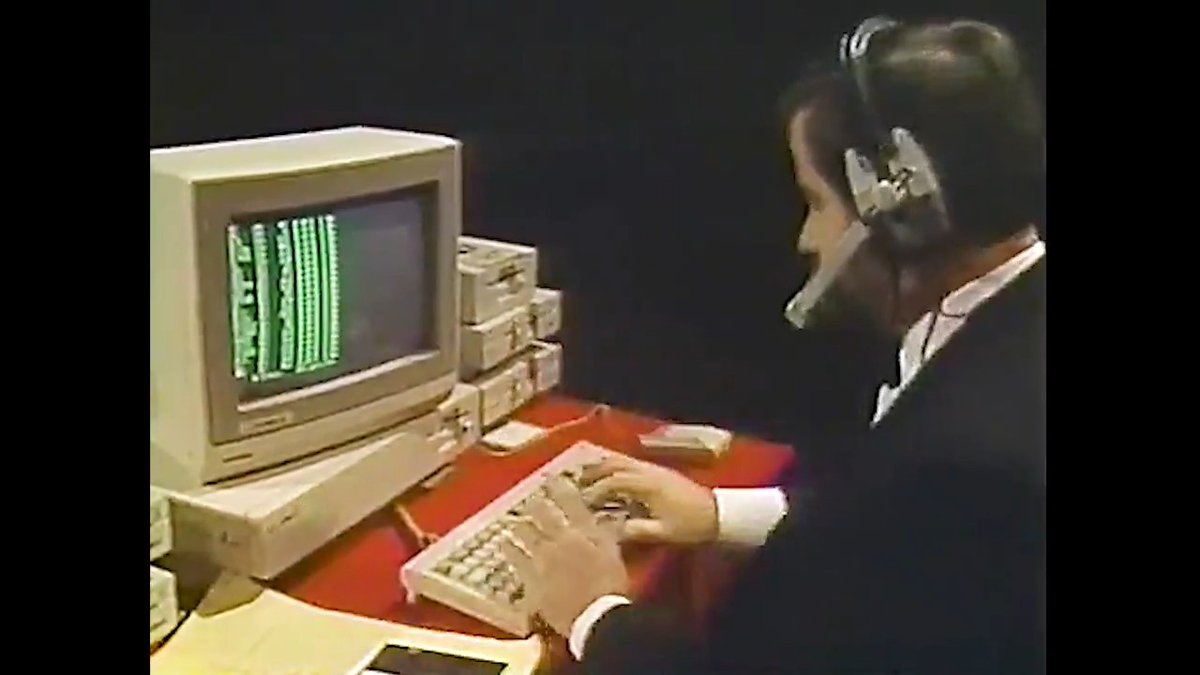
Remember the TV series Babylon 5? Seasons 1-3 utilized inexpensive Commodore Amiga 2000 computers for 3D modeling, rendering, scene manipulation, and alien character creation and animation. Only Amiga makes it possible!

19,105 Aufrufe • vor 8 Monaten •via X (Twitter)

0 Kommentare

Keine Kommentare verfügbar

Kommentare vom Original-Post werden hier angezeigt

Ähnliche Videos

Official Babylon 5 episodes on YouTube every week (link in comments). Why is this significant to Commodore fans? (You might want to bookmark this) The Amiga 2000's Role in Babylon 5's Special Effects (read the full article: In the annals of television history, few shows leveraged technology as innovatively as Babylon 5. The series, which aired from 1993 to 1998, was groundbreaking not only for its storytelling but also for its pioneering use of computer-generated imagery (CGI). A key component in this visual revolution was the often-overlooked Commodore Amiga 2000. The Babylon 5 Amiga 2000 Setup Explained • Hardware: The Amiga 2000 was a major upgrade from earlier Amiga models, with an open architecture that allowed extensive hardware enhancements. It was powered by the Motorola 68000-series CPU, with options for further upgrades. • Video Toaster: This video effects card, designed specifically for the Commodore Amiga, included a genlock for broadcast-quality video synchronization, a framebuffer for real-time effects, and LightWave 3D software for 3D modelling and animation. • Networked Computing: Foundation Imaging, the special effects house for Babylon 5, networked 24 Commodore Amiga 2000s to form a render farm. This setup enabled parallel processing of CGI frames, dramatically speeding up the rendering process. Did you watch it? Are you going to watch it? Check out this making of Babylon 5 video too where they show the Amiga 2000 in operation!

Commodore Computer Museum 🕹

16,632 Aufrufe • vor 6 Monaten

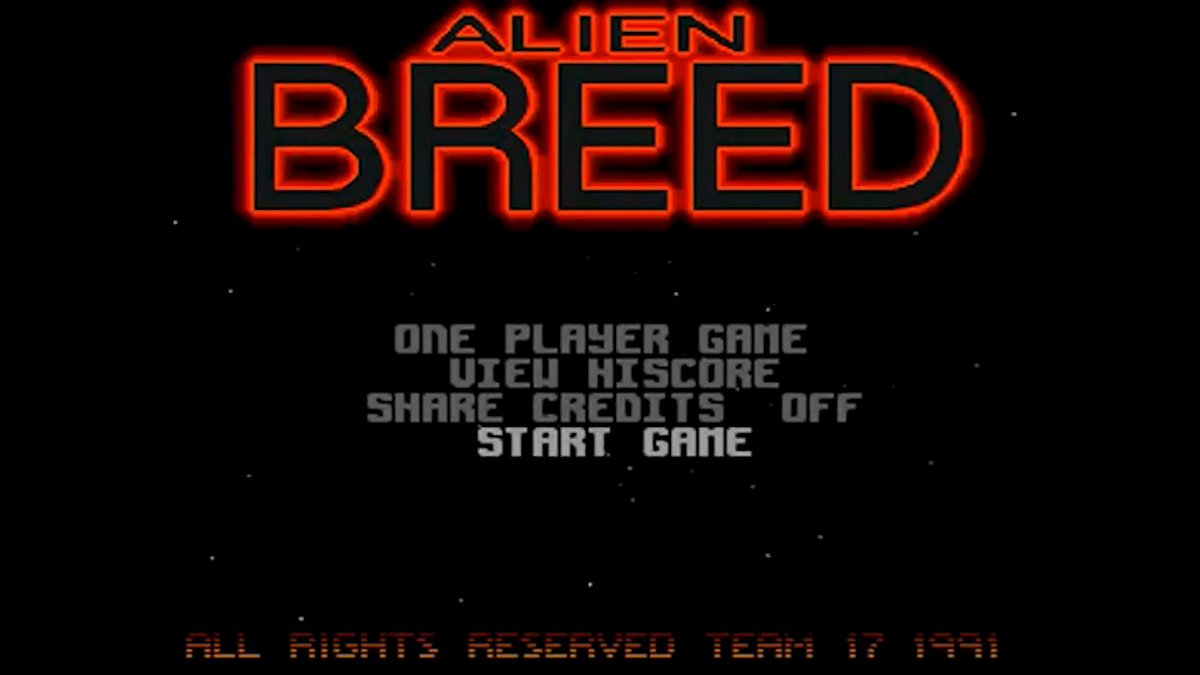
5 Facts you didn't want to know about Alien Breed for the Commodore Amiga Alien Breed (1991) is a landmark Amiga title that defined Team17’s early style: tense, atmospheric, and brutally addictive. It was perfect for co-op gaming with mates. Programmed by Andreas Tadic and Peter Tuleby, with graphics by Rico Holmes and iconic music by Allister Brimble. 1. Top-down run-and-gun sci-fi shooter heavily inspired by Aliens: You (and a friend in co-op) explore an infested space station, blasting xenomorph-like aliens (I originally thought they were aliens) while managing limited ammo and health. It mixes fast arcade action with tense resource management. 2. Team17’s breakthrough hit: This was only their second game, after Full Contact, and their first full-price release. It put the UK developer and publisher on the map, before they became famous for the Worms series. 3. Extremely well-received on Amiga: Launched to critical acclaim, with many magazines scoring it 85–91% (CVG 91%, Zero 91%, CU Amiga 90%, Amiga Action 87%). It was usually praised for its smooth multi-directional scrolling, atmosphere, co-op play, and technical excellence on the Amiga. 4. Infamously difficult: The original game was notoriously tough and short, with only six levels. Because of this, Team17 later released Alien Breed Special Edition 92, with rebalanced difficulty, extra levels, and various fixes. In my opinion, it’s a much more enjoyable game. 5. No official Commodore 64 version: it was developed primarily for the Amiga, and the Commodore 64 never got a conversion :( Would you have played it? I would have big time! Still one of the best top-down shooters ever made on the Amiga. Who else remembers the panic when the ammo ran low and the aliens kept coming?

Commodore Computer Museum 🕹

13,291 Aufrufe • vor 3 Monaten

🎉 41 years ago today — July 23, 1985 — Commodore launched the Amiga 1000 at Lincoln Center in New York City and completely changed personal computing. Restored and presented in 1080p HD In front of a star-studded audience, Andy Warhol live-painted Debbie Harry (Blondie) on stage using the Amiga, proving this machine was something special. This wasn’t just another computer — it was the birth of multimedia computing. ✅ True preemptive multitasking ✅ Up to 4096 colors & advanced custom graphics chips ✅ 4-channel stereo sampled sound ✅ Years ahead of Apple, IBM, and Atari The Amiga 1000 brought professional-level graphics, sound, and creativity into people’s homes for the first time. Did you own an Amiga? Timestamps: 0:00 - Launch Event Musical Intro 0:51 - Introduction by Bob Truckenbrode, Vice President of Marketing for Commodore 1:17 - Presentation by Bob Pariseau, Head of Software Engineering for Amiga 1:50 - Amiga 1000's Workbench & Features 2:25 - Textcraft Amiga's Wordprocessor 2:58 - The Amiga's 4096 Colours and Graphics 4:00 - Moving graphics on the Amiga 1000 5:31 - Amiga's Amazing Sound Abilities 6:40 - Amiga's Smoke on the Water 6:53 - The Amiga Talks 7:40 - Animation on the Amiga 9:17 - IBM Emulation 11:24 - Boing Ball "Follow the Ball" demo 11:41 - Bob Pariseau's outro 12:02 - Andy Warhol & Deborah Harry (Blondie) 12:57 - Andy Paints Blondie with Propaint on the Amiga 13:44 - Bob Truckenbrode's Outro 14:19 - Final demo Animated Ballerina and world famous Gelsey Kirkland If you love retro computing, don’t forget to LIKE 👍 and FOLLOW for more classic tech history! #Amiga #Amiga1000 #Commodore

Commodore Computer Museum 🕹

17,490 Aufrufe • vor 20 Tagen

Alibaba presents MIMO Controllable Character Video Synthesis with Spatial Decomposed Modeling Character video synthesis aims to produce realistic videos of animatable characters within lifelike scenes. As a fundamental problem in the computer vision and graphics community, 3D works typically require multi-view captures for per-case training, which severely limits their applicability of modeling arbitrary characters in a short time. Recent 2D methods break this limitation via pre-trained diffusion models, but they struggle for pose generality and scene interaction. To this end, we propose MIMO, a novel framework which can not only synthesize character videos with controllable attributes (i.e., character, motion and scene) provided by simple user inputs, but also simultaneously achieve advanced scalability to arbitrary characters, generality to novel 3D motions, and applicability to interactive real-world scenes in a unified framework. The core idea is to encode the 2D video to compact spatial codes, considering the inherent 3D nature of video occurrence. Concretely, we lift the 2D frame pixels into 3D using monocular depth estimators, and decompose the video clip to three spatial components (i.e., main human, underlying scene, and floating occlusion) in hierarchical layers based on the 3D depth. These components are further encoded to canonical identity code, structured motion code and full scene code, which are utilized as control signals of synthesis process. The design of spatial decomposed modeling enables flexible user control, complex motion expression, as well as 3D-aware synthesis for scene interactions. Experimental results demonstrate effectiveness and robustness of the proposed method.

AK

149,079 Aufrufe • vor 1 Jahr