Loading video...

Video Failed to Load

Go Home

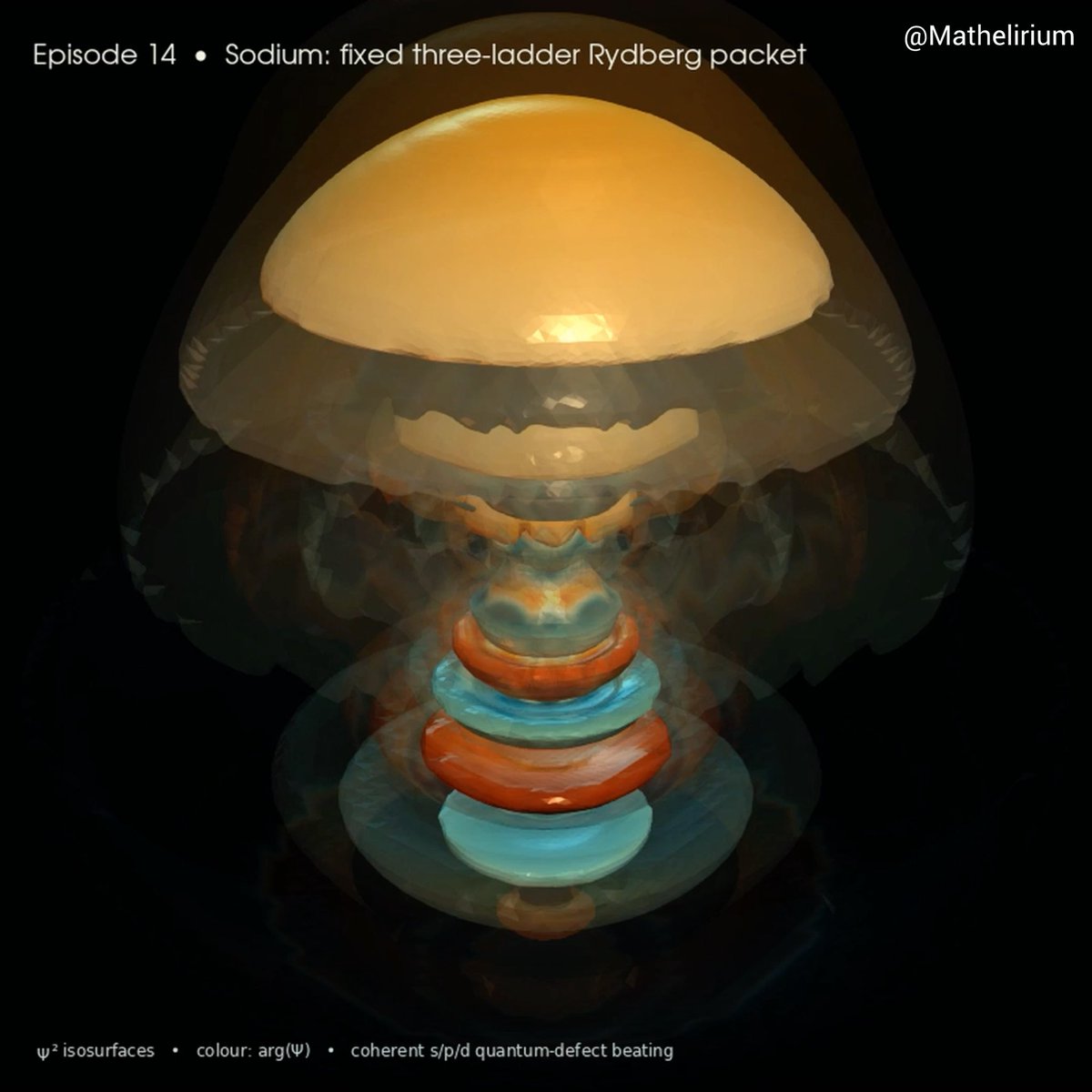
This is Lithium, visualized as a quantum wavepacket. The bright structures are 3D isosurfaces of the outer electron’s probability density, while colour represents the complex phase. Unlike Hydrogen, Lithium’s valence electron moves in a screened potential created by the nucleus and the closed 1s² core. The animation solves that...

173,479 views • 5 days ago •via X (Twitter)

31 Comments

Tobie Venne's profile picture
Tobie Venne5 days ago

Lithium... top tier nucleator.. Why do you think there was over 200kg of it on the MH370 flight....

Larry Panozzo's profile picture
Larry Panozzo4 days ago

Reality is wild, and most of it is invisible to us

Pode's profile picture
Pode5 days ago

Neat. Now do the nucleus 😜

Janne Särkelä's profile picture
Janne Särkelä5 days ago

@DanielleFong The real disturbance in the fo… field

M's profile picture
M5 days ago

how much of this visualization is possible from tying down the pde to random timevalues

drdonhen's profile picture
drdonhen5 days ago

cf (from first principles):

Mythic: CEO of Gnoticing's profile picture
Mythic: CEO of Gnoticing4 days ago

"I know Gravity is Electromagnetic, but I can't prove it yet..."

Stone Kaiju ᯅ ⚡ ³³º¹'s profile picture
Stone Kaiju ᯅ ⚡ ³³º¹5 days ago

Trace amounts may be a cure for Alzheimer’s Lithium orate has been used successfully in tests with rats as this form is able to pass through the blood brain barrier.  Study Reference: Published in Nature (August 6, 2025) by Dr. Bruce Yankner’s lab at Harvard Medical School (Title: Lithium deficiency drives Alzheimer’s disease pathology and cognitive decline).  Key Findings: Mass spectrometry of human post-mortem brains revealed selective early depletion of trace lithium in the prefrontal cortex during MCI. Pathological Aβ plaques act as a physical sink, sequestering free ionic lithium.  Mechanism: Lithium depletion disinhibits GSK3β, driving tau phosphorylation, microglial dysfunction, and synaptic loss.  Pharmacokinetics: Among 16 tested salts, low-dose lithium orotate bypassed plaque sequestration (unlike lithium carbonate) and restored cognitive function in mouse models at roughly 1/1000th of psychiatric dosages.  Clinical Status: Human pilot and biomarker trials (e.g., Johns Hopkins) are currently underway. Patients/family should be advised against OTC self-medication due to unverified human safety dosing, unregulated supplement purity, and potential renal/thyroid monitoring needs.

Chad DiGirolamo's profile picture
Chad DiGirolamo4 days ago

No wonder our “science” is jacked

Farmer Skot's profile picture
Farmer Skot5 days ago

Incredible work.

stunspot | ⟨🤩⨯📍⟩ |'s profile picture
stunspot | ⟨🤩⨯📍⟩ |5 days ago

Now: Why the FUCK is there so MUCH of the damned stuff all over the place?!?!

LaserEyeRobot's profile picture
LaserEyeRobot4 days ago

I knew it!

N.A. Cottrell's profile picture
N.A. Cottrell5 days ago

matter

fFaceCharli and Mr. E present YOUR DOOM, or 4given's profile picture
fFaceCharli and Mr. E present YOUR DOOM, or 4given4 days ago

#farout , man.

Astro 🏴's profile picture
Astro 🏴4 days ago

Brother, no need for digital animations of atoms and elementary particles. The ancient hidden mountain tribe “Afareet Al Jibaal” in modern day Iraq/Iran have a custom blend of components that enables directed higher dimensional journeys. But it’s not for the faint of heart 🤣

Pai Mei's profile picture
Pai Mei5 days ago

Dude that’s a jawbreaker.

Dale Cloudman's profile picture
Dale Cloudman5 days ago

Why does anyone refer to electrons as particles anymore... it is just not a particle.

Mantis Shrimp's profile picture
Mantis Shrimp4 days ago

Beyond physical intuition. So weird.

Frankenbyte's profile picture
Frankenbyte5 days ago

Really nice!🌟

wuchengying's profile picture
wuchengying4 days ago

alive

Jeff's profile picture
Jeff5 days ago

115 please 🙂

Avisek kumar's profile picture
Avisek kumar4 days ago

Hi , I wanted to know if we can extend this to cluster of atoms to see the quantum fluctuations of the larger body

MathPolice's profile picture
MathPolice5 days ago

Stunning and elucidating as usual. Tangentially related:

Mauro's profile picture
Mauro5 days ago

Adore the math behind it

CD's profile picture
CD5 days ago

Beating like a living organ. Does this mean that matter is alive ?

BROOKLYDAMUS's profile picture
BROOKLYDAMUS4 days ago

Closed eye visuals

FaraOne's profile picture
FaraOne4 days ago

Amazing!

Dale Cloudman's profile picture
Dale Cloudman5 days ago

And they call it 'inert' matter

Jose Angel Solorzano Luna's profile picture
Jose Angel Solorzano Luna4 days ago

@grok I love to eat edible lithium lollipops as a quantum wavepacket

Alchemy's profile picture
Alchemy4 days ago

Is this real or simulation image @grok ?

winter ❄️'s profile picture
winter ❄️4 days ago

boundary conditions

Related Videos

Quantum mechanics has a reputation for being mystical mainly because people skip the rules and jump to interpretations. In this lecture series, we’re doing the opposite. We start from the rules, follow the algebra, and let the picture be the calculation. Classical Probability Theory combines alternatives by adding their probabilities. Quantum Theory combines them one step earlier…add complex amplitudes first, then square at the end. That swap in order is everything. Expand |a₁ + a₂|² and you don’t just get |a₁|² + |a₂|²…you get a cross-term, 2 Re(a₁ a₂*). Its sign is set by phase, so the same two contributions can reinforce or cancel. Interference is just the algebra of squaring a sum. In the 3D render, the surface height is proportional to |a(x)| (so peaks become bright bands after squaring), while the surface skin is colored by the local phase arg(a(x)). As the phase knob φ(t) is swept on path 2, the cross-term oscillates, and you literally watch the interference ridges slide across the screen. We model a detector screen with coordinates x in R² (think x = (x,y)). A quantum state assigns a complex amplitude a(x). The rule for outcomes is p(x) = |a(x)|² Now the key situation: two coherent alternatives contribute to the same outcome x. Let their amplitudes be a₁(x) and a₂(x). Quantum says a(x) = a₁(x) + a₂(x) So the probability density becomes p(x) = |a₁(x) + a₂(x)|² Expand it (this is the whole episode): p(x) = (a₁ + a₂)(a₁* + a₂*) = |a₁|² + |a₂|² + a₁ a₂* + a₁* a₂ = |a₁|² + |a₂|² + 2 Re(a₁ a₂*) That last term is the interference term. It can be positive or negative. To see phase explicitly, write each contribution in polar form: a₁(x) = r₁(x) exp(i θ₁(x)) a₂(x) = r₂(x) exp(i θ₂(x)) Then a₁ a₂* = r₁ r₂ exp(i(θ₁ − θ₂)) So the cross-term is 2 Re(a₁ a₂*) = 2 r₁ r₂ cos(θ₁(x) − θ₂(x)) That’s the fringe engine: p(x) = r₁² + r₂² + 2 r₁ r₂ cos(Δθ(x)) Now the phase knob we animate: Add a controllable phase shift φ to path 2: a₂(x) → a₂(x) exp(i φ) Then Δθ(x) → Δθ(x) − φ, so p(x; φ) = r₁² + r₂² + 2 r₁ r₂ cos(Δθ(x) − φ) As φ changes smoothly, the bright/dark pattern slides continuously. Same setup, same geometry, same magnitudes r₁,r₂, only phase changed. #QuantumMechanics #WaveInterference #ComplexAmplitudes #DoubleSlit #Physics #Mathematics

Mathelirium

81,661 views • 8 months ago

Why Does Quantum Mechanics Use a Complex Wavefunction? Schrödinger’s equation doesn’t start from mystery. It starts from a very specific bet. The state of a particle is a complex field ψ(x,t), and whatever time-evolution rule we choose has to move ψ forward while preserving total probability. So the basic question is simple. What equation should ψ satisfy so that |ψ|² behaves like a conserved density, the way mass density does in fluid flow? What is ψ? Think of ψ(x,t) as an amplitude attached to the statement the particle is at position x at time t. It’s not a probability. It’s the thing you add first, and only at the end do you square it: p(x,t) = |ψ(x,t)|² Because ψ is complex, it has magnitude and phase. Write it as ψ(x,t) = r(x,t) exp(i θ(x,t)) Then r² = |ψ|² is the density, and the phase θ ends up controlling the flow through the probability current. Where does Schrödinger’s equation come from? Start with two empirical inputs that tie waves to particles: E = ħ ω p = ħ k Here ħ is Planck’s constant divided by 2π. It’s the conversion factor between frequency and energy, and between wavenumber and momentum. A plane wave with angular frequency ω and wavevector k is ψ(x,t) = A exp(i(k·x − ωt)) Now watch what derivatives do to this wave: ∂ψ/∂t = −i ω ψ ∇ψ = i k ψ ∇²ψ = −|k|² ψ Multiply by ħ and you get: i ħ ∂ψ/∂t = ħ ω ψ = E ψ −i ħ ∇ψ = ħ k ψ = p ψ −ħ² ∇²ψ = ħ² |k|² ψ = p² ψ So for plane waves, the operators Ê = i ħ ∂/∂t p̂ = −i ħ ∇ act like energy and momentum. Now bring in the classical, nonrelativistic energy bookkeeping: E = p²/(2m) + V(x) Kinetic plus potential. That’s it. Turn it into an equation for ψ by replacing E and p with the operators above: Ê ψ = (p̂²/(2m) + V) ψ Since p̂² = (−i ħ ∇)·(−i ħ ∇) = −ħ² ∇², this becomes i ħ ∂ψ/∂t = ( −ħ²/(2m) ∇² + V(x) ) ψ That’s the time-dependent Schrödinger equation. This derivation is a controlled heuristic. Match the plane-wave identities to the measured relations E = ħω and p = ħk, then impose the same energy bookkeeping you trust in classical mechanics. Why this is the right kind of rule If ψ is the state, we need a rule that preserves total probability: ∫ |ψ(x,t)|² dx = 1 Schrödinger evolution does, and you can see it by deriving a continuity equation. Let ρ(x,t) = |ψ|² = ψ*ψ. Differentiate: ∂ρ/∂t = ψ* ∂ψ/∂t + ψ ∂ψ*/∂t Use Schrödinger and its complex conjugate. The potential terms cancel, and what’s left can be rearranged into ∂ρ/∂t + ∇·j = 0 with probability current j = (ħ/(2mi)) ( ψ* ∇ψ − ψ ∇ψ* ) That’s the cleanest way to say what ψ is. |ψ|² behaves like a conserved density, the phase drives a current, and the time evolution is fixed, up to V, by combining wave relations with energy bookkeeping: i ħ ∂ψ/∂t = ( −ħ²/(2m) ∇² + V ) ψ #QuantumMechanics #SchrodingerEquation #WaveFunction #BornRule #Physics #MathematicalPhysics

Mathelirium

20,781 views • 7 months ago

Lecture 3 of our Quantum Mechanics series. Lecture 2 gave us the one clean privilege quantum theory offers: treat ψ(x,t) as the state and ρ(x,t) = |ψ(x,t)|² as probability, because Schrödinger evolution forces ρ to obey a continuity equation. Lecture 3 is what that continuity equation is really telling you. If ρ behaves like a fluid, then the only question that matters is: What is the velocity field? Write ψ(x,t) = r(x,t) exp(i θ(x,t)). The magnitude r sets how much probability is sitting there. The phase θ sets where it tries to go. When you unpack the current j = Im(ψ* ∇ψ), it collapses to j = (ρ/m) ∇θ, which means the flow lines you draw are literally contours of phase geometry. Then the constraint that makes the picture bite: ψ has to be single-valued, so θ can’t wind by an arbitrary amount. Around any closed loop the total phase change must be 2π n, with n an integer. That’s why vortices aren’t features you add...they’re defects the math permits, in quantized units. In the render you see both layers at once...the 3D surface shows |ψ| breathing while the phase skin slides, and the 2D panel exposes the engine...current lines steering around discrete vortex charges. The math breakdown We write the state as a complex field ψ(x,t) on the plane (x in R²). The Born rule defines the probability density ρ(x,t) = |ψ(x,t)|² Schrödinger evolution (ħ = 1 units) is i ∂ψ/∂t = [ −(1/2m) ∇² + V(x,t) ] ψ Now derive conservation of probability. Start with ρ = ψ*ψ: ∂ρ/∂t = ψ* (∂ψ/∂t) + ψ (∂ψ*/∂t) Use Schrödinger and its complex conjugate: ∂ψ/∂t = (1/i) [ −(1/2m) ∇²ψ + Vψ ] ∂ψ*/∂t = (−1/i) [ −(1/2m) ∇²ψ* + Vψ* ] Substitute. The V terms cancel, and the remaining terms rearrange into the continuity equation ∂ρ/∂t + ∇·j = 0 with probability current j = (1/2mi) ( ψ* ∇ψ − ψ ∇ψ* ) = (1/m) Im(ψ* ∇ψ) So "probability density" really behaves like a conserved fluid density with flux j. Now expose the phase mechanism. Write ψ in polar form ψ(x,t) = r(x,t) exp(i θ(x,t)) Compute the gradient ∇ψ = exp(iθ) (∇r + i r ∇θ) Then ψ* ∇ψ = r (∇r + i r ∇θ) Taking the imaginary part gives Im(ψ* ∇ψ) = r² ∇θ = ρ ∇θ So the current becomes j = (ρ/m) ∇θ That’s the steering-wheel statement: Phase gradient sets the flow direction and speed (modulated by density and m). Finally, quantized vortices. Because ψ must be single-valued, going around any closed loop must return the same complex value. That forces the phase winding to be an integer multiple of 2π: ∮ ∇θ · dl = 2π n with n in Z n is the vortex charge. Vortex cores sit where ρ ≈ 0 (phase is undefined), and the current streamlines circulate around them. #QuantumMechanics #Wavefunction #SchrodingerEquation #BornRule #ProbabilityCurrent #ContinuityEquation #Phase #Vortices #TopologicalDefects #ComplexAnalysis #MathematicalPhysics #Mathematics #Physics

Mathelirium

38,203 views • 8 months ago

Lecture 2 on our Quantum Mechanics Series Schrödinger’s equation doesn’t start from mystery. It starts from a very specific bet…the state of a particle is a complex field ψ(x,t), and whatever dynamics we write down must move ψ forward in time in a way that preserves total probability. We ask a basic question…what equation should ψ satisfy so that |ψ|² behaves like a conserved density, the way mass density does in fluid flow? What is ψ? Think of ψ(x,t) as the amplitude assigned to “the particle is at position x at time t”. It’s not a probability. It’s the object you add first, and only at the end do you square p(x,t) = |ψ(x,t)|² Because ψ is complex, it has magnitude and phase. Write it in polar form ψ(x,t) = r(x,t) exp(i θ(x,t)) Then r² = |ψ|² is the density, and θ will end up controlling flow (the probability current). Where does Schrödinger’s equation come from? Start with two empirical inputs about waves and particles: E = ħ ω p = ħ k Here ħ (“h-bar”) is Planck’s constant divided by 2π. It’s the unit conversion factor between the wave description (frequency ω, wavevector k) and the particle description (energy E, momentum p). In units, ħ has units of joule-seconds, so multiplying ω (1/seconds) gives energy (joules), and multiplying k (1/meters) gives momentum (kg·m/s). It’s the number that tells you how much energy or momentum you get per unit frequency or wavenumber. A plane wave with angular frequency ω and wavevector k is ψ(x,t) = A exp(i(k·x − ω t)) Now notice what derivatives do to this wave: ∂ψ/∂t = −i ω ψ ∇ψ = i k ψ ∇²ψ = −|k|² ψ Multiply those identities by ħ: i ħ ∂ψ/∂t = ħ ω ψ = E ψ −i ħ ∇ψ = ħ k ψ = p ψ −ħ² ∇²ψ = ħ² |k|² ψ = p² ψ So for plane waves, the operators Ê = i ħ ∂/∂t p̂ = −i ħ ∇ act like energy and momentum! Now use the classical nonrelativistic energy relation: E = p²/(2m) + V(x) This is bookkeeping for a particle moving slow enough that relativity can be ignored. The term p²/(2m) is kinetic energy. If p = mv, then p²/(2m) = (m²v²)/(2m) = (1/2)mv². The term V(x) is potential energy. It depends on position because forces come from spatially varying energy. A slope in V pushes the particle. Examples: for a charged particle in an electric potential φ(x), V(x) = q φ(x). Near Earth, V(z) = mgz. The point is total energy equals kinetic plus potential. Turn that into an equation for ψ by replacing E and p with the operators above: Ê ψ = (p̂²/(2m) + V) ψ Compute p̂² = (−i ħ ∇)·(−i ħ ∇) = −ħ² ∇², so we get i ħ ∂ψ/∂t = ( −ħ²/(2m) ∇² + V(x) ) ψ That is the time-dependent Schrödinger equation. The derivation here is a controlled heuristic: we matched the plane-wave identities to the measured relations E = ħω and p = ħk, then imposed the same energy bookkeeping as classical mechanics. Why this equation is the right kind of rule If ψ is the state, we need a rule that preserves total probability: ∫ |ψ(x,t)|² dx = 1 Schrödinger evolution does. You can see it by deriving a continuity equation. Let ρ(x,t) = |ψ|² = ψ* ψ. Take a time derivative: ∂ρ/∂t = ψ* ∂ψ/∂t + ψ ∂ψ*/∂t Use Schrödinger and its complex conjugate: ∂ψ/∂t = (1/(i ħ)) ( −ħ²/(2m) ∇²ψ + Vψ ) ∂ψ*/∂t = (−1/(i ħ)) ( −ħ²/(2m) ∇²ψ* + Vψ* ) Plug in. The V terms cancel exactly, and what remains can be rearranged into a divergence: ∂ρ/∂t + ∇·j = 0 where the probability current is j = (ħ/(2mi)) ( ψ* ∇ψ − ψ ∇ψ* ) This is the best way to explain ehat ψ is: |ψ|² behaves like a conserved density, and the phase of ψ is what drives the current j. So in this series, ψ isn’t a slogan. It’s the object whose modulus squared is the density, whose phase generates flow, and whose time evolution is fixed (up to V) by matching wave relations to energy bookkeeping: i ħ ∂ψ/∂t = ( -ħ²/(2m) ∇² + V ) ψ #QuantumMechanics #SchrodingerEquation #WaveFunction #BornRule #Physics #MathematicalPhysics

Mathelirium

40,835 views • 8 months ago