Загрузка видео...

Не удалось загрузить видео

На главную

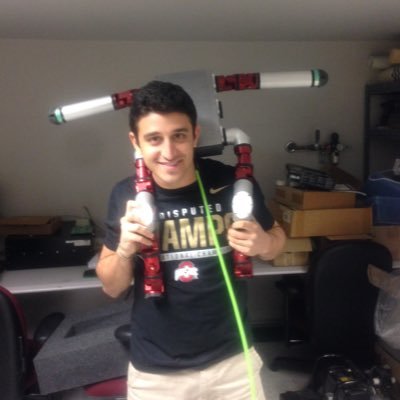
Vision alone isn’t enough to solve dexterous manipulation. The sense of touch is needed. UMI-FT uses a custom PCB to provide 6-axis force-torque sensing at each finger for under $10.
20,731 просмотров • 7 месяцев назад •via X (Twitter)

Комментарии: 11

Фото профиля Simon Kalouche
Simon Kalouche7 месяцев назад

UMI-FT Project website: CoinFT Project website:

Фото профиля Embedr
Embedr7 месяцев назад

this could seriously democratize robotics research. no more selling a kidney for decent tactile feedback

Фото профиля MechatronicsEngineer
MechatronicsEngineer7 месяцев назад

tactile revolution begins

Фото профиля Devesh Vyas
Devesh Vyas7 месяцев назад

Yeah, robots needs data about torque, force, and other parameters to gauge the situation and perform tasks aptly. Vision alone ain’t enough. Though it could teach a few things, but still data from actuators and other sensors would be the moat going forward

Фото профиля Akshay Kumar
Akshay Kumar7 месяцев назад

I keep wondering why the biggest labs building VLAs have barely scraped the surface of tactile sensing and joint torque sensing modalities yet! Perhaps a data issue?

Фото профиля Peter Kazanjy
Peter Kazanjy7 месяцев назад

Sick demo. Going to be used in Nimble?

Фото профиля Sudhir Pratap Yadav
Sudhir Pratap Yadav7 месяцев назад

Can you explain little bit what is happening in first video. I can its responding to the push but like while maintaining ee position? Like orientation chnage is allowed etc? What kind of controller is it, is it OSC?

Фото профиля Lidoor L. Joseph
Lidoor L. Joseph7 месяцев назад

This

Фото профиля Gabriele Tinelli
Gabriele Tinelli7 месяцев назад

Do you think this scales beyond development environments? Will production robots still need expensive FT?

Фото профиля milan 🌞
milan 🌞7 месяцев назад

Awesome stuff. I agree, touch is absolutely necessary.

Фото профиля adamyathegreat
adamyathegreat7 месяцев назад

Cool

Похожие видео

Force-sensing fingers! 🧤 Stanford researchers just released UMI-FT, a handheld data collection platform that puts compact six-axis force/torque sensors on each finger, enabling finger-level wrench measurements alongside RGB, depth, and pose data. Many manipulation tasks require careful force modulation: too little force and the task fails, too much and you cause damage. But commercial force/torque sensors are expensive, bulky, and fragile, which has limited large-scale force-aware policy learning. UMI-FT changes the economics. The platform uses an iPhone for RGB vision, ultrawide RGB, depth, and pose via ARKit, with each finger sensorized using a CoinFT sensor to capture per-finger wrench information during manipulation. This multimodal data trains an adaptive compliance policy that predicts position targets, grasp force, and stiffness for execution on standard compliance controllers. The learned policy runs slowest and generates reference targets, while model-based compliance and force controllers provide delicate 6D compliance control and real-time force modulation. They tested on three contact-rich, force-sensitive tasks: whiteboard wiping (locate eraser, grasp, wipe until clean), skewering zucchini (grasp slice firmly, push onto stick until punctured), and lightbulb insertion (grasp bulb, align bayonet pin with socket slit, insert while overcoming spring force, rotate to light up). The results are clear. Policies without compliance struggle to modulate contact force and trigger safety faults from excessive force. Policies without force sensing fail to grasp unseen objects or resist reaction forces, causing slippage. Here's the project page: ~~ ♻️ Join the weekly robotics newsletter, and never miss any news →

Lukas Ziegler

12,822 просмотров • 7 месяцев назад