NVIDIA AI Released DiffusionRenderer: An AI Model for Editable,... Photorealistic 3D Scenes from a Single Video In a groundbreaking new paper, researchers at NVIDIA, University of Toronto, Vector Institute and the University of Illinois Urbana-Champaign have unveiled a framework that directly tackles this challenge. DiffusionRenderer represents a revolutionary leap forward, moving beyond mere generation to offer a unified solution for understanding and manipulating 3D scenes from a single video. It effectively bridges the gap between generation and editing, unlocking the true creative potential of AI-driven content. DiffusionRenderer treats the “what” (the scene’s properties) and the “how” (the rendering) in one unified framework built on the same powerful video diffusion architecture that underpins models like Stable Video Diffusion..... Read full article here: Paper: GitHub Page: NVIDIA NVIDIA AI NVIDIAnewsroom NVIDIA AIDevshow more

Marktechpost AI Dev News ⚡
104,741 görüntüleme • 1 yıl önce
As announced in partnership with NVIDIA at CES, we’re... excited to introduce Stable Point Aware 3D (SPAR3D), setting a new standard in 3D generation. Ideal for running on NVIDIA RTX AI PCs, SPAR3D enables real-time editing and complete structure generation of 3D objects from a single image in under a second. You can download the weights on Hugging Face and code on GitHub, or access the model through the Stability AI API. Learn more here: (1/3)show more

Stability AI
181,441 görüntüleme • 1 yıl önce
DimensionX: Create Any 3D and 4D Scenes from a... Single Image with Controllable Video Diffusion TL;DR: Create 3/4DGS from Video Diffusion Note: Some first inference code released (not all yet). Contributions (cited): • We present DimensionX, a novel framework for generating photorealistic 3D and 4D scenes from only a single image using controllable video diffusion. • We propose ST-Director, which decouples the spatial and temporal priors in video diffusion models by learning (spatial and temporal) dimension-aware modules with our curated datasets. We further enhance the hybriddimension control with a training-free composition approach according to the essence of video diffusion denoising process. • To bridge the gap between video diffusion and real-world scenes, we design a trajectory-aware mechanism for 3D generation and an identity-preserving denoising approach for 4D generation, enabling more realistic and controllable scene synthesis. • Extensive experiments manifest that our DimensionX delivers superior performance in video, 3D, and 4D generation compared with baseline methods.show more

MrNeRF
17,039 görüntüleme • 1 yıl önce
Selected as a best paper finalist at #CVPR2026: PixelDiT... from NVIDIA Research In most image generation models, a pretrained autoencoder compresses the image before any diffusion happens, causing quality loss that accumulates across the entire pipeline. PixelDiT, or Pixel Diffusion Transformers, removes this step entirely. It's a single-stage model that learns the diffusion process directly in pixel space, end-to-end.show more

NVIDIA AI
27,833 görüntüleme • 1 ay önce
Wonderland: Navigating 3D Scenes from a Single Image Contributions:... • First, we introduce a representation for controllable 3D generation by leveraging the generative priors from camera-guided video diffusion models. Unlike image models, video diffusion models are trained on extensive video datasets. This enables them to capture comprehensive spatial relationships within scenes across multiple views and embed a form of "3D awareness" in their latent space, which allows us to maintain 3D consistency in novel view synthesis. • Second, to achieve controllable novel view generation, we empower video models with precise control over specified camera motions. We introduce a novel dual-branch conditioning mechanism that effectively incorporates desired diverse camera trajectories into the video diffusion model. This enables expansion of a single image into a multi-view consistent capture of a 3D scene with precise pose control. • Third, to achieve efficient 3D reconstruction, we directly transform video latents into 3DGS. We propose a novel latent-based large reconstruction model (LaLRM) that lifts video latents to 3D in a feed-forward manner. With this design, during inference, our model directly predicts 3DGS from a single input image, effectively aligning the generation and reconstruction tasks—and bridging image space and 3D space—through the video latent space. Compared with reconstructing scenes from images, the video latent space offers a 256× spatial-temporal reduction while retaining essential and consistent 3D structural details. Such a high degree of compression is crucial, as it allows the LaLRM to handle a wider range of 3D scenes within the reconstruction framework, with the same memory constraints.show more
MrNeRF
52,801 görüntüleme • 1 yıl önce
NVIDIA just released a very impressive text-to-video paper. Video... Latent Diffusion Models (Video LDMs) use a diffusion model in a compressed latent space to generate high-resolution videos. Here's a brief overview of how it works: 1. Pre-train image LDM on a dataset of images. 2. Turn the image LDM into a Video LDM by adding temporal layers to model video frames. 3. Fine-tune the Video LDM on encoded video sequences to create a video generator. 4. Temporally align diffusion model upsamplers to generate high-resolution videos. 5. Validate Video LDM on real driving videos of 512x1024 resolution, achieving state-of-the-art performance. 6. Apply the approach in creative content creation with text-to-video modeling. Paper: Project:show more

Lior Alexander
158,558 görüntüleme • 3 yıl önce
Google dropped a new AI paper called LUMIERE. It's... remarkably flexible, supporting video inpainting, image-to-video, AND stylized video generation tasks. Say hello to “space-time diffusion” for video generation! Now what the heck does that mean exactly?! 🌐⏳ → TL;DR it utilizes a “Space-Time UNet” architecture that generates the full duration of the video in one pass, rather than generating distant keyframes and interpolating between them like prior works. Because the computation is done in this “compressed space-time representation” to generate the full clip at once, it's far more temporally consistent. → Another benefit of generating the full video at once is that you can “direct” the video generation, making it easier to hand off to other models/tasks without having to stitch together partial solutions. You can condition generations on additional inputs, meaning you get the full stack of AI video capabilities – from video inpainting to image-to-video and beyond. → New SOTA for AI video generation? User study results in the paper suggest human evaluators preferred Lumiere over Runway Gen-2, Pika Labs, and Stable Video Diffusion in terms of quality, text alignment AND motion. But as always, we need to get hands-on with this tech when Google *actually* decides to ship it. → Could this end up inside YouTube? Y’all know i’m obsessed with blending reality and imagination – so it’s the video inpainting tech I'm most excited about. I really hope this model finds its way into YouTube's Generative AI efforts, and based on their prior announcements and the list of acknowledgments in the paper I think it might! 🤞🏽 Links: 🔗Paper: 🔗Project:show more

Bilawal Sidhu
44,822 görüntüleme • 2 yıl önce
What if a network could deliver AI results closer... to where data is created, instead of sending it to far‑off data centers? In collaboration with NVIDIA and Decart, we’re making that a reality by bringing GPU‑powered computing to the network edge — closer to homes and businesses — so AI applications respond in real-time. This is how we're laying the foundation for the next generation of AI‑driven services:show more

Comcast
15,350 görüntüleme • 4 ay önce
A quick test of using 3d drawing with 6DOF... controllers as an "instructor" for a generative AI process. There's so many powerful and fun new ways to create just around the corner.. Here I'm using Dreams, Krea and 3daistudio. The 3d model at the end of the video was generated from the Dreams+Krea output in just around 15 seconds. Only the model on the left is a "true" 3d model. #ai #madeindreamsshow more

Martin Nebelong
132,864 görüntüleme • 2 yıl önce
This guy built a mini AI farm out of... 4 Nvidia boxes It does not look like a data center. It looks like a stack of small machines sitting next to a laptop. But each box is a DGX Spark with Grace Blackwell inside, 128GB unified memory, and enough room to run models normal gaming GPUs cannot even open. Using the launch price from the article, 4 of them is almost $12,000 of local AI compute on one desk. That sounds expensive until you compare it to cloud GPUs. A serious AI builder can burn $1,500 to $3,000 a month renting A100s and H100s for client work, fine-tunes, agents and 70B models. He basically moved that bill from the cloud into hardware he owns. 4 Nvidia boxes. 512GB unified memory. No hourly meter running in the background. No rented GPUs eating the margin every time an agent runs too long. The funny part is most people still think local AI means a slow laptop running a toy model. Meanwhile guys like this are stacking compute at home. Save this, local AI is turning into the new mining farm.show more
Gipp 🦅
590,100 görüntüleme • 1 ay önce
Vision AI agents are becoming a practical way to... automatically turn video data from the physical world into operational intelligence in factories, cities, warehouses and transportation systems. See how Roboflow, DeepHow, and Linker Vision use NVIDIA Cosmos and NVIDIA Metropolis to generate synthetic data, fine-tune vision models faster, and deploy vision agents at scale. 📰 Read the blog:show more

NVIDIA Omniverse
21,412 görüntüleme • 15 gün önce
We took a 30B model and split it in... two to write tokens in parallel instead of one at a time. Introducing Nemotron-Labs-TwoTower: a diffusion language model from NVIDIA Research adapted from Nemotron-3-Nano-30B-A3B. Here’s how it works: one half holds the context, the other writes the tokens, with both reusing the pretrained model instead of training a new one from scratch. We found it kept 98.7% of the original model’s quality at 2.42× faster generation.show more
NVIDIA AI
756,535 görüntüleme • 15 gün önce
Create a 3D model from a single image, set... of images or a text prompt in < 1 minute 😮💨 This new AI paper called CAT3D shows us that it’ll keep getting easier to produce 3D models from 2D images — whether it’s a sparser real world 3D scan (a few photos instead of hundreds) or your favorite 2D image generator like Midjourney (just an image). How does this magic work? “This architecture is similar to video diffusion models, but with camera pose embeddings for each image instead of time embeddings. The generated views are passed into a robust 3D reconstruction pipeline to create the 3D representation (Zip-NeRF or 3DGS)”show more
Bilawal Sidhu
92,792 görüntüleme • 2 yıl önce
I can't believe that Nvidia looked at this "AI... on top of games filter" and said to themselves this is the future of gaming. Like it or not, this is where Nvidia is heading and they're calling it neural rendering with DLSS 5. The examples they've showed reminded me a lot of those AI generated filter videos on top of GTA V, except that now it is supposed to run in real-time. Honestly, I don't like this current look at allshow more

NikTek
3,328,440 görüntüleme • 4 ay önce
Today, we are releasing Stable Video Diffusion, our first... foundation model for generative AI video based on the image model, Stable Diffusion. As part of this research preview, the code, weights, and research paper are now available. Additionally, today you can sign up for our waitlist to access a new upcoming web experience featuring a Text-To-Video interface. To access the model & sign up for our waitlist, visit our website here:show more

Stability AI
1,024,485 görüntüleme • 2 yıl önce
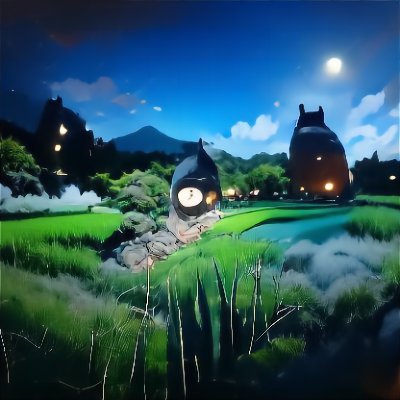
MaskINT: Video Editing via Interpolative Non-autoregressive Masked Transformers paper... page: Recent advances in generative AI have significantly enhanced image and video editing, particularly in the context of text prompt control. State-of-the-art approaches predominantly rely on diffusion models to accomplish these tasks. However, the computational demands of diffusion-based methods are substantial, often necessitating large-scale paired datasets for training, and therefore challenging the deployment in practical applications. This study addresses this challenge by breaking down the text-based video editing process into two separate stages. In the first stage, we leverage an existing text-to-image diffusion model to simultaneously edit a few keyframes without additional fine-tuning. In the second stage, we introduce an efficient model called MaskINT, which is built on non-autoregressive masked generative transformers and specializes in frame interpolation between the keyframes, benefiting from structural guidance provided by intermediate frames. Our comprehensive set of experiments illustrates the efficacy and efficiency of MaskINT when compared to other diffusion-based methodologies. This research offers a practical solution for text-based video editing and showcases the potential of non-autoregressive masked generative transformers in this domain.show more
AK
25,449 görüntüleme • 2 yıl önce
Join NVIDIA for AI in Production Day at SIGGRAPH... 2026. 🎥 On Thursday, July 23, explore how generative and agentic AI are moving into real-world creative pipelines through a full day of sessions focused on film, animation, storytelling, and production workflows. Hear from industry experts on how AI is helping teams direct generative video, support artist-centered pipelines, modernize animation and VFX workflows, and reshape the infrastructure behind production. 📍 Los Angeles | Room 502A 🗓️ Thursday, July 23 | 9 a.m.–3 p.m. PTshow more

NVIDIA
55,853 görüntüleme • 9 gün önce
It looks like DLSS 5 was an AI-gen filter... after all. YouTube Creator “Daniel Owen” asked Nvidia some questions regarding DLSS 5 and if it essentially just takes a single 2D frame with motion vectors as input to generate the output frame. The amount of buzz words Jensen Huang said like; Neural Rendering, Content-Control Generative AI and generative control at the geometry level just to end up admitting that DLSS 5 is what everyone suspected; an AI filter on top of your video-games.show more
NikTek
579,868 görüntüleme • 3 ay önce
Wow. AI-generated animation from a video. This experiment combines... video of dance choreography by Erica Klein and hok with AnimateDiff and a text prompt. #AnimateDiff feels like the missing link in diffusion video generation -no flickering! More soon. #stablediffusionshow more

Nathan Shipley
172,681 görüntüleme • 2 yıl önce
🔬 Built with an entirely new model architecture, our... diffusion-based approach uses 6B+ parameters and leverages the latest NVIDIA hardware. This is the most dynamic and wide-ranging video enhancing method we’ve ever created, setting a new standard for AI video restoration. Videos degrade due to compression artifacts, blurring, aliasing, noise, atmospheric distortion, missing pixels, etc. Each frame suffers from unique types of corruption, making AI video restoration a highly challenging task. Our technology solves this complexity by analyzing hundreds of frames to accurately restore details, delivering unmatched detail recovery combined with unparalleled temporal consistency.show more

Topaz Labs
23,199 görüntüleme • 1 yıl önce
Rerender A Video: Zero-Shot Text-Guided Video-to-Video Translation paper page:... Large text-to-image diffusion models have exhibited impressive proficiency in generating high-quality images. However, when applying these models to video domain, ensuring temporal consistency across video frames remains a formidable challenge. This paper proposes a novel zero-shot text-guided video-to-video translation framework to adapt image models to videos. The framework includes two parts: key frame translation and full video translation. The first part uses an adapted diffusion model to generate key frames, with hierarchical cross-frame constraints applied to enforce coherence in shapes, textures and colors. The second part propagates the key frames to other frames with temporal-aware patch matching and frame blending. Our framework achieves global style and local texture temporal consistency at a low cost (without re-training or optimization). The adaptation is compatible with existing image diffusion techniques, allowing our framework to take advantage of them, such as customizing a specific subject with LoRA, and introducing extra spatial guidance with ControlNet. Extensive experimental results demonstrate the effectiveness of our proposed framework over existing methods in rendering high-quality and temporally-coherent videos.show more
AK
375,123 görüntüleme • 3 yıl önce