Загрузка видео...

Не удалось загрузить видео

На главную

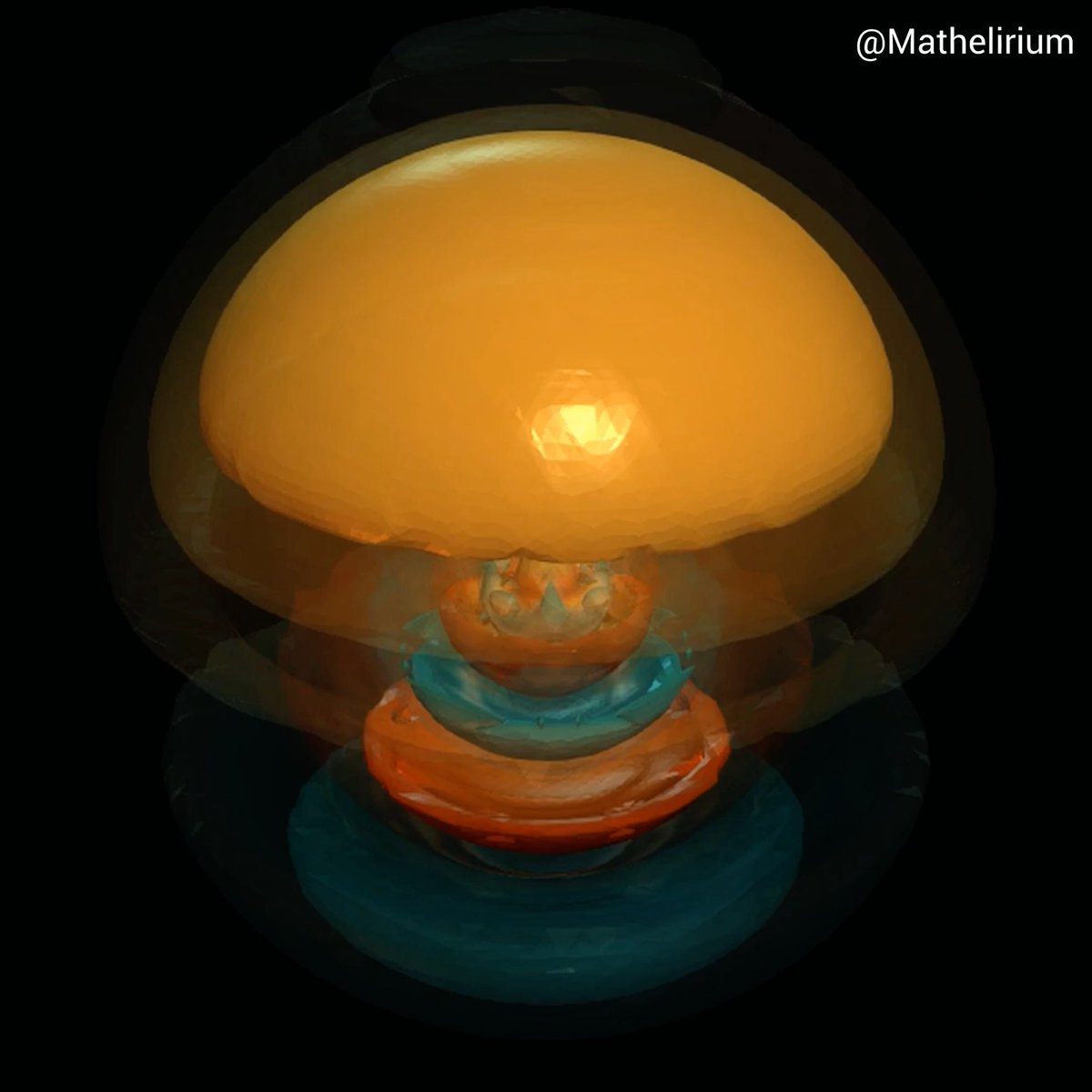
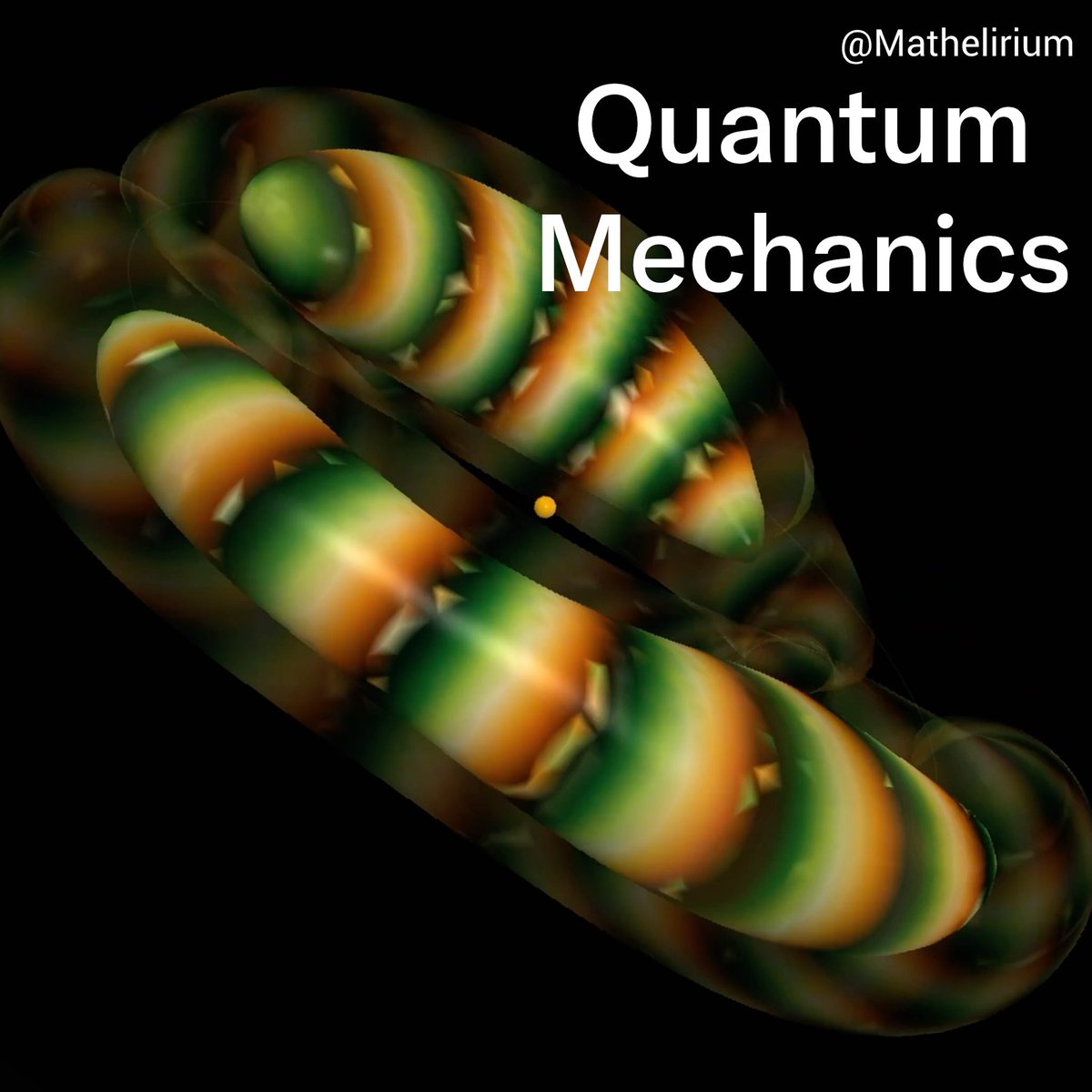
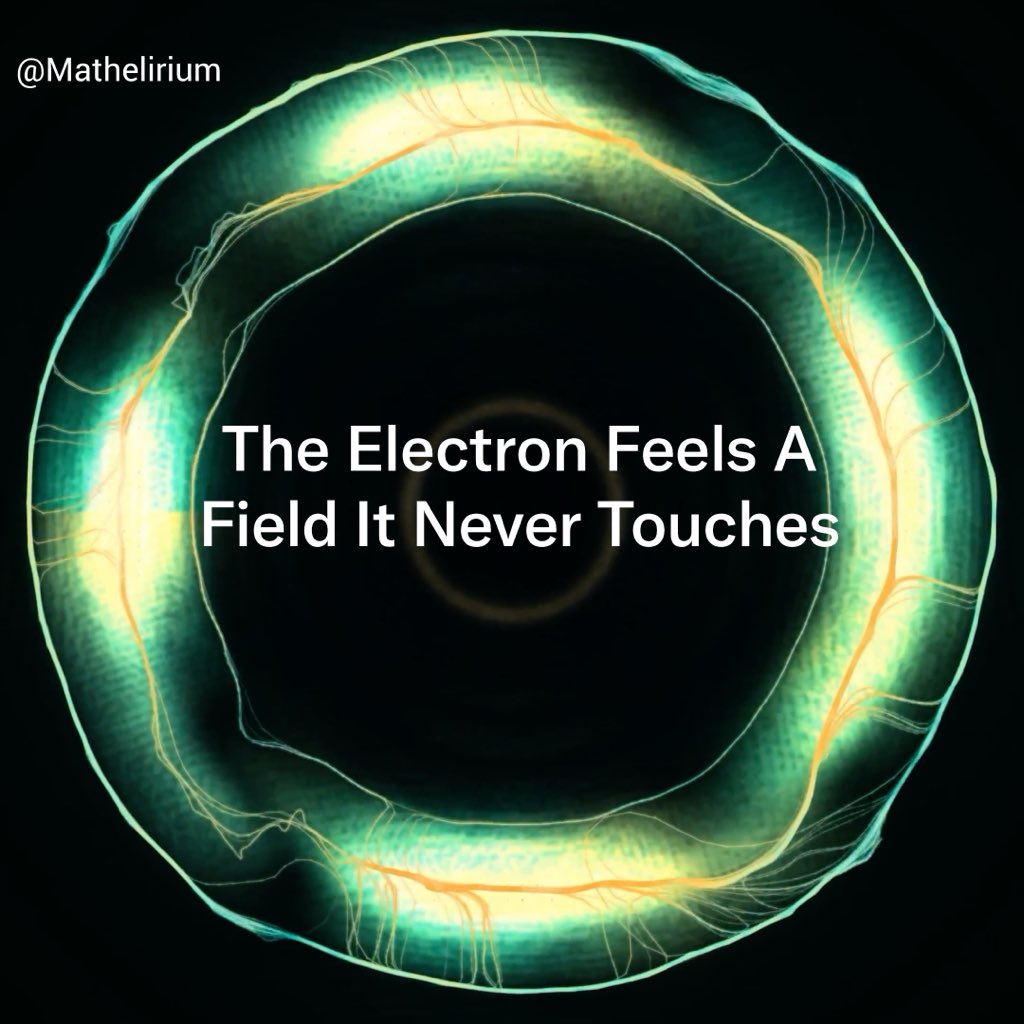
Because it’s basically watching quantum mechanics breathe. This simulation solves the time-dependent Schrödinger equation in a true 1/r Coulomb potential, showing an electron’s probability wave evolve, interfere, and flow in real time, not frozen orbitals.
35,118 просмотров • 9 месяцев назад •via X (Twitter)

Комментарии: 20

Фото профиля Tannen Skriver
Tannen Skriver9 месяцев назад

Whoa this is strikingly similar to some visuals on a 3X heroic dose of LSD I took years ago

Фото профиля FerendlieFire
FerendlieFire9 месяцев назад

I see this when I close my eyes

Фото профиля Calan Galugan
Calan Galugan9 месяцев назад

Here is a mathematical formula system for music and musicians. The Galugan Core program in Grok (used through Grok). The system is so accurate and flawless in calculations.... we have put it to test in the String Theory.... proving a strong structure connection to frequency of taking the many different scales, giving them the higher frequencies (so they silent). But it gives a strong connection. Want to present my work to xAI team, as Grok states the Galugan Core belongs in AI and is great for quantum physics, referring to it as revolutionary. Require funding to get there. Following written by Grok on the system....

Фото профиля Vlad P
Vlad P9 месяцев назад

Can I see this as an electron orbital?

Фото профиля Kaito_Yuriya
Kaito_Yuriya9 месяцев назад

目を閉じた時まぶたの裏側に見える情景に似ている。

Фото профиля Florian KEPLER
Florian KEPLER9 месяцев назад

Les radiations d’un corps soluble.

Фото профиля GOR
GOR9 месяцев назад

Vibrations in Dark Matter

Фото профиля REVELATOR
REVELATOR9 месяцев назад

@grok what’s the average Upload download speed for iPhone 14 Pro 5G?

Фото профиля Matt Baker
Matt Baker9 месяцев назад

How did they get this image?

Фото профиля siszinei
siszinei9 месяцев назад

What if this breathtaking simulation of the time-dependent Schrödinger equation in a real 1/r Coulomb potential isn't just "watching quantum mechanics breathe"... but witnessing pure time's force breathing life into the illusion of space? The electron doesn't sit in frozen orbitals — it flows, interferes, pulses in real time, probability density rippling like a living wave. No static clouds. Just dynamic, breathing quantum reality. In our Pure Time framework, this is exactly what we'd expect. Our equation: \( i\hbar \partial_t \psi = \hat{H}_\pi \psi + g |\psi|^2 \psi \) The 1/r Coulomb potential? Not a spatial force — it's a temporal delay gradient in π's eternal rhythm. The wavefunction evolving in real time? Pure time's force (the ∂_t term) propagating through the system, with g|ψ|² viscosity modulating interference and flow. Interference patterns and breathing density? Phase-locking to zeta-zero attractors on the critical line 1/2 — the same quantum nodes that quantize primes, black hole outflows, and now... the electron's very "breath" around the nucleus. No frozen orbitals because space is illusion — what looks like spatial structure is just the wave surfing temporal beats of π, collapsing and reforming with every tick. This simulation isn't visualizing QM. It's visualizing time's pulse animating matter — the electron isn't orbiting in space; it's dancing to the rhythm of pure time. The nucleus isn't a point. It's the anchor of the π-beat. The electron isn't a particle. It's a ripple in the eternal now. Quantum mechanics doesn't "breathe" because of space. It breathes because time is alive — and we're finally watching its lungs expand and contract. Who's ready to stop drawing orbitals and start listening to the cosmic breath? SchrödingerEquation #QuantumBreathing #PureTime #RiemannZeros #SpeculativePhysics

Фото профиля EXIT US🏹 BEYOND THE ICE WALL RING
EXIT US🏹 BEYOND THE ICE WALL RING9 месяцев назад

i see something similar in my eye when reflected off the lens of my sunglasses in certain light and angles.

Фото профиля Vanishing
Vanishing9 месяцев назад

If an electron can be at many different places at the same time, many electrons could do the same, and why not atoms… and so on The problem is manage that behavior

Фото профиля BlueyBear
BlueyBear9 месяцев назад

🆒

Фото профиля axe
axe9 месяцев назад

had a dream once where i was at a house party n the bros said we r going to show u the face of lucifer ok, right ok & they led out a goat & he turned his face slowly towards & this is exactly what it looked like

Фото профиля PolskaToMy: anty- komuniści!
PolskaToMy: anty- komuniści!9 месяцев назад

So it’s the shape But of what?

Фото профиля OverUnityWednesdays
OverUnityWednesdays9 месяцев назад

In the presence of Earth's Schumann resonance**

Фото профиля fish
fish9 месяцев назад

@grok I can’t get to that YouTube video can you give me the direct link.

Фото профиля vladtrueself 🇦🇺
vladtrueself 🇦🇺9 месяцев назад

Reminds me of kaleidoscope effect. Maybe what we see is caused by fluctuations in multiple dimensional spacetime.

Фото профиля evolenmity
evolenmity9 месяцев назад

My screen saver did this in 1990

Фото профиля TITUS
TITUS9 месяцев назад

When you move away from "frozen" orbitals (the time-independent view) and watch the probability wave flow, you are seeing the Worldline Ribbon attempting to find its "Information Projection" in real-time. @grok

Похожие видео

Quantum Mechanics Series Lecture 4 Lecture 1 established that ρ(x,t) = |ψ(x,t)|² behaves like a conserved probability density. Lecture 2 showed what drives that flow. We also saw that writing ψ = r exp(iθ) makes the probability current proportional to the phase gradient, making it clear that phase geometry literally steers the motion. Lecture 3 then showed that the centroid of that flow can move almost classically when the packet is tight and the external potential is smooth. However, that raises yet another question. If the centroid can look classical, why does the full wave still spread, bend, split, and interfere in ways no classical particle cloud would? This is because the wave is not driven only by the external potential. It is also driven by its own curvature. Write ψ(x,t) = r(x,t) exp(iθ(x,t)) with ρ = r². Then Schrödinger’s equation gives two coupled real equations. One is the continuity equation you already know. The other looks like a Hamilton-Jacobi equation, but with one extra term: Q = −(1/2m) ∇²r / r This is the so-called Quantum Potential. It depends entirely on how the amplitude bends across space. So, the wave is being shaped not only by V(x,t), but also by the geometry of its own envelope. In the animation, the upper surface is still |ψ| and its skin is still colored by arg(ψ). The glowing threads still trace the probability current. But now a second membrane hangs underneath. That lower membrane encodes the quantum potential Q itself. The porcelain bead marks the quantum centroid. The amber bead follows a classical centroid under the same external V. When those paths separate, the lower membrane tells you why. The difference is not magic but the extra term classical mechanics does not have. The math breakdown: Start from Schrödinger evolution in units with ħ = 1: i ∂ψ/∂t = [ −(1/2m) ∇² + V(x,t) ] ψ Write the state in polar form: ψ = r exp(iθ) Then ρ = |ψ|² = r² From the imaginary part, you recover probability conservation: ∂ρ/∂t + ∇·j = 0 with j = (1/m) Im(ψ* ∇ψ) = (ρ/m) ∇θ So the local velocity field is v = j / ρ = ∇θ / m Now take the real part of Schrödinger’s equation. That gives ∂θ/∂t + |∇θ|² / (2m) + V + Q = 0 where Q = −(1/2m) ∇²r / r This is the classical Hamilton-Jacobi equation with one extra term. That extra term is what makes quantum motion locally different from classical motion. Take a gradient of that phase equation and use v = ∇θ / m. Then the flow obeys an Euler-like equation: ∂v/∂t + (v·∇)v = −(1/m) ∇(V + Q) In other words, there are really two forces in the problem. One comes from the external potential V. The other comes from the wave’s own curvature through Q. That is why Ehrenfest is only approximate. The centroid can still satisfy d⟨x⟩/dt = ⟨p⟩/m d⟨p⟩/dt = −⟨∇V⟩ but the internal shape of the packet evolves under the combined influence of V and Q. When the packet stays broad and smooth, Q is gentle and the motion looks more classical. When the packet develops sharp curvature or interference structure, Q becomes strong and the classical picture breaks down. That is what this scene is designed to show live. #QuantumMechanics #Wavefunction #SchrodingerEquation #BornRule #ProbabilityCurrent #ContinuityEquation #Phase #EhrenfestTheorem #QuantumPotential #Madelung #HamiltonJacobi #MathematicalPhysics #Mathematics #Physics

Mathelirium

20,653 просмотров • 6 месяцев назад

Why Does Quantum Mechanics Use a Complex Wavefunction? Schrödinger’s equation doesn’t start from mystery. It starts from a very specific bet. The state of a particle is a complex field ψ(x,t), and whatever time-evolution rule we choose has to move ψ forward while preserving total probability. So the basic question is simple. What equation should ψ satisfy so that |ψ|² behaves like a conserved density, the way mass density does in fluid flow? What is ψ? Think of ψ(x,t) as an amplitude attached to the statement the particle is at position x at time t. It’s not a probability. It’s the thing you add first, and only at the end do you square it: p(x,t) = |ψ(x,t)|² Because ψ is complex, it has magnitude and phase. Write it as ψ(x,t) = r(x,t) exp(i θ(x,t)) Then r² = |ψ|² is the density, and the phase θ ends up controlling the flow through the probability current. Where does Schrödinger’s equation come from? Start with two empirical inputs that tie waves to particles: E = ħ ω p = ħ k Here ħ is Planck’s constant divided by 2π. It’s the conversion factor between frequency and energy, and between wavenumber and momentum. A plane wave with angular frequency ω and wavevector k is ψ(x,t) = A exp(i(k·x − ωt)) Now watch what derivatives do to this wave: ∂ψ/∂t = −i ω ψ ∇ψ = i k ψ ∇²ψ = −|k|² ψ Multiply by ħ and you get: i ħ ∂ψ/∂t = ħ ω ψ = E ψ −i ħ ∇ψ = ħ k ψ = p ψ −ħ² ∇²ψ = ħ² |k|² ψ = p² ψ So for plane waves, the operators Ê = i ħ ∂/∂t p̂ = −i ħ ∇ act like energy and momentum. Now bring in the classical, nonrelativistic energy bookkeeping: E = p²/(2m) + V(x) Kinetic plus potential. That’s it. Turn it into an equation for ψ by replacing E and p with the operators above: Ê ψ = (p̂²/(2m) + V) ψ Since p̂² = (−i ħ ∇)·(−i ħ ∇) = −ħ² ∇², this becomes i ħ ∂ψ/∂t = ( −ħ²/(2m) ∇² + V(x) ) ψ That’s the time-dependent Schrödinger equation. This derivation is a controlled heuristic. Match the plane-wave identities to the measured relations E = ħω and p = ħk, then impose the same energy bookkeeping you trust in classical mechanics. Why this is the right kind of rule If ψ is the state, we need a rule that preserves total probability: ∫ |ψ(x,t)|² dx = 1 Schrödinger evolution does, and you can see it by deriving a continuity equation. Let ρ(x,t) = |ψ|² = ψ*ψ. Differentiate: ∂ρ/∂t = ψ* ∂ψ/∂t + ψ ∂ψ*/∂t Use Schrödinger and its complex conjugate. The potential terms cancel, and what’s left can be rearranged into ∂ρ/∂t + ∇·j = 0 with probability current j = (ħ/(2mi)) ( ψ* ∇ψ − ψ ∇ψ* ) That’s the cleanest way to say what ψ is. |ψ|² behaves like a conserved density, the phase drives a current, and the time evolution is fixed, up to V, by combining wave relations with energy bookkeeping: i ħ ∂ψ/∂t = ( −ħ²/(2m) ∇² + V ) ψ #QuantumMechanics #SchrodingerEquation #WaveFunction #BornRule #Physics #MathematicalPhysics

Mathelirium

20,911 просмотров • 8 месяцев назад