Загрузка видео...

Не удалось загрузить видео

На главную

universe simulator built with opus 5.5 every single star, galaxy and black hole we know, everything is fully interactable took 4 weekly limits on 20x max plan using ultracode and model cooked hard really impressed by what current models can do, now imagine how good fable 5.5 will be...

39,928 просмотров • 10 дней назад •via X (Twitter)

Комментарии: 36

Фото профиля Alex
Alex10 дней назад

Imagine Fable 5.5 can one shot this

Фото профиля J A Z I I
J A Z I I10 дней назад

it will be way more expensive tho

Фото профиля J A Z I I
J A Z I I10 дней назад

even runs on mobile with about 30 fps.. explore around made by "proslayerz_" from discord, i am just sharing their work with full permission

Фото профиля fawn
fawn10 дней назад

Feel like I could do this in 2 prompts

Фото профиля J A Z I I
J A Z I I10 дней назад

you are built different

Фото профиля fawn
fawn10 дней назад

No I’m not but I’m js saying like. What were your prompts dude cuz 4x weekly usages of 20x?

Фото профиля Bhavy☄️
Bhavy☄️10 дней назад

We can cook anything now with Opus 5.5 now imagine with fable 5.5

Фото профиля BLANK _
BLANK _10 дней назад

opus really cooked huh

Фото профиля Shubh 🔜 TOKEN 2049 🇸🇬
Shubh 🔜 TOKEN 2049 🇸🇬10 дней назад

fable 5.5 will make wonders happen

Фото профиля Zachary Golinger
Zachary Golinger10 дней назад

For reference I developed this! It did indeed take 4x weekly limits on a max 20x plan, but that is the cost of something so good. I plan to update it once fable 5.5 comes out, for those wondering it was the claude code ultracode think setting. All 6000 known exoplanets r unique!

Фото профиля Paruchh
Paruchh10 дней назад

The scale of this is mind-blowing, almost too limitless, wow, I'm really surprised

Фото профиля 𝓔𝓼𝓴𝓲𝓭 ✦
𝓔𝓼𝓴𝓲𝓭 ✦10 дней назад

Really impressive

Фото профиля 𝙳𝚛𝚊𝚟𝚎𝚗
𝙳𝚛𝚊𝚟𝚎𝚗10 дней назад

Wow looks crazy

Фото профиля Deepu
Deepu10 дней назад

holy shit jazii, you and opus cooked

Фото профиля J A Z I I
J A Z I I10 дней назад

haha thanks

Фото профиля Man
Man10 дней назад

Wait , that's actually cool. Didn't expect you to keep zooming out.

Фото профиля J A Z I I
J A Z I I10 дней назад

you can play around too

Фото профиля zhod
zhod10 дней назад

Bro this is sickk

Фото профиля J A Z I I
J A Z I I10 дней назад

Opus cooking

Фото профиля Rivon
Rivon10 дней назад

After i get gpu I'm gonna build this kinda sht too It's so cool

Фото профиля J A Z I I
J A Z I I10 дней назад

you can do without gpu too man cloud computers are the way

Фото профиля K2S
K2S10 дней назад

opus cook hard working fine on my device smooth

Фото профиля J A Z I I
J A Z I I10 дней назад

yeah it's fully optimized

Фото профиля Revealyte
Revealyte10 дней назад

4 weekly limits for one build is brutal, but this looks worth it

Фото профиля Tak 🦞
Tak 🦞10 дней назад

opus cooked 🔥

Фото профиля J A Z I I
J A Z I I10 дней назад

anthropic is cooking

Фото профиля Nimi
Nimi10 дней назад

not bad i built a motion animation like this with opus 5.5

Фото профиля Forha
Forha10 дней назад

can't wait to see the cosmos simulation in action with fable 5.5

Фото профиля Fayeque Peerzade
Fayeque Peerzade10 дней назад

Try this out with the antigravity harness. Let's see if my test output still stands.

Фото профиля Veyra | AI & Tech
Veyra | AI & Tech10 дней назад

Taking 4 weekly limits on 20x max is insane dedication but it shows, every star interactable is next level

Фото профиля kepo
kepo10 дней назад

sheeeesh bro amazing

Фото профиля Sakata
Sakata10 дней назад

Opus 5.5 is a fokin beast Hope they ain't gonna nerf it

Фото профиля Andy Walters
Andy Walters10 дней назад

Very cool! Thx for making. Allowing flying with WASD controls would be great :)

Фото профиля Patryk Ochman
Patryk Ochman10 дней назад

i`have been trying to make a game like this yet millions tokens to spend before i`ll achive desired effect.

Фото профиля Daniel Johnsen
Daniel Johnsen10 дней назад

interactable black holes 👀

Фото профиля Ishan
Ishan10 дней назад

looks crazy good

Похожие видео

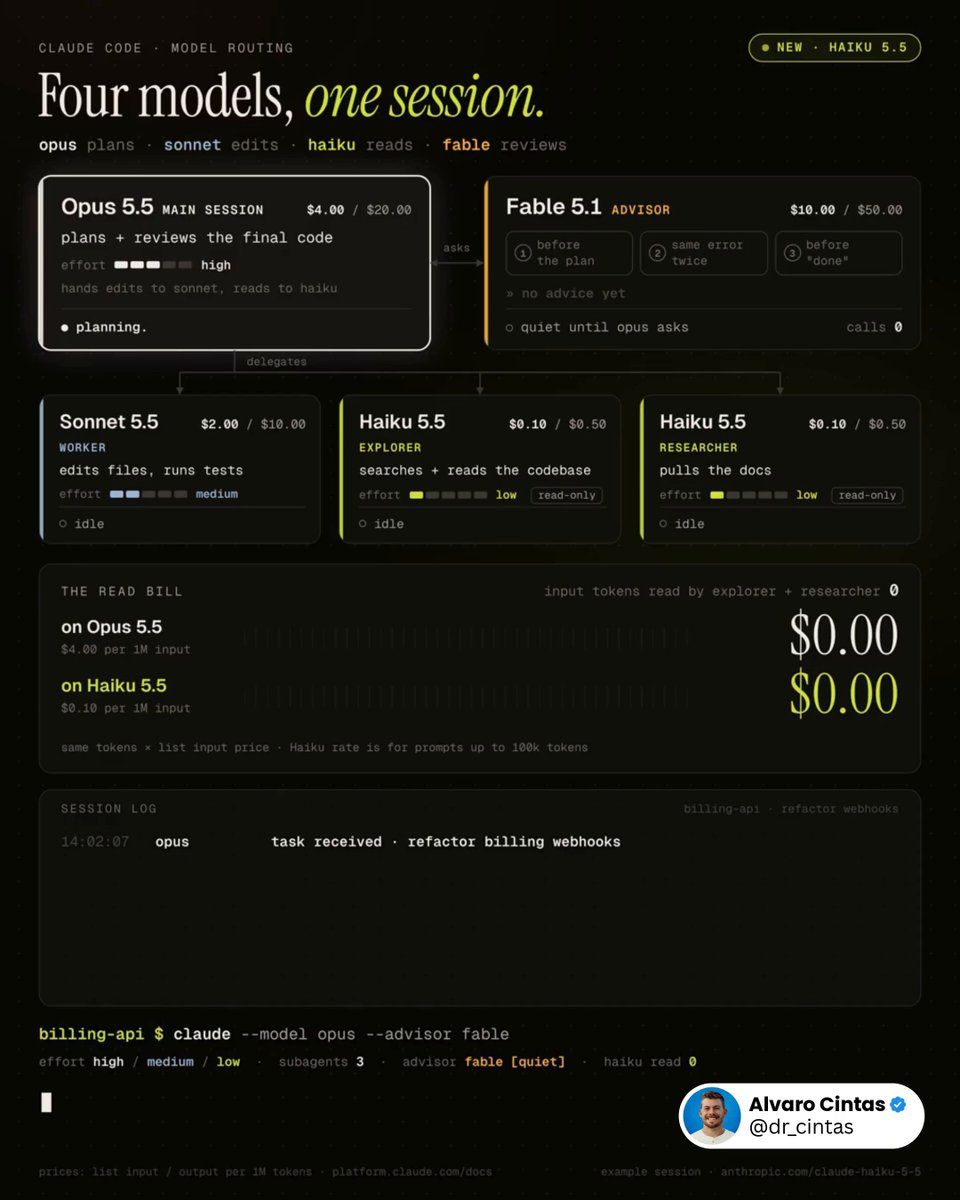
This is f*cking insane. This Claude Code tip saved me thousands of dollars. once Opus 5.5 is your main model, stop burning it on work Sonnet 5.5 can do, while Fable 5.1 sits idle hand the grunt work to Sonnet 5.5 subagents and put Fable 5.1 on call run /advisor fable Opus 5.5 plans and ships the final code Sonnet 5.5 subagents read, edit and run the tests Fable 5.1 reads the full session, every tool call included, and only speaks up at three points: → before a plan: is this the right approach? → when the same error comes back: am I digging in the wrong place? → before "done": what did I miss? Sonnet 5.5 builds. Fable 5.1 reviews. Opus 5.5 ships Jev engineering is the same move one layer down: the forks that need no thinker (which file, which tool, retry or stop) go to Jev in under half a second, and the big models only see the ones that split anyone still running one model for everything is paying Opus prices to decide whether a file exists - the full tree > Opus 5.5 on high runs the main session > explorer reads the code on Sonnet 5.5 > worker edits and runs tests on Sonnet 5.5 > researcher pulls the docs on Sonnet 5.5 > all three on medium > Fable 5.1 on call for main and every subagent paste the tree and this prompt into Claude Code ↓ "Rebuild my Claude Code setup around this tree: 1. Check ~/.claude/agents and .claude/agents for subagents that already fit explorer, worker and researcher. > Draft new ones only for missing roles > Give each model: sonnet, effort: medium > Skip any that pin a different model and list them 2. Set the main session to high via effortLevel in ~/.claude/settings.json, and set advisorModel to fable 3. Find anything that keeps the advisor off (CLAUDE_CODE_DISABLE_ADVISOR_TOOL, DISABLE_TELEMETRY) plus CLAUDE_CODE_EFFORT_LEVEL, which overrides subagent effort. Report them, change nothing 4. Add one rule to ~/.claude/CLAUDE.md: consult the advisor before a large plan, when an error repeats, and before calling a long task done Show me every change as a diff first. No edits until I say go." ↳

delost

48,494 просмотров • 10 дней назад

This workflow will save you thousands with Claude. Run Opus 5.5, Sonnet 5.5, Haiku 5.5, and Fable 5.1 together, and stop spending Opus tokens on work that doesn't need Opus. The entire idea in one line: Opus plans, Sonnet edits, Haiku reads, Fable reviews at decision points. Roles, broken down: - Opus 5.5, high effort, owns the plan and reviews the final code - Sonnet 5.5, medium effort, is the worker: edits files, runs tests - Haiku 5.5, low effort, splits into explorer (searches and reads the codebase) and researcher (pulls docs). it's the first Haiku with an effort setting - Fable 5.1, set with /advisor fable. Opus calls it at decision points, and it gets the full transcript each time Three moments Opus tends to call it: → before committing to a plan: is this the right approach? → the same error shows up again: is this going nowhere? → before marking the task done: did something get skipped? Why Haiku only reads: Anthropic's launch post says Sonnet 5.5 and Opus 5.5 are still the better choice for complex agentic coding (Terminal-Bench 4.0: 39.2% for Haiku 5.5, 70.6% for Sonnet 5.5) and that Haiku 5.5 fits narrowly scoped subagent work. so it gets the lookups, not the edits. Anyone still running one model for everything is paying $4 per million input tokens to check whether a file exists. Haiku 5.5 does it for $0.10. Drop this into Claude Code 👇 "Rebuild my Claude Code setup around this structure: Confirm Claude Code is v2.1.293 or later, so the haiku alias resolves to Haiku 5.5. If it isn't, stop and tell me to run claude update. Look through ~/.claude/agents and .claude/agents for subagents already covering explorer, worker, and researcher. Only create new ones for roles that are missing. Set model: haiku, effort: low on explorer and researcher, with no Edit or Write tools. Set model: sonnet, effort: medium on worker. If an existing subagent is locked to a different model, leave it as is and just list it. Name the explorer subagent Explore so it overrides the built-in one, which otherwise runs on my main model. In ~/.claude/settings.json, set advisorModel to fable, and set effortLevel to high for claude-opus-5-5 under modelSettings. A top-level effortLevel in user settings doesn't apply to Opus 5.5. Check for anything disabling the advisor: CLAUDE_CODE_DISABLE_ADVISOR_TOOL, DISABLE_TELEMETRY, or anything blocking feature-flag fetches. Also check CLAUDE_CODE_EFFORT_LEVEL, which overrides subagent effort settings, and CLAUDE_CODE_SUBAGENT_MODEL_FORCE, which makes Claude Code ignore subagent model fields. Report what you find. Don't change any of it yet. Add one line to ~/.claude/CLAUDE.md: consult the advisor before a big plan, when the same error shows up twice, and before marking a long task done. Show every change as a diff first. Wait for my go-ahead before touching anything."

Alvaro Cintas

55,249 просмотров • 6 дней назад

Official Anthropic tip for Claude Code: stop burning Opus 5.5 on work Sonnet 5.5 can do, while Fable 5.1 sits idle hand the grunt work to Sonnet 5.5 subagents and put Fable 5.1 on call run /advisor fable Opus 5.5 plans and merges Sonnet 5.5 subagents read, edit and run the tests Fable 5.1 reads the full session and only speaks up at three points: → before a plan: is this the right approach? → when the same error comes back: am I digging in the wrong place? → before "done": what did I miss? Sonnet 5.5 builds. Fable 5.1 reviews. Opus 5.5 ships Jev engineering is the same move one layer down: the forks that need no thinker (which file, which tool, retry or stop) go to Jev in under half a second, and the big models only see the ones that split - the full tree > Opus 5.5 on high runs the main session > explorer reads the code on Sonnet 5.5 > worker edits and runs tests on Sonnet 5.5 > researcher pulls the docs on Sonnet 5.5 > all three on medium > Fable 5.1 on call for main and every subagent paste the tree and this prompt into Claude Code ↓ "Rebuild my Claude Code setup around this tree: 1. Check ~/.claude/agents and .claude/agents for subagents that already fit explorer, worker and researcher. > Draft new ones only for missing roles > Give each model: sonnet, effort: medium > Skip any that pin a different model and list them 2. Set the main session to high via effortLevel in ~/.claude/settings.json, and set advisorModel to fable 3. Find anything that keeps the advisor off (CLAUDE_CODE_DISABLE_ADVISOR_TOOL, DISABLE_TELEMETRY) plus CLAUDE_CODE_EFFORT_LEVEL, which overrides subagent effort. Report them, change nothing 4. Add one rule to ~/.claude/CLAUDE.md: consult the advisor before a large plan, when an error repeats, and before calling a long task done Show me every change as a diff first. No edits until I say go." ↳

delost

44,001 просмотров • 11 дней назад

Claude Code tip: once Opus 5.5 is your main model, stop leaving Fable 5.1 sitting idle and stop burning Opus tokens on tasks Sonnet 5.5 can swarm put it on call with /advisor run /advisor fable Opus 5.5 plans and ships the code Sonnet 5.5 swarms the routine work at medium effort Fable 5.1 reads the full session, every tool call included, and only speaks up at three points: → before a plan: is this the right approach? → when the same error comes back: am I digging in the wrong place? → before "done": what did I miss? Fable 5.1 reviews. Sonnet 5.5 executes. Opus 5.5 ships Jev engineering is the same move one layer down: the forks that need no thinker (which file, which tool, retry or stop) go to Jev in under half a second, and the big model only sees the ones that split Plan on high. Delegate on medium. Keep Fable on call. - the full tree > Opus 5.5 on high runs the main session > explorer reads the code > worker edits and runs tests > researcher pulls the docs > all three on Sonnet 5.5 at medium effort > Fable 5.1 on call as the advisor paste the tree and this prompt into Claude Code ↓ "Rebuild my Claude Code setup around this tree: 1. Check ~/.claude/agents and .claude/agents for subagents that already fit explorer, worker and researcher. > Draft new ones only for missing roles > Give each model: sonnet, effort: medium > Skip any that pin a different model and list them 2. Set the main session to high via effortLevel in ~/.claude/settings.json, and set advisorModel to fable 3. Find anything that keeps the advisor off (CLAUDE_CODE_DISABLE_ADVISOR_TOOL, DISABLE_TELEMETRY, any variable that stops feature-flag fetching) plus CLAUDE_CODE_EFFORT_LEVEL, which overrides subagent effort. Report them, change nothing 4. Add one rule to ~/.claude/CLAUDE.md: consult the advisor before a large plan, when an error repeats, and before calling a long task done Show me every change as a diff first. No edits until I say go." ↳

mirku

421,711 просмотров • 14 дней назад

this is pure f*cking treasure Claude Code tip: once Opus 5.5 is your main model, stop leaving Fable 5.1 sitting idle and stop burning Opus tokens on tasks Sonnet 5.5 can swarm put it on call with /goal claude --auto-mode "/goal all tests pass and lint is clean" Opus 5.5 keeps writing the code in auto mode Sonnet 5.5 swarms the routine work at medium Fable 5.1 inspects the full transcript and only speaks up at the turn boundary: → not yet met: am I drifting from acceptance criteria? → met: do the tests, diffs, and lint hold? → impossible: am I chasing an unreachable state? Fable grades. Opus ships JEV engineering is the same move one layer down: the forks that need no thinker (which file, which tool, retry or halt) go to JEV in under 16ms, and the big models only see the ones that split — the full tree > Opus 5.5 on high runs the main session > worker edits and patches code on Sonnet 5.5 > explorer indexes AST maps and call sites on Sonnet 5.5 > verifier runs tests and linters on Sonnet 5.5 > all three subagents on medium effort > Fable 5.1 on call as the Stop hook evaluator > JEV routes micro-forks under 16ms paste the tree and this prompt into Claude Code ↓ "Reconfigure my Claude Code setup around this tree: 1. Set the main session to Opus 5.5 on high effort with auto mode enabled. 2. Put Fable 5.1 on call as a session-scoped evaluator attached to the Stop hook: - Read-only transcript evaluation with zero tool calls - Three structured outcomes: not yet met (with steering notes), met (auto-clear), and impossible (abort early) 3. Spawn Sonnet 5.5 subagents on medium effort for worker, explorer, and verifier roles. Defer goal checks while background tasks run. 4. Route fast deterministic forks (tool resolution, path selection, auto-retries) through JEV. 5. Add one rule to CLAUDE.md: run long tasks with: claude --auto-mode \"/goal \" Show me every configuration change as a diff first. No edits until I say go." ↳

mirku

41,739 просмотров • 7 дней назад

This is f*cking insane. I spent thousands of dollars before I split my work across three models put Opus 5.5 on the plan, Sonnet 5.5 on the legwork and Fable 5.1 on call, and you stop spending Opus money on jobs it was never needed for who does what: Opus 5.5, high effort: makes the plan and owns the final diff Sonnet 5.5, medium effort, three jobs: explorer reads the code, worker edits files and runs tests, researcher pulls the docs Fable 5.1, through /advisor fable: reads the whole session, but only when it gets called Fable is consulted at three points: → before a plan ships: is this the right approach? → when an error comes back twice: is the search stuck in the wrong place? → before a long task counts as done: what got missed? Jev engineering applies the same split to the smallest decisions. which file to open, which tool to run, retry or stop need no reasoning, so Jev answers them in under half a second and the big models only get the real forks run Opus on everything and you pay it to check whether a file exists paste this into Claude Code: "Rebuild my Claude Code setup around three tiers. Look in ~/.claude/agents and .claude/agents for subagents that already cover explorer, worker and researcher. Create only the missing ones, each with model: sonnet and effort: medium. If an existing one is pinned to another model, list it and leave it alone. In ~/.claude/settings.json, set advisorModel to fable. Set high effort for Opus inside modelSettings for claude-opus-5-5, because a top-level effortLevel does not apply to Opus 5.5. Report, without changing anything: CLAUDE_CODE_DISABLE_ADVISOR_TOOL, DISABLE_TELEMETRY or anything blocking feature-flag fetches, CLAUDE_CODE_EFFORT_LEVEL, which can override subagent effort, and whether Fable as advisor needs a one-time billing consent. If you can't tell, say so. Add one line to ~/.claude/CLAUDE.md: consult the advisor before a big plan, when the same error shows up twice, and before marking a long task done. Show every change as a diff first. Touch nothing until I say go."

Ryven

46,513 просмотров • 6 дней назад

BREAKING: GPT-5.5 "Spud" is out and it is a BEAST We've been testing it Every 📧 for the last 3 weeks on everything from coding, to writing, to knowledge work. Here's our day 0 vibe check: - It's a step change in coding AND it's easy to talk to. It's fast and friendly and quickly became my daily driver. But it's also a coding powerhouse—a really rare combination. - It scored 62/100 on our Senior Engineer benchmark. Opus 4.7 scored only a 33/100. (But GPT-5.5 performed best when using an Opus 4.7 plan). Naveen Naidu used over 900 million tokens during testing—and it let him ship production features for Monologue at both high speed and quality. - It has serious conceptual clarity. It can hold a complex plan in its head over hours of work, without getting distracted by existing code. This makes it the first model that we've tested that can perform well on complex refactors requiring deleting and reimagining an substantial existing codebase. - It's a very good writer. This is the first OpenAI model in about a year that got our writers Every 📧 to switch away from Claude. 5.5 has Katie Parrott's seal of approval—not an easy task. Its writing feels more organic and it's better at mimicking a writing style without going overboard. - It's great for agentic knowledge-work. This is the first OpenAI model that manages to be both a stellar senior engineer AND that can be used for everything from spreadsheets to research. It's crazy fast, and it's amazing inside of the Codex desktop app, and got much of our team to switch away from Claude Code and Cowork during the testing period. However, it's not a perfect model. - 5.5 still loses to Opus 4.7 on plan quality. It's plans are extremely readable but Opus has better attention to detail and sharper insight. - 5.5 still loses to Opus 4.7 by a bit on front-end and full-stack product work. Kieran Klaassen found that it wasn't quite as good when full-stack thinking and design are involved. And it's not great writing Ruby. - 5.5 is a great vibe coder but if you're vibe coding without a plan it's worse than Opus. Mike Taylor found that Opus is better at reading in between the lines on underspecified vibe-coding tasks. Overall GPT-5.5 is a massive achievement from OpenAI and it deserves a serious look as your daily driver. Read our full vibe check on Every 📧 here:

Dan Shipper 📧

130,382 просмотров • 5 месяцев назад